

8 Ways Summer Breaks Can Transform Your Life
When you're struggling through a difficult school year, drowning in social isolation and academic pressure, summer break can feel like a lifeline. But it's more than just a pause from stress. The right summer experience can become a turning point that reshapes your entire trajectory.
Sometimes stepping away from your daily environment provides the clarity and perspective needed to discover who you really are and what you're capable of becoming. Geographic distance, supportive family members, honest conversations, and new social environments can work together to create transformation that seemed impossible just months earlier.
Whether you're a struggling student, a parent seeking solutions, or someone who survived difficult years and wants to understand your journey better, recognizing how change happens can provide hope and direction when you need it most.
Table of Contents
Physical Distance Creates Emotional Clarity
Makeovers Are More Than Skin Deep
New Environments Offer Fresh Social Opportunities
Family Can See What You Cannot
Honest Conversations Change Life Trajectories
Work Experience Builds Character and Confidence
Creative Outlets Provide Emotional Release
Setting New Anchors Creates Hope
1. Physical Distance Creates Emotional Clarity
When you're stuck in a toxic environment day after day, it becomes impossible to see beyond your immediate circumstances. Your world narrows to survival mode. Getting physical distance through travel or staying elsewhere provides perspective you simply cannot gain while immersed in daily struggles.
Leaving your hometown, even temporarily, removes you from the social hierarchies and painful dynamics that define your everyday existence. You're no longer the person everyone has labeled and boxed in. You become anonymous, which paradoxically allows you to be more authentically yourself.
This geographical shift often reveals that your struggles aren't inherent character flaws but products of specific environments and circumstances. What feels like personal failure in one setting can dissolve completely in another, proving that context matters enormously in how we experience ourselves.
The breathing room that distance provides allows suppressed emotions to surface and process. When you're constantly in fight-or-flight mode, real reflection becomes impossible. Space creates safety for honest self-examination.
Discover how one transformative summer away from a toxic school environment changed everything.

2. Makeovers Are More Than Skin Deep
External transformations often receive criticism as superficial, but they can serve as powerful catalysts for internal change. When you've spent years feeling invisible, unattractive, or wrong in your own skin, experiencing yourself differently through appearance changes can be revelatory.
A good makeover isn't about conforming to beauty standards. It's about seeing yourself with fresh eyes and recognizing that you're worthy of care, attention, and effort. For someone who has been bullied or ostracized, looking in the mirror and genuinely liking what they see can be the first positive self-perception they've had in years.
The confidence that comes from feeling good about your appearance isn't shallow. It affects how you carry yourself, how you interact with others, and how you allow yourself to be treated. When you feel attractive and put-together, you're more likely to advocate for yourself and expect respect.
These external changes can mark important turning points, serving as visual reminders that transformation is possible. They represent taking control over at least one aspect of your life when so much feels uncontrollable.
3. New Environments Offer Fresh Social Opportunities
One of the most liberating aspects of spending time in a new place is encountering people who know nothing about your past. You're not defined by mistakes you made in middle school or behaviors people won't let you forget. You meet others as a blank slate.
This fresh start allows you to practice social skills without the weight of reputation and judgment. When classmates in summer programs or new settings accept you easily, it proves that the rejection you face at home isn't inevitable or deserved. The problem wasn't you; it was the specific social ecosystem you were trapped in.
Meeting ambitious, talented peers in different environments expands your vision of what's possible. Seeing others balance academics, sports, and active social lives demonstrates that thriving is achievable, even if it hasn't been your experience yet. These encounters plant seeds about the kind of life you might build.
Even brief friendships formed during summer experiences matter. They provide templates for healthy interaction, show you what genuine acceptance feels like, and prove that connection is possible for you. These relationships, however fleeting, offer hope that lasting friendships will eventually come.
Want to understand how temporary friendships and new environments can plant seeds for future growth? Dropped in a Maze explores the profound impact of summer experiences, get the book today to see how small moments of acceptance create ripples of lasting change.
4. Family Can See What You Cannot
When you're drowning in immediate struggles, it's nearly impossible to think clearly about your future. You're focused on surviving this week, this day, sometimes just this hour. Extended family members who aren't caught up in daily crises often see your potential more clearly than you can see it yourself.
Relatives observing from outside your immediate household notice strengths you've stopped recognizing in yourself. They see your intellectual curiosity, your determination, your creativity—qualities buried under the weight of social failure and academic stress. Their outside perspective becomes invaluable.
These family members can also provide honest feedback about limitations without it feeling like criticism. When someone who genuinely cares about your success points out that your strengths lie elsewhere than your stated goals, it opens possibilities rather than closing them. They redirect rather than deflate.
The validation that comes from extended family believing in you creates a lifeline during periods when you don't believe in yourself. Knowing that someone sees promise in your future, even when you can't, keeps hope alive during the darkest stretches.
5. Honest Conversations Change Life Trajectories
Single conversations can pivot entire lives. When someone asks the right questions at the right time, they create space for truths to emerge that were waiting to be acknowledged. These moments of clarity often happen away from the pressure and noise of daily life.
Realizing you're pursuing a path because of external expectations rather than genuine interest is liberating. Many young people chase goals based on what parents want, what seems prestigious, or what they think they "should" do. Honest dialogue exposes these misalignments.
When trusted adults point out the disconnect between your stated goals and demonstrated abilities, it's not cruelty—it's kindness. Struggling miserably in chemistry and physics while excelling in writing and thinking should inform your path forward. Acknowledging this isn't giving up; it's being realistic.
These conversations work best when they highlight strengths rather than just identifying weaknesses. Hearing "your strengths lie elsewhere" while being reminded of your intellectual nature, good character, and specific talents creates a positive redirection. You're not failing at the right path; you're being redirected toward a better one.
Curious about how one dinner conversation completely changed a teenager's future trajectory? The complete story in Dropped in a Maze reveals how honest family dialogue and outside perspective created the clarity needed to choose an authentic path forward.
Purchase your copy to explore the power of transformative conversations.

6. Work Experience Builds Character and Confidence
Actually contributing to something productive, even in a small way, provides a sense of purpose and capability that academic struggles can't offer. Work experiences during summer breaks expose you to adult responsibilities and expectations in manageable doses.
Showing up consistently, completing tasks, and being part of a functioning operation proves to yourself that you're capable and reliable. When school makes you feel incompetent, work can restore confidence by demonstrating your ability to meet expectations and add value.
These experiences also provide glimpses into various career paths and work environments, helping clarify what you might enjoy or want to avoid in your future. Abstract career aspirations become more concrete when you see daily operations firsthand.
Additionally, work environments judge you on current performance rather than past reputation. Your coworkers don't know or care about your middle school behavior. They evaluate you based on how you show up today, providing yet another fresh start.
7. Creative Outlets Provide Emotional Release
When you've experienced trauma, bullying, isolation, or depression, creative expression becomes essential for processing and healing. Reading stories about characters grappling with loneliness, writing your own narratives, or engaging with art that explores difficult emotions provides catharsis.
Finding authors and characters who articulate feelings you've struggled to express makes you feel less alone. When Tennessee Williams explores isolation in The Glass Menagerie or Salinger captures alienation in Catcher in the Rye, readers struggling with similar emotions find validation and connection through literature.
Creative writing allows you to shape narratives, exercise control over outcomes, and explore possibilities that don't exist in your current reality. The imaginative space becomes a laboratory for working through emotions and envisioning different futures. It's both escape and processing.
Bonding with others over shared responses to creative works builds connections based on intellectual and emotional resonance rather than social status. Discussing stories, sharing viewpoints, and appreciating artistry together creates intimacy that superficial social interactions lack.
8. Setting New Anchors Creates Hope
Hope requires something concrete to attach to—a future goal, a vision of who you might become, a destination beyond your current circumstances. When you're mired in present suffering without any sense of future possibility, despair takes hold. Creating new anchors changes everything.
Identifying a field of study that genuinely interests you rather than one chosen by default creates excitement about learning. When education shifts from obligation to pathway, motivation follows. Having academic goals aligned with genuine interest rather than external pressure transforms the entire experience.
Setting geographical goals—deciding you want to attend college on the East Coast, planning to leave your hometown—provides direction and purpose. Every difficult day becomes endurable because it's one day closer to escape and new beginnings. The future becomes something to build toward rather than dread.
These anchors must be specific enough to be real but flexible enough to evolve. "I'm going to study psychology at a good East Coast college" gives clear direction while leaving room for adjustment. The specificity creates motivation without becoming rigid prison.
Most importantly, having something to look forward to, work toward, and hope for makes present suffering survivable. You're no longer just enduring; you're preparing. Each challenge overcome becomes proof of your determination and capability, building the strength needed for the journey ahead.
Ready to read the complete journey from despair to determination? Dropped in a Maze offers the full story of finding purpose, setting new anchors, and building toward a future that felt impossible during the darkest times.
Moving Forward
Summer breaks, family support, honest conversations, and new environments can catalyze profound personal transformation. When you're stuck in toxic situations feeling hopeless about your future, remember that change is possible. Distance creates perspective, fresh starts prove your worth, and single conversations can redirect your entire life trajectory.
The journey from surviving a difficult year to discovering purpose and setting meaningful goals isn't linear or easy, but it's achievable. Whether you're currently struggling or supporting someone who is, understanding how transformative experiences unfold provides a roadmap for change.
This exploration of summer transformation and life-changing conversations comes from a deeply personal journey chronicled in Dropped in a Maze. The complete book reveals how one summer away from a toxic environment, combined with family support and honest dialogue, created the turning point needed to move from survival to hope.
Get your copy today to read the full story of transformation, resilience, and finding your authentic path forward in the face of overwhelming obstacles.
7 Red Flags of Unethical Mental Health Practice
Therapy should be a safe space where you can be vulnerable without judgment. Your therapist should maintain professional boundaries while helping you navigate challenges. But what happens when those boundaries get blurred? What if your therapist's actions make your life worse instead of better?
If you're in therapy—whether you're a teen, parent, or adult—you need to know when professional boundaries are being violated. These violations might seem helpful in the moment, but they can cause lasting harm.
Here are major red flags that indicate your therapist is crossing ethical boundaries, based on my personal experience and what I've learned since.
Table of Contents
Your Therapist Shares Your Information With People in Your Life
Your Therapist Orchestrates Your Friendships
Your Therapist Uses Other Clients to Monitor You
Your Therapist Gives Clues About Other Clients' Identities
Your Therapist Gets Defensive About Your Valid Concerns
Your Therapist Has Undisclosed Conflicts of Interest
Your Therapist Fails to Teach You Essential Self-Advocacy Skills
What Ethical Therapy Looks Like
Moving Forward
1. Your Therapist Shares Your Information With People in Your Life
Perhaps the most fundamental principle of therapy is confidentiality. When a mental health professional begins discussing your case with people you know personally, they've violated a sacred trust.
Therapists are bound by strict confidentiality rules. They cannot share details about your treatment with classmates, neighbors, colleagues, or acquaintances without your explicit written consent. Even well-intentioned disclosures made in an attempt to help you socially constitute serious ethical violations.
The harm extends beyond the immediate privacy breach. When your therapist talks about you to others in your social circle, they compromise your autonomy and create complex dynamics that interfere with genuine relationship building. You deserve to form connections based on authentic interest, not orchestrated interventions.
If your therapist casually mentions speaking with people you know about your case, this should immediately raise concerns about their professional judgment and adherence to ethical standards.
These violations aren't just theoretical—they happen to real people with lasting consequences. Dropped in a Maze chronicles Sonia's journey through these exact scenarios during high school, showing how unethical practices affected relationships, self-esteem, and personal growth.
2. Your Therapist Orchestrates Your Friendships
Therapy should empower you to develop social skills and confidence. It should never involve your therapist arranging friendships on your behalf or coordinating with others to befriend you.
When mental health professionals step into the role of social coordinator, they cross into territory that undermines your growth. Manufactured friendships don't teach you how to navigate relationships authentically. Instead, they create artificial scenarios that can actually delay your social development.
Real therapeutic work involves helping you understand social dynamics, build communication skills, and develop the confidence to pursue connections independently. A therapist who calls potential friends on your behalf or sets up playdates like you're a child has lost sight of their professional role.
These orchestrated relationships often come with hidden complications. The people involved may feel obligated rather than genuinely interested, creating unstable foundations that eventually crumble. You're left not only without the friendship but also with the painful knowledge that it was never authentic to begin with.
3. Your Therapist Uses Other Clients to Monitor You
The therapeutic relationship should be a confidential space between you and your provider. When your therapist has multiple clients from the same school, workplace, or community, they must maintain strict boundaries to prevent information from crossing between cases.
A therapist who tells you about other clients, even without naming them, has already begun eroding appropriate boundaries. When they go further and actually discuss you in other clients' sessions or use those clients to report back on your behavior, they've created an unethical surveillance network.
This practice is deeply problematic for several reasons. First, it violates the confidentiality of everyone involved. Second, it creates divided loyalties that compromise the therapeutic relationship. Third, it transforms peers into informants rather than supporting you in developing genuine connections.
You might hear hints that your therapist knows things about you that you didn't share directly. They might reference your behavior in specific settings or repeat comments others made about you. These are warning signs that information is flowing inappropriately between sessions.
Curious about what happens when multiple clients from the same school see the same therapist? Dropped in a Maze provides an insider's perspective on the tangled web that forms when professional boundaries collapse.

4. Your Therapist Gives Clues About Other Clients' Identities
Professional ethics require therapists to protect client identities rigorously. When a therapist suggests you "pay attention to students who might start being nice to you" as a way to identify their other clients, they've violated multiple ethical principles.
This behavior shows poor professional judgment and a concerning lack of respect for confidentiality. It also puts clients in awkward positions, knowing or suspecting who else is in treatment and potentially changing how they interact with those individuals.
The mental health field has clear standards about client privacy precisely because violations can cause significant harm. Knowing who else sees your therapist can influence your relationships, create uncomfortable dynamics, and make you question whether your own information is being protected.
If your therapist hints at, suggests, or outright tells you who their other clients are, recognize this as a serious red flag about their professional standards.
5. Your Therapist Gets Defensive About Your Valid Concerns
Healthy therapeutic relationships allow space for clients to express concerns, ask questions, and even challenge their therapist's approaches. When a therapist responds to legitimate concerns with defensiveness, blame, or dismissiveness, the relationship has become problematic.
Expressing that you feel uncomfortable with certain dynamics or questioning therapeutic decisions is not only appropriate but essential for effective treatment. A competent therapist welcomes this feedback and works collaboratively to address concerns.
Defensive responses often sound like: "What, they can't have any other friends? That's really unfair of you!" or "You're being too sensitive" or "I'm the professional here." These reactions shut down communication and make you feel guilty for advocating for yourself.
This defensiveness may stem from the therapist's ego being tied to your progress. When they view your struggles as their professional failure, they may double down on questionable strategies rather than acknowledging limitations and adjusting their approach.
6. Your Therapist Has Undisclosed Conflicts of Interest
Ethical practice requires transparency about any relationships or interests that could compromise objectivity. When your therapist has hidden financial arrangements, business relationships, or other connections related to your case, they're operating in ethically murky territory.
These conflicts create situations where the therapist's judgment may be clouded by factors other than your best interest. They might push certain relationships, make specific recommendations, or take particular approaches based on outside considerations you're unaware of.
Warning signs include the therapist being unusually invested in you connecting with specific people, especially if those people or their families have business interests. Other red flags include the therapist seeming to benefit personally from connections they're facilitating or relationships they're encouraging.
You have the right to know if your therapist has any relationships or interests that could affect their objectivity in your care. If you discover undisclosed conflicts after the fact, this represents a serious breach of trust.
7. Your Therapist Fails to Teach You Essential Self-Advocacy Skills
Perhaps the most subtle but damaging boundary violation is when a therapist manages your life rather than teaching you to manage it yourself. Effective therapy should progressively empower you to handle challenges independently.
When your therapist intervenes directly in your social situations, speaks to others on your behalf, or handles conflicts for you rather than coaching you through them, they're preventing your growth. The goal should be to help you develop skills, not to become your permanent intermediary.
You should be learning how to set boundaries, how to respond to difficult comments, how to advocate for your needs, and how to navigate complex social situations. If your therapist consistently steps in to do these things for you, they're creating dependency rather than building competence.
Real therapeutic progress looks like gradually needing less intervention, not more. You should feel increasingly capable over time, not more reliant on your therapist to manage your relationships and daily challenges.

What Ethical Therapy Looks Like
Understanding what went wrong helps illuminate what right looks like. Ethical, effective therapy operates within clear boundaries that protect and empower you.
In appropriate therapeutic relationships, your confidentiality is sacrosanct except in legally mandated situations involving safety risks. Your therapist maintains professional distance from your social world, helping you develop skills rather than managing your relationships. They welcome your feedback, acknowledge limitations, and adjust approaches based on your needs.
Good therapists teach you to fish rather than fishing for you. They help you understand social dynamics, practice communication skills, and build confidence to pursue connections authentically. They celebrate your independent successes rather than taking credit for orchestrated outcomes.
If you recognize these warning signs in your own therapeutic relationship, trust your instincts. Speak with the therapist about your concerns, consult with another mental health professional for a second opinion, or consider finding a new provider who operates within appropriate boundaries.
Moving Forward
Mental health treatment should be empowering, not disempowering. It should build your independence, not create dependency. And it should always operate within clear ethical boundaries that protect your privacy, autonomy, and dignity.
Understanding these principles helps you become an informed consumer of mental health services and advocate for the quality care you deserve. Whether you're currently in therapy or considering it, knowing what's appropriate and what crosses the line is essential for your wellbeing.
This exploration of therapy boundaries comes from a deeply personal story of navigating mental health care during the vulnerable teenage years.
Dropped in a Maze provides an unflinching look at the challenges of growing up different, the lasting impact of bullying, and the complicated relationship between mental health support and personal growth.

How to Stand Up for Yourself
"Just stand up for yourself." "Give them a taste of their own medicine." "Put them in their place." If you're being bullied, you've probably heard this advice countless times from well-meaning adults.
It sounds empowering. It sounds like the solution. But for autistic teens who struggle with social cues and context, this kind of black-and-white advice can backfire spectacularly—turning you from victim to villain in the eyes of everyone around you.
I learned this the hard way during my freshman year of high school. After years of bullying in middle school, my parents found me a therapist who promised to teach me how to defend myself. Dr. Shah's advice was simple: "If someone is being rude to you, give them a double dose of what they've given you. Let them have it!"
It made sense. It felt empowering. And it completely blew up in my face.
This is the story of why standard "stand up for yourself" advice doesn't work for autistic people, what actually does work, and how to navigate social conflicts when you can't read the invisible rules everyone else seems to understand instinctively.
Table of Contents
When Therapy Advice Misses the Mark
The Pickleball Incident: When Standing Up Goes Wrong
Why Literal Interpretation Creates Problems
The Pattern That Kept Repeating
What Actually Works: Better Strategies for Self-Advocacy
Finding Safe Spaces Outside of School
Key Takeaways for Teens and Parents
Moving Forward
When Therapy Advice Misses the Mark
At the start of freshman year, my parents' biggest fear was a repeat of my sixth-grade behavioral outbursts. Forest Ridge High School was made up of the same people from middle school, plus a few students from St. Joseph's Catholic School. Everyone already had established friend groups from community sports and church. I was still the outsider.
My mom made sure I started seeing a therapist right away. When I met Dr. Shah, I was impressed. She was sharp and picked up on my peculiarities immediately:
Delayed social skills compared to my peers
Different and awkward facial expressions
Lack of eye contact during conversation
Dr. Shah taught me social skills, including how to stand up to bullies. Her advice was clear and confident:
"You have to put people in their place. If someone is being rude to you, then give them a double dose of what they've given you. Let them have it! No one should treat people that way. And when you stand up for yourself, they won't."
Her idea made me smile. Maybe this was the answer I'd been looking for. Maybe if I just showed people I wouldn't take their abuse anymore, they'd finally respect me.
I didn't know if I could actually do it, but I was willing to try anything to avoid getting picked on again.
The Problem with One-Size-Fits-All Advice
Here's what Dr. Shah didn't account for: autistic people tend to take advice very literally. We don't automatically understand:
When to apply the advice and when not to
How much is "standing up for yourself" versus "going too far"
The social context that determines appropriate responses
The invisible line between assertiveness and aggression
Neurotypical people have an instinct for these nuances. They can read a room, gauge reactions, and adjust their approach on the fly. For autistic people, these invisible rules might as well be written in a language we don't speak.
The Pickleball Incident: When Standing Up Goes Wrong
The first place I tried Dr. Shah's advice was gym class during our pickleball unit. While other students paired up in teams of two, I played solo against Misty's team.
I wasn't coordinated or athletic. I missed the ball frequently and moved slowly. The comments came from multiple directions:
"You couldn't hit that ball?" "Can't you move any faster?" "Pick up the damn ball, and hurry up!"
The frustration and irritation built up inside me. Following Dr. Shah's advice, I told people to "shut up" and "fuck off."
As we left the court, Misty suddenly tried to be nice. "That was fun. We should do that again."
This confused me, but I remembered what Dr. Shah taught me. I had to stick up for myself. I didn't like how snippy Misty had been the entire time, so I used the exact phrase Dr. Shah had taught me:
"You were being so rude, and now you are being so nice. What is your scenario?"
Misty looked shocked. "Excuse me, but you told me to fuck off."
She went around telling other girls, "Sonia is such a trip," laughing about it with everyone.
When Things Escalated Further
I didn't think anything was funny. I turned to a classmate from a different grade and said, "Some freshman girls are just bitches."
Another classmate overheard me and said, "You're a bitch, too, because you're a freshman."
Then she went to others and twisted my words: "Sonia said you're bitches because you're freshmen."
That's not what I said at all, but it didn't matter. Girls started giving me deadly stares. People kept their distance. I was confused and hurt. I thought I was simply standing up for myself like Dr. Shah told me to.
The Therapist's Response
When I told Dr. Shah what happened, she said, "It's good not to be too over-eager or too nice at school, but Sonia, you have to be careful about name-calling."
I took part of her advice to heart. I started ignoring people I thought were fake, especially the popular girls. But I never really understood why I couldn't retaliate with name-calling if I felt attacked. If they could call me names, why couldn't I defend myself the same way?
This is where the advice broke down for me. The rules weren't clear. The boundaries weren't defined. And I was left to figure out the invisible line on my own.
In my book, I explore the complete aftermath of this incident and detail the specific communication strategies that actually work for autistic teens trying to navigate social conflicts without making things worse.
Why Literal Interpretation Creates Problems
Autistic people are often very literal thinkers. When Dr. Shah said "give them a double dose of what they've given you," I heard:
If they're rude, be rude back
If they curse at me, curse at them
Match their energy exactly
What she probably meant was something more nuanced:
Stand firm in your boundaries
Don't let people walk all over you
Respond assertively but appropriately
But those subtleties weren't spelled out. And without clear guidelines on when, where, and how much to push back, I applied the advice indiscriminately.
The Gym Class Locker Room Problem
Gym class presented another challenge. During dodgeball and soccer units, the teacher had one team turn their gym shirts inside out to distinguish teams.
The first time the teacher gave this order, I didn't comply. I was afraid of being laughed at because I didn't know how to turn my shirt around without my bra showing, the way other girls seemed to do effortlessly.
Eventually, I had to comply to avoid looking defiant. But I couldn't do it without showing my bra. Girls started noticing and staring. I felt uncomfortable with the way their eyes wandered during shirt-turning times.
Then I overheard a conversation where this became a topic of discussion. Of course, they brought up the middle school swimming unit locker room drama. Even guys who hadn't attended the same middle school heard about it.
I couldn't escape my past mistakes, and every new situation felt like a trap waiting to spring.
The Spanish Class Confrontation
Spanish class was another place where my snappy, defensive side emerged. A classmate repeatedly called me "Sanya" after I corrected her pronunciation of my name. She continued saying "Sanya" in a sardonic tone.
I told her I wasn't going to answer to that name. She laughed and became defensive herself, exclaiming loudly to others: "Sonia just gets worked up over nothing."
I was following what Dr. Shah taught me, hoping people would learn to respect me. Instead, I got the opposite of respect. I became more of a target, more of a pariah.
What I Should Have Done Instead
Looking back, I could have handled the Spanish class situation differently:
Responded in a way that wasn't defensive
Tried going along with it by mispronouncing her name in the same joking manner
Said something light like "Who is Sanya? I don't know her"
Used humor to deflect instead of confrontation to escalate
But these strategies require reading social context and understanding tone. They require knowing when someone is genuinely trying to hurt you versus when they're just teasing. For autistic people, that distinction isn't always clear.
The Pattern That Kept Repeating
Every Friday, I would call Dr. Shah crying out of loneliness. I felt alone and alienated at school every single day. I sat by myself at lunch tables, then moved to the Hangout Area where I'd sit alone again, either doing homework or watching other people socialize.
I was trying to learn social skills through observation, but watching isn't the same as understanding. I could see what people did, but I couldn't figure out why it worked for them and not for me.
Dr. Shah had me read a book about friendships that talked about learning hobbies, dressing nicely, and being interesting so people would want to be around you. But by freshman year, I didn't have hobbies. I didn't know what I was good at or what interested me. I had no idea who I even was. My self-concept never really had a chance to develop or be explored.
The Tennis Recommendation
Dr. Shah recommended to my parents that I learn a sport. She introduced us to the Love All Tennis Club in a nearby town, about 15 minutes from Forest Ridge. She knew one of the tennis instructors because he taught her family.
I grew to like tennis, and eventually, tennis became my anchor to get through high school. It gave me something I was working toward, something where I could measure progress, something that was mine.
Sports and hobbies won't solve social problems, but they provide structure, purpose, and sometimes a community of people who share your interests rather than your history.
Finding Safe Spaces Outside of School
Dr. Shah emphasized the importance of trying to make friends outside of school. She insisted I attend a Halloween Party at a place called the After School Center. I finally agreed because, honestly, who doesn't like Halloween candy and themed desserts?
The person in charge, Ruth, was dressed as the wicked witch from The Wizard of Oz. Her excitement in welcoming me was refreshing. There were activities everywhere—scary movies in one room, dancing in the gymnasium, people sitting on bleachers.
After touring the place, Ruth introduced me to a group of girls on the bleachers. Within minutes, I realized they were talking about wanting to beat up someone who was at the party that night.
I was immediately turned off. I didn't know how to leave the conversation gracefully, so I tried to divert by talking to the person next to me. She immediately launched into intense topics about wanting to drop out of school because she was failing.
I got up and left altogether. My dad and brother had been watching scary movies in the other room, so I found them and we went home.
I later learned the After School Center was for at-risk youth to keep them off the streets. The conversation that night made complete sense in that context.
The Temple Experience
The next place I tried was the Hindu Temple, about an hour from Forest Ridge. I signed up for two classes: Bhagavad Gita and Hindi.
When I first attended the Bhagavad Gita class, people were welcoming. I struck up a good conversation with someone named Bhavna. We ate lunch together in the temple cafeteria, bonded over TV shows, movies, and tennis. We exchanged numbers and had a phone conversation after my second visit.
We even discussed making plans to go shopping together after temple. I thought I was finally making progress.
I couldn't have been more wrong.
When Friendship Disappeared Without Explanation
The next time I attended class, Bhavna treated me like I'd done something horrible. She didn't acknowledge me at all. When I tried to talk to her during a break, she blew me off and continued her conversation with another friend. That friend gave me a sympathetic look, but Bhavna remained standoffish.
I never found out what happened. My first automatic thought was "another friendship failure." After all, it was easy to assume the problem was me because of my relentless social challenges.
But here's something important: it's easy for people on the autism spectrum to believe that every rejection or mistreatment is about something they said or did. However, that isn't always the case. Sometimes it's about the other person and their own shortcomings.
After that experience, I stopped going to the classes. I figured if I was going to be driven an hour away just to be treated poorly, what was the point? I was already dealing with enough rejection at school. I deserved better.
The full story of these friendship attempts—and the crucial lessons about when to keep trying and when to walk away—is something I explore extensively in my book. Understanding this distinction is vital for protecting your mental health while still remaining open to genuine connections.
What Actually Works: Better Strategies for Self-Advocacy
After years of trial and error, I've learned that effective self-advocacy for autistic people looks different than the standard "stand up for yourself" advice. Here's what actually works:
Understand Your Literal Interpretation Tendency
When someone gives you advice, ask clarifying questions:
"Can you give me specific examples of when I should use this?"
"What are situations where this approach wouldn't work?"
"How do I know if I've gone too far?"
"What does 'standing up for myself' look like in different contexts?"
Don't assume you understand the nuances. Ask for explicit guidelines.
Learn the Difference Between Types of Conflict
Not all negative interactions require the same response:
Genuine bullying (intentional, repeated, power imbalance)
Document incidents
Report to trusted adults
Remove yourself from the situation when possible
Don't engage directly with the bully
Teasing that includes you (joking, reciprocal, everyone's laughing together)
Try responding with light humor
Don't take it personally
Observe how others respond in similar situations
Teasing that excludes you (mocking, one-sided, laughing at you not with you)
State clearly: "I don't find that funny"
Walk away
Don't try to joke back if you can't read whether it will land well
Misunderstandings (confusion, miscommunication, no malice intended)
Ask clarifying questions
Explain your perspective calmly
Give people the benefit of the doubt initially
Use "I" Statements Instead of Attacks
Instead of: "You're being rude!" Try: "I feel uncomfortable when you talk to me that way."
Instead of: "What is your scenario?" Try: "I'm confused because you seemed upset earlier, but now you seem friendly. Can you help me understand?"
Instead of: "Some freshman girls are just bitches." Try: "I'm having a hard time with some of the social dynamics in our class."
"I" statements express your feelings without attacking others. They're less likely to escalate conflicts.
Know When to Walk Away
Sometimes the best self-advocacy is recognizing when a situation isn't worth your energy:
If people consistently disrespect you, find different people
If an environment is toxic, seek healthier spaces
If someone blows you off without explanation, accept it and move on
If "standing up for yourself" consistently makes things worse, try a different approach
Walking away isn't weakness. It's wisdom.
Find Your Anchors
Develop interests, hobbies, or activities that:
Give you purpose beyond social acceptance
Provide measurable progress you can see
Connect you with people who share interests, not history
Build confidence in areas where you can succeed
For me, tennis became that anchor. It gave me something stable when everything else felt chaotic.
In my book, I provide a comprehensive guide to these strategies with real-life examples, scripts you can use in different situations, and step-by-step approaches for building genuine self-advocacy skills that work for autistic people.
Key Takeaways for Teens and Parents
For Autistic Teens
Standard advice often doesn't account for literal thinking. When adults give you social advice, ask for specific examples and clear boundaries. Don't assume you understand all the unspoken nuances.
Not every conflict requires confrontation. Sometimes the most powerful response is no response at all. Learn to distinguish between situations that require action and situations that require distance.
Your confusion is valid. If you don't understand why something that seemed like self-advocacy backfired, that's not a personal failure. The social rules are genuinely confusing and often contradictory.
Find spaces where you can be yourself. Whether it's a hobby, sport, or interest-based community, having places where you're valued for what you contribute rather than judged for how you socialize makes an enormous difference.
Walking away is a form of self-respect. You don't have to keep trying with people who consistently reject or mistreat you. Protecting your mental health by removing yourself from toxic situations is healthy self-advocacy.
For Parents and Therapists
Be specific with social advice. Don't assume autistic teens will understand implied nuances. Provide explicit examples, contexts, and boundaries for when advice applies and when it doesn't.
Teach distinction between conflict types. Help your teen understand the difference between bullying, teasing, misunderstandings, and genuine malice. Each requires a different response strategy.
Monitor how advice is being applied. Check in regularly to see if the strategies you've taught are working or backfiring. Be ready to adjust your approach based on real results.
Prioritize mental health over social success. If pursuing friendships or social integration is causing significant distress, it's okay to pull back and focus on building confidence in other areas first.
Create opportunities outside school. School is one ecosystem with established social hierarchies. Extracurricular activities, hobby-based groups, and community programs offer fresh starts with different people.
Validate their interpretation. When an autistic teen applies advice literally and it goes wrong, don't just correct them. Acknowledge that your advice wasn't clear enough. Take responsibility for the miscommunication.
Moving Forward
The "stand up for yourself" advice I received from Dr. Shah was well-intentioned but fundamentally flawed for someone who processes social interactions literally. It turned me from a victim of bullying into someone who appeared aggressive and confrontational—making my social isolation worse, not better.
If you're struggling with similar challenges—or if you're a parent or therapist trying to help an autistic teen navigate social conflicts, my book provides the detailed guidance I wish I'd had during those difficult high school years. It's filled with specific strategies, real conversations, and practical approaches that account for how autistic people actually think and process social situations.

From "Problem Child" to Honor Roll: The Sweetest Revenge
There's a particular kind of satisfaction that comes from proving everyone wrong. Not through words or arguments, but through undeniable results that speak louder than any comeback ever could.
When my name was called during study hall for making the honor roll, I heard the whispers ripple through the classroom: "Sonia?" The bewilderment in their voices was palpable. After all, I was the girl they'd labeled a "problem child," the one administrators said was "unfit to attend a 4-star school district," the student they predicted would be "lucky to make it to eighth grade."
Yet there I stood, receiving my certificate and pencil alongside students who'd never doubted their place in that moment. My brother summed it up perfectly later: "You just told your school 'fuck you,' right?" And he was absolutely right—though I'd done it in the classiest way possible.
This is the story of how setting boundaries, refusing to be entertainment for bullies, and focusing on what actually mattered transformed me from the girl everyone wrote off to someone they couldn't ignore. It's about the academic wins that felt like personal victories and the social skills that finally clicked into place when I stopped trying to fit in and started protecting my peace.
Table of Contents
The Birthday Party They'll Never Attend
The "You Go First" Strategy That Changed Everything
The Loneliness That Follows Liberation
The Victory Nobody Saw Coming
What This Victory Actually Meant
The Lessons That Honor Roll Taught Me
The Sweetest Kind of Victory
From Eighth Grade to Beyond
The Birthday Party They'll Never Attend
The school year started with the same girls who'd ignored me all summer suddenly becoming very interested in my plans. They remembered that last year, I'd thrown a birthday party during the first weekend of school. Suddenly, they were all smiles, asking if I'd be having another party and whether they'd be invited.
My answer was simple: "No."
Their shock was almost comical. But here's what I'd learned over that summer of loneliness and reflection: people who weren't there for you during your struggles don't deserve a spot in your celebrations. This is one of those life lessons that sounds obvious but takes real pain to truly understand.
These were the same girls who'd:
Blown me off repeatedly when I tried to connect
Set me up to act weird for their entertainment
Called me names and excluded me from their groups
Made my middle school years a living nightmare
Why would I reward that behavior with access to my home, my family, and my celebration? I wouldn't. And that boundary felt incredibly empowering to hold.
The "You Go First" Strategy That Changed Everything
At the beginning of eighth grade, Dr. Wagner gave me advice that would become a turning point in how I handled social manipulation. He noticed how other students would set me up to act out, getting me to do embarrassing things while they watched and laughed.
His strategy was brilliantly simple: "The next time someone tries to set you up to act weird, you tell them, 'I will go after you go first.' That way, you let them be the ones doing the acting."
I was confused. "What happens after they're done?"
"You tell them, 'I changed my mind. But it looks great on you, so keep on going.'"
The genius of this approach is that it flips the script entirely. Instead of being the target, you become the observer. Instead of entertaining others at your own expense, you hand them the spotlight and watch them squirm.
The Power of Refusing to Perform
It only took one more incident of being called "weird" and remembering Dr. Wagner's advice for me to completely stop the repertoire of acting out. I simply refused to be their entertainment anymore.
The reaction from my peers was telling. They kept asking, "What's wrong? What's wrong with you?" Nothing was wrong—that was the point. What had changed was that I finally got a clue and stopped letting people use me as their personal comedy show.
Here's what refusing to perform looked like:
Saying no when asked to do embarrassing things
Calling out manipulation attempts directly
Walking away from situations designed to humiliate me
Protecting my dignity even when it meant being alone
The bullying continued for a while after I stopped playing along, but once those incidents were handled, something interesting happened: people completely left me alone. They ignored me, yes, but at least they weren't actively tormenting me anymore.
Learning to set boundaries and protect yourself from manipulation is a critical skill for neurodivergent individuals navigating hostile social environments. Discover the complete journey of building these skills and what happens when you finally stop performing for others in the full book.

The Loneliness That Follows Liberation
Stopping the act of entertaining others came with an unexpected cost: profound loneliness. While I'd been busy acting out and being bullied during previous school years, everyone else had formed strong friendship groups. By the time I realized how my behavior and others' cruelty had affected my ability to bond with anyone, it was too late. People had already formed their tight-knit circles, and they were miles ahead in the social maze.
The loneliness hit hardest during passing periods and lunch. In those moments sitting alone in the cafeteria, I found myself missing the resource room where I used to eat lunch. At least there, even without peers to sit with, I was still around people who weren't judging me. There were even times I started missing being on restrictions and being escorted to classes—at least then I had adult supervision and structure.
Where Crying Happens When You're Older
During my acting-out years, I'd cry openly at school, expressing to anyone who'd listen that I had no friends. Family members would comfort me, with one uncle simply acknowledging that kids can be very cruel. Somehow, hearing that validation was soothing.
By eighth grade, the crying had moved from school hallways to Friday nights and weekends at home. I'd stopped being a spectacle at school, but the pain of isolation hadn't disappeared—it had just found a more private stage.
Dance classes had been my outlet and source of comfort, a way to find relief from the daily throws of being in a horrible environment. But the homework in eighth grade became so overwhelming that I had to stop. Even my tutor, Mrs. Goldstein, noticed the excessive workload.
"Does everybody have this much homework every night?" she'd ask.
I didn't know about everyone else, but I was drowning in assignments every single night, plus periodic exams that seemed designed to break me.
The relationship between academic pressure, social isolation, and mental health for neurodivergent students is complex and often misunderstood. Learn how to navigate these challenges and find support systems that actually work in the complete book.
The Victory Nobody Saw Coming
Remember how school administrators told my parents I'd be "lucky to make it to eighth grade"? Not only did I make it to eighth grade, but I did something nobody expected: I made the honor roll for the very first time ever.
I didn't even know I'd achieved it until Ms. Anderson told me on the day report cards came out. The news spread quickly—Mrs. Horowitz called my mom before I even got home to tell her. We celebrated with ice cream, a simple but perfect acknowledgment of what felt like an impossible achievement.
Mrs. Goldstein's reaction was the most memorable. She couldn't contain her excitement, asking repeatedly with genuine joy, "Did you really?! Did you really?!" Her face lit up the entire room. After all the struggles, all the late nights, all the times I wanted to give up—this moment validated everything.
The Public Recognition
The next day during study hall, all students who made the honor roll were recognized in front of the class. Each recipient received a pencil and a certificate—small tokens that represented so much more.
When my name was called, I heard the whispers immediately: "Sonia?" The tone was pure bewilderment. You could feel the shock rippling through the room as students turned to their friend groups, trying to process what they'd just heard.
What made this moment so powerful:
I was the "problem child" who supposedly didn't belong
Administrators had written me off as unlikely to succeed
Peers had spent years treating me as less than
Yet here I was, being recognized for academic achievement alongside everyone else
Jessica, one of the girls who'd been particularly cruel to me over the years, witnessed the whole thing. Watching her watch me receive that award added an extra layer of satisfaction to an already sweet victory.
My brother Jay understood exactly what I'd accomplished. "Sonia, you know you just told your school 'fuck you,' right?"
He was absolutely right. And it was the classiest way to say it.
What This Victory Actually Meant
Making the honor roll wasn't just about grades or academic validation, though those things mattered. It represented something far more significant: proof that everyone who'd written me off was wrong.
The school administrators who said I was unfit for their district? Wrong.
The teachers who predicted I'd never make it to eighth grade? Wrong.
The peers who treated me like I was stupid and incapable? Wrong.
The system that punished my differences instead of accommodating them? Wrong about my potential.
The Ingredients of an Unlikely Success
Looking back, several factors contributed to this achievement:
Setting Boundaries: Refusing to be entertainment for bullies freed up mental and emotional energy I could redirect toward academics.
Professional Support: Despite some problematic therapists, having people like Dr. Wagner who gave practical advice made a real difference.
Tutoring and Structure: Mrs. Goldstein's support and the systems she helped me implement allowed me to manage the workload.
Shifting Focus: When social acceptance seemed impossible, I channeled that energy into something I could control—my academic performance.
Sheer Determination: There's something powerful about wanting to prove everyone wrong. That anger, when properly directed, becomes fuel.
Success for neurodivergent students looks different for everyone and requires understanding what specific supports each individual needs. Explore the strategies, systems, and mindset shifts that made this transformation possible in the full book.
The Lessons That Honor Roll Taught Me
Making the honor roll in eighth grade taught me lessons that extended far beyond academics:
You Don't Need Everyone's Approval
Those girls who suddenly wanted birthday party invitations when they'd ignored me all summer? They taught me that some people only show up when there's something in it for them. Learning to say no to those relationships was liberating.
Boundaries Are Protection, Not Punishment
Refusing to act weird for others' entertainment wasn't mean—it was self-preservation. Setting boundaries felt uncomfortable at first, but it was essential for my dignity and growth.
Your Worth Isn't Determined by Others' Predictions
Every adult who said I wouldn't make it, every peer who treated me as less than—they were all operating from their own limitations and biases. Their inability to see my potential didn't make it any less real.
Loneliness Can Be a Catalyst
The isolation that came with refusing to perform for others was painful, but it created space for me to focus on what actually mattered. Sometimes you have to be alone before you can find your people.
Success Is the Best Response
No amount of arguing or defending myself could have made the impact that silently achieving honor roll made. Results speak louder than any words ever could.
The Sweetest Kind of Victory
There's something particularly satisfying about achieving what everyone said was impossible. Not because it proves you're better than them, but because it proves you're capable despite them. Despite the bullying, the restrictions, the low expectations, the isolation—you still found a way.
The honor roll certificate was just a piece of paper, but what it represented was everything. It was validation that I could succeed in a system designed for neurotypical students. It was proof that labels like "problem child" didn't define my capabilities. It was evidence that the administrators and teachers who'd written me off had fundamentally misunderstood who I was and what I could achieve.
Most importantly, it was the beginning of understanding that my worth didn't depend on social acceptance or others' approval. I could define success on my own terms, achieve it through my own efforts, and feel proud regardless of whether anyone else celebrated with me.
From Eighth Grade to Beyond
That honor roll achievement in eighth grade became a turning point—not just academically, but in how I viewed myself and my place in educational environments. It didn't erase the loneliness or make friends suddenly appear. It didn't undo years of bullying or make the school system suddenly understand neurodivergence.
But it did something perhaps more important: it showed me I was capable of success despite obstacles, that I could thrive even in hostile environments, and that the people who counted me out were operating from incomplete information.
The girl who sat alone in the cafeteria, who cried on Friday nights because she had no friends, who'd been told she was lucky to make it to eighth grade—she made the honor roll. And in doing so, she discovered that sometimes the best revenge isn't getting back at people who hurt you. It's succeeding in ways they never thought possible.
For the complete story—including how high school changed everything, what strategies actually worked for building genuine friendships, and how early struggles transformed into strengths, read the full book and discover that being counted out doesn't mean you're out of the running.

My Summer of Loneliness and Self-Discovery
There's a moment in every struggling person's life when reality hits differently. For me, it happened during the summer of 1996, between seventh and eighth grade. After years of desperately trying to make friends, throwing birthday parties that felt more like performances than celebrations, and bending over backward to fit in, the truth finally crashed down on me like a tidal wave.
Nobody was coming. Nobody wanted to hang out. Every invitation was met with "I can't." And this time, I couldn't ignore it anymore.
That summer taught me brutal lessons about fake friendships, self-hatred, and what happens when you internalize every cruel message thrown your way. But it also planted seeds of self-advocacy and showed me what real friendship could look like—even if I wasn't ready to receive it yet.
If you've ever felt friendless, if you've ever wondered why people keep rejecting you, or if you're watching your autistic child struggle with similar pain, this story will resonate deeply. More importantly, the lessons I learned might help you avoid some of the mistakes I made.
Table of Contents
Teachers Saw the Problem But Did Nothing
The Phone Call That Confirmed My Fears
When I Finally Told the Truth
Meeting Real Friends Outside of School
How I Became Toxic to the One Person Who Cared
The Internal Battle That Destroyed My Friendship
Key Takeaways for Parents and Teens
Moving Forward
Teachers Saw the Problem But Did Nothing
At my annual end-of-year case conference meeting, teachers didn't hold back in their reports. They described my social skills as "below average" and noted my peculiar behaviors. My Social Science teacher wrote that "Sonia tries too hard to get people to like her." My reading teacher even documented how I was "the target of cruel jokes and peer ridicule in the hallways."
Everything was there in black and white. The teachers saw what was happening to me.
But here's what didn't happen at that meeting: no discussion about next steps. No plan for how to help me improve my social skills as part of my Individual Educational Plan (IEP). The school administrator just read through the reports like they were reading a magazine article, then moved on.
The only decision made? Take me completely off restrictions for eighth grade. At the time, I didn't care one way or another.
What Parents Need to Know
If teachers are commenting on your child's poor social skills at case conference meetings, this is your moment to speak up. Don't let the meeting end without answers to these questions:
What specific interventions will address the social skills issues?
Who will be responsible for teaching these skills?
How will progress be measured?
What support will be provided to prevent bullying?
How often will we reassess and adjust the plan?
Being proactive at these meetings can change the trajectory of your child's school experience. I wish my parents had known to push for more than just reading reports out loud.
The Phone Call That Confirmed My Fears
During that lonely summer, I spent my days trying to connect with classmates who clearly didn't want to connect with me. Every invitation was met with "I can't" or vague excuses. But I kept trying because I didn't know what else to do.
One evening, I was on the phone with a classmate named Eileen. What she said next would stick with me for years.
"Sonia, you should know a lot of people hate you."
This wasn't news. I'd been told multiple times by various people, including Misty, that "a lot of people make fun of you." But hearing it stated so bluntly still hurt.
"I am not a weirdo," I protested.
"Yes, you are! I heard about things you used to do in sixth grade, even. I heard about all your crying outbursts. I also heard about those cheers. That was all really stupid. You are weird!"
"Who hates me?" I asked.
"I better not tell you because you will cry forever."
"Okay, I guess I am hated then," I said, my voice flat.
"Yep!"
I hung up the phone.
The Social Cues I Missed
Looking back, Eileen was giving me an important social cue: give up on trying to be her friend or anyone else's friend from that group. When she said "a lot of people hate me because I'm annoying and weird," she was really saying "I don't really like you either."
But I didn't catch it at the time. That's the challenge with autism—reading between the lines doesn't come naturally. We take words at face value and miss the hidden messages underneath.
Eileen had always played both sides. She'd laugh with others who set me up and participate in mocking me in gym class, then turn around and tell me how "disruptive" I was with her friends. She was never my friend. She was documenting my failures for entertainment.
In my book, I explore the full dynamics of these toxic relationships and provide strategies for recognizing when someone is playing both sides before you invest emotional energy in them.

Dropped in a Maze: My Life on The Spectrum
When I Finally Told the Truth
My parents took me to see a new psychiatrist that summer at a major teaching hospital in Chicago. I was hesitant because of my previous bad experience with Dr. Patel, but my mom insisted. They automatically thought Dr. Wagner was good because of his position at an acclaimed hospital.
I would learn that just because someone works at a prestigious institution doesn't mean they're a good fit for you as a patient.
Dr. Wagner got a history of everything that had happened and sold me on one thing: "Let's work on getting you some friends." I was desperate enough to believe him.
On the drive to the hospital, my parents asked if I was planning on throwing a birthday party that year.
For the first time, I was honest with them.
"No," I said. "Nobody will come, at least not for the right reasons."
"Why don't you think they will come?"
"Because they have been blowing me off this whole time. We are into August now. Nobody wants to hang out with me. People keep telling me, 'I can't, I can't, I can't.' There's simply no need for a birthday party."
This was the first time I had been vulnerable and outspoken with my parents. For a brief moment, I felt brave. I was proud of myself for telling the truth instead of pretending everything was fine.
My dad tried to push me to make friends with his colleague's daughters—the same girls I didn't get along with at Indian cultural events. I told him no. It wasn't easy for my family to understand why I was having social issues, and it would remain that way for a long time.
Meeting Real Friends Outside of School
Outside of school, my family was part of an Indian cultural group made up of down-to-earth families from neighboring townships and suburbs. Some we already knew, but there were new families too.
I connected most with Meera. She was a year older than me and lived in the neighboring township of Oakland. Meera was quite mature for a 14-year-old and carried herself differently than most teenagers.
While other kids were interested in bonding with their age groups, Meera preferred helping the aunties (what Indian people call elderly women) in the kitchen. But when she hung out with the rest of us, she was fun, kind, and had an open vibe about her.
Our friendship started slowly after we performed a skit together for a Diwali show in October 1995.
Meeting Ambika
I also met Ambika through the cultural group. She was a year younger than me and lived in Dyers Village. Ambika had a youthful glow and a bubbly personality. One of my favorite memories was her trying to sing along to popular pop songs but not knowing the lyrics and just making up her own. We'd all laugh—the good kind of laughter, the kind that includes everyone.
When Ambika had a birthday party and invited Meera and me, I noticed something important. Even though the girls were pranking cute guys in their grade, they weren't making prank calls the way people did at my house. The difference was clear: people were laughing with Ambika and making sure she was included. They didn't just help themselves to the phone or her things.
I could see a stark difference in energy between Ambika's friends from Dyers Village and people from Forest Ridge. Dyers Village was a bigger, more diverse township without the elitist attitude that Forest Ridge pushed. There was a more relaxed energy because the pressure to maintain status simply wasn't there.
During the party, I noticed Meera wasn't really connecting with many of the girls. She and I sat on the couch in Ambika's basement and chatted. This is where I learned about her strong interest in dancing and tennis. Our love for dancing and music connected us.
Sadly, Ambika's family moved to India for her father's sabbatical at the beginning of summer 1996. I felt sad to see them go and missed them dearly.
How I Became Toxic to the One Person Who Cared
As my friendship with Meera grew towards the end of seventh grade and into the summer, I should have been grateful. Someone actually wanted to spend time with me. Someone saw value in our friendship.
But I couldn't see it. I couldn't appreciate it. Because I had become toxic.
Let me be clear about something: I was the problem. I hated myself and turned all the negative messages from others inward so that I would hate me too. This is what made me toxic.
I didn't realize how negative I had become until moments came up over the summer when I would start berating myself in front of Meera.
When I say "berate myself," I mean I would say the meanest things about myself to myself:
"You're trash"
"You're junk"
"You're unworthy"
"You're stupid"
"You're scum"
I was desperate to feel cared about and accepted. I wanted someone to prove me wrong about all these terrible things I believed about myself.
What I Was Really Looking For
The only way I felt I could be proven wrong was if people from my school came around and said, "Sonia is cool and worthy of being around. She didn't deserve all that bullying. We're sorry you went through that."
I was looking for answers to the big questions:
Why was it okay to always target me?
What was in it for everyone to laugh at me and not like me?
What made me so different that I deserved this treatment?
What I didn't realize then was this was an internal job. It was my responsibility to validate myself. This is where attending therapy sessions and supportive group therapy—where social, emotional, self-esteem-building, and communication skills are taught—would have made all the difference.
In my book, I detail the therapeutic approaches that eventually helped me build self-worth from the inside out, rather than seeking it from people who would never give it to me.
The Internal Battle That Destroyed My Friendship
There were times I cried to my mom and even to Meera about all the bullying and how I was friendless at school. There were also times when I had fun with Meera. I learned Indian dance moves, we watched movies together, and we played tennis.
Despite the validation Meera tried to give me—letting me know I wasn't trash—I was dying inside. I was depressed and anxious about having to go back to the same place where I had been broken down so badly. The place where I was left friendless and lonely.
The Physical Toll of Emotional Pain
I started to feel the pain in my body. My stomach hurt every day. I knew it was due to emotional pain rather than any physical ailment—even back then, my intuition told me that.
The constant self-deprecating dialogue played on repeat all day long:
"You are trash. Nobody likes you. You were and are never invited by people at school to anything. Everybody thinks you're a baby and a weirdo. Nobody really likes you, and nobody will ever be your friend."
This internal soundtrack certainly didn't help my stomach pain or my ability to be present with the one person who actually cared about me.
Missing What Was Right in Front of Me
I couldn't appreciate the good times as much as I should have. If I could rewind time, I would've appreciated all the moments I had with Meera instead of constantly getting down on myself.
I would've taken notice of the fact that someone was actually trying to be my friend.
But all I could focus on was everything that happened during school—all the alienation, ostracism, and bullying. It was all I could talk about. It was all I could perseverate on.
Meera, understandably, grew tired of it.
When the Friendship Ended
Meera and I remained close for a little bit at the beginning of eighth grade. She eventually distanced herself from me.
I remember trying to discuss with her how I noticed we weren't hanging out on weekends like we used to. All she said was, "You have to understand my situation. I am busy with school."
I respected her decision. I would see her sporadically at cultural group meetings after that. Meera already had plenty of other friends from her school by then.
What made the friendship break even more saddening was that Meera was my only friend. Now that was gone, and it was my fault.
Making Amends Years Later
I wrote to her years later apologizing for my behavior. She was very sweet about the letter and denied that I had anything to do with the friendship breaking—a generous lie on her behalf.
I knew what I had done. Even though I regret the way I treated Meera at the time, I have learned to have compassion for myself and forgive myself for not knowing any better back then.
I look back now and feel ashamed of how I handled that friendship. But I also understand that I was a deeply hurt child who didn't have the tools to process trauma while simultaneously maintaining a healthy friendship.
The full story of this friendship—and the specific therapeutic interventions that could have helped me handle it better—is something I explore in depth in my book. These lessons are crucial for any teen or parent navigating similar struggles.
Key Takeaways for Parents and Teens
For Teens Who Are Struggling
Someone showing you friendship is precious—don't take it for granted. Even if you've been going through a tough time being bullied, if someone shows you genuine friendship, try to relish the moment. Friendships thrive when both people are happy and can do fun things together. Friendships don't thrive when one person is always negative and talking about their issues.
Bullies want you to internalize their messages. Bullies want you to feel bad about yourself as part of their scheme to exert power and control over you. Please remember that the messages they give you are lies designed to make you feel bad. They are not the truth about who you are.
Self-validation is an inside job. You cannot wait for the people who hurt you to validate you. They won't. Your healing and self-worth must come from within, supported by people who genuinely care about you—not from the approval of people who have shown you they don't value you.
Negative self-talk becomes a self-fulfilling prophecy. When you constantly berate yourself, you push away the people who actually want to be your friend. They can't compete with the negative voice in your head, and they'll eventually grow tired of trying.
For Parents of Struggling Teens
Case conference meetings require active participation. When teachers document social skills issues, bullying, or peer ridicule, demand concrete action plans. Don't let the meeting end with just reports being read aloud. Push for specific interventions, timelines, and measurable goals.
Prestigious doesn't mean appropriate. Just because a professional works at a well-known institution doesn't mean they're the right fit for your child. Trust your instincts and your child's feedback about whether a therapist or doctor is actually helping.
Watch for signs of internalized negativity. When your child starts making extremely negative comments about themselves, they need immediate mental health support. This isn't typical teenage angst—it's a sign they've internalized bullying messages and are in real distress.
Create opportunities outside of school. Cultural groups, hobby-based activities, and community organizations can provide friendships with peers who don't know your child's "reputation" at school. These fresh starts are invaluable.
Therapeutic support should include specific skills. Look for therapy that teaches social skills, emotional regulation, self-esteem building, and communication strategies—not just talk therapy that processes feelings without building new capabilities.
Moving Forward
The lessons from that summer didn't fully crystallize until years later, after I'd done the therapeutic work I needed. But looking back now, I can see how that painful period was a turning point—even if I couldn't appreciate it at the time.
If you're going through something similar, whether as a struggling teen or as a parent watching your child suffer, know that there is a path forward. The strategies I eventually learned—and wish I'd known during that summer—are detailed in my book, along with the complete story of how I moved from self-hatred to self-acceptance.

Can Being Different Make You a Target?
Middle school is hard for everyone. But what happens when you're trying to navigate those difficult years while also being on the autism spectrum?
For me, it meant being unable to read the social cues that came naturally to others. It meant being desperate to fit in but not understanding how. And it meant becoming a target.
My experience at Forest Ridge Middle School taught me lessons the hard way—through manipulation, bullying, and well-meaning adults who didn't actually help. I'm sharing parts of my story here because I believe it can help other young people on the spectrum, as well as the parents and educators who support them.
This is about what happens when you're different in a place that demands conformity. But it's also about resilience, self-advocacy, and the wisdom that comes from survival.
Table of Contents
The Warning Signs of Fake Friendship
Why Monitored Socialization Doesn't Work
When Adults Scapegoat the Autistic Student
Understanding Stimming in Hostile Environments
Fighting Back Against Rumors and Bullying
Key Takeaways for Parents and Educators
Moving Forward
The Warning Signs of Fake Friendship
By the end of sixth grade, I was allowed to invite classmates to lunch in the resource room under strict conditions. Only girls could come, I couldn't invite certain people, and adults had to extend the invitations for me.
Suddenly, three girls from the "in crowd" became very friendly. They called me regularly, came to my Super Bowl party, and seemed genuinely interested in being my friend. I was thrilled.
The reality was different. I was being used as a messenger between them. Phone conversations consisted of "What did she say about me?" and "Did she mention anything about our argument?" I didn't understand this at the time because people on the autism spectrum often miss subtle social cues like hidden agendas and manipulative patterns.
What Fake Friendship Looks Like
When the girls came to my Super Bowl party, they ran through my house like it was a museum tour. They were interested in seeing where I lived, not in spending time with me. My mom noticed immediately. The invitations were never reciprocated.
Here are the warning signs I learned to recognize:
Questions that extract information about others - "What did she say about me?" is a classic red flag that someone is using you as a go-between.
Sudden interest after previous indifference - When people who ignored you suddenly become friendly, there's usually a reason. They want something.
One-sided invitations - If you're always the one hosting or inviting, and they never reciprocate, that's a clear sign the friendship isn't genuine.
Interest in your stuff over you - People who spend time exploring your house or asking about your things rather than engaging with you are treating you like a museum exhibit.
Different behavior depending on audience - Friends who act one way around adults and another way around peers aren't being genuine.
Learning to spot these patterns early can save you from months or years of being used. In my book, I explore these dynamics in much greater depth and provide strategies for protecting yourself from social manipulation before it escalates.
Why Monitored Socialization Doesn't Work
When classmates did join me for lunch, every word was monitored to ensure I didn't say "anything inappropriate." The adults thought they were helping me learn social skills.
They weren't.
One day, I asked a lunch companion questions about her dating history. She answered politely. The conversation seemed fine. Only after lunch did staff tell me I'd been "nosy."
The Problem with After-the-Fact Correction
Post-hoc correction doesn't teach social skills. It teaches fear of making mistakes. I walked away from that interaction not knowing what questions were appropriate, only that I'd done something wrong.
What would have actually helped:
Pre-teaching conversation strategies - Before lunch, give specific prompts or topics to practice. "Today, try asking about weekend plans and hobbies."
Real-time gentle redirection - If a conversation goes off track, redirect in the moment with a soft "Let's shift to talking about..." rather than lecturing afterward.
Specific skill practice - Assign one conversation skill to focus on for a week. Practice it daily, get feedback, master it, then move to the next skill.
Constructive examples - Show what good conversation looks like, not just what bad conversation looks like.
Surveillance followed by criticism creates anxiety. Structured practice with immediate feedback builds competence.
When Adults Scapegoat the Autistic Student
Seventh grade brought more freedom, but also more opportunities for things to go wrong. In math class with Ms. Morgan, a classmate named Emilie would constantly bug me to make silly faces or gestures when the teacher's back was turned.
I'd eventually give in just to get her to stop asking. Wrong approach, I know now.
Here's where things got absurd: Emilie had a very distinctive laugh. Ms. Morgan learned to automatically kick me out of class whenever she heard that laugh, without even looking to see what happened.
It was pure classical conditioning. Emilie's laugh became the signal for my removal from class.
The Assistant Principal Meeting
This pattern continued until I was sent to the assistant principal's office twice. The second time, Ms. Anderson, my special education teacher, tried to explain what was actually happening in math class.
The assistant principal, Mr. Benson, cut her off.
"If you can't behave properly in that class, I am going to call your father and have him take you home for five days. Is that clear?!" he yelled at me.
Ms. Anderson tried again to explain. He told her he didn't care to hear it.
This is textbook scapegoating. The autistic student becomes "the problem" even when adults know there's more to the story. Students learn quickly that reporting me to staff is an effective weapon. They had visual proof of my "otherness" through seeing me escorted separately, which reinforced that I was different, lesser, fair game for manipulation.
What Should Have Happened
The assistant principal should have:
Listened to the full context from Ms. Anderson
Investigated the classroom dynamics
Addressed the student who was prompting the behavior
Worked with the teacher to change the seating arrangement
Provided me with strategies to decline requests from peers
Instead, I learned that the system would always blame me first and ask questions never.
For parents and educators dealing with similar situations, my book provides detailed strategies for ensuring autistic students aren't automatically scapegoated when behavioral issues arise in the classroom.
Dropped in a Maze: My Life on the Spectrum
Understanding Stimming in Hostile Environments
In science class, I was paired with a classmate named Misty for group work. She looked physically ill at the prospect of working with me.
I was rocking back and forth, which is called stimming. It's a self-soothing behavior that helps many autistic people manage stress and anxiety.
What Stimming Is
Stimming (self-stimulatory behavior) is a core feature of autism that includes:
Hand flapping
Rocking
Spinning
Finger flicking
Pacing
Humming
Repeating words or phrases
Using objects repetitively
For me, rocking was calming. The back-and-forth motion reminded me of my grandparents' rocking chair, one of my few peaceful childhood memories. In that hostile classroom environment, it helped me cope.
When Self-Soothing Becomes Ammunition
Other students didn't understand stimming. They saw another thing to mock.
Classmates started imitating my rocking. One student encouraged others to join in. I got defensive and told them to stop. Then I saw Misty mocking me too, making exaggerated faces and repeating "Stop" in a mocking tone.
I was stunned that she would participate in the bullying.
The teacher did nothing to intervene effectively. The laughter continued. My self-soothing behavior became entertainment for others.
What I Needed Instead
Ideally, the classroom environment should have been one where stimming was understood and accepted. The teacher should have:
Educated the class about neurodiversity and different ways people self-regulate
Immediately shut down mocking behavior
Separated me from students who were bullying
Provided me with additional coping strategies
While stimming is a neurological need that shouldn't have to be hidden, having additional tools would have helped me navigate that hostile environment better. I share these alternative strategies in detail in my book because they're crucial for autistic students in mainstream classrooms.
Fighting Back Against Rumors and Bullying
During a swimming unit in gym class, someone asked me to move out of the way in the locker room while I was changing. I wasn't as skilled as other girls at covering myself while changing positions.
Somehow, this became a rumor that spread through all three grades: "Sonia walks around the locker room naked."
The Relentless Harassment
The comments came from everywhere:
"I heard you were walking around naked in the locker room. Are you a lesbian?"
"Why would you do that? You're a seventh grader—you should know better."
"Locker rooms are for changing clothes, not for walking around naked."
Every comment was accompanied by laughter from bystanders. One day in gym class, a classmate screamed loud enough for everyone to hear: "Maybe we can get someone to walk around naked in the locker room like Sonia."
I stood up for myself. "I didn't do that."
"It's true. Ask anybody in here," she shot back.
Silence from the other girls. Then, as people lined up to leave: "It's not a rumor; it's true."
I ended up in tears, escorted out of reading class to the resource room.
Being Persistent When Adults Don't Want to Help
I brought my concern to Mrs. Horowitz, the guidance counselor. The first time, she told me to stop crying about the rumor. She was dismissive and acting lazy about the situation.
It took me being persistent before she finally took action. I knew if nothing changed, the harassment would only get worse.
Mrs. Horowitz eventually called several classmates to her office and discovered that Donna had started the rumor. Donna admitted she saw me standing undressed while moving to a different spot because someone asked me to move. She didn't know why I did it, but she started the rumor anyway.
The Disappointing Outcome
Mrs. Horowitz's solution was minimal:
Tell Donna she wouldn't call her mother
Have Donna tell people who bring up the rumor that it isn't true
Teach me how other girls cover themselves while changing
That was it. A slap on the wrist for Donna. More "skills training" for me. No real consequences for spreading a harmful rumor that led to weeks of harassment.
What I'm Proud Of
Even though the outcome was disappointing, I was proud of myself for being persistent. I didn't give up when the adult initially dismissed my concerns. I kept pushing until she took action.
That persistence came from an inner strength I didn't know I had. Despite all the challenges I faced, both from peers and from adults who should have helped me, I had the drive not to give up.
This is a lesson I want other autistic students to learn: Your voice matters. Your concerns are valid. If one adult won't help, find another. Keep advocating for yourself until someone listens. Seeing that been different can make you a target, it is important you know how to stand up for yourself as an autistic person.
Key Takeaways for Parents and Educators
Recognize Social Manipulation Early
Autistic students are vulnerable to social manipulation because they often miss subtle cues. Watch for warning signs like:
Sudden friendship from previously disinterested peers
Questions that extract information about others
One-sided relationships where your child always gives but never receives
Different behavior from "friends" depending on who's watching
Teach Social Skills Proactively
Don't wait until mistakes happen to correct them. Pre-teach strategies before social situations:
Give specific conversation prompts to practice
Role-play different scenarios
Provide real-time gentle redirection
Focus on one skill at a time until mastered
Get the Full Story Before Disciplining
When behavioral issues arise, investigate thoroughly:
Listen to the special education staff who know the full context
Ask about peer dynamics and who might be prompting behaviors
Consider whether the autistic student is reacting to or being manipulated by others
Apply consequences fairly to all students involved, not just the autistic student
Understand and Accept Stimming
Self-stimulatory behaviors are neurological needs, not misbehavior:
Educate classrooms about neurodiversity
Create environments where stimming is accepted
Immediately shut down mocking of stimming behaviors
Provide additional coping strategies when needed
Take Bullying Reports Seriously
When an autistic student reports bullying:
Act immediately, don't dismiss their concerns
Investigate thoroughly to identify who started rumors or harassment
Apply meaningful consequences to students who bully
Follow up to ensure the bullying has stopped
Advocate for Real Solutions
If you're a parent:
Request written evaluations when you have concerns
Ask for measurable goals in IEPs
Ensure evidence-based methods are being used
Communicate regularly with all adults supporting your child
Don't accept dismissive responses from school staff
If you're an educator:
Coordinate with other teachers and specialists supporting the student
Share information about what's working and what isn't
Don't automatically blame the autistic student when problems arise
Create inclusive classroom environments where differences are respected
Moving Forward
My middle school experiences were difficult, but they taught me invaluable lessons about self-advocacy, resilience, and what actually helps autistic students succeed in mainstream education.
The system failed me in many ways. Adults who should have protected me often made things worse. Peers who should have been taught empathy were allowed to bully without real consequences. Restrictions that were supposed to help me only isolated me further.
But I survived. I learned. And now I'm sharing what I know so others don't have to learn these lessons the hard way.
If you want the complete story of my middle school experiences, including many more incidents I couldn't fit into this blog post and the detailed strategies I wish someone had taught me back then, my book provides everything you need. It's written for autistic students who are struggling, parents trying to support their children, and educators who want to do better.
Order for yours here
The Double Isolation of Being Neurodivergent and Different
Table of Content
Intro
Watched Like a Prisoner: When School Restrictions Follow You Everywhere
When Your Therapist Becomes Another Source of Shame
Happy Diwali: Your Place Is on the Floor in the Corner
The Big Blow-Up: When Rejection Becomes Confrontation
The Lessons That Emerged From Isolation
From Corner Floors to Claiming Space
The Double Isolation of Being Neurodivergent and Different
Imagine sitting alone on a gymnasium floor during a cultural celebration meant to bring your community together. While everyone around you laughs, dances, and connects with their families, you're relegated to a corner—not by choice, but because no one wants you there. Not even the people who share your heritage, your language, your traditions.
This wasn't a one-time incident in my life. It was a pattern that repeated itself at Indian-American gatherings throughout my adolescence, adding another painful layer to the isolation I already experienced at school. When you're neurodivergent, the rejection from peers is crushing. But when your own cultural community—the place where you're supposed to find belonging—also turns you away, the loneliness becomes unbearable.
The question that haunted me during those years was simple yet devastating: If I'm not welcomed here, then where? Where do I belong when I'm too different for my school and too "problematic" for my community?
This is the story of navigating restrictions, cultural backlash, and the profound isolation that comes when rejection follows you everywhere—even to places meant to celebrate who you are.
Watched Like a Prisoner: When School Restrictions Follow You Everywhere
The consequences of being labeled a "problem child" didn't stay confined to classroom walls. By sixth grade, the restrictions extended to every school-related activity, including something as simple as a band concert.
I was part of the school band, and performing at the Winter Holiday Concert in the high school auditorium was mandatory. But Ms. Anderson pulled me and a group of popular girls out of class before the concert with specific instructions.
"I need you all to watch Sonia at this upcoming band concert," she announced. "At the last band concert, parents complained that she was a distraction and disrespectful. We can't afford to have that happen again."
I had to be watched at a band concert. Like a prisoner awaiting a court hearing, I needed constant supervision just to sit and listen to music. The girls assigned to monitor me were from the popular group—the only ones who gave me any attention, though it was never sincere.
I later discovered from a therapist that parents had instructed their children to stay away from me. These complaints to the school weren't about my behavior at the concert—they were about preventing me from participating at all. Families wanted me gone, and they used any excuse to make it happen.
The Breaking Point
During the concert, while sitting and listening to other bands perform, the weight of it all crashed down on me. Everyone else had friends. Everyone else belonged. I was alone and embarrassed, constantly monitored as if I might explode at any moment.
I broke down in tears.
Looking back, the school should have offered me an alternative: give me an A for the semester in exchange for not performing. It would have saved me the humiliation and relieved other students from the burden of playing "watch guard." Creating exceptions to mandatory rules for neurodivergent students isn't weakness—it's compassion and common sense.
The isolation experienced at school was only one part of the story. The cultural rejection that followed created wounds that cut even deeper. Discover the complete journey of navigating dual rejection and finding your voice in the full book.
When Your Therapist Becomes Another Source of Shame
You'd expect a therapist to provide a safe space—somewhere you can express yourself without judgment. Instead, Dr. Patel, a therapist who shared my Indian cultural background, became another voice of shame.
Every session felt like being scolded by a disapproving parent rather than receiving professional mental health support. He repeatedly reminded me how he had advocated to keep me at Forest Ridge School District, as if I should be perpetually grateful and guilty.
"When I went to your school, they wanted to throw you out that day," he'd say. "If I hadn't been there to advocate for you, that would've been the end of it."
This wasn't helpful. I didn't learn emotional regulation, conflict resolution, or social skills. The only thing keeping me at school was fear of my parents' wrath if I got expelled and transferred.
The Question Without an Answer
Dr. Patel did ask one question worth pondering: "If you don't respect yourself, how do you expect others to respect you?"
It was a valid concept—but completely meaningless without guidance on how to achieve self-respect. For someone who had been bullied, rejected, and constantly told they were the problem, self-respect wasn't something I could just decide to have. It needed to be taught through self-esteem-building exercises and therapeutic support.
Instead, I received lectures about gratitude and behavior modification, delivered in a manner resembling disappointed Indian parents rather than an objective mental health professional.
Critical lesson for mental health professionals: Individuals who have faced peer rejection and bullying typically have low self-esteem. If you're going to emphasize the importance of self-respect, you must provide concrete direction on how to build it. Otherwise, you're just adding another voice to the chorus telling them they're not good enough.
Professional support should heal, not harm. Learn how to find the right therapeutic help and what effective intervention actually looks like in the complete book.
Happy Diwali: Your Place Is on the Floor in the Corner
My parents were members of an Indian-American Physicians Group, composed mainly of families from Forest Ridge and surrounding towns. Many attendees were classmates and their families—people who already gave me the cold shoulder at school.
At a previous event held in the Forest Ridge Middle School gymnasium, I tried sitting with classmates Amisha and Beena. Amisha gave me a death stare that I didn't pick up on at the time. Beena kept her answers short, trying to be polite without causing drama. Once Amisha got up, Beena immediately followed.
Another classmate, Leena, kept her distance entirely. I understood why—they were weirded out by my eccentric behaviors. But understanding didn't make it hurt less.
The Diwali Gathering That Changed Everything
The next gathering was a Diwali celebration at a community center about thirty minutes from Forest Ridge. My mom was out of town visiting my brother Jay at college, leaving me with my dad for the weekend. I knew he wouldn't let me skip the event, especially because our close family friends, the Ahujas, were supposed to attend.
I felt particularly close to the Ahuja daughters, especially Priyanka, who battled her own mental health challenges. Knowing she'd be there gave me comfort, though anxiety gnawed at me all day.
I went to the hairdresser earlier, getting nice curls put in my hair, hoping it would help me feel more confident. My dad assured me multiple times that the Ahujas were coming. But when we arrived, Priyanka's parents informed me she wasn't there.
I tried saying hi to people—classmates from school and their friends from neighboring towns. They barely acknowledged me, treating me as invisible.
So I sat on the floor in a corner of the hallway. Alone.
I understand now why they didn't want me around—rumors had spread, and my acting out at school had weirded everyone out. In all fairness, they were behaving like most of my peers, embarrassed and ashamed to be associated with me.
But it hit differently coming from my own cultural community. At school, I was different because I was Indian, neurodivergent, and didn't fit in. At Indian gatherings, I was rejected despite sharing heritage, language, and traditions with everyone there.
If I wasn't welcomed here, then where? Where could I possibly find acceptance?
The bitter truth: there was nowhere left to go.
A Small Act of Kindness
I sat in that corner for what felt like hours, staring at the outdated floor tiles—white with sprinkles of light blue, desperately needing remodeling. My dad was too busy socializing with friends to check on me. People occasionally glanced over, shooting me looks, but I kept my eyes down.
Only one girl approached me. Nidhi, whom I'd met years earlier at a family friend's gathering, walked over with genuine concern.
"Sonia, people are feeling sorry for you because you're by yourself," she said.
"They hate me, Nidhi."
"But I don't hate you. Why do they hate you?" she asked sympathetically.
I explained briefly about everything at school. She listened, expressed sympathy, and eventually had to leave. Before she went, she made sure to tell me she didn't hate me.
That small acknowledgment meant everything.
But here's the truth: If people really felt sorry for me, they could have easily invited me to join them. It's that simple. Instead, their "pity" was just another form of rejection, dressed up in more socially acceptable language.
Sitting on that floor was just the beginning. I'd be coerced to attend many more Indian events where I was left to fend for myself. Eventually, I graduated from sitting on floors to sitting at tables—alone. My only source of comfort was that chairs felt better than floors screaming "Please remodel me."
Cultural rejection adds a unique dimension to the isolation faced by neurodivergent individuals. The journey from floor corners to finding genuine community is transformative. Read the complete story to understand how identity, belonging, and acceptance intersect.
The Big Blow-Up: When Rejection Becomes Confrontation
After the floor incident, my anxiety about attending Indian gatherings intensified. I felt it in my gut—I didn't fit in, and everyone knew it.
Another gathering came in spring 1995. My whole family and a cousin were attending, which meant I couldn't avoid it. As soon as we arrived, I spotted Amisha and Beena sitting at a table. I told my mom people from school were there.
Despite knowing how they'd treated me before, my mom thought it was important I try to make friends. She approached their table and asked if I could sit with them. They were polite to her face and agreed.
Once my mom left to sit with my dad and their friends, everything changed.
I was sitting next to a friend of Amisha and Beena's—someone from a different school who I didn't know well. I tried joining their conversation, but I didn't have the skills to smoothly insert myself into an ongoing discussion. Understandably, their friend got annoyed and made a snarky remark.
A full argument erupted. Amisha and Beena laughed at their friend's comments, half-heartedly saying "Stop, stop" while clearly supporting her.
"I'm trying to have a conversation with MY friends. Who are you?" their friend asked snarkily.
"I was just trying to be friendly and join the conversation," I replied timidly.
"You're really annoying. Leave us alone."
"How am I the one being annoying?"
"The way you're acting. You won't even let us talk. Are you always this annoying?"
"I'm not annoying."
"Sonia, you weren't even invited to sit here. Your mom had to come and ask."
"So?"
"My point exactly. Why don't you name your friends or count how many you have? I bet you don't have many."
That cut deep. She was right—I didn't have many friends. But I responded defiantly, "I do. In fact, I'm throwing a huge birthday party for when I turn 13."
"I bet nobody will even show up."
That was enough. I left the table as Amisha, Beena, and their friend shot me dirty glares. I heard laughter as I walked away.
The Aftermath
I ran into Nisha, a friend from my second-grade redo year, who happened to be at the gathering. I told her what happened. She mentioned thinking Amisha, Beena, and their friend were really nice, then went to hear their version of events.
Years later, I learned those girls called me a "bitch" behind my back. In my mind, that was actually an improvement—I'd rather be called a bitch than a baby.
The patterns of rejection, confrontation, and resilience shape who we become. Understanding these dynamics and learning how to navigate them changes everything. Explore the full journey and the strategies that finally worked in the complete book.
The Lessons That Emerged From Isolation
Looking back at those painful experiences—being monitored at band concerts, sitting alone on gymnasium floors, enduring confrontations at cultural gatherings—several critical lessons emerge:
For Mental Health Professionals
Create genuine safe spaces. Reinforcing how much you had to advocate for a client each session comes across as shaming, not supportive. Focus on emotional regulation, conflict resolution, and social skills development.
Provide direction, not just concepts. Telling someone with low self-esteem to "respect themselves" without teaching them how is useless. Build concrete strategies for developing self-worth through exercises and consistent support.
Maintain professional boundaries. Shared cultural background shouldn't blur the lines between therapist and family member. Objective, professional care is essential regardless of cultural connections.
For Parents and Community Leaders
Isolation compounds trauma. When a child is already struggling socially at school, adding rejection from their cultural community creates unbearable loneliness. One safe space—just one—can make all the difference.
Teach children compassion. If you notice a child sitting alone at community gatherings, teach your children to include them. Model the kindness you want to see. Small gestures of acceptance can have profound impacts.
Question the narrative. When parents tell their children to avoid someone, ask why. Often, the reasons stem from fear and misunderstanding rather than legitimate concerns. Challenge the impulse to ostracize neurodivergent community members.
For Those Experiencing Similar Rejection
Your worth isn't determined by acceptance. The communities that reject you aren't equipped to see your value—that's their limitation, not your deficiency.
Find your people. They exist, even when it feels impossible. Sometimes you have to look beyond traditional spaces to find genuine belonging.
Document your journey. One day, your story of surviving dual rejection will help someone else feeling that same crushing isolation. Also, if you are wondering how been Autistic affects the brain, this blogpost answers all your questions.
From Corner Floors to Claiming Space
The girl who sat on that gymnasium floor, staring at outdated tiles while cultural celebrations happened around her, eventually learned something powerful: belonging isn't about forcing yourself into spaces that don't want you. It's about finding or creating spaces where your authentic self is welcomed.
The journey from being monitored at band concerts to advocating for neurodivergent acceptance wasn't linear. It required navigating therapists who shamed rather than healed, enduring cultural gatherings where loneliness felt suffocating, and confronting the painful reality that sometimes your own community can be your harshest critics.
But here's what those difficult years taught me: The restrictions placed on you don't define your worth. The people who reject you don't determine your value. And the isolation you feel today doesn't predict the community you'll find tomorrow.
The question "If I'm not welcomed here, then where?" eventually found its answer—not in the spaces that rejected me, but in the understanding that I could create my own belonging.
This is just one chapter in a longer story of navigating neurodivergence, cultural identity, and finding your voice when everyone tells you to be quiet. For the complete journey—including how professional support evolved, what finally broke the cycle of isolation, and how advocacy transforms pain into purpose, read the full book and discover that your differences are your greatest strengths.
Navigating Autism in the Classroom
Table of Contents
Intro
The Awakening: When School Becomes a Maze
The Problem Child Label: A Self-Fulfilling Prophecy
The Invisible Rules Everyone Else Knows
When Crushes Become Intense Interests
The Candid Truth From an Unexpected Friend
The Critical Takeaways
Conclusion
Navigating Autism in the Classroom
The moment a teacher dumps your desk contents onto the floor in front of your entire class, forcing you to clean it up on your knees while classmates watch—that's when you realize something is deeply wrong. Not with you, but with a system that punishes what it doesn't understand.
This isn't a hypothetical scenario. It happened to me in second grade, and it's just one story from my journey navigating autism in a world that wasn't built for neurodivergent minds. The education system often fails children on the autism spectrum, not because these children are incapable, but because adults mistake confusion for defiance, sensory overwhelm for drama, and the need for clear systems as an inability to follow basic instructions. What I needed wasn't punishment—it was understanding, accommodation, and someone willing to teach me the "invisible rules" that everyone else seemed to know instinctively.
This is my story of navigating those early school years, the painful lessons learned, and why early intervention and proper support can mean the difference between a child who mentions suicide at age ten and one who thrives.
The Awakening: When School Becomes a Maze
First grade at St. Margaret's Academy hit me like a tidal wave. While other children seemed to intuitively understand the unwritten rules of classroom behavior, I was drowning in confusion. The way information was presented, the sensory assault of fire alarms, the social choreography everyone else seemed born knowing, it all felt like navigating a maze without a map.
I remember being shocked when classmates helped me pick up crayons I'd dropped. This simple act of kindness wasn't something I'd anticipated or understood as normal social behavior. For neurotypical students, these courtesies come naturally. For someone on the autism spectrum, they need to be learned, observed, and consciously practiced.
The challenge wasn't laziness or defiance, it was that my brain processed information differently. I needed systems, step-by-step processes, clearly mapped-out instructions. When teachers showed us exactly how to organize—"homework goes in this folder, reading materials in that one"—I could follow. Without that structure, I floundered.
The Power of Early Intervention
Looking back, what I desperately needed was early intervention that understood how I learned, not just what I was supposed to learn. Instead, I received punishment for forgetting to bring a baby picture for show-and-tell—excluded from sitting with my classmates during the activity.
Key insight: What could have helped? A simple written reminder placed in a folder, with a system to check my backpack each night. Instead of punishment, I needed accommodation and understanding.
The danger of ignorance runs deep in our education system. We're too quick to punish students we don't understand, assuming malice or laziness when the reality is a child who desperately needs help but doesn't have the skills to ask for it. After all, what can you expect from a six-year-old who doesn't understand her own mind yet?
This is just the beginning of understanding how autism shows up in schools. For the complete story of navigating diagnosis, social challenges, and finding your voice, explore the full journey in my book.
The Problem Child Label: A Self-Fulfilling Prophecy
By second grade, my reputation was solidified. Mrs. Schmidt, my teacher, held students to rigid standards with zero tolerance for anything outside her narrow expectations. When she asked us to pull out a worksheet and discovered my disorganized desk, she didn't teach me organization—she humiliated me.
She dumped my entire desk onto the floor. In front of everyone. Three times in one day.
I knelt on the classroom floor, picking up papers and supplies while fighting back tears, my classmates' stunned faces burning into my memory. To escape the shame, I retreated into daydreams where my father reassured me: "The same things happened to me. Teachers were rude to me too, and I was bullied. But I became a success story, and I know you can too."
When Students Mirror Teachers
The power teachers hold over classroom culture cannot be overstated. When Mrs. Schmidt constantly criticized and humiliated me, it gave other students permission—even encouragement—to do the same.
A group of girls cornered me in the bathroom, lecturing me about being a "bad student" who couldn't keep up. They told me I would be a failure. One girl, attempting kindness, said "Sorry to break your heart, Sonia" after the verbal assault.
Here's the critical lesson: If a teacher consistently treats a student as "no good," how can we expect other students to show that child respect? Teachers set the behavioral example for their entire classroom. Their influence ripples through every social interaction.
The impact of teacher attitudes on student wellbeing goes even deeper than you might imagine. Discover the long-term effects and how to advocate for neurodivergent children in the complete book.
The Invisible Rules Everyone Else Knows
Remember that rule Mrs. Schmidt announced? If you invite one person to your birthday party, you must invite the whole class. Simple, clear, everyone would follow it—right?
Wrong.
People on the autism spectrum tend to take rules literally and expect others to do the same. When Julia distributed birthday party invitations, I waited for mine. It never came. When I asked why, she explained her mother made her "cut one person," and that person was me.
I went around the room, asking every single student if they'd been invited. Every single one said yes—except me.
The excuse "I had to cut one person" was code I'd hear repeatedly throughout my childhood. It really meant "I didn't want to invite you," dressed up in nicer language. But at that age, I took words at face value, unable to read between the lines.
Standing Out for All the Wrong Reasons
Being different on the autism spectrum isn't just about learning differences—it's about missing the unwritten social codes that govern childhood interactions.
Ways I unknowingly stood out:
Stimming behaviors: Rocking and leg jitters that I didn't realize I was doing, but peers immediately noticed
Fashion blindness: Wearing the same clothes repeatedly, not understanding the importance of variety in a community that valued "keeping up with the Joneses"
Hygiene gaps: Not knowing what deodorant was until a classmate had to explain why people said I smelled bad
Emotional regulation: Crying far more than peers found acceptable, unable to "shake things off"
Social timing: Not understanding when to exit conversations or when playful teasing crossed into bullying
These weren't choices. They were gaps in my social education—skills that neurotypical children absorb naturally but neurodivergent children must be explicitly taught.
The Desperation to Belong
My solution to social rejection? Throw bigger birthday parties. Surely if I invited people to my house, showed them I had a nice home and fun activities, they'd finally accept me.
The reality was heartbreaking.
Guests treated our home like an amusement park. Girls broke our treadmill by running on it like a toy. Kids made prank calls on our phone until someone threatened to call the police. They behaved in ways they'd never dare at their own homes or at the parties of popular peers.
My mom and brother observed the same thing: these weren't real friends. They were people using me for access to a big house and entertainment.
The painful truth: No amount of birthday parties can buy genuine friendship. If people don't accept you for who you are, a party won't change their minds. It only creates another opportunity for manipulation.
The journey from desperate attempts at belonging to genuine self-acceptance is transformative. Learn how this story evolves and what finally breaks the cycle in the full book.
When Crushes Become Intense Interests
One bedrock feature of autism spectrum disorder is intense interests that occupy significant mental space. For me, these interests centered on people—particularly romantic crushes and the elusive goal of maintaining friendships.
At my fifth-grade slumber party, we played the classic game of sharing crushes. I confessed I liked Jacob, begging everyone to keep it secret. They all promised.
By Monday morning, Blossom pulled me aside. "All your friends told me who you like," she said with a knowing smile. Despite my denials and eventual confession paired with another plea for secrecy, she immediately told Jacob in front of everyone.
"Sonia, you like me?! Ewww! I would never go out with someone like you!" His words were followed by erupting laughter.
Finding Refuge in Imagination
The swing sets became my sanctuary. The back-and-forth sensation felt like flying, offering escape into an imaginary world where I was finally accepted, even celebrated. I fantasized about being famous, having fans, receiving the attention and acceptance I craved.
I wrote letters in my diary addressed to Jacob, searching for answers: "Why don't you like me?" Deep down, I was seeking validation that something was inherently wrong with me. I felt abnormal and thought if someone could just tell me what was wrong, I could fix it and become normal.
The Candid Truth From an Unexpected Friend
Patricia, a classmate from my past who returned to Forest Ridge, became an unlikely source of honest feedback. Unlike others who talked behind my back, she told me directly:
"Sonia, you stick out a little. You cry a lot. You need to learn to shake things off."
She tried to help, teaching me comebacks and social strategies. But she also delivered harsh truths:
"You need to start figuring stuff out for yourself. Everyone thinks you're such a baby! You never can do anything yourself."
It was painful to hear, but there was truth in it. My struggles were visible to everyone. The excessive crying, the need for extra academic support, the social missteps—they all painted a picture of someone who seemed younger and less capable than peers.
When Frustration Boils Over
During our fifth-grade camping trip, walking alone while everyone else enjoyed their friend groups, my accumulated frustrations exploded. Under a beautiful starlit sky with a full moon, I screamed: "I hate myself! I want to kill myself!"
Jacob asked if I wanted to kill myself. Without thinking it through, I said yes.
The backlash was immediate. Classmates badgered me with questions: "Did you mean it? Are you suicidal? Do you have a plan?" The teacher found out, my mom was called in, and I was soon introduced to a psychiatrist.
The warning signs were everywhere:
Social isolation despite desperate attempts to connect
Never being invited to peers' homes or birthday parties
Visible struggles with daily social interactions
Emotional dysregulation and expressions of self-hatred
What Could Have Changed the Outcome
Early social skills training could have made all the difference. An hour a day working on specific skills:
How to make and keep friends
Reading social cues and non-verbal communication
Knowing when to stop pursuing someone's friendship
Handling conflict appropriately
Regulating emotions in peer-appropriate ways
Understanding the difference between playful teasing and bullying
Parents and educators: pay attention to what happens outside school. How often is your child invited to social events? Do you see them socializing in real-time? Quick access to appropriate help can prevent a child from ever reaching the point of mentioning suicide.
The path from social struggles to finding community and purpose is possible. See how professional intervention, self-advocacy, and understanding change everything in the complete story.
The Critical Takeaways
For Teachers: You hold immense power. Your treatment of struggling students sets the tone for how peers treat them. Build strong partnerships with parents. Address emerging issues early as a team. Implement systems that help neurodivergent students succeed rather than punishing them for thinking differently.
For Parents: Early intervention is everything. Understanding how your child on the autism spectrum learns and helping them develop organizational and social systems sets them up for success. Don't wait for crisis—act on early warning signs. Social skills training isn't optional; it's essential.
For Students: No matter how bad life feels, how lonely and empty you are, the world is better with you IN IT. You're here for a reason. People look up to you and need you more than you realize. All the rejection, bullying, and ostracism you're experiencing will one day transform into gifts, even though it's impossible to see that in the moment.
Conclusion
The label "problem child" followed me through elementary school, but it never defined my potential—only the system's failure to understand neurodivergence. My story doesn't end with camping trip confessions and classroom humiliation.
The journey from being the kid whose desk gets dumped out to becoming someone who advocates for others like her—that's where transformation happens. Understanding autism, receiving proper support, developing social skills, and learning self-advocacy changes everything.
The maze has an exit. The storm eventually calms. And the differences that made you a target become the strengths that make you remarkable.
This excerpt only scratches the surface of navigating autism, building resilience, and finding your voice. For the complete journey, read the full book and discover how being different becomes being empowered.
How Autism Affects the Brain
Table of Contents
Intro
Autism as a Neurodevelopmental Difference
Brain Structure and Connectivity in Autism
Sensory Processing Differences in the Autistic Brain
Emotional Processing and Regulation
Social Communication and the Brain
Executive Function and Autistic Thinking
Stress, Trauma, and the Autistic Nervous System
Autism, Learning, and Memory
What Brain Differences Mean for Support and Inclusion
Why Understanding the Autistic Brain Matters
Conclusion
How Autism Affects the Brain
Many people wonder what makes the autistic brain different. Parents, educators, partners, and autistic individuals themselves often seek to understand the neurological foundations of autism—not to pathologize, but to understand and support better.
It's crucial to start with this: autism is not a disease, a defect, or brain damage. It's a difference in how the brain develops and processes information. Just as left-handedness represents a natural variation in human neurology, so does autism. The autistic brain isn't broken; it's wired differently, with its own strengths, challenges, and ways of experiencing the world.
This post aims to explore autism through a brain-based lens while maintaining respect for the humanity and dignity of autistic people. We'll look at what science tells us about neurological differences, and what those differences mean in everyday life.
Autism as a Neurodevelopmental Difference
Neurodevelopment simply refers to how the brain grows, forms connections, and organizes itself from before birth through early childhood and beyond. During this process, billions of neurons connect and communicate, creating the neural networks that shape how we think, feel, and interact with the world.
Autism begins during this early developmental period. Research shows that autistic brains develop along a different trajectory, with variations in how neurons connect and communicate. These differences aren't deficiencies—they're variations, much like how people naturally differ in height, temperament, or artistic ability.
This understanding has given rise to the concept of neurodiversity: the idea that neurological differences like autism, ADHD, and dyslexia are natural variations in human neurology rather than disorders that need curing. The neurodiversity perspective doesn't deny that autistic people face real challenges, but it reframes autism as a different way of being rather than a diminished one.
Brain Structure and Connectivity in Autism
Differences in Neural Connections
One of the most consistent findings in autism research involves how different brain regions connect and communicate. Studies using brain imaging have revealed two key patterns:
Stronger local connections: Some areas of the autistic brain show increased connectivity within specific regions, creating dense networks of communication in particular zones.
Weaker long-range connections: There's often reduced connectivity between distant brain regions that typically coordinate complex, whole-brain activities.
What This Means in Daily Life
These connectivity differences help explain some common autistic experiences:
Deep focus and special interests: The strong local connections may contribute to the intense focus many autistic people bring to their areas of interest. When an autistic person is engaged with something meaningful to them, their brain can create remarkably detailed mental models and retain vast amounts of information.
Difficulty with transitions: Weaker long-range connectivity can make it harder for different brain systems to coordinate rapidly, which explains why switching tasks, handling interruptions, or adapting to sudden changes can be exhausting or distressing. It's not stubbornness or inflexibility, it's the brain needing more time and energy to reorganize itself.
Sensory Processing Differences in the Autistic Brain
How the Brain Processes Sensory Input
The autistic brain often processes sensory information differently from neurotypical brains. Many autistic people experience:
Heightened sensitivity to sounds, lights, textures, tastes, or smells
Difficulty filtering out background noise or visual clutter
Seeking certain sensory inputs (like pressure, movement, or specific textures)
Under-sensitivity in some sensory areas
Why Sensory Overload Happens
The autistic brain may have difficulty with "sensory gating"—the process of filtering out irrelevant sensory information. While neurotypical brains automatically tune out the hum of fluorescent lights or the tags in clothing, the autistic brain might process all of this information consciously and simultaneously.
Imagine trying to have a conversation while hearing every sound in the room at equal volume, feeling every thread of your clothing, and noticing every flicker of the overhead lights. This isn't hypersensitivity for its own sake—it's the brain taking in more unfiltered information.
Real-World Impact
Sensory differences aren't just preferences; they have significant impacts:
Physical and mental fatigue from constant sensory input
Overwhelm leading to shutdowns or meltdowns
Need for quiet, predictable environments to decompress
Avoidance of certain places or situations
Understanding these as brain-based differences rather than behavioral problems changes how we respond—with accommodation rather than criticism.
Emotional Processing and Regulation
How Autistic Brains Process Emotions
The autistic brain often experiences and processes emotions differently:
Intense emotional experiences: Many autistic people feel emotions deeply and powerfully. What might be mild annoyance to one person could be overwhelming frustration to an autistic individual—not because they're overreacting, but because their brain processes emotional intensity differently.
Delayed emotional processing: Sometimes autistic people need time to identify what they're feeling. The brain might register "something is wrong" before being able to label the specific emotion. This isn't emotional immaturity; it's a different processing timeline.
Fight, Flight, Freeze, or Shutdown Responses
When overwhelmed, the autistic nervous system can trigger strong stress responses:
Meltdowns might look like emotional outbursts but are actually nervous system overwhelm
Shutdowns involve withdrawal, going non-verbal, or seeming disconnected
Freeze responses can appear as indecision or inability to act
These aren't choices or manipulations—they're involuntary neurological responses to system overload.
Social Communication and the Brain
Different Social Processing Styles
The autistic brain processes social information through different neural pathways:
Difficulty automatically reading facial expressions, tone of voice, or body language
Challenges understanding implied meanings or indirect communication
Strong preference for direct, explicit communication
Different eye contact patterns (often feeling uncomfortable or overstimulating)
Research suggests that autistic brains may not automatically activate the same social processing regions that neurotypical brains do, or they may process social information more consciously and deliberately rather than intuitively.
Why This Is Often Misunderstood
Here's what's crucial: autistic communication is different, not deficient. Autistic people often communicate clearly, honestly, and directly. They may prefer written communication where there's time to process, or concrete language over social niceties that feel insincere.
Studies have even shown that autistic people communicate effectively with other autistic people—the "communication problem" often lies in the gap between neurotypes, not within autism itself.
Executive Function and Autistic Thinking
Planning, Organization, and Task Initiation
Executive function involves the brain's management systems—planning, organizing, initiating tasks, and switching between activities. Many autistic people experience challenges in these areas because different brain regions must coordinate, which relates back to those long-range connectivity differences.
This might look like:
Difficulty starting tasks even when motivated
Challenges breaking large projects into steps
Trouble switching between activities
Needing external structure and routines
Strengths in Autistic Cognition
The same neurological differences that create challenges also produce remarkable strengths:
Pattern recognition: Autistic brains often excel at identifying patterns, systems, and connections others might miss
Logical thinking: Many autistic people bring rigorous logic and systematic thinking to problem-solving
Attention to detail: The ability to notice and remember details can be extraordinary
Creativity and innovation: Different thinking patterns lead to novel solutions and perspectives
These aren't consolation prizes—they're genuine cognitive strengths that have contributed to innovations across every field.
Stress, Trauma, and the Autistic Nervous System
The autistic nervous system often operates with less margin for stress. Because the brain is already working harder to process sensory input, navigate social situations, and manage daily demands, there's less capacity to absorb additional stress before reaching overload.
Masking—the practice of suppressing autistic traits to appear more neurotypical—places enormous strain on the nervous system. It's like running a computer with too many programs open simultaneously; eventually, the system crashes. For autistic people, this often manifests as autistic burnout: a state of physical, emotional, and cognitive exhaustion that can last months or years.
Chronic stress and the need to constantly adapt to a world not designed for autistic brains can have lasting impacts on mental and physical health, making understanding and accommodation not just nice to have, but essential.
To understand the profound emotional impact of navigating the world in an autistic body and mind, read My Life on the Spectrum. Her story illuminates the inner experience of stress, self-discovery, and the journey toward self-acceptance that statistics and brain scans cannot capture.
Autism, Learning, and Memory
Autistic brains often have distinctive learning profiles:
Different learning styles: Many autistic people are visual learners or need hands-on experience rather than verbal instruction
Strong memory in areas of interest: The ability to retain detailed information about special interests can be remarkable
Need for structure and predictability: Clear expectations and routines help the autistic brain allocate resources efficiently
Challenges with implicit learning: What neurotypical people pick up through observation might need to be taught explicitly
Understanding these learning differences allows for more effective education and skill development that works with autistic neurology rather than against it.
What Brain Differences Mean for Support and Inclusion
Understanding the neurological basis of autism should inform how we support autistic people:
Accommodations aren't special treatment, they're necessary adjustments that account for different neurological needs:
Sensory-friendly environments with adjustable lighting and quiet spaces
Flexible communication methods (written options, extra processing time)
Clear, direct instructions and expectations
Permission to use coping tools like noise-canceling headphones or fidget items
Strength-based support means building on autistic strengths rather than trying to make autistic people neurotypical. It means asking "How can we make this environment work for your brain?" rather than "How can we fix your behavior?"
Why Understanding the Autistic Brain Matters
When we understand that autism is about brain differences rather than behavioral problems, everything changes:
Reduced stigma: Knowledge replaces fear and misunderstanding
Better relationships: Understanding leads to patience, accommodation, and genuine connection
Improved education and employment: When we design for neurodiversity, everyone benefits
Autistic self-understanding: For autistic people themselves, understanding their neurology can be profoundly validating
This understanding helps autistic individuals feel seen and valued for who they are, not criticized for who they're not.
For a powerful example of how this understanding transforms lives, read Sonia's My Life on the Spectrum. Her journey from confusion to self-acceptance shows why connecting scientific knowledge with lived experience matters so deeply.
Conclusion
Autism affects how the brain develops, connects, processes information, and responds to the world—but it doesn't affect a person's worth, potential, or humanity. The autistic brain isn't a broken version of a neurotypical brain; it's a different configuration entirely, with its own logic, strengths, and needs.
As we learn more about the neuroscience of autism, our responsibility is to translate that knowledge into compassion, accommodation, and genuine inclusion. We must move beyond simply understanding that autistic brains are different to appreciating how those differences shape lived experience.
Every autistic person deserves to be understood on their own terms, supported in their challenges, and celebrated for their strengths. Science gives us the framework for understanding, but stories give us empathy and connection.
Also, you can read Sonia's book, My Life on the Spectrum. Her honest, heartfelt account will help you understand not just how autism affects the brain, but how it feels to live in an autistic mind and that understanding makes all the difference.
When Is Autism Awareness Month? And Why It Matters
Table of Contents
Intro
Why Autism Awareness Month Was Created
Autism Awareness vs Autism Acceptance
Why Autism Awareness Month Still Matters
How Autism Awareness Month Is Observed
Autism Awareness Month and Adults
How to Participate Thoughtfully
Moving Beyond One Month
Conclusion
When Is Autism Awareness Month?
Autism is being talked about more openly than ever before. Many people are learning about autism for the first time. Others are discovering that they or someone they love may be autistic. Because of this growing awareness, one question keeps coming up again and again:
When is Autism Awareness Month?
This blog post will explain when Autism Awareness Month takes place, why it exists, how it is observed, and why many people are now shifting the conversation from awareness to acceptance. It will also explore why listening to autistic voices matters, especially for adults who are only now beginning to understand themselves.
When Is Autism Awareness Month?
Autism Awareness Month is observed every year in April.
Within Autism Awareness Month, April 2nd is recognized as World Autism Awareness Day. This day was officially designated by the United Nations to help raise global awareness about autism and encourage inclusion and understanding.
Throughout April, you will often see educational campaigns, social media conversations, community events, and fundraising efforts focused on autism. The month serves as a focal point for individuals, families, educators, and advocates to come together and share knowledge about the autistic experience.
Why Autism Awareness Month Was Created
Autism Awareness Month was created to help people learn what autism is and to challenge harmful myths and misunderstandings.
For many years, autism was misunderstood or ignored. It was often seen only as a childhood condition, and many autistic people were overlooked, misdiagnosed, or misunderstood. Some were institutionalized or subjected to harmful treatments based on fear rather than understanding. Awareness efforts were meant to bring attention to autism and help people recognize that autistic individuals exist in every community and at every age.
Awareness was an important first step. It helped open the door to conversations that were long overdue. It created opportunities for families to access support and for society to begin questioning long-held stereotypes about what autism looks like and what autistic people are capable of achieving.
Autism Awareness vs Autism Acceptance
Over time, many autistic people began to say that awareness alone is not enough.
This is where the idea of autism acceptance comes in.
Awareness is about knowing autism exists. Acceptance is about understanding, respecting, and supporting autistic people as they are.
Acceptance focuses on things like inclusion, accommodations, listening to lived experiences, and valuing neurodiversity. It moves beyond simply talking about autism to actually improving the quality of life for autistic people. Acceptance means recognizing that autistic people do not need to be fixed or changed, but rather understood and supported in ways that honor their unique needs and strengths.
Today, many people use Autism Awareness Month as a time to promote both awareness and acceptance together. The goal is not just to spread information, but to create real change in how autistic individuals are treated in schools, workplaces, healthcare settings, and communities.
Why Autism Awareness Month Still Matters
Autism Awareness Month still plays an important role, especially for people who are just beginning to learn.
It helps reduce stigma by challenging outdated ideas about autism. It encourages education in schools, workplaces, and healthcare settings. It creates space for autistic voices to be heard. It reminds people that autism is lifelong, not something limited to childhood.
For many adults, Autism Awareness Month is the moment they first see stories that feel familiar and validating. It can be the catalyst for someone to pursue a diagnosis, seek community, or finally understand why they have always felt different. The visibility that comes with this month can be life-changing for those who have spent years feeling isolated or misunderstood.
If you want to hear honest conversations about autism, identity, and lived experience, this is a great time to listen to Sonia's podcast. Her episodes cover different topics around neurodiversity, emotional awareness, and real life experiences that many autistic adults relate to deeply.
How Autism Awareness Month Is Observed
Autism Awareness Month is marked in many different ways around the world.
Some communities host educational talks, workshops, or panel discussions. Schools and organizations share learning resources. Social media fills with personal stories and advocacy messages. Some landmarks are lit up in blue as a symbol of autism awareness.
In recent years, there has also been a stronger push to center autistic led conversations rather than speaking over autistic people. Many advocates encourage the use of the phrase "nothing about us without us," emphasizing that autistic individuals should be the ones leading discussions about their own lives and needs. This shift has brought more authenticity and nuance to public conversations about autism.
Autism Awareness Month and Adults
One important shift in recent years is the growing recognition of autistic adults.
Many adults were never identified as children. Some were misdiagnosed. Others learned to mask their traits in order to survive. Autism Awareness Month has become a powerful time for adults to finally see themselves reflected in the conversation.
This is why personal stories matter so much. When adults hear experiences that mirror their own, it can bring both relief and validation. It can answer questions they have carried for decades about why certain things have always felt harder for them or why they never quite fit in.
Books and podcasts created by autistic people help others feel less alone. Sonia's book, My Life on the Spectrum, is one of those resources. It offers insight, reflection, and emotional clarity for anyone wanting to understand autism beyond stereotypes. Her work speaks directly to the lived reality of being autistic in a world that was not designed with neurodivergent people in mind.
How to Participate Thoughtfully
You do not need to be an expert to participate in Autism Awareness Month in a respectful way.
You can start by listening to autistic voices. You can learn from books, podcasts, and first hand experiences. You can reflect on how workplaces, schools, and families can be more inclusive. You can be mindful of language and assumptions.
Thoughtful participation is about curiosity, compassion, and humility. It means being willing to unlearn old ideas and embrace new perspectives. It also means recognizing that every autistic person is different, and no single story or experience can represent the entire community.
Moving Beyond One Month
Autism Awareness Month happens in April, but autism does not end when the month is over.
True support means continuing the conversation all year long. It means listening, learning, and making space for difference every day. It means advocating for systemic change, accessibility, and accommodations long after the blue lights have been turned off and the social media posts have stopped.
Resources like Sonia's podcast and her book My Life on the Spectrum are valuable not just during April, but anytime you want to deepen your understanding and connect with authentic experiences. Building genuine understanding takes time, patience, and ongoing effort.
Conclusion
Autism Awareness Month takes place every year in April, with World Autism Awareness Day on April 2nd.
It exists to promote understanding, reduce stigma, and create space for autistic voices. While awareness is important, acceptance and inclusion are just as essential.
Whether you are autistic, love someone who is autistic, or are simply learning, Autism Awareness Month can be a meaningful time to listen, reflect, and grow.
And most importantly, it can be a reminder that autistic people have always been here and deserve understanding, respect, and support every day of the year.
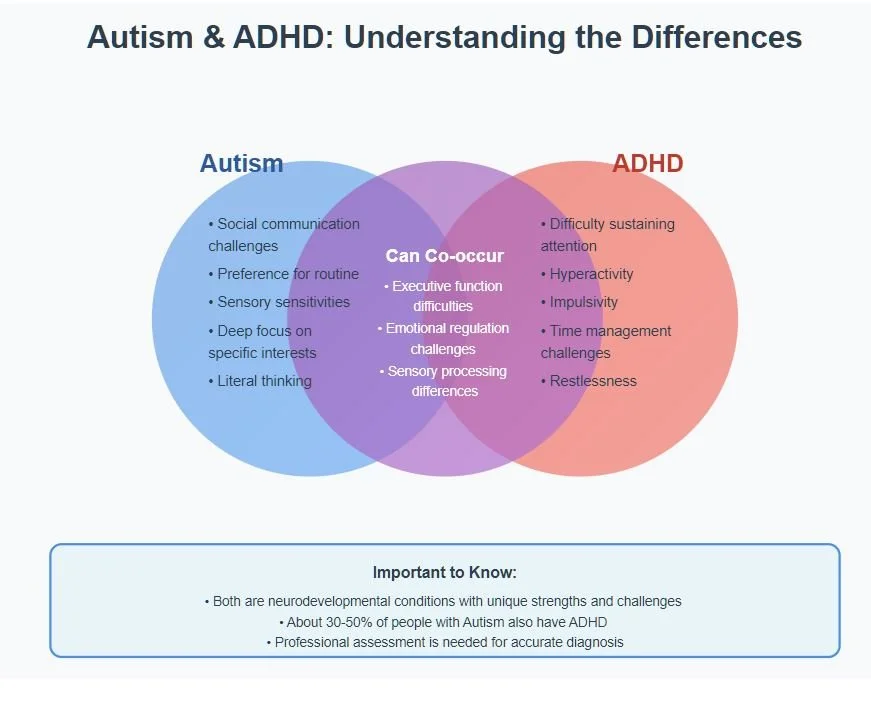
Autism or ADHD? Understanding the Differences and What Matters
Table of Contents
Intro
What Autism Is
What ADHD Is
Why Autism and ADHD Are Often Confused
Key Differences Between Autism and ADHD
Can Someone Have Both Autism and ADHD?
How Diagnosis and Support Differ
Why Understanding the Difference Matters
Supporting Neurodivergent Individuals With Confidence
Conclusion
Autism or ADHD?
Many parents, adults, and educators find themselves asking the same question at some point. Is this autism or ADHD? Sometimes the question comes after a teacher raises concerns. Other times it comes from personal reflection, especially when someone recognizes patterns in themselves they have carried since childhood.
The confusion is understandable. Autism and ADHD can look similar on the surface. Both affect how people focus, communicate, regulate emotions, and move through the world. But they are not the same thing. Understanding the difference can bring relief, clarity, and a better path forward.
This article is not about labeling people or creating boxes. It is about understanding how neurodevelopmental differences show up, why they are often confused, and how the right information can help people feel supported rather than judged. When we understand these differences, we can move away from frustration and toward meaningful connection.
If this topic resonates with you, Sonia Chand's book on autism offers a clear and compassionate guide to understanding neurodevelopment in real life. Her podcast also explores mental health, parenting, and wellness from many perspectives, making complex topics easier to understand.
What Autism Is

Autism, also called autism spectrum disorder, is a neurodevelopmental condition. This means it affects how the brain develops and processes information from early life.
Autism primarily involves differences in:
Social communication and interaction
Sensory processing
Patterns of behavior, interests, or routines
Autistic people may communicate differently. Some may struggle with eye contact or small talk. Others may communicate very clearly but prefer direct language and honesty. Sensory experiences can be heightened, meaning sounds, lights, textures, or crowds may feel overwhelming. What feels like background noise to one person may feel like painful static to someone who is autistic.
Many autistic people develop deep, passionate interests in specific topics. These interests bring joy, comfort, and a sense of mastery. They are not obsessions that need to be eliminated. They are often strengths that can become careers, hobbies, or lifelong sources of fulfillment.
Routines and predictability often feel essential for autistic people. This is not about being rigid or controlling. It is about creating safety and reducing the mental energy required to navigate an unpredictable world. When routines are disrupted without warning, it can feel destabilizing in ways that are hard to explain to others.
One important thing to understand is that autism is a spectrum. There is no single way autism looks. Some autistic people need a lot of support in daily life. Others live independently, work, build relationships, and may not be diagnosed until adulthood. The idea that autism always looks one particular way has led to countless people being overlooked, misunderstood, or dismissed.
Autism is not caused by parenting style, trauma, or lack of effort. It is part of how a person's brain is wired. It is present from birth, even if it is not identified until later.
For a deeper and more grounded understanding of autism that goes beyond stereotypes, Sonia Chand's book is a helpful place to start.
What ADHD Is
ADHD, or attention deficit hyperactivity disorder, is also a neurodevelopmental condition. It mainly affects attention, impulse control, and activity levels.
ADHD shows up in three main ways:
Inattentive presentation, where focus and organization are difficult
Hyperactive impulsive presentation, where movement and impulses are hard to regulate
Combined presentation, which includes both patterns
People with ADHD may struggle to stay focused on tasks that are not interesting to them, even if they care deeply about doing well. They may forget things, interrupt conversations, or feel restless inside their bodies. Time can feel slippery. What seems like five minutes may actually be an hour, or the other way around.
Executive function, which includes skills like planning, organizing, starting tasks, and managing time, is often affected by ADHD. This does not mean someone is incapable. It means their brain processes these tasks differently, and they may need different strategies or support to succeed.
People with ADHD often experience something called hyperfocus, where they become deeply absorbed in activities they find engaging. During these periods, they may lose track of time entirely and accomplish impressive amounts of work. This intensity of focus can be a strength, especially in creative or problem solving work.
ADHD is not about laziness, intelligence, or willpower. Many people with ADHD are creative, passionate, and highly capable. The challenge lies in regulating attention and energy in environments that are not designed for how their brains work. Schools and workplaces often reward sustained attention on tasks that may not feel inherently rewarding, which can make ADHD particularly challenging in these settings.
Sonia's podcast often explores topics like focus, mental health, and emotional regulation. Listening to these conversations can help normalize experiences that many people quietly struggle with.
Why Autism and ADHD Are Often Confused
Autism and ADHD share some overlapping traits, which is why they are often mistaken for one another.
Some shared experiences include:
Difficulty with attention or focus
Sensory sensitivity
Emotional regulation challenges
Social difficulties
Feeling overwhelmed in busy environments
From the outside, these behaviors can look very similar. A child who struggles in school may be labeled disruptive or unfocused. An adult who avoids social situations may be seen as withdrawn or inattentive. Without context, it can be hard to tell what is driving the behavior.
Both conditions can also lead to anxiety, especially when someone feels different from their peers but does not understand why. The internal experience of constantly trying to keep up, fit in, or meet expectations that feel impossible can be exhausting. This exhaustion is real and valid, regardless of the underlying cause.
Another reason for confusion is that many people have both autism and ADHD. This is called co occurrence, and it is more common than many realize. In these cases, traits overlap and interact, making identification more complex. Someone might have sensory sensitivities from autism and impulsivity from ADHD, creating a unique experience that does not fit neatly into one category.
Understanding this overlap helps reduce shame. It reminds us that behavior is communication, not a character flaw. When we stop judging and start listening, we can better understand what someone actually needs.
Key Differences Between Autism and ADHD
While there is overlap, autism and ADHD differ in important ways.
Autism often centers on:
Differences in social communication
A strong need for predictability or routines
Deep, focused interests
Sensory sensitivities that are consistent over time
ADHD often centers on:
Difficulty regulating attention
Impulsivity or restlessness
Trouble with time management and organization
Seeking stimulation or novelty
For example, an autistic person may prefer routines because predictability feels calming. A person with ADHD may struggle to maintain routines because their attention shifts quickly and repetition can feel unbearably boring.
Socially, an autistic person may not intuitively understand unspoken social rules. They may need these rules explained directly and clearly. A person with ADHD may understand the rules perfectly well but struggle to follow them consistently due to impulsivity or distraction. They might interrupt not because they do not care, but because the thought feels urgent in the moment.
When it comes to interests, autistic people often develop deep, lasting interests that bring comfort and joy. People with ADHD may jump between interests frequently, diving deeply into something for weeks or months before moving on to something else entirely.
These are general patterns, not rules. Every individual experience is unique. The key is to look at the pattern of behaviors over time and in different contexts, rather than focusing on isolated moments.
Can Someone Have Both Autism and ADHD?
Yes, absolutely.
Many people are both autistic and have ADHD. In fact, research increasingly shows that the two conditions often occur together. Studies suggest that up to half of people with one condition may also have the other. For some people, this dual diagnosis explains why they felt misunderstood for so long. Maybe they related to some descriptions of autism but not others, or they felt like the ADHD diagnosis did not quite capture their full experience.
Having both does not mean someone is more limited. It simply means their brain processes information in more than one neurodivergent way. It can also mean that support needs to be more individualized, taking both sets of traits into account.
Understanding co occurrence can:
Reduce self blame
Improve access to appropriate support
Help people understand their own needs more clearly
Validate experiences that felt confusing or contradictory
For people who have spent years feeling like they do not quite fit anywhere, discovering that they have both autism and ADHD can be profoundly validating. It explains why some strategies work and others do not, and why their experience feels layered and complex.
Sonia Chand's work consistently emphasizes that diagnosis is not about labeling. It is about understanding and support. Her book and podcast both reflect this balanced, human centered approach.
How Diagnosis and Support Differ
Diagnosis for autism and ADHD usually involves behavioral observations, developmental history, and clinical assessments. There is no single test that gives a yes or no answer. Professionals look at patterns across time and settings, often gathering input from multiple sources.
Accurate identification matters because support strategies differ.
Autism support may focus on:
Communication tools
Sensory accommodations
Predictable environments
Social understanding without forcing conformity
ADHD support may focus on:
Executive functioning strategies
Time management tools
Medication when appropriate
Environmental structure and flexibility
The goal is not to change who someone is. The goal is to help them thrive in a world that often does not accommodate neurodivergent brains. This might mean noise canceling headphones, visual schedules, fidget tools, flexible deadlines, or a combination of many different supports.
Support is not one size fits all. What works for one autistic person may not work for another. What helps someone with ADHD today might not help them next year. Flexibility, communication, and respect are essential.
For parents, educators, and adults navigating this process, Sonia's book provides practical guidance that feels realistic rather than overwhelming.
Why Understanding the Difference Matters
When autism and ADHD are misunderstood, people are often blamed for things outside their control. Children may be punished instead of supported. Adults may internalize shame or feel broken.
Understanding the difference helps:
Reduce stigma
Improve self understanding
Strengthen relationships
Create better learning and work environments
It also helps shift the conversation from what is wrong with you to what do you need to thrive. This shift is powerful. It moves us from a deficit model, where neurodivergent people are seen as problems to fix, to a support model, where differences are acknowledged and accommodated.
When teachers understand the difference, they can create classrooms that work for more students. When employers understand, they can build workplaces that value diverse minds. When families understand, they can connect more deeply and reduce conflict that comes from misunderstanding.
Sonia Chand's podcast plays an important role here. By bringing together voices from mental health, wellness, and lived experience, it helps listeners feel less alone and more informed.
Supporting Neurodivergent Individuals With Confidence
Whether someone is autistic, has ADHD, or both, support should be flexible and respectful.
Support looks like:
Listening without judgment
Adapting environments when possible
Valuing strengths alongside challenges
Recognizing that needs change over time
It also means believing people when they tell you what they need. Neurodivergent people are the experts on their own experiences. Sometimes support means stepping back and trusting that someone knows themselves better than anyone else could.
Neurodiversity is part of human diversity. When we understand that, we stop trying to fix people and start supporting them. We recognize that different does not mean less than. We create space for people to be themselves without apology.
Sonia's work consistently reflects this mindset. Her book offers a clear and compassionate framework for understanding autism, while her podcast opens up wider conversations around mental health and wellbeing.
Conclusion
Autism and ADHD are different neurodevelopmental conditions, but they often overlap in ways that can be confusing. Understanding both helps replace fear with clarity and judgment with compassion.
The more informed we are, the better we can support children, adults, families, and communities. Understanding is not about labels. It is about connection, dignity, and care. It is about building a world where neurodivergent people can thrive as themselves, not in spite of themselves.
This work matters. Every time we choose understanding over judgment, we create a little more space for people to breathe, to be seen, and to belong.
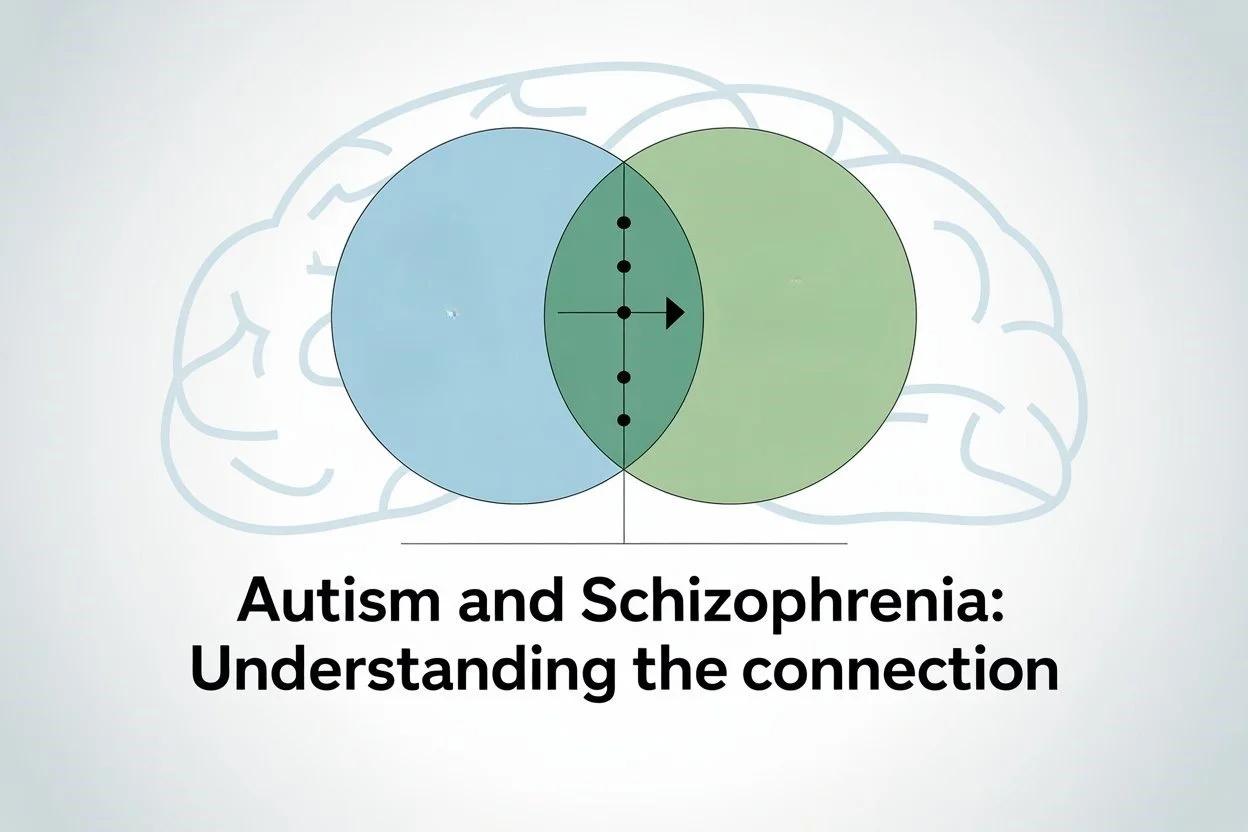
Are Autism and Schizophrenia Related?
Table of Contents
Intro
What Autism and Schizophrenia Are
Why People Often Think Autism and Schizophrenia Are Related
Key Differences Between Autism and Schizophrenia
Why Accurate Information Matters
How Conversations Like This Should Be Handled
Conclusion
Are Autism and Schizophrenia Related?
Many people wonder whether autism and schizophrenia are related. The question often comes up because both conditions can affect how someone thinks, communicates, or relates to others. For families and caregivers, this can feel confusing and sometimes even worrying, especially when information online is unclear or conflicting.
It is important to talk about this topic with care and accuracy. Autism and schizophrenia are often misunderstood, and mixing the two can lead to fear or incorrect assumptions. This article is here to bring clarity, not confusion.
In the sections that follow, we will explore what autism and schizophrenia are, why people sometimes think they are connected, and what current research actually says. The goal is to help readers understand the similarities without losing sight of the important differences.
What Autism and Schizophrenia Are
When we talk about whether autism and schizophrenia are related, the first step is to understand what each condition actually is. They are very different, both in how they begin and how they affect a person’s life.
Autism is a neurodevelopmental condition. That means it starts early in life and relates to how the brain develops and works. Autism affects how a person interacts with others, communicates, learns, and behaves. Some common features include challenges with social communication and repetitive or restricted patterns of behavior. Autism is called a “spectrum disorder” because people with autism can have a wide range of strengths and challenges that vary from one person to another. Autism is typically identified in early childhood, often before age three, although some people may not receive a formal diagnosis until later in life. Research from major health institutes describes autism in this way to help professionals and families understand the condition clearly.
Schizophrenia is a serious mental health condition that affects how a person thinks, feels, and behaves. People with schizophrenia may experience symptoms such as hallucinations (seeing or hearing things that others do not), delusions (strong beliefs that are not based in reality), disorganized thinking, or difficulty distinguishing what is real from what is not. It often changes how someone perceives the world around them and can make everyday life very hard without support and treatment. Schizophrenia usually begins later than autism, most often in late adolescence or early adulthood, although early warning signs may appear earlier. Leading mental health research organizations describe schizophrenia as a condition involving disruptions in thought processes, perception, emotional responses, and social interactions.
It is important to know that autism and schizophrenia are classified differently. Autism is categorized as a neurodevelopmental condition because it affects early brain development and shows itself in childhood. Schizophrenia is categorized as a mental health condition that generally appears later and involves changes in perception and thought processes. While both conditions involve the brain and may affect social behavior, they are diagnosed at different stages of life and for different reasons.
Understanding these basic definitions helps us see that, although there can be some overlap in behaviors or traits, autism and schizophrenia are not the same condition. They have different causes, different symptoms, and different developmental patterns, and they are treated and supported in different ways.
Why People Often Think Autism and Schizophrenia Are Related
Many people assume autism and schizophrenia are connected because some of the outward behaviors can look similar at first glance. For example, both conditions can involve social withdrawal, difficulty with communication, or challenges in reading social cues. When someone sees these traits without context, it is easy to think they come from the same place, even though they do not.
Another reason for the confusion comes from history. In early psychiatric research, autism and schizophrenia were not clearly separated. Decades ago, autism was sometimes described as a childhood form of schizophrenia. This outdated thinking has stayed in public memory, even though modern research has clearly shown that they are different conditions with different developmental paths. Unfortunately, once an idea enters public discussion, it can take a long time to disappear.
Media and misinformation also play a big role. Movies, headlines, and social media posts sometimes oversimplify or sensationalize mental health topics. Autism and schizophrenia may be grouped together under vague terms like severe mental illness or misunderstood behavior. This blending can create fear and misunderstanding, especially for families who are looking for clear answers.
Because of these factors, it is common for people to connect the two conditions even when science does not support that conclusion. Understanding where this confusion comes from is an important step toward having more accurate and compassionate conversations.
Key Differences Between Autism and Schizophrenia
While autism and schizophrenia can sometimes appear similar on the surface, there are important differences that help doctors and researchers tell them apart. Understanding these differences can reduce confusion and prevent incorrect assumptions.
Age of Onset and Developmental Timeline
One of the biggest differences is when each condition begins.
Autism is a neurodevelopmental condition, which means signs are usually present early in life.
Many autistic traits appear in early childhood, often before the age of three.
Schizophrenia typically develops much later, most often during late adolescence or early adulthood.
This difference in timing is a key reason why the two conditions are diagnosed and treated differently.
Differences in Symptoms
The types of symptoms involved are also very different.
Autism commonly involves:
Differences in social communication
Sensory sensitivities, such as being overwhelmed by sounds or textures
Repetitive behaviors or strong interests
Schizophrenia often involves:
Hallucinations, such as hearing or seeing things that are not there
Delusions, which are strong beliefs that do not match reality
Disorganized thinking or speech
These symptoms affect the brain in different ways and require very different kinds of support.
Stability of Traits Over Time
Another important difference is how symptoms change over time.
Autistic traits tend to be consistent and stable throughout a person’s life, even though support needs may change.
Schizophrenia often involves episodes, where symptoms may worsen for a period of time and then improve with treatment.
This difference in stability versus episodic symptoms is another clear reason why autism and schizophrenia are considered separate conditions.
Recognizing these differences helps families, educators, and healthcare providers respond with understanding rather than fear.
Why Accurate Information Matters
When autism and schizophrenia are misunderstood or mixed together, it can create unnecessary fear. Families may worry about outcomes that are not accurate, and individuals may face stigma based on assumptions that do not reflect their reality. Clear and accurate information helps replace fear with understanding.
Accurate knowledge also helps families seek the right kind of support. Autism and schizophrenia require very different approaches to care, education, and treatment. When people understand the differences, they are better equipped to ask the right questions, find appropriate services, and advocate effectively for themselves or their loved ones.
Perhaps most importantly, accurate information helps prevent harmful assumptions and incorrect diagnoses. Mislabeling behaviors can delay support or lead to interventions that are not helpful. When we take the time to understand each condition clearly, we create space for compassion, respect, and better outcomes.
How Conversations Like This Should Be Handled
Conversations about autism and schizophrenia should always be approached with care, respect, and compassion. The words we use matter. When language is thoughtful and accurate, it helps people feel seen rather than labeled. Compassionate communication also reduces fear and creates space for honest questions without judgment.
Lumping different conditions together can be harmful. Autism and schizophrenia are distinct, and treating them as the same can lead to misunderstanding, stigma, and inappropriate support. Each condition deserves to be understood on its own terms, with attention to the unique experiences of the people who live with it.
Education plays a key role in improving public understanding. When people have access to clear, reliable information, they are less likely to rely on stereotypes or misinformation. Education helps families, educators, and communities respond with empathy and confidence rather than fear.
If you want to hear thoughtful conversations that explore mental health, neurodiversity, and wellness from many different perspectives, listen to Sonia’s podcast. Her episodes offer insight, clarity, and real conversations that help make complex topics easier to understand.
Conclusion
Autism and schizophrenia are distinct conditions, even though they may share some overlapping features on the surface. Understanding this difference is important. Similar traits do not mean the conditions are the same, and shared areas of research do not lead to the same life experiences or outcomes.
When conversations around mental health are driven by fear or confusion, they can do more harm than good. Thoughtful and informed discussions help reduce stigma and support individuals and families in meaningful ways. The more we learn, the better we can respond with empathy, accuracy, and care.
If you want to continue learning, listen to Sonia Chand’s podcast for broader conversations on mental health, neurodiversity, and wellness. You can also read her book for a clear, human centered guide to autism that offers understanding, confidence, and practical support for real life situations.
Sources
1. National Institute of Child Health and Human Development. (n.d.). Autism spectrum disorder.
https://www.nichd.nih.gov/health/topics/autism/conditioninfo
2. National Institute of Mental Health. (n.d.). Schizophrenia.
https://www.nimh.nih.gov/health/statistics/schizophrenia
3. Rapoport, J. L., Giedd, J. N., & Gogtay, N. (2021). Neurodevelopmental model of schizophrenia: Update 2012. Molecular Psychiatry, 27, 1040–1053.
https://pubmed.ncbi.nlm.nih.gov/34967130/

When Was Autism Discovered?
Table of Contents
Intro
Early Observations of Autistic Traits Before the Term "Autism"
1910–1930s: The First Uses of the Word "Autism"
1940s: Autism Recognized as a Distinct Condition
How the Understanding of Autism Evolved Over the Decades
When Did People Realize That Adults Can Be Autistic?
Myths About Autism's "Discovery"
Why Many Adults Only Recently Learned About Autism
The Role of Autistic Voices in Re-Shaping Autism History
What We Now Know: Autism Has Always Existed
Conclusion
When Was Autism Discovered? (A Gentle Look at the History of Autism)
If you've recently discovered you're autistic, you might find yourself asking: when was autism first recognized? It's a question many late-identified autistic adults ask as they piece together their own stories. Understanding when and how autism was identified can help explain why so many of us spent years feeling different without knowing why.
The history of autism isn't just about dates and names in medical textbooks. It's about understanding how generations of autistic people lived without the language to describe their experiences, how bias shaped early research, and why so many adults are only now discovering their autistic identity.
For those of us navigating this journey of self-discovery, learning this history can be validating, frustrating, and ultimately empowering. It helps us see that our neurotype has always existed—it just took the world a long time to understand it properly.
Early Observations of Autistic Traits Before the Term "Autism"
Autism existed long before anyone gave it a name. Throughout history, there are accounts of individuals who likely were autistic—people described as eccentric, withdrawn, unusually focused on specific interests, or communicating differently from their peers. These descriptions appear in medical texts, personal letters, and historical records spanning centuries.
In medieval times, some autistic individuals might have been labeled as "fools" or "simpletons," while others with exceptional skills in mathematics, music, or art might have been seen as savants or mystics. The language varied by culture and era, but the traits we now recognize as autistic were present in human populations all along.
Why These Early Accounts Were Misunderstood
Without a framework for understanding neurodevelopmental differences, people interpreted autistic traits through the lens of moral judgment, supernatural beliefs, or intellectual disability. Someone who didn't make eye contact might be seen as rude or possessed. A child who had meltdowns might be considered poorly disciplined. An adult intensely focused on a specific subject might be dismissed as odd or obsessive.
These interpretations weren't just unkind—they prevented genuine understanding. Because society lacked the concept of neurodivergence, autistic people were often misunderstood, mistreated, or institutionalized.
Society's Limited Understanding of Neurodivergence in Past Centuries
For most of human history, differences in how people's brains worked were invisible to society at large. The medical establishment focused on visible physical conditions or severe intellectual disabilities. Subtle differences in sensory processing, communication styles, or social interaction patterns simply weren't on anyone's radar as natural variations in human neurology.
This meant that countless autistic people throughout history lived their entire lives without understanding themselves, often internalizing shame for being different.
1910–1930s: The First Uses of the Word "Autism"
Origin of the Word "Autism" From the Greek Autos ("Self")
The term "autism" comes from the Greek word "autos," meaning "self." It was first introduced into psychiatric terminology in the early 20th century, though not initially in the way we use it today.
Swiss Psychiatrist Eugen Bleuler and Early Usage in Relation to Schizophrenia
In 1911, Swiss psychiatrist Eugen Bleuler coined the term "autism" to describe what he saw as a symptom of schizophrenia—specifically, a withdrawal into one's inner world and a detachment from external reality. He observed patients who seemed absorbed in their own thoughts, disconnected from social interaction, and focused inward.
What He Got Right and Wrong
Bleuler noticed something real: some people relate to the world differently, with intense inner focus and unique patterns of social engagement. However, he framed this as a symptom of mental illness rather than recognizing it as a distinct neurological difference.
Why This Early Definition Did Not Reflect Autism as We Understand It Today
Bleuler's concept of autism was tied to psychosis and schizophrenia, conditions fundamentally different from what we now call autism. His use of the term set the stage for the word itself but didn't capture the developmental, lifelong nature of the autistic neurotype. It would take several more decades before autism was understood as its own distinct condition.
1940s: Autism Recognized as a Distinct Condition
Leo Kanner's 1943 Paper Describing "Early Infantile Autism"
The pivotal moment in autism history came in 1943 when American psychiatrist Leo Kanner published a paper describing eleven children who shared distinctive characteristics. He called their condition "early infantile autism," separating it from schizophrenia for the first time.
Key Features He Observed
Kanner noticed these children had intense desires for sameness, unique language patterns (including echolalia), exceptional memory skills, and what he described as difficulties with social relationships. Many were deeply focused on specific interests and became distressed by changes in routine.
Limitations and Biases in His Interpretation
While Kanner's work was groundbreaking, it had significant limitations. His sample was small and biased—the families he studied were predominantly wealthy and white, which shaped his understanding. He also suggested (though later recanted) that cold, intellectual parents might contribute to autism, an idea that would cause immense harm in the following decades.
Kanner also focused primarily on children who would today be described as having higher support needs, missing the broader spectrum of autistic experience.
Hans Asperger's 1944 Research and How It Shaped What We Now Call the Autism Spectrum
Just one year after Kanner's paper, Austrian pediatrician Hans Asperger published his own research describing children with many similar traits but who had strong language skills and were often highly intelligent in specific areas. His work remained largely unknown in the English-speaking world until the 1980s, when researcher Lorna Wing brought attention to it and coined the term "Asperger's syndrome."
Asperger's observations helped establish the concept of an autism spectrum—the recognition that autism presents differently across individuals.
Ethical Issues in Asperger's History
It's important to acknowledge the troubling context of Asperger's work. Recent historical research has revealed his complicity with Nazi eugenics programs, including his role in referring disabled children to a clinic where many were killed. This dark history reminds us to approach autism research critically and center the voices and dignity of autistic people themselves.
How the Understanding of Autism Evolved Over the Decades
1950s–1960s: Harmful Theories (e.g., "Refrigerator Mother")
In the decades following Kanner's research, psychology was dominated by psychoanalytic theories that blamed parents—particularly mothers—for their children's autism. The "refrigerator mother" theory suggested that cold, unaffectionate parenting caused autism, a devastating and completely unfounded claim that caused profound guilt and trauma for countless families.
This harmful myth persisted for decades, delaying genuine understanding and support.
1980s: Autism Officially Recognized in Diagnostic Manuals
Autism was first included in the Diagnostic and Statistical Manual of Mental Disorders (DSM) in 1980 as "infantile autism." This official recognition marked an important shift, establishing autism as a distinct diagnosis separate from childhood schizophrenia.
Throughout the 1980s and 1990s, diagnostic criteria evolved to recognize a broader range of presentations.
1990s–2000s: Rise of the Autism Spectrum Concept
The concept of autism as a spectrum gained traction during this period. Asperger's syndrome, pervasive developmental disorder not otherwise specified (PDD-NOS), and other diagnoses emerged, acknowledging that autism presented differently across individuals.
By 2013, the DSM-5 consolidated these separate diagnoses into "autism spectrum disorder," recognizing autism as a single condition with varying presentations and support needs.
Modern View: Autism as a Neurotype, Not a Disorder to Cure
Today, many autistic people and researchers advocate for understanding autism as a neurotype—a natural variation in how human brains develop and process information—rather than a disease or disorder requiring a cure. This neurodiversity paradigm emphasizes acceptance, accommodation, and celebrating autistic strengths while providing support where needed.
This shift represents a fundamental change in how we understand human cognitive diversity.
When Did People Realize That Adults Can Be Autistic?
The Shift Toward Recognizing Late-Identified Adults
For most of autism's recognized history, it was viewed primarily as a childhood condition. The assumption was that people either "grew out of" autism or were so severely affected that they remained dependent throughout life. This narrow view left countless autistic adults unrecognized.
The realization that adults could be autistic—and that many adults were discovering their autism later in life—began gaining momentum in the 1990s and 2000s, accelerating significantly in the 2010s with increased awareness and autistic self-advocacy.
Why Many Adults Were Overlooked for Decades
Several factors contributed to adults being missed. Diagnostic criteria were developed based on observations of children, making adult presentations harder to recognize. Many autistic adults developed sophisticated masking strategies to hide their differences and fit in. Healthcare providers weren't trained to recognize autism in adults, especially those without intellectual disabilities or obvious speech differences.
Understanding Autism Beyond Childhood Stereotypes
We now know that autism is a lifelong neurological difference. Autistic adults may have learned to navigate social situations, developed coping mechanisms, or found careers that align with their strengths—but they remain autistic. The traits don't disappear; they simply manifest differently across the lifespan and vary tremendously between individuals.
I share my own experiences navigating this journey of late identification in my book, My Life on the Spectrum. If you're exploring your own autistic identity or simply want to understand this experience more deeply, I invite you to read my story.
Myths About Autism's "Discovery"
Myth: Autism Is a New Condition
One of the most persistent myths is that autism is somehow new—a modern phenomenon that didn't exist in previous generations. This is false. Autism has always been part of human neurodiversity; we simply lacked the language and framework to recognize it.
Myth: Autism Didn't Exist Before the 20th Century
The formal recognition of autism came in the 1940s, but autistic people have existed throughout human history. Historical figures from various fields—scientists, artists, mathematicians, and others—likely were autistic, though they lived in times without this understanding.
Myth: Autism Comes From Modern Lifestyle or Vaccines
Science has thoroughly debunked claims that autism is caused by vaccines, modern technology, or contemporary lifestyles. These myths persist despite overwhelming evidence to the contrary. Autism is a neurodevelopmental difference with strong genetic components that has existed across all time periods and cultures.
Gentle, Science-Based Debunking
It's understandable why these myths emerge—humans look for explanations when confronted with something unfamiliar. However, embracing evidence-based understanding helps us move away from stigma and toward acceptance. Autism isn't caused by parenting, vaccines, screens, or processed food. It's simply one of many ways human brains can be wired.
Why Many Adults Only Recently Learned About Autism
Masking and Survival Behaviors
Many autistic adults, particularly women and gender-diverse individuals, became experts at masking—suppressing autistic traits and mimicking neurotypical behavior to fit in. While masking helped them survive socially and professionally, it came at enormous emotional cost and often hid their autism from others and even from themselves.
Gender and Cultural Biases
Early autism research focused almost exclusively on boys and men, creating diagnostic criteria that missed how autism often presents in girls and women. Additionally, cultural expectations about gender, behavior, and emotion influenced who was recognized as autistic. Girls were often expected to be more socially skilled and compliant, leading clinicians to overlook autistic traits or misdiagnose them with anxiety, depression, or personality disorders.
Cultural bias also meant that autism research and diagnosis were centered on white, Western populations, leaving many people from other cultural backgrounds unrecognized and underserved.
Lack of Awareness in Past Decades
Information about autism was simply not widely available until recently. Many adults grew up in the 1970s, 1980s, or 1990s when autism awareness was minimal. Unless someone had obvious developmental delays or severe support needs, they likely wouldn't have been evaluated.
How Diagnosis and Self-Identification Have Expanded
With the internet, autistic self-advocacy, and broader public awareness, many adults have encountered information about autism and recognized themselves in those descriptions. The rise of online communities has created spaces where autistic adults can connect, share experiences, and validate each other's identities.
Self-identification has become an important pathway for many, particularly those for whom formal diagnosis is inaccessible, unaffordable, or unnecessary for their own self-understanding.
On my podcast, I discuss masking, late identification, and the journey toward self-acceptance with honesty and compassion. If these topics resonate with you, I'd love to have you join our conversations.
The Role of Autistic Voices in Re-Shaping Autism History
Self-Advocacy Movements
The autism rights and neurodiversity movements, led by autistic people themselves, have fundamentally changed how autism is understood and discussed. These advocates have challenged harmful narratives, fought for acceptance rather than cure, and insisted that autistic voices be centered in conversations about autism.
The Neurodiversity Paradigm
The neurodiversity paradigm reframes autism not as a tragedy or medical problem but as a natural form of human diversity. Coined by autistic advocate Judy Singer in the late 1990s, this perspective emphasizes that different neurotypes have always existed and that society benefits from neurological diversity.
Why First-Person Stories Matter
For too long, autism was defined entirely by non-autistic clinicians and researchers observing from the outside. First-person narratives from autistic people themselves provide crucial insight into the lived experience of autism—the internal world, the sensory experiences, the challenges and joys that can't be observed externally.
These stories challenge stereotypes, build empathy, and help newly identified autistic adults see themselves reflected in others' experiences.
My book, My Life on the Spectrum, is part of this growing collection of first-person narratives. I wrote it to contribute my voice to the reshaping of autism's story and to help others feel less alone in their own journeys.
Conclusion
The history of autism is complex—filled with both breakthroughs and harm, recognition and misunderstanding. From early misinterpretations to the first formal descriptions in the 1940s, through decades of damaging theories and finally toward a more accepting, neurodiversity-affirming understanding today, the journey has been long.
What matters most is that we're moving in the right direction. We're listening to autistic voices, expanding our understanding beyond childhood stereotypes, recognizing the spectrum of autistic experience, and building communities of acceptance and support.
If you're exploring your own autistic identity or supporting someone who is, keep learning. Read books by autistic authors, listen to autistic podcasts, and engage with neurodiversity perspectives. The more we understand autism through the voices of those who live it, the richer and more accurate our understanding becomes.

Are Autism Rates Higher in the US
Table of Contents
Intro
Understanding What Autism Rates Really Mean
Comparing the United States to Other Countries
Why This Discussion Matters for Parents and Educators
Conclusion
Sources
Are Autism Rates Higher in the US
When people talk about autism, one question often comes up. Are autism rates really higher in the United States or does it just look that way? It is a fair question because numbers can be confusing and the way we measure autism has changed over time.
This topic matters for many people. Parents want to understand what the numbers mean for their children. Educators need clarity so they can support students in the classroom. Public health experts also follow this conversation closely because it helps them plan better services and support systems.
Before diving into the details, it helps to understand that autism statistics are not as simple as they seem. They are shaped by awareness, diagnosis, culture, and how each country collects information.
Understanding What Autism Rates Really Mean
Before comparing numbers, it is important to understand what autism actually means in a medical and research context. Autism Spectrum Disorder is a developmental condition that affects communication, behavior, and how a person interacts with the world. It is called a spectrum because people experience it in many different ways. Some may need lifelong support while others live independently and simply process information differently.
The definition of autism has also changed over time. Years ago, doctors used several separate labels. Today, these have been grouped into one broad spectrum. Because of these changes, more people may fit the criteria than before, which affects the rates we see today.
Prevalence vs Diagnosis Rates
Another important point is the difference between prevalence and diagnosis. Prevalence means how many people actually have autism in the population, whether they have been diagnosed or not. Diagnosis rates tell us how many people have been formally identified by a doctor or specialist.
These two numbers are not always the same. Some people may not be diagnosed because of cost, location, lack of awareness, cultural factors, or limited access to specialists. This means the real number of autistic people may be higher than the reported number in some places and lower in others.
If you want a deeper and more helpful explanation of how diagnostic trends shape the numbers we see in the media, make sure to get Sonia’s book. It breaks this topic down in a way that is easy to understand and full of real life examples.
Comparing the United States to Other Countries
When you look at autism numbers from around the world, you will see big differences — and a large part of that comes from how countries collect and report data. Some countries have robust national screening and tracking systems. Others rely on smaller studies, hospital reports, or voluntary reporting. Because of that, the numbers are often not directly comparable.
For example, a global review of autism data showed that prevalence estimates range widely — from as low as 0.02% in some places to as high as 3.66% in others. (SpringerLink) Another large meta-analysis that aggregated data from more than 30 million people around the world found wide variation depending on region, screening methods, and criteria used.
Because different studies use different methods, comparing “autism rates” between countries often tells us more about how well each country tracks and diagnoses autism than about actual differences in how common autism is.
This makes international comparisons tricky. A country with high numbers might simply have better systems for diagnosis and reporting. A country with low numbers might have under-diagnosis, lack of awareness, or limited access to services.
Cultural and Social Factors
Beyond data systems, culture and society play a big role in whether families seek a diagnosis and report autism. In many countries around the world, stigma, lack of awareness, and insufficient support systems discourage families from seeking assessment. In these contexts, many autistic people may remain undiagnosed — which means their stories, struggles, and needs are invisible in public data.
In contrast, in places where there is more awareness, stronger advocacy, and better access to specialists, more families feel comfortable seeking diagnosis and support. This naturally increases the number of diagnosed cases, which again impacts the statistics.
Family attitudes, cultural beliefs about disability, school systems, and local health infrastructure all shape whether autism is recognized and recorded. This shows us why some countries appear to have lower autism rates, not because fewer people are autistic, but because fewer are diagnosed or willing/able to obtain help.
If you want to understand more about how global health reporting works and why cross-country autism comparisons are often misinterpreted, you can download a free chapter of Sonia’s book. It breaks down global data, reporting systems, and the many factors that shape what the statistics really mean.
Why This Discussion Matters for Parents and Educators
When parents and teachers understand what autism numbers really mean, it becomes easier to take the right steps early. Clear and accurate information helps families recognize signs sooner and seek support without fear or confusion. Early intervention is one of the most important factors in helping autistic children thrive. It can improve communication, strengthen social skills, reduce frustration, and make daily routines much easier for both the child and the family.
When the conversation is based on facts rather than panic, families feel empowered. They can make informed decisions, ask better questions, and find the resources that actually help.
Reducing Stigma
Another important reason this topic matters is stigma. Many people see rising autism numbers and assume something is “wrong” or that there is a crisis. In reality, higher numbers often reflect progress. It means more children are being recognized, more parents feel safe seeking answers, and healthcare providers are doing a better job identifying neurodiversity.
Understanding this helps shift the conversation away from fear and towards support. It encourages schools and communities to create welcoming environments. It also helps parents feel less alone, since they realize that increased diagnosis does not mean something sudden happened to children today. It often simply means more children are finally being seen.
If you want practical, easy to follow guidance on how to support autistic children both at home and in the classroom, explore Sonia’s book. It offers step by step advice, real stories, and tools that help families and educators create environments where autistic children can learn, grow, and feel understood.
Conclusion
Understanding autism statistics can feel confusing, but the key point is simple. Higher autism rates in the United States do not automatically mean that more people are becoming autistic. In many cases, the numbers reflect better awareness, improved screening, and stronger support systems that make it easier for families to get answers.
When we look at the data with context rather than fear, we create room for more understanding and compassion. Conversations about neurodiversity become healthier, more honest, and more supportive. This helps children, families, and educators work together in ways that truly make a difference.
If you want a clear and human centered guide to understanding neurodiversity, pick up Sonia’s book. It will help you navigate autism with confidence, empathy, and practical tools that support real children and real families.
Sources
Author(s): Smith J, Doe A; Year: 2022; Article title: “Global autism prevalence: a review”; Journal: Italian Journal of Pediatrics; Volume 48; Article ID

Building Human Connection With AI Through Family Memories
Table of Contents
Intro
The Childhood Story That Sparked a Vision
From Corporate Life to Purpose Driven Work
The Tools That Bring Memories to Life
Why Memory Preservation Matters for Social Health
Conclusion

Building Human Connection With AI Through Family Memories
Every family carries stories that shape who we are, yet with time those memories fade, scatter, or disappear entirely. Moments we think we will never forget become harder to recall. Voices we once heard every day become distant. In a world where we capture everything except the things that truly matter, preserving family memories has quietly become one of the most important challenges of our generation.
This is the mission that drives Jeremy Horne. After years of building technology and creative solutions for major global brands, he shifted his focus toward something more meaningful: helping families protect their stories, their voices, and their emotional legacy. Through a thoughtful blend of human centered design and responsible AI, Jeremy is working to make connection and remembrance easier, more intentional, and more accessible.
In this podcast episode, Jeremy dives deep into the personal experiences that shaped his work, the ethics of memory preservation, and the future of building technology that strengthens human connection rather than replacing it.
The Childhood Story That Sparked a Vision
How Jeremy Grew Up With Storytelling
Jeremy’s relationship with storytelling began long before he ever imagined building technology around it. He grew up in a remote town where distance created a natural separation between his immediate family and his grandparents. There were no quick video calls, no instant messages, no social feeds to bridge the gap. Instead, his family relied on a simple but powerful ritual: exchanging cassette recordings.
These tapes carried more than updates. They carried tone, laughter, pauses, warmth, breathing, and presence. Each side of a cassette became a conversation across miles. A grandparent would sit down, press the red record button, and speak directly to their loved ones. Jeremy’s family would listen, rewind, and record their own side in response. What they lacked in closeness, they made up for with intention.
Those recordings became Jeremy’s earliest education in the emotional weight of human stories. He learned that a story told in your own voice carries memory in a way that written words cannot. He learned that a voice is more than sound. It is history. It is affection. It is belonging. These early experiences planted the idea that preserving voices could preserve connection, even when people are far apart or no longer here.
Nana Winny and the Value of Preserved Voices
Among all the tapes his family exchanged, the ones that stayed with Jeremy the most were the recordings from his grandmother, Nana Winny. Her messages were warm and generous, filled with the kind of everyday stories that families often overlook until they are gone. She talked about her day, shared reflections, and offered advice. Ordinary moments became extraordinary once preserved in her voice.
For Jeremy, listening to his grandmother’s recordings was like receiving a piece of her presence. Even as years passed, hearing her voice brought back memories in full, living color. Those tapes became a form of emotional continuity, a way to keep relationships alive across distance and time.
This childhood experience is the root of Jeremy’s adult mission. It shaped his belief that technology should protect what is human rather than dilute it. It also shaped the vision behind the tools he later built: digital systems that make it easier to capture the richness of a person’s voice, personality, and stories, so that families never lose the people they love.
To experience Jeremy’s childhood memories and hear his story in his own voice, you can listen to the full podcast episode here.
From Corporate Life to Purpose Driven Work
Shifting From Major Agency Work
Before dedicating himself to preserving family stories, Jeremy spent years working inside major global agencies, creating campaigns and digital solutions for some of the world’s most recognizable brands. From automotive giants to household names in consumer goods, he built products, crafted strategies, and helped companies communicate with millions of people.
It was exciting work. Fast paced. Creative. Filled with innovation and large scale impact. But over time, Jeremy began to feel a growing gap between the projects he was working on and the meaning he wanted his work to carry. The metrics and milestones were impressive, but something was missing. The work was technically brilliant, yet emotionally hollow.
The turning point came when he realized that the technology he was helping build could move people, but it rarely helped them preserve what truly mattered. He wanted to build something that did not only entertain or convert customers, but something that could strengthen relationships, deepen connection, and touch the part of life that advertising never reaches.
Choosing Storytelling and Human Connection
That realization pushed him back toward the roots of his childhood: the power of a recorded voice, the intimacy of a shared story, and the emotional weight carried through human memory. He recognized that although technology had advanced rapidly, it had not solved one simple and universal problem: families were still losing their stories.
People had thousands of photos in their phones but almost no recordings of their parents telling a story from their youth. They had endless chat threads but almost no preserved conversations with grandparents. The digital world had made communication faster, but not necessarily deeper.
Jeremy saw this gap and understood it as both an opportunity and a responsibility. He chose to step away from corporate work and toward something more personal. Something that could help families protect their memories and strengthen their relationships. Something that brought technology and humanity closer together.
This shift became the foundation for the memory capturing tools he would later build, and ultimately the mission that guides his work today.
The Tools That Bring Memories to Life
As Jeremy explored the idea of preserving human stories, he realized that families needed tools that were simple, personal, and emotionally intuitive. This vision led to two products that work together: Winnie and Forever You. Each one serves a different role, but both are built around the belief that technology can make human connection stronger and more lasting.
Winnie: The App For Meaningful Conversations
Winnie was created to solve a problem almost every family faces. People want to share stories, but they often do not know where to start. Some conversations feel awkward to initiate. Some memories only surface when someone asks the right question. Winnie removes that pressure by giving families gentle guidance.
What it does
It offers thoughtful prompts that help people ask deeper, more meaningful questions
It helps capture memories with ease rather than making storytelling feel like a chore
It encourages families to talk more intentionally, whether across a table or across continents
Why it matters
Most people only share fragments of their lives because no one ever asks the questions that unlock the full story. Winnie gives families those questions. It creates a space where storytelling feels natural instead of forced. Over time, these conversations become a living archive of memories, values, and life lessons that would otherwise be lost.
Winnie is not just a tool. It is a nudge toward more intentional relationships.
Forever You: Digital Avatars Based on Real Memories
While Winnie helps families capture their stories, Forever You focuses on preserving their presence. Forever You is a conversational avatar built from real recordings of a person. It does not generate synthetic histories or fictional versions of someone. Instead, it recreates a person’s voice, style, and personality based on memories they actually shared.
What it is
A digital avatar created using real videos, audio messages, and recordings
A technology that reflects a person’s true tone, mannerisms, and expressions
Designed to help future generations hear and connect with someone they may have never met
Key insight
Forever You is not intended to take the place of a loved one.
It is a bridge.
A way to preserve a voice, a story, a personality.
A way to keep a sense of presence alive long after time has created distance.
It is memory made accessible, intimate, and interactive.
To hear the emotional story of how Jeremy created a Forever You version of his mother, and what that experience meant for him and his family, you can listen to the full podcast episode here.
Why Memory Preservation Matters for Social Health
When people talk about well being, they often focus on physical health and mental health. Yet there is a third dimension that shapes how we move through the world. It is called social health. Social health is the strength we gain from connection, belonging, and the sense that we are part of a story larger than ourselves.
Knowing your family history plays a powerful role in that. When people understand where they come from, they often feel more grounded and resilient. They gain a stronger sense of identity. They carry a clearer picture of the values, struggles, and victories that have shaped their family over time.
A memory shared by a parent becomes more than a story. It becomes a roadmap. A source of perspective. A quiet reminder that you belong to something that did not start with you and will not end with you.
Jeremy’s work is built on the belief that preserving stories strengthens this foundation. When families capture their experiences in their own voices, they create a heritage that supports emotional well being not just for one generation, but for the ones that follow.
Technology as a Support System for Real Human Bonding
A common fear about technology is that it weakens relationships. Jeremy approaches it differently. His tools are not designed to replace human connection. They are designed to support it.
Winnie does not speak for families. It encourages them to speak to each other. Forever You does not try to imitate a person’s life. It preserves what the person already shared so their memories do not vanish.
The goal is simple. Lower the barriers that stop people from having meaningful conversations. Remove the friction that keeps families from capturing the moments that matter. Give people more chances to express themselves, to listen to each other, and to carry their stories forward.
When used with intention, technology can create stronger bonds, not weaker ones. It can make storytelling easier. It can help families feel closer. It can protect the voices we love most.
Memory preservation is not just about the past. It is about building emotional strength for the future.
Conclusion
At its core, the greatest value of AI isn’t speed or automation. It’s the way it can help us stay connected to what matters most. When technology supports storytelling, strengthens relationships, and keeps our memories alive, it stops being a tool and becomes a bridge between generations.
Preserving family memories is one of the most meaningful things we can do, and today’s technology makes that easier, more intentional, and more human than ever. It helps us honor the past, nurture the present, and shape the stories that will guide the future.
Can Autism Develop Later in Life?
Intro
Understanding the science
Why So Many Adults Are Just Realizing They Are Autistic
Major Signs of Autism That Adults Often Overlook
What Triggers Recognition Later in Life?
Is Late Diagnosis Helpful?
Common Myths About Autism in Adults
How Adults Can Explore Their Autistic Identity
Practical Support for Newly Identified Autistic Adults
Conclusion
Can Autism Develop Later in Life?
More adults are beginning to ask an important question: can autism show up later in life? The conversation is growing because many people reach adulthood before realizing that their lifelong patterns, strengths, and struggles might actually fit the autistic profile.
A lot of the confusion comes from the idea that a person can “develop” autism. In reality, autism does not suddenly appear in adulthood. What often happens is that someone finally has the language, awareness, or safe environment to recognize traits that were always there. Many adults also learn that they have been masking or hiding their autistic traits for years without knowing it.
This blog post will walk you through why autism can remain unseen during childhood, why it becomes more noticeable later in life, and how late diagnosis or self identification happens. The goal is to help you understand this experience in a clear and supportive way.
Understanding the science
Many adults who start exploring autism wonder if it is something that can develop over time. The short answer is no. Autism is a lifelong neurodevelopmental condition. This means it begins during early brain development, long before a person becomes aware of it. It does not suddenly show up in your twenties, thirties, or forties.
What does happen very often is something different. People experience late recognition, late diagnosis, or late unmasking. In other words, the autism was always there, but it went unnoticed for many reasons.
Why it feels like it appears later
For many people, childhood signs were either subtle, misunderstood, or completely missed. Maybe they were seen as shy, gifted, sensitive, stubborn, introverted, or quirky. These labels can easily cover up autistic traits.
Some people develop strong masking skills without knowing it. Masking means copying social behaviors, studying people, forcing eye contact, or adjusting yourself constantly so you fit in. When masking becomes a habit, it can hide autism for years.
Autism may also feel more obvious later in life because adulthood comes with new challenges. Stress, burnout, major life transitions, or losing a predictable routine can make long standing difficulties more noticeable. When the structure that helped you cope falls away, the traits that were hiding in the background can suddenly become clearer.
This is why many adults feel like autism just appeared out of nowhere. The truth is that it was always part of who they are. They just did not have the words or understanding to recognize it until now.
If this section feels familiar, Sonia’s book offers comforting guidance. She breaks down self awareness in a way that helps you understand your patterns and emotions with clarity, especially if you are exploring neurodiversity for the first time.
Why So Many Adults Are Just Realizing They Are Autistic
A. Generational gaps in diagnosis
A lot of adults grew up in a time when autism was understood in a very narrow way. The focus was usually on young boys who showed very obvious traits. This meant many girls, quiet children, gifted kids, or anyone who did not match the stereotype were often overlooked. Their struggles were seen as personality quirks, moodiness, or simply being different. Because of this, countless autistic adults never received support or even an explanation for why life felt harder for them.
B. Social expectations and conditioning
Many adults were also raised with strong expectations to behave, blend in, and not cause problems. They learned to be polite, pleasant, adaptable, and quiet. Over time, this conditioning created automatic masking habits. Masking can help someone fit socially, but it also hides natural autistic traits. The effort it takes can be incredibly draining, and many people only begin to understand this later in life when burnout becomes impossible to ignore.
C. New awareness and online communities
In the last several years, online spaces have changed everything. Autistic creators, late diagnosed adults, educators, and advocates have started sharing their experiences openly. Their stories often match what many undiagnosed adults have felt their entire lives. Seeing this reflected back creates a moment of recognition that many people describe as life changing. It gives them language, validation, and the courage to look deeper.
If you are beginning to see yourself in these patterns, Sonia’s book can help you understand your emotional world with more clarity. She guides readers through self awareness and inner reflection in a gentle, relatable way that supports anyone exploring who they truly are.
Major Signs of Autism That Adults Often Overlook
Many adults go through life sensing that something feels different but never connect those feelings to autism. This happens because autistic traits often show up in quiet, subtle ways. They can be misunderstood or explained away as personality quirks. Below are some of the signs that many adults look back on and finally recognize.
A. Sensory differences
A lot of autistic adults notice that they react more strongly to certain sounds, textures, lights, or smells. This might mean feeling irritated by buzzing lights, tags on clothing, loud conversations, or strong scents. Sensory overload can make everyday environments feel stressful or draining. Many people also prefer predictable spaces where they can control noise, lighting, and movement.
B. Social and communication patterns
Some adults have always found small talk confusing or tiring. They may miss social cues, misunderstand tones, or take things very literally. They often feel like they are not quite in rhythm with the people around them. This can lead to feeling out of place even in friendly or familiar settings.
C. Emotional regulation
Autistic adults often look back and realize they struggled with emotions in ways they could not name. When things become too overwhelming, they may shut down, retreat, or suddenly lose the ability to communicate clearly. Others may feel emotions very deeply but find it hard to express what they need. These patterns can go unnoticed for years because many people assume they are just “too sensitive.”
D. Thinking and processing styles
Many autistic adults relate strongly to deep focus. When something interests them, they can stay with it for hours with zero effort. They often prefer routines because they bring comfort and clarity. On the other hand, multitasking or dealing with sudden changes can feel stressful or confusing. These traits are often seen as personality rather than part of a neurotype.
E. Internal experiences
Perhaps the most common overlooked sign is the quiet feeling of being different without knowing why. Many adults say they spent years trying to fit in or act “normal.” Masking becomes second nature and leads to chronic exhaustion. It explains why so many people reach adulthood before finally recognizing themselves in the autistic community.
These signs do not look the same in everyone, but they show up often enough to help adults start connecting the dots.
What Triggers Recognition Later in Life?
Many adults go through years or even decades without realizing they are autistic. Then something happens that brings everything into focus. These moments do not create autism. They simply make long standing traits easier to see.
A. Burnout
One of the biggest triggers for late recognition is autistic burnout. This type of burnout is different from ordinary stress. It builds up slowly from years of masking, pushing yourself, and trying to meet expectations that were never designed for your brain. When burnout hits, the strategies that used to help you blend in stop working. Social skills feel harder. Sensory issues feel stronger. Your energy drops, and masking becomes impossible to maintain. This sudden shift often makes autistic traits stand out in a way they never did before.
B. Major life changes
Big life transitions can also reveal traits that were easy to hide in the past. A new job with unpredictable demands, becoming a parent, dealing with health issues, or going through a relationship change can stretch your coping abilities. When routine breaks or pressure increases, old struggles that were once manageable come to the surface. This is often when people start to realize that their challenges have a deeper explanation.
C. Parenting an autistic child
Another common turning point is raising a child who has autism. Many adults begin researching signs, seeking evaluations, and learning about neurodiversity to support their child. In that process, they start to notice similarities with their own experiences. They see themselves in their child’s traits, sensitivities, or emotional patterns. This recognition is often both surprising and deeply validating.
If you are going through burnout, transitions, or a season of self discovery, Sonia’s book can be a grounding companion. It offers emotional insight and gentle reflection tools that help you understand yourself during times when everything feels clearer, louder, or heavier than before.
Is Late Diagnosis Helpful?
Many adults wonder if getting a diagnosis later in life actually makes a difference. The truth is that a late diagnosis can bring clarity, connection, and emotional healing, even after years of confusion.
Benefits of diagnosis
A late diagnosis often gives people a deeper sense of self understanding. It helps them connect past experiences, struggles, and patterns in a way that finally makes sense. Instead of feeling broken or difficult, many people start to see themselves with more compassion.
A diagnosis can also open doors to support. This might include accommodations at work, therapy with someone who understands autism, or access to local or online communities.
Another important benefit is the reduction of shame. Many adults spent years thinking their challenges were personal failures. A diagnosis helps people see that their brains simply work differently. This shift alone can transform how they speak to themselves.
It also improves communication in relationships. It becomes easier to explain needs, set boundaries, and build healthier connections.
Emotional reactions
The emotional side of a late diagnosis is complex. Many people feel relief because they finally have an explanation for things that never made sense. There is also grief, especially when they realize how much support they missed growing up. It is common to think about the ways life might have been easier with earlier understanding. Alongside these feelings is a deep sense of validation. For the first time, people feel seen and understood.
Self diagnosis versus formal diagnosis
Many adults start with self diagnosis. This is valid and often reflects real lived experience. Self diagnosis is also sometimes the only option because official assessments can be expensive, hard to access, or limited by long waiting lists.
A professional evaluation can be helpful when someone needs documentation for school, work, or mental health support. It can also be useful when there is doubt or when other conditions may overlap.
Both paths deserve respect. What matters most is understanding yourself in a way that brings clarity, peace, and support.
Common Myths About Autism in Adults
Many adults hesitate to explore autism because of the myths they have heard throughout their lives. These misunderstandings can hold people back from seeking clarity or trusting their own experiences. Below are some of the most common myths and the truth behind them.
Myth: “You cannot have autism if no one noticed earlier.”
The truth is that many autistic adults grew up in environments where the signs were misunderstood or ignored. Teachers, parents, and even doctors often did not have the knowledge we have today. Many traits were mistaken for personality differences or emotional struggles. Late recognition does not mean autism was not there. It simply means it was not identified.
Myth: “You are too social or articulate to be autistic.”
Autism does not look the same in everyone. Some autistic adults are talkative, friendly, or skilled at conversation. They may have learned how to socialize through observation, practice, or masking. Being articulate also does not erase the challenges someone may face with communication, sensory overload, or emotional regulation. Autism is a spectrum with a wide range of experiences.
Myth: “Only children have autism.”
Autistic children grow up to become autistic adults. Autism is lifelong and does not disappear with age. Many people were simply raised during a time when the signs were overlooked. The challenges and traits remain, even if a person has learned to adapt.
Myth: “Masking means you are fine.”
Masking can help someone appear calm, social, or confident, but it often comes at a high emotional and physical cost. It can lead to exhaustion, burnout, anxiety, and a loss of identity. Being able to mask does not mean someone is not struggling. It usually means they have been working very hard to hide it.
Understanding these myths helps open the door to more compassion and self acceptance. It also makes space for adults to explore their experiences without guilt or doubt.
How Adults Can Explore Their Autistic Identity
Discovering you might be autistic as an adult can feel both exciting and overwhelming. It is a journey that involves curiosity, honesty, and gentle self reflection. Here are some supportive ways to explore this part of yourself.
A. Self reflection questions
A helpful first step is asking yourself questions that make you look deeper into your experiences. For example:
How do I handle social situations?
What drains me the most?
What brings me comfort?
Have I spent most of my life feeling different?
These questions can open the door to patterns you may not have noticed before.
B. Traits checklists
Many adults find clarity by going through autism trait checklists created with adults in mind. These lists highlight common experiences related to sensory needs, communication, routines, and emotional patterns. They are not a diagnosis, but they can help you understand whether your experiences align with autistic traits.
C. Talking to therapists familiar with autism
If you want deeper insight, talking to a therapist who understands autism in adults can be incredibly helpful. A supportive professional can help you explore your history without judgment. They can also help you understand the difference between autism, trauma responses, anxiety, and other experiences that sometimes overlap.
D. Learning through autistic voices and communities
One of the most powerful ways to understand autism is by learning directly from autistic adults. Their stories, perspectives, and explanations often resonate in a way that textbooks never can. Online communities, videos, blogs, and support groups can help you feel seen and understood. Many people say these spaces gave them their first sense of belonging.
If you are exploring your identity and trying to understand yourself more deeply, Sonia’s book helps you look inward with clarity and honesty, and it offers gentle guidance for anyone going through self discovery or a late understanding of neurodiversity.
Practical Support for Newly Identified Autistic Adults
Realizing you might be autistic is only the beginning. The next step is learning how to support yourself in a way that feels gentle, practical, and sustainable. Here are some helpful areas to focus on as you begin this part of your journey.
Understanding sensory needs
A big part of feeling grounded is understanding what your senses need. Pay attention to what overwhelms you and what helps you feel calm. This might include using noise cancelling headphones, choosing softer clothing, adjusting lighting, or creating quiet spaces. Honoring your sensory needs is not being picky. It is caring for your nervous system.
Setting boundaries
Learning to set boundaries is another important step. Many autistic adults spent years trying to please others or fit expectations that caused stress. Boundaries help protect your energy and create healthier relationships. This can look like saying no when something feels too demanding, asking for clear communication, or limiting social time when you need rest.
Creating sustainable routines
Routines bring comfort and stability. Creating a daily flow that supports your energy can make life feel more manageable. This might include planning quiet time, scheduling breaks, organizing tasks visually, or building habits that reduce decision making. A steady routine can help you feel more grounded and less overwhelmed.
Addressing burnout
If burnout is part of your story, give yourself permission to slow down. Burnout is not laziness. It is a sign that your mind and body need recovery. Rest, reduced pressure, therapy, and sensory friendly environments can help you rebuild your energy. Many adults discover that understanding their autistic needs is the first step toward healing burnout.
Finding community support
Community makes a huge difference. Connecting with other autistic adults can bring understanding and validation that you may not have experienced before. Online groups, local meetups, and autistic creators can offer insights and companionship. Being in a space where you feel seen and understood can be deeply healing.
These practical steps support a more compassionate and sustainable way of living as you learn more about yourself and what you need.
Conclusion
Autism does not suddenly develop later in life. What many adults experience is recognition, unmasking, and a deeper understanding of themselves. For years, traits may have been hidden or misunderstood, and adulthood often provides the clarity to see them clearly.
Exploring this part of yourself takes patience, compassion, and curiosity. It is normal to have a mix of emotions, from relief to grief, as you process your experiences. The most important thing is to honor your journey and give yourself permission to learn at your own pace.
Seek out resources, support, and stories that make you feel seen. Whether it is supportive books, online communities, therapists familiar with adult autism, or personal reflection, these tools can help you navigate self-discovery with confidence and care. This is your opportunity to understand yourself more fully and to embrace who you have always been.
Rethinking Bipolar Disorder
Table of Contents
Intro
The Problem With the Traditional Narrative
Sean Blackwell’s Transformational Experience
A New Lens: Psychospiritual Crisis Instead of Disorder
An Integrative Healing Model
Important Caveats
Why This Perspective Matters Today
Conclusion
Rethinking Bipolar Disorder
For years, many people have been taught that bipolar disorder is simply a chemical imbalance in the brain. This explanation feels straightforward, but it often leaves out the emotional, spiritual, and human layers of what people actually experience.
This is where Sean Blackwell’s perspective becomes important. Sean has spent years studying bipolar experiences, and his ideas invite us to look beyond the medical definition and consider what might be happening on a deeper level. His work suggests that some bipolar episodes may involve emotional breakthroughs, unresolved trauma, or spiritual shifts that deserve more attention than they usually get.
This blog explores his approach and offers a more human and integrative way to think about bipolar disorder. The goal is not to dismiss medical care but to widen the conversation and make room for the meaning, healing, and personal transformation that many people describe.
The Problem With the Traditional Narrative
A. The limits of the “chemical imbalance” explanation
Most people have heard the idea that bipolar disorder happens because chemicals in the brain are out of balance. This explanation is simple, and it can feel comforting because it gives a clear answer. The problem is that many people eventually discover that this story does not fully match their lived experience.
Some people take medication for years and still feel stuck, confused, or disconnected from themselves. Others feel that their episodes carry emotional themes or come during moments of deep stress, grief, or transition. These experiences suggest that something more complex is going on. The chemical imbalance story can help with symptom management, but it does not always help someone understand why these episodes happen in the first place or how to heal the emotional layers underneath.
This creates a gap. Medication can calm symptoms, but many people still search for meaning, clarity, and lasting healing. They want to understand the roots of their experiences, not only how to manage them.
B. The danger of reducing people to a diagnosis
When the conversation centers only on diagnosis and brain chemistry, it can unintentionally reduce a whole person to a single label. This often leaves out important parts of their story. Many people with bipolar diagnoses carry histories of trauma, emotional neglect, anxiety, or life events that shaped how their mind and body respond to stress. When these layers are ignored, people can feel misunderstood or invalidated.
It becomes easy for society, and even loved ones, to see only the diagnosis and overlook the person behind it. Emotional pain, personal growth, spiritual questioning, and past experiences can all get pushed aside, even though they play a major role in mental well-being.
This is why a more holistic lens is important. People deserve to be seen as whole human beings. Their biology matters, but so do their feelings, memories, relationships, beliefs, and inner world. A fuller understanding creates space for compassion, self-awareness, and more meaningful healing.
Sean Blackwell’s Transformational Experience
A. His 1996 awakening experience
In 1996, Sean Blackwell went through an experience that looked very much like a mental health crisis from the outside. It began during an intense self-help and meditation workshop. As the practices went deeper, he started feeling powerful emotional waves rising through his body. His senses became sharper, his thoughts sped up, and he entered a state that many would describe as psychosis.
He felt disconnected from ordinary reality and deeply connected to something larger than himself. Colors felt brighter. Insights came rapidly. Emotions poured out in ways he had never experienced. It was overwhelming, frightening, and confusing, yet at the same time he could sense that something meaningful was happening. It did not feel like a random breakdown. It felt like a hidden part of his inner life was finally surfacing.
B. Why this moment changed everything
What happened next shaped the rest of Sean’s life. Instead of spiraling into a long-term psychiatric cycle, he gradually came out of the experience with a sense of clarity, emotional release, and inner shift. He describes the episode not only as a crisis but also as a turning point. Something inside him felt reorganized. He understood himself in a deeper way. He felt more emotionally open and spiritually grounded.
Most importantly, he did not go through repeated hospitalizations, and he did not become dependent on long-term medication. The intense episode became the beginning of his healing journey, not the start of a lifelong struggle. This outcome pushed him to question the traditional view of bipolar disorder. It led him to explore the idea that some crises may carry transformative potential, especially when emotional or spiritual layers are involved.
This moment changed everything because it opened a door. It showed him that mental health episodes can hold meaning, and that healing can sometimes take forms that do not fit neatly within the medical model.
A New Lens: Psychospiritual Crisis Instead of Disorder
A. The “breakdown vs. breakthrough” idea
Sean Blackwell introduces a different way of looking at intense mental health episodes. Instead of seeing them only as breakdowns, he suggests that some people may be going through a breakthrough. In this view, a crisis is not just a malfunction. It can be a process where the mind and body are trying to reorganize themselves at a deeper level.
During these episodes, painful memories, old trauma, suppressed emotions, and inner conflicts may rise to the surface. The intensity can feel chaotic, but it may also reflect the body’s attempt to release what has been held inside for years. Some people describe their episodes as moments when buried truth comes up all at once, forcing them to face parts of themselves they have avoided or forgotten.
This perspective does not romanticize suffering. Instead, it acknowledges that emotional and spiritual growth can sometimes happen in messy and overwhelming ways. It recognizes that crises may carry meaning, especially when they happen at times of major life stress or inner tension.
B. What this reframing does for people
Seeing a crisis through a psychospiritual lens can create space for hope. It tells people that their experience is not only a sign of something wrong. It may also be a sign of something trying to change or heal.
This reframing gives people a sense of agency. Instead of feeling powerless, they can explore what their mind and body are trying to communicate. They can look at their emotional history, their relationships, their spiritual questions, and their personal patterns with more compassion and curiosity.
It also helps reduce the shame and fear that often surround bipolar diagnoses. When people understand that their experience may have emotional or spiritual meaning, they feel less broken. They feel less alone. They feel more encouraged to seek healing approaches that address the whole person.
Ultimately, this perspective honors the complexity of human experience. It gives people permission to see their journey as meaningful, even when it is intense and difficult.
An Integrative Healing Model
A. Somatic and breath-based methods
A key part of Sean Blackwell’s work focuses on the body. He uses somatic practices and breath-based methods, particularly approaches similar to holotropic breathwork. These methods are designed to help people access deep emotional layers that talk therapy alone may not reach.
Breathwork can create a state where the body releases tension, memory, and emotion that have been stored for years. During these sessions, people often experience strong emotional releases. They may cry, shake, or express feelings that were never expressed when the original pain occurred. This kind of embodied work can bring hidden truths to the surface in a safe and supported way.
The reason these methods are powerful is that trauma is often held in the body, not just in the mind. Someone may intellectually understand their past, yet still feel the physical impact of old wounds. Breathwork helps bridge that gap by involving the body directly in the healing process.
B. Trauma as a root, not just symptoms
Sean’s model highlights trauma as a major underlying factor in many bipolar-type crises. Unresolved emotional energy can build for years. When life becomes stressful or when someone begins to explore their inner world, that energy can rise quickly. It may look like mania or psychosis on the outside, but the internal experience often has emotional themes, memories, or meaning attached to it.
For some people, the crisis is the body’s attempt to release what has been unprocessed. If the root cause is trauma, simply suppressing symptoms may bring temporary calm but not long-term healing. Addressing the trauma directly can reduce the intensity and frequency of future episodes and help someone feel more grounded and whole.
C. Combining modern psychiatry with deeper healing
Sean does not reject modern psychiatry. Instead, he encourages a balanced approach. Medication can be very helpful in stabilizing someone during acute episodes. It can create the space needed for self-care and emotional work. At the same time, medication alone may not uncover the deeper layers that created the crisis in the first place.
A fuller healing model brings together several forms of support. Psychotherapy helps people understand their patterns and emotions. Somatic work helps release trauma stored in the body. Peer support provides community and reduces isolation. Spiritual exploration helps people find meaning and connection in their experiences.
When these pieces come together, the healing process becomes more complete. People are not treated only as patients with a diagnosis. They are seen as whole human beings with a story, a history, and an inner life that deserves attention and care.
Important Caveats
A. Not everyone’s crisis is an awakening
It is important to understand that not every mental health crisis carries a spiritual or transformative meaning. People have different histories, different nervous systems, and different levels of support. What feels like an awakening for one person may feel dangerous or disorienting for someone else.
Safety needs to come first. Intense mental states can involve real risks, especially when someone becomes confused, overwhelmed, or unable to care for themselves. Recognizing individual differences helps us avoid making assumptions about what a person is going through. Each crisis needs to be approached with care, support, and respect for the person’s unique experience.
B. This is not a replacement for medical care
Sean Blackwell’s perspective does not remove the value of medical treatment. Many people benefit from medication, hospitalization, and professional intervention during acute episodes. These options can protect someone’s safety and provide stability when their inner world feels out of control.
Holistic approaches work best when there is a foundation of safety. A crisis should never be handled alone or without support. Medical professionals, therapists, and a safe environment all play essential roles during vulnerable moments. Integrative healing does not ignore these tools. It recognizes that immediate safety is the first priority before deeper emotional or spiritual work can begin.
C. Sean’s approach is experiential, not a universal formula
Sean’s model comes from lived experience, personal study, and years of working with individuals who resonate with his perspective. It is meaningful for many people, but it is not designed to fit everyone. Human beings are diverse, and so are their paths to healing.
Some people may find somatic or spiritual approaches incredibly helpful. Others may feel more supported by traditional psychiatric care. Many benefit from a combination of both. What matters most is that each person discovers a path that honors their story, their needs, and their safety.
This perspective invites exploration rather than telling anyone what they should believe or do. It reminds us that healing is personal and that each journey deserves compassion and choice.
Why This Perspective Matters Today
A. Mental health is evolving
The way we understand mental health is shifting. More people are recognizing that emotional well-being cannot be separated from the body or the spirit. There is a growing desire for approaches that see the whole person rather than only the symptoms they show. People want care that respects their inner world, their history, and their capacity for growth.
Trauma-informed healing is becoming more valued. Many individuals now understand that past experiences can shape how the mind and body respond to stress. Because of this, there is a stronger interest in integrative care. People want access to therapy, somatic work, and supportive practices that help them process and release what has been held inside for years.
This shift shows that mental health care is moving toward a more rounded and human-centered understanding. It reflects a deeper truth. Healing often requires more than one tool.
B. A more compassionate way to talk about bipolar
This perspective also matters because it changes the way we talk about bipolar disorder. Instead of focusing only on risk, dysfunction, or imbalance, it invites us to see the person behind the diagnosis. It encourages conversations that honor lived experience, emotional complexity, and personal meaning.
When we view bipolar episodes as potentially connected to trauma, emotional release, or inner transformation, the stigma begins to soften. People feel less judged and more understood. They are able to share their stories without feeling like something is wrong with who they are.
This approach brings humanity back into mental health conversations. It reminds us that people are not defined by their episodes or their labels. They are individuals with feelings, strengths, and personal wisdom. Compassion grows when we make room for different perspectives, and this allows healing to happen in a more supportive and dignified way.
Conclusion
At the heart of this conversation is a simple idea. Some mental health crises are not only signs of disorder. They can also be moments that reveal deeper emotional or spiritual layers that have been waiting to be understood. For certain people, these intense experiences may act as invitations to look within, release old pain, and begin a more honest relationship with themselves.
This perspective does not replace medical care. It simply reminds us that healing can be complex and deeply personal. It encourages readers to explore different viewpoints, listen to their own story, and pay attention to what their body and emotions may be trying to communicate.
As we continue to evolve in how we understand bipolar experiences, open-mindedness and compassion remain essential. Every person deserves support that sees them as a whole human being. When we honor both science and lived experience, we create space for healing that feels safer, kinder, and more complete.
Want the full story? Click to listen and explore the complete conversation with Sean Blackwell.
Can Autism Be Developed?
Table of Contents
Intro
Autism as a Neurodevelopmental Condition
Why Some People Think Autism Can Be Developed, and What They Might Be Confusing It With
What This Means: Autism Is Not “Developed” Later
Implications for Parents, Adults, and Supporters
Conclusion
Can Autism Be Developed?
A lot of people wonder if autism can develop later in life. Some believe it might appear because of environment, trauma, stress, or certain experiences. Others think a child can grow up without any signs and then suddenly become autistic. These ideas are common, but they also create confusion.
This question matters because when people misunderstand autism, it leads to problems. It can cause stigma, where autistic people are judged unfairly. It can lead to wrong diagnoses, which means people do not get the right support. It can also create fear for parents or false hope for those who think autism can simply appear or disappear.
In this post, we will look at what research actually says about the origin of Autism Spectrum Disorder. Studies show strong links to genetics, prenatal development, and early brain growth. We will explore whether science supports the idea of autism being something that develops later in life or if it is something that begins much earlier.
Autism as a Neurodevelopmental Condition
Research shows that autism does not begin in childhood, teenage years, or adulthood. It starts much earlier, during pregnancy. Studies have found signs linked to autism in the second and third trimesters, which means the brain begins developing differently before birth.
Other research has shown that many genes connected to autism are active during prenatal brain development. When these genes are disrupted, they can affect how brain cells grow, move, and connect with each other. This influences the overall wiring of the brain.
Brain scans support this too. Imaging studies of infants and toddlers show clear differences in brain structure and how different parts communicate with each other. These differences appear very early, long before the age when most children receive a diagnosis. This suggests that autism begins with early brain development, not from something that happens later in life.
Genetics and Early Influences Play a Big Role
Scientists have found many genetic variations linked to autism. These include changes in chromosomes and small mutations that happen on their own. It is rarely caused by a single gene. Instead, many genes work together, which is why autism looks different from person to person.
Epigenetics, which involves how genes are turned on or off, also plays a role. These changes can be influenced by the environment during pregnancy. Factors like maternal stress, inflammation, or certain prenatal exposures can increase the chances of autism. These influences act during prenatal or early development, not later in life.
All this research points to one thing. Autism is shaped by a combination of genetics and early developmental factors, not something that develops out of nowhere.
Early Signs Often Appear Before Age Two
Even though many people are diagnosed in school age or adulthood, the early signs usually show up much younger. Studies consistently report that differences in behavior, communication, or social interaction appear before 18 months of age.
This means the brain differences that lead to autism are already present, even if no one notices them yet. Some children mask symptoms, or adults may not understand what the signs mean. This can lead to late diagnosis, but it does not mean autism started late.
In simple terms, research strongly supports that autism does not suddenly develop in adolescence or adulthood. It begins early, even before a baby is born, and becomes clearer as the child grows.
Why Some People Think Autism Can Be Developed, and What They Might Be Confusing It With
Many people assume autism can suddenly appear later in life because some individuals do not get diagnosed until their teenage years or adulthood. This can make it seem like autism “developed” over time. But research shows something different. When someone is diagnosed late, it is usually because their traits were subtle, overlooked, misunderstood, or masked. They had autism from early on, but the signs were not recognized.
There are also environmental factors that can increase the chances of autism, such as prenatal stress, maternal health issues, or exposure to certain toxins. However, these factors affect brain development during pregnancy or early life. They do not create autism after the brain has already developed in a typical way. This misunderstanding often leads people to believe autism forms later, even though science does not support that idea.
Another common source of confusion comes from other conditions that may look similar to autism. For example, a brain injury, trauma, or certain mental health disorders can lead to behaviors like withdrawal, communication difficulties, or sensory changes. These behaviors may resemble autism, but they are not the same as Autism Spectrum Disorder. This confusion can lead some to believe autism can be “developed,” when in reality the person is experiencing something different.
To understand these differences with more clarity and compassion, Sonia Chand explores the human side of autism in her book. She offers real stories, insights, and reflections that help readers see beyond the stereotypes and understand what autism truly is. If you want a deeper look into the lived experiences behind these discussions, her book is a powerful and eye opening read.
What This Means: Autism Is Not “Developed” Later
When you look at the full body of scientific research, the conclusion is consistent. Autism is a neurodevelopmental condition that begins early in life. Its roots are found in genetics, prenatal development, and the way the brain grows during pregnancy and early childhood.
Life experiences, environment, or stress can influence how strongly autistic traits show up. They can make symptoms more noticeable or more challenging. But there is no scientific evidence that autism can form in a brain that developed typically. In other words, autism does not suddenly appear later in life.
It is also important to remember that autism is very diverse. People have different strengths, challenges, and ways their traits show up. Some individuals have mild signs that are easy to miss in early childhood. Others learn to mask their traits to fit in, especially in social or work settings. When these individuals are finally diagnosed as teenagers or adults, it may feel like autism “just appeared.” But in reality, the signs were always there. They were simply not recognized or understood.
The consensus is clear. Autism does not develop out of nowhere. It starts early, even if the diagnosis comes much later.
Implications for Parents, Adults, and Supporters
For parents:
Understanding that autism begins in early development shows why early monitoring matters. Many early signs are subtle, so being aware of developmental milestones can make a major difference. Early intervention supports language, social skills, and emotional regulation. When parents know what to look for, they are better positioned to advocate for their child’s strengths and needs.
For adults and people who were diagnosed later in life:
A late diagnosis does not mean autism started late. It often means the signs were masked, misunderstood, or overlooked. Knowing that autism has always been part of who you are can bring a sense of clarity and self acceptance. It also guides you toward support that fits your real needs, rather than forcing yourself into patterns that do not work for you. Sonia talks about this in her work, especially in her book, which helps adults understand their neurodevelopmental journey with compassion.
For supporters, educators, and advocates:
Clear information helps reduce stigma. When people understand that autism is not caused by trauma, parenting style, or social experiences, it becomes easier to push back against harmful myths. Awareness rooted in science creates better environments for autistic children and adults. It also encourages communities to support individuality instead of blaming life events for a neurodevelopmental condition.
If you want to understand these ideas deeply and from a compassionate voice, encourage readers to explore Sonia’s book. It is an accessible guide for parents, professionals, and adults who want clarity without the noise and misinformation that often surrounds autism conversations.
Conclusion
The strongest scientific evidence shows that autism begins in early brain development, either before birth or in the first months of life. There is no reliable research that supports the idea that autism can simply appear in a fully typical brain later in life. What may look like a late beginning is often a late recognition.
Research is still growing. Autism is complex, and scientists continue to explore how genetics, epigenetics, and early environmental factors interact. There is still a lot to understand about why autism looks different from person to person and why some signs are easy to notice while others remain hidden for years. What we do know is this: empathy, understanding, and accurate information make life better for autistic children and adults.
If you want to learn more in a grounded and compassionate way, check out Sonia Chand’s book.
Will Autism Get Worse With Age?
Table of Contents
Intro
What We Mean by “Getting Worse”: Symptoms, Functioning, Quality of Life
Factors That Influence Change in Autism Across the Lifespan
What Worsening Often Looks Like and Why It Happens
What This Means for People on the Spectrum, Families, and Support Systems
Conclusion
Sources
Will Autism Get Worse With Age?
Many people ask whether Autism Spectrum Disorder, often called ASD, gets worse as a person grows older. It is a common concern for parents, caregivers, autistic adults, and anyone who wants to understand long term development. The question matters because understanding how autism changes over time helps with early diagnosis, long term planning, and setting up the right support at each stage of life.
Autism is a spectrum, which means every autistic person has a unique way of experiencing the world. Some children grow into adults who need less support than they did earlier. Others may find that life becomes more challenging as demands increase. There is no single pattern for how autism evolves with age. The experience varies widely, and this can make it difficult to know what to expect.
This blog post explores what research tells us about autism across the lifespan. We will look at what tends to change, what usually stays the same, and the factors that can influence whether life becomes easier or harder for an autistic person. We will also discuss what people often mean when they ask if autism gets worse, since this can refer to many different parts of a person’s life and wellbeing.
What We Mean by “Getting Worse”: Symptoms, Functioning, Quality of Life
Before we can answer the question of whether autism gets worse with age, we need to understand what “worse” really means. For some families, it means a child who becomes more withdrawn. For others, it means an adult who once managed well but is now struggling with daily responsibilities. The idea of “worsening” is not simple, because autism can show up in many different ways.
Imagine a boy when he is eight, his biggest challenges are social play and understanding jokes. He prefers routines, loves lining up his toy cars, and gets overwhelmed by noise. These are his core autism traits. Now imagine when he is twenty five. He may not line up cars anymore, but he might struggle to keep a job because sudden changes stress him. He might find social expectations confusing in ways that were not obvious when he was younger. Has his autism become worse, or has life simply become more demanding?
This is why understanding “worse” is so important. It can refer to many things, such as:
stronger or more visible traits, like difficulty with social communication or increased repetitive behaviors
a decline in adaptive skills, such as managing money, building relationships, or handling daily tasks
new challenges with mental health, such as anxiety, depression, or stress
physical health issues that appear with age and make coping harder
losing skills that were once solid because support systems changed or life became more stressful
Changes can also be subtle. A teenager might seem more anxious during puberty. An adult might feel exhausted by social demands at work. An older autistic adult might find sensory sensitivities increasing again after years of improvement. These shifts are not always dramatic, but they still affect a person’s quality of life.
So the idea of autism “getting worse” is not about a single symptom or a fixed pattern. It is about how someone is coping with the world around them as that world changes. Sometimes the world becomes harder. Sometimes support decreases. Sometimes a person’s strengths grow. Understanding these layers helps us move away from fear and toward a more compassionate, informed view of autistic development across the lifespan.
Factors That Influence Change in Autism Across the Lifespan
Individual Differences
Cognitive ability and IQ
Research consistently shows that individuals with average or higher cognitive functioning often experience more positive developmental trajectories. Studies found that autistic people without intellectual disability are more likely to show reductions in symptom severity over time. However, cognitive aging may affect them differently as they grow older, since higher functioning individuals often face greater social demands that can increase stress.
Presence or absence of intellectual disability (ID)
Individuals with co-occurring ID tend to have more stable symptom patterns across the lifespan. Improvement may occur, but it often progresses more slowly.
Sex and Gender Differences
Several longitudinal studies report that girls often show a reduction in symptom severity or slower increases during childhood compared to boys.
Girls may also present differently because of social masking or coping strategies, which can influence how symptoms appear over time.
Environmental and Support Factors
Early intervention: Early access to speech therapy, behavioral therapy, and structured support can lead to significant improvement in communication, adaptive skills, and social functioning.
Family and community support: Children and adults who receive consistent support from parents, caregivers, teachers, and therapists tend to show better long-term outcomes.
Socio-demographic factors: Factors like parental education, access to resources, and socioeconomic stability strongly influence progress. Studies show that consistent access to services predicts better developmental change.
Life Stage Transitions and External Pressures
Major life transitions often increase environmental demands. For many autistic individuals, these transitions can temporarily make symptoms or difficulties more noticeable.
Common pressure points include:
Starting school
Puberty and hormonal changes
Moving from adolescence to adulthood
Entering the workforce
Navigating independence and relationships
These transitions can heighten anxiety or stress, which can give the impression of symptoms getting worse even when core autism traits remain stable.
Co-occurring Conditions and Physical or Mental Health
Many autistic individuals experience anxiety, depression, ADHD, or sensory processing differences. These conditions can intensify at different life stages.
Some studies suggest that even when core autism symptoms improve, physical health may decline with age, especially in areas like sleep, motor skills, and chronic health conditions.
Stress sensitivity and burnout can also affect functioning in adulthood.
What Worsening Often Looks Like and Why It Happens
Increase in Certain Behaviors in Midlife or Older Age
Long term studies following autistic adults into midlife show that some individuals experience increases in repetitive behaviors, sensory distress, or difficulty managing daily tasks as they get older.
Research from the Journal of Autism and Developmental Disorders has noted that aging can bring added pressure on executive functioning. This can make routines, planning, or flexibility harder to maintain.
Decline in Adaptive Functioning
Adaptive functioning refers to independent living skills, communication in everyday life, problem solving, and social functioning.
Some studies, including work by Smith et al. and Taylor et al., found that autistic adults can experience a decline in adaptive functioning over time.
A major reason is the reduction in structured support. Many autistic individuals receive strong intervention during childhood, but after adolescence and early adulthood, support often becomes inconsistent. When support decreases but demands increase, functioning can drop.
New Challenges Connected to Aging
As autistic adults age, new health related issues can appear. These may include chronic fatigue, joint pain, sleep disturbances, sensory changes, or increased anxiety and depression. Aging can heighten existing sensory differences, making noise, light, or touch more overwhelming.
Reduced social networks and limited access to autism informed healthcare can also make older age more difficult to navigate.
Stress Created by Societal Expectations
As people grow older, life becomes more demanding. Work responsibilities, relationships, family roles, and social expectations become more complex.
For autistic adults, these pressures can cause stress that makes traits more noticeable. Executive functioning demands increase in adulthood, and if coping skills are limited or support is low, daily life becomes harder.
This does not mean autism itself is getting worse. Instead, the environment becomes more challenging.
What This Means for People on the Spectrum, Families, and Support Systems
When we look at the research as a whole, one message becomes clear. Autism is a lifelong condition, and every stage of life brings its own kind of growth, change, and challenge. This means support must grow and change too.
Tailored Support Across the Lifespan
Many families focus heavily on early intervention, and while that foundation is valuable, it is only the beginning. Adolescence brings new social pressures. Adulthood brings expectations about work, independence, and relationships.
Older age brings health changes that may affect sensory processing or daily functioning. Each stage calls for its own type of guidance, therapy, and community support.
Recognizing Changing Needs
A child may need help with communication or play skills. An adult might need support with job coaching, independent living, or managing anxiety. An older adult may need help maintaining physical health or adjusting to changes in routine.
The point is not to assume that what worked at age 10 will still work at 30, 50, or 70. Needs shift, and support should shift with them.
Avoiding the Idea of a Fixed Level
It is easy for families or professionals to label someone as a certain level of autistic and expect that to stay the same forever. But research shows that people can grow in areas where they once struggled. They can also face setbacks when demands increase or when support drops. Instead of holding on to labels, it helps to see autism as something that evolves with life circumstances.
The Need for Continuous Mental Health and Community Support
Anxiety, depression, burnout, and isolation are common in autistic adults, especially when they feel misunderstood or unsupported. Regular mental health care, supportive friendships, understanding coworkers, and autism informed professionals can make a powerful difference. Community matters at every age.
Acceptance and Accommodation for Every Life Stage
As autistic individuals age, their traits might look different, but this does not mean they have failed or become less capable. It simply means life has changed. Acceptance from family, schools, employers, and society is essential. When people feel understood, they cope better. When environments are flexible, daily life becomes easier.
Compassion and accommodation are not acts of pity. They are acts of respect, allowing autistic individuals to live well and be themselves at every age.
Conclusion
There is no single path that autism follows throughout a person’s life. For many individuals, certain traits improve as they grow older. For others, things remain mostly stable. And for some, challenges may increase, often because of stress, major life transitions, or the natural changes that come with aging.
The idea that autism automatically gets worse with age is not supported by research. What we do see is that change is common. Sometimes the change is positive, sometimes it reflects new pressure points or unmet needs. What matters most is the quality of support and understanding that surrounds each person.
When we view autism as a lifelong and evolving condition, we open the door to better planning, better advocacy, and better care. Families, caregivers, and autistic individuals themselves can prepare for shifts at different stages of life and seek out the resources that make those stages easier to navigate.
In the end, the goal is simple. Embrace neurodiversity. Support each developmental journey with patience and respect. Stay attentive to changing needs and continue creating environments where autistic people can grow, adapt, and thrive at every age.
Sources
Hong, J., Smith DaWalt, L., Lounds‑Taylor, J., Haider, A., & Mailick, M. (2023). Autism through midlife: trajectories of symptoms, behavioral functioning, and health. Journal of Neurodevelopmental Disorders, 15(1), 36. https://doi.org/10.1186/s11689-023-09505-w PubMed
Davis, J., et al. (2016). Trajectories of autism symptom severity change during early childhood. Journal of Autism and Developmental Disorders. [PDF].
Jobs for People with Autism
Table of Contents
Intro
Employment Challenges for Autistic Adults
The Strengths of Autistic Individuals in the Workplace
Evidence Backed Job Roles That Suit Many Autistic Adults
Company Models That Support Neurodivergent Employment
Challenges and Considerations
Conclusion
Sources
Best Jobs for People with Autism
There is a big employment gap for autistic adults, and it is something we need to talk about. Research shows that many autistic people want to work, but only a small percentage actually find jobs. In some studies, fewer than half of autistic adults are in any form of paid employment. This makes life harder for them and also means the world is missing out on the unique strengths they bring.
The goal of this post is to highlight Jobs for people with autism and show evidence backed job paths that match the strengths of autistic individuals. We will also look at what research says about their work experience, what helps them succeed, and why some jobs fit better than others.
This topic matters because finding the right job can change everything. When a job matches a person’s strengths, it improves their confidence, job satisfaction, and long term success. For many autistic adults, the right job is not only possible. It is life changing.
So let us explore real, research supported jobs for a person with autism and how we can build workplaces where they can thrive.
Employment Challenges for Autistic Adults
When we talk about jobs for a person with autism, it is important to understand why many autistic adults still struggle to find and keep work. Research shows that a large number of autistic adults are unemployed or underemployed even when they have strong skills that many workplaces need.
One big reason is social expectations at work. Many jobs require a lot of social interaction, quick communication, or reading social cues. These demands can be stressful and make it harder for an autistic person to fully show their strengths.
Another challenge is the work environment. Many workplaces are not designed with neurodivergent people in mind. Bright lights, noise, unclear instructions, sudden changes, and fast paced teamwork can make the job harder. Research from PubMed studies shows that these environmental barriers affect job performance and overall well being.
Executive functioning is another area that plays a role. This includes things like planning, multitasking, time management, and switching between tasks. When these skills are challenged, it can affect how long someone stays in a job, even when they are capable and talented.
But the good news is that research also highlights what helps autistic adults succeed at work. Social support at work is a major factor. When managers and coworkers understand neurodiversity, communication becomes easier and the work feels more comfortable.
Another important factor is person environment fit. This happens when the job matches the person’s strengths, preferences, and natural way of working. When the role aligns with who they are, it becomes one of the good jobs for people with autism or even one of the best jobs for someone with autism.
Structured support also makes a big difference. Training programs, job coaches, autism aware employers, and clear guidelines help autistic workers feel confident and supported. This increases job satisfaction and makes it more likely for them to stay long term.
Understanding these challenges and supports helps us see why the right job match truly matters for autistic adults.
The Strengths of Autistic Individuals in the Workplace
When we talk about jobs for person with autism, good jobs for people with autism, or the best jobs for someone with autism, it is important to understand what they naturally do well. This helps create a better job fit and leads to higher performance and satisfaction.
Here are some of the most common strengths reported in studies:
Strong Focus and Attention to Detail
Many autistic individuals are able to concentrate deeply on tasks. They notice small details that others often miss. This can be very helpful in roles like data analysis, software testing, quality control, research, and editing.
Excellent Memory and Pattern Recognition
Research shows that autistic adults often have strong long term memory and the ability to see patterns quickly. This can be valuable in jobs that involve coding, numbers, analysis, design, and any task that needs quick recognition of errors or changes.
High Efficiency, Strong Dedication, and Honesty
Many autistic individuals work with a clear sense of fairness and commitment. They stay focused, avoid unnecessary distractions, and often produce high quality work. Employers value this because it leads to consistency and trust.
Unique Perspectives and Autism Specific Ways of Thinking
Autistic adults often think differently, and this difference is a strength. They can bring fresh ideas, new problem solving styles, and creative approaches to tasks. This can be useful in technology, design, research, engineering, and creative fields.
Why These Strengths Matter for Job Roles
When a job matches these natural strengths, the individual is more satisfied, more confident, and more likely to stay in the role long term. This is why understanding strengths is key when choosing good jobs for people with autism or deciding the best jobs for someone with autism.
Evidence Backed Job Roles That Suit Many Autistic Adults
Research shows that many autistic adults do well in jobs that match their strengths. These strengths often include focus, routine, pattern recognition, honest communication, and the ability to work deeply on tasks. Because of this, there are several careers for people with high functioning autism that stand out.
Below are some of the most common evidence based roles, supported by studies and real world examples. These are also great jobs for autistic adults who want stable and meaningful work.
Technology and Software Engineering
There is strong evidence that autistic adults perform very well in tech roles. Jobs in software development, software testing, cybersecurity, and data analysis match common autistic strengths like attention to detail, logical thinking, and long periods of focus.
Research on inclusive pathways in tech shows that autistic individuals often excel when tasks are structured and logic based. Companies like Auticon are real examples of this. They hire autistic adults as IT consultants and software testers because these strengths often lead to high quality work.
These tech roles are some of the most recommended careers for people with high functioning autism because they offer predictable routines, problem solving tasks, and clear expectations.
Research and Laboratory Work
Jobs like lab technician, research assistant, or quality control technician are also great jobs for autistic adults. These roles involve structured tasks, clear procedures, and repetitive processes that many autistic individuals find comfortable and manageable.
Some research also notes that laboratory environments can be improved with simple adjustments, such as better lighting, quieter spaces, and clearer communication. When these supports are in place, autistic workers often thrive.
Library, Archival, and Information Management
Roles such as librarian, archivist, or data cataloger are a good fit for people who enjoy organizing information and working in calm spaces. These jobs match strengths like strong memory, pattern recognition, and a love for structured tasks.
Psych Central also highlights these roles as good jobs for autistic adults because library and archive environments are usually quiet, predictable, and supportive of focused work.
Creative and Digital Arts
Many autistic adults are very talented in creative fields. Jobs in animation, graphic design, illustration, video editing, and VFX blend creativity with repetition and pattern based work. These roles also allow people to work independently, which benefits many autistic individuals.
An example is Exceptional Minds, a vocational program and professional studio built specifically for autistic adults interested in digital arts. Graduates work in animation and visual effects for major studios.
These roles are good careers for people with high functioning autism who enjoy visual creativity and digital tools.
Animal Care Jobs
Working with animals is a strong fit for someone who prefers hands on tasks and limited social pressure. Jobs like animal care specialist, groomer, dog trainer assistant, or veterinary assistant provide routine based work that feels meaningful and predictable.
These roles suit autistic adults who enjoy working calmly and consistently, especially in environments that involve clear schedules and physical tasks.
Accounting and Skilled Trades
Accounting roles like bookkeeper or accounting technician work well because they involve rules, structure, and detail heavy tasks. Many autistic adults excel when the job requires accuracy and routine.
Skilled trades like mechanic, electrician, and carpenter can also be good jobs for autistic adults. These roles use visual spatial skills, problem solving, and hands on learning. With the right training support, many autistic adults build successful careers in these fields.
Company Models That Support Neurodivergent Employment
Some companies are already creating strong and effective systems that support autistic adults in the workplace. These companies understand neurodivergent strengths and design roles that help people succeed.
Specialisterne
Specialisterne is a global company that builds its business around the strengths of neurodivergent people. They hire autistic adults for roles in quality control, software testing, logistics, and other detail focused tasks. Their goal is to create an environment where autistic talent is not only included but fully valued.
Auticon
Auticon is an IT consulting firm that employs mostly autistic adults. They focus on roles like software testing, data analysis, and quality assurance. Auticon provides structured support, coaching, and a work culture that reduces social pressure. This model allows autistic employees to use their strengths in focus, logic, and precision.
Exceptional Minds
Exceptional Minds is a non profit animation studio and training academy for autistic adults. They train people in digital arts, animation, visual effects, and professional editing. Many graduates go on to work in major studios or build freelance careers in creative industries. This model proves that autistic adults can thrive in both technical and creative fields when given the right support.
Challenges and Considerations
When we talk about jobs for autistic adults, it is important to remember that autism is not the same for everyone. There is no one size fits all situation. What works perfectly for one person may not work for another at all. This is why finding the right job or work environment takes patience, support, and the right information.
Another challenge is the high rate of unemployment and underemployment among autistic adults. Many people with strong skills and great potential are still struggling to find meaningful work. Research keeps showing that this gap exists for many reasons, and most of them come from the environment and not the person.
A lot of workplaces are still not designed with neurodivergent people in mind. This includes noisy spaces, unclear
Conclusion
Many autistic individuals have strengths that can make them stand out in the workplace. In fact, when these strengths are matched with the right job roles, autistic adults can do very well and feel more satisfied at work
This is a good time for employers to look at their hiring practices and create workplaces that welcome neurodivergent talent. Small changes like clearer expectations, better communication, and flexible structures can make a big difference. Autistic adults are also encouraged to explore strength based careers, look for supportive environments, and use programs that help them connect with the right opportunities.
With the right support, autistic adults can not only find jobs but thrive in meaningful and fulfilling careers. Everyone deserves a workplace where they can grow, contribute, and feel valued.
If you want to learn more about how to support autistic people in real life settings, make sure you get Sonia’s book. It is a helpful guide for families, educators, and employers who want to understand autism better and create real change.
Sources
Cope, R., & others. (2022). The Strengths and Abilities of Autistic People in the Workplace. PMC. https://pmc.ncbi.nlm.nih.gov/articles/PMC8992926/ PMC
Sarker, O., Jamshaid, M., & Babar, M. A. (2025). Inclusive Employment Pathways: Career Success Factors for Autistic Individuals in Software Engineering. arXiv. https://arxiv.org/html/2508.09680v1 arXiv
“10 Fulfilling Jobs for Autistic People.” (n.d.). PsychCentral. https://psychcentral.com/autism/jobs-for-autistic-people Psych Central