
How Autism Affects the Brain
Table of Contents
Intro
Autism as a Neurodevelopmental Difference
Brain Structure and Connectivity in Autism
Sensory Processing Differences in the Autistic Brain
Emotional Processing and Regulation
Social Communication and the Brain
Executive Function and Autistic Thinking
Stress, Trauma, and the Autistic Nervous System
Autism, Learning, and Memory
What Brain Differences Mean for Support and Inclusion
Why Understanding the Autistic Brain Matters
Conclusion
How Autism Affects the Brain
Many people wonder what makes the autistic brain different. Parents, educators, partners, and autistic individuals themselves often seek to understand the neurological foundations of autism—not to pathologize, but to understand and support better.
It's crucial to start with this: autism is not a disease, a defect, or brain damage. It's a difference in how the brain develops and processes information. Just as left-handedness represents a natural variation in human neurology, so does autism. The autistic brain isn't broken; it's wired differently, with its own strengths, challenges, and ways of experiencing the world.
This post aims to explore autism through a brain-based lens while maintaining respect for the humanity and dignity of autistic people. We'll look at what science tells us about neurological differences, and what those differences mean in everyday life.
Autism as a Neurodevelopmental Difference
Neurodevelopment simply refers to how the brain grows, forms connections, and organizes itself from before birth through early childhood and beyond. During this process, billions of neurons connect and communicate, creating the neural networks that shape how we think, feel, and interact with the world.
Autism begins during this early developmental period. Research shows that autistic brains develop along a different trajectory, with variations in how neurons connect and communicate. These differences aren't deficiencies—they're variations, much like how people naturally differ in height, temperament, or artistic ability.
This understanding has given rise to the concept of neurodiversity: the idea that neurological differences like autism, ADHD, and dyslexia are natural variations in human neurology rather than disorders that need curing. The neurodiversity perspective doesn't deny that autistic people face real challenges, but it reframes autism as a different way of being rather than a diminished one.
Brain Structure and Connectivity in Autism
Differences in Neural Connections
One of the most consistent findings in autism research involves how different brain regions connect and communicate. Studies using brain imaging have revealed two key patterns:
Stronger local connections: Some areas of the autistic brain show increased connectivity within specific regions, creating dense networks of communication in particular zones.
Weaker long-range connections: There's often reduced connectivity between distant brain regions that typically coordinate complex, whole-brain activities.
What This Means in Daily Life
These connectivity differences help explain some common autistic experiences:
Deep focus and special interests: The strong local connections may contribute to the intense focus many autistic people bring to their areas of interest. When an autistic person is engaged with something meaningful to them, their brain can create remarkably detailed mental models and retain vast amounts of information.
Difficulty with transitions: Weaker long-range connectivity can make it harder for different brain systems to coordinate rapidly, which explains why switching tasks, handling interruptions, or adapting to sudden changes can be exhausting or distressing. It's not stubbornness or inflexibility, it's the brain needing more time and energy to reorganize itself.
Sensory Processing Differences in the Autistic Brain
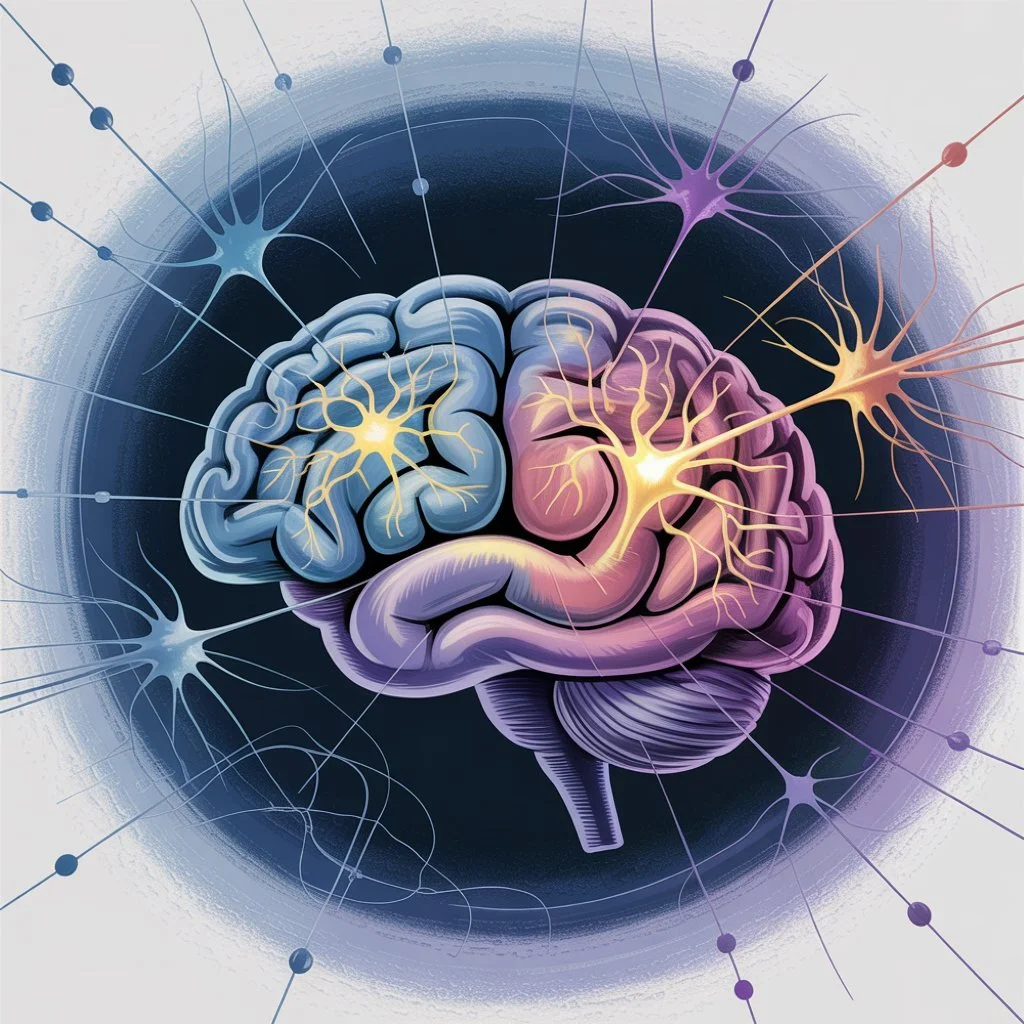
How the Brain Processes Sensory Input
The autistic brain often processes sensory information differently from neurotypical brains. Many autistic people experience:
Heightened sensitivity to sounds, lights, textures, tastes, or smells
Difficulty filtering out background noise or visual clutter
Seeking certain sensory inputs (like pressure, movement, or specific textures)
Under-sensitivity in some sensory areas
Why Sensory Overload Happens
The autistic brain may have difficulty with "sensory gating"—the process of filtering out irrelevant sensory information. While neurotypical brains automatically tune out the hum of fluorescent lights or the tags in clothing, the autistic brain might process all of this information consciously and simultaneously.
Imagine trying to have a conversation while hearing every sound in the room at equal volume, feeling every thread of your clothing, and noticing every flicker of the overhead lights. This isn't hypersensitivity for its own sake—it's the brain taking in more unfiltered information.
Real-World Impact
Sensory differences aren't just preferences; they have significant impacts:
Physical and mental fatigue from constant sensory input
Overwhelm leading to shutdowns or meltdowns
Need for quiet, predictable environments to decompress
Avoidance of certain places or situations
Understanding these as brain-based differences rather than behavioral problems changes how we respond—with accommodation rather than criticism.
Emotional Processing and Regulation
How Autistic Brains Process Emotions
The autistic brain often experiences and processes emotions differently:
Intense emotional experiences: Many autistic people feel emotions deeply and powerfully. What might be mild annoyance to one person could be overwhelming frustration to an autistic individual—not because they're overreacting, but because their brain processes emotional intensity differently.
Delayed emotional processing: Sometimes autistic people need time to identify what they're feeling. The brain might register "something is wrong" before being able to label the specific emotion. This isn't emotional immaturity; it's a different processing timeline.
Fight, Flight, Freeze, or Shutdown Responses
When overwhelmed, the autistic nervous system can trigger strong stress responses:
Meltdowns might look like emotional outbursts but are actually nervous system overwhelm
Shutdowns involve withdrawal, going non-verbal, or seeming disconnected
Freeze responses can appear as indecision or inability to act
These aren't choices or manipulations—they're involuntary neurological responses to system overload.
Social Communication and the Brain
Different Social Processing Styles
The autistic brain processes social information through different neural pathways:
Difficulty automatically reading facial expressions, tone of voice, or body language
Challenges understanding implied meanings or indirect communication
Strong preference for direct, explicit communication
Different eye contact patterns (often feeling uncomfortable or overstimulating)
Research suggests that autistic brains may not automatically activate the same social processing regions that neurotypical brains do, or they may process social information more consciously and deliberately rather than intuitively.
Why This Is Often Misunderstood
Here's what's crucial: autistic communication is different, not deficient. Autistic people often communicate clearly, honestly, and directly. They may prefer written communication where there's time to process, or concrete language over social niceties that feel insincere.
Studies have even shown that autistic people communicate effectively with other autistic people—the "communication problem" often lies in the gap between neurotypes, not within autism itself.
Executive Function and Autistic Thinking
Planning, Organization, and Task Initiation
Executive function involves the brain's management systems—planning, organizing, initiating tasks, and switching between activities. Many autistic people experience challenges in these areas because different brain regions must coordinate, which relates back to those long-range connectivity differences.
This might look like:
Difficulty starting tasks even when motivated
Challenges breaking large projects into steps
Trouble switching between activities
Needing external structure and routines
Strengths in Autistic Cognition
The same neurological differences that create challenges also produce remarkable strengths:
Pattern recognition: Autistic brains often excel at identifying patterns, systems, and connections others might miss
Logical thinking: Many autistic people bring rigorous logic and systematic thinking to problem-solving
Attention to detail: The ability to notice and remember details can be extraordinary
Creativity and innovation: Different thinking patterns lead to novel solutions and perspectives
These aren't consolation prizes—they're genuine cognitive strengths that have contributed to innovations across every field.
Stress, Trauma, and the Autistic Nervous System
The autistic nervous system often operates with less margin for stress. Because the brain is already working harder to process sensory input, navigate social situations, and manage daily demands, there's less capacity to absorb additional stress before reaching overload.
Masking—the practice of suppressing autistic traits to appear more neurotypical—places enormous strain on the nervous system. It's like running a computer with too many programs open simultaneously; eventually, the system crashes. For autistic people, this often manifests as autistic burnout: a state of physical, emotional, and cognitive exhaustion that can last months or years.
Chronic stress and the need to constantly adapt to a world not designed for autistic brains can have lasting impacts on mental and physical health, making understanding and accommodation not just nice to have, but essential.
To understand the profound emotional impact of navigating the world in an autistic body and mind, read My Life on the Spectrum. Her story illuminates the inner experience of stress, self-discovery, and the journey toward self-acceptance that statistics and brain scans cannot capture.
Autism, Learning, and Memory
Autistic brains often have distinctive learning profiles:
Different learning styles: Many autistic people are visual learners or need hands-on experience rather than verbal instruction
Strong memory in areas of interest: The ability to retain detailed information about special interests can be remarkable
Need for structure and predictability: Clear expectations and routines help the autistic brain allocate resources efficiently
Challenges with implicit learning: What neurotypical people pick up through observation might need to be taught explicitly
Understanding these learning differences allows for more effective education and skill development that works with autistic neurology rather than against it.
What Brain Differences Mean for Support and Inclusion
Understanding the neurological basis of autism should inform how we support autistic people:
Accommodations aren't special treatment, they're necessary adjustments that account for different neurological needs:
Sensory-friendly environments with adjustable lighting and quiet spaces
Flexible communication methods (written options, extra processing time)
Clear, direct instructions and expectations
Permission to use coping tools like noise-canceling headphones or fidget items
Strength-based support means building on autistic strengths rather than trying to make autistic people neurotypical. It means asking "How can we make this environment work for your brain?" rather than "How can we fix your behavior?"
Why Understanding the Autistic Brain Matters
When we understand that autism is about brain differences rather than behavioral problems, everything changes:
Reduced stigma: Knowledge replaces fear and misunderstanding
Better relationships: Understanding leads to patience, accommodation, and genuine connection
Improved education and employment: When we design for neurodiversity, everyone benefits
Autistic self-understanding: For autistic people themselves, understanding their neurology can be profoundly validating
This understanding helps autistic individuals feel seen and valued for who they are, not criticized for who they're not.
For a powerful example of how this understanding transforms lives, read Sonia's My Life on the Spectrum. Her journey from confusion to self-acceptance shows why connecting scientific knowledge with lived experience matters so deeply.
Conclusion
Autism affects how the brain develops, connects, processes information, and responds to the world—but it doesn't affect a person's worth, potential, or humanity. The autistic brain isn't a broken version of a neurotypical brain; it's a different configuration entirely, with its own logic, strengths, and needs.
As we learn more about the neuroscience of autism, our responsibility is to translate that knowledge into compassion, accommodation, and genuine inclusion. We must move beyond simply understanding that autistic brains are different to appreciating how those differences shape lived experience.
Every autistic person deserves to be understood on their own terms, supported in their challenges, and celebrated for their strengths. Science gives us the framework for understanding, but stories give us empathy and connection.
Also, you can read Sonia's book, My Life on the Spectrum. Her honest, heartfelt account will help you understand not just how autism affects the brain, but how it feels to live in an autistic mind and that understanding makes all the difference.
