
Online Therapy for Autism: Is It as Effective as In Person?
There is a moment many autistic adults know well. You finally decide you are ready to get support. You research therapists, find someone who seems to understand autism, and then comes the part that quietly stops everything: the in-person appointment.
The commute. The waiting room. The fluorescent lighting. The stranger's office with unfamiliar smells and unpredictable sounds. The small talk before the session even begins. By the time you sit down, you have already spent more energy managing the environment than you have on the actual reason you came.
This is one of the reasons online therapy has been genuinely life changing for many autistic adults. Not because it is a lesser version of in-person support. But because for many people, it removes the barriers that were quietly preventing them from getting support at all.
This post looks honestly at the question parents and autistic adults ask most often: is online therapy actually as effective as in-person therapy? The answer is more nuanced than a simple yes or no, and understanding it will help you make a decision that is right for you specifically.
Table of Contents
Why This Question Matters for Autistic Adults
The Real Advantages of Online Therapy for Autistic Adults
Where Online Therapy Has Limitations
What to Look for in an Online Therapist or Coach
The Difference Between Online Therapy and Online Coaching
Socio-Emotional and Self-Esteem Coaching With Sonia Chand
How to Know if Online Support Is Right for You
Final Thoughts
Why This Question Matters for Autistic Adults
For a long time, accessing mental health support as an autistic adult meant navigating a system that was not built with autistic people in mind. Therapy rooms, rigid appointment structures, eye contact expectations, and communication styles designed for neurotypical clients created an experience that was often more exhausting than helpful.
Many autistic adults stopped going. Not because they did not need support, but because the format was getting in the way of the support itself.
Online therapy changed that equation. And since the pandemic accelerated its adoption across the mental health field, it has become a genuine and widely accepted option rather than a last resort.
But the question of effectiveness is a fair one. When you are investing time, money, and emotional energy into getting support, you deserve an honest answer about whether the format you choose is actually going to help.
The Real Advantages of Online Therapy for Autistic Adults
For autistic adults specifically, online therapy does not just match in-person therapy. In several meaningful ways, it can actually be better.
Sensory comfort
Being in your own environment removes a significant layer of sensory demand. Your own home is a known quantity. The lighting, the sounds, the smells, and the temperature are all within your control. That means you arrive at the session with a more regulated nervous system than you would after navigating an unfamiliar environment.
No transition stress
Transitions are genuinely hard for many autistic people. Getting from one place to another, managing the uncertainty of travel, arriving somewhere new, and then immediately being expected to open up emotionally is a significant ask. Online therapy removes that entirely.
More predictable structure
Online sessions tend to start and end on time. There is no waiting room, no receptionist interaction, and no unpredictable small talk in the corridor. The structure is clean and consistent, which works well for autistic brains that thrive on predictability.
Wider access to the right specialist
This is one of the most significant advantages. Finding a therapist or coach who genuinely understands autism is hard enough. Finding one who is both qualified, autism informed, and geographically close to you is even harder. Online access means you are not limited to whoever happens to be within a twenty mile radius. You can find the right person regardless of where either of you is located.
Communication flexibility
Many online platforms allow for text-based communication before and after sessions, which suits autistic adults who process thoughts more effectively in writing. Some practitioners also offer asynchronous check-ins between sessions, which can be particularly valuable during difficult periods.
Reduced masking pressure
Being in your own space, possibly with your camera off if that is what you need, reduces the pressure to perform neurotypical social behaviour during the session itself. That means more of your energy goes toward the actual work.
Where Online Therapy Has Limitations
Honesty matters here. Online therapy is not the right fit for every person or every situation.
Crisis support: If you are in acute mental health crisis, in-person care or crisis line support is more appropriate than an online session. Online therapy works best as ongoing, preventative, and developmental support rather than emergency intervention.
Severe technology challenges: If unreliable internet, limited access to a private space, or significant difficulty with technology creates more stress than it removes, the format may work against you rather than for you.
Some communication styles: For autistic adults who find video calls particularly overstimulating or who struggle to process spoken information in real time, online video sessions may not be the most effective format. It is worth exploring whether a practitioner offers phone sessions or text-based support as alternatives.
Physical therapies: Occupational therapy that involves sensory integration work, for example, requires in-person delivery. Online is not a substitute for hands-on therapeutic work.
The key is being honest with yourself about what your specific needs are and finding a format that serves those needs rather than adding to your load.
What to Look for in an Online Therapist or Coach
What to Look for in an Online Therapist or Coach
Not everyone who offers online therapy is equipped to work effectively with autistic adults. Here is what to look for before you commit:
Specific experience working with autistic adults, not just general mental health experience
A neurodiversity affirming approach that treats autism as a difference to be understood rather than a disorder to be corrected
Clear communication about how sessions are structured and what to expect
Flexibility in communication format where possible
A genuine willingness to adapt their style to yours rather than expecting you to adapt to them
Transparent information about qualifications, approach, and session logistics
Questions worth asking before your first session:
How much of your practice involves working with autistic adults?
How do you approach sessions with clients who find verbal communication tiring?
What is your theoretical framework and how does it apply to autistic experiences?
How do you handle sensory or communication needs that come up during sessions?
The right practitioner will welcome these questions. They signal that you are an informed client who knows what good support looks like.
For a broader look at what genuine autism support involves and why the approach matters as much as the credentials, the post on autism awareness vs autism acceptance covers this in depth.
The Difference Between Online Therapy and Online Coaching
This distinction matters and it is worth understanding before you decide what kind of support you are looking for.
Therapy is delivered by a licensed clinical professional and focuses on diagnosing and treating mental health conditions. It works with the past as well as the present, addressing trauma, clinical anxiety, depression, and other conditions that require clinical intervention.
Coaching is not clinical but it is not lesser. Coaching focuses on the present and the future. It works on building skills, developing strategies, and helping individuals move forward in specific areas of their life. For autistic adults, coaching can address social navigation, self-confidence, emotional regulation, communication, and the practical challenges of living and working in a neurotypical world.
Many autistic adults benefit from both at different points in their lives. Some need therapy to work through clinical mental health challenges. Others need coaching to build the everyday tools that therapy does not always cover. Some need both simultaneously with different practitioners serving different purposes.
Understanding which one you need right now is the first step to finding the right support.
Socio-Emotional and Self-Esteem Coaching With Sonia Chand
Sonia Chand is a licensed psychotherapist who offers specialised online coaching services built specifically for neurodivergent individuals. Both services are delivered entirely online, which means wherever you are, the right support is accessible.
Socio-Emotional Coaching
Navigating the social world as an autistic adult is genuinely complex. The unwritten rules, the layered communication, the exhaustion of decoding what people mean versus what they say, and the loneliness that can come from feeling perpetually out of step with the people around you are real and significant challenges.
Socio-emotional coaching works directly on this. It is not about teaching autistic adults to perform neurotypical behaviour. It is about building a genuine toolkit for the social world you are actually navigating, understanding your own patterns, developing strategies that work with your brain rather than against it, and building the kinds of connections that feel meaningful and sustainable to you.
Sessions are practical, personalised, and grounded in a deep understanding of what it actually feels like to be an autistic adult trying to build a life that works.
Book a socio-emotional coaching session with Sonia here and start building social confidence that is genuinely yours.
Self-Esteem Coaching
Many autistic adults carry years of accumulated experiences of being misunderstood, corrected, left out, or made to feel that something is fundamentally wrong with them. That history leaves marks. It shows up as chronic self-doubt, difficulty advocating for your own needs, a tendency to minimize your own experience, and a deep seated sense that you are somehow less than the people around you.
Self-esteem coaching works on rebuilding that foundation. It helps autistic adults reconnect with their genuine strengths, challenge the stories they have been telling themselves for years, and develop a stable, grounded sense of identity that does not depend on external validation or neurotypical approval.
This is not motivational coaching. It is deep, practical work that draws on Sonia's background as a licensed psychotherapist and her firsthand understanding of the autistic experience.
Book a self-esteem coaching session with Sonia here and start reclaiming the narrative about who you are.
How to Know if Online Support Is Right for You
Online therapy or coaching is likely a good fit if:
You find in-person appointments draining before they even begin
You have struggled to find a local therapist or coach who genuinely understands autism
You do better in your own environment than in unfamiliar spaces
You value consistency and predictability in the structure of your support
You are ready to do focused, intentional work on a specific area of your life
It may be worth reconsidering if:
You are currently in crisis and need immediate in-person support
You find video calls significantly more draining than in-person conversation
You do not have access to a private, quiet space for sessions
If you are unsure, the best approach is simply to try one session and pay attention to how you feel during and after it. The format should reduce your load, not add to it.
Final Thoughts
Online therapy and coaching are not a compromise. For many autistic adults, they are simply the better option, more accessible, more comfortable, more consistent, and just as effective as anything a traditional therapy room can offer.
The question is not really whether online support works. The evidence says it does. The question is whether you have found the right person to work with online, someone who understands the autistic experience, who communicates in a way that works for you, and who is genuinely invested in helping you build a life that feels like yours.
That person exists. And for many autistic adults who have found their way to the right support, the only regret is not starting sooner.
You deserve support that works for your brain, on your terms, in an environment where you can actually show up fully.
That is what good online coaching looks like. And it is what every session with Sonia is built around.
How to Find an Autism Specialist in Your Area: A Guide
Finding the right autism specialist feels straightforward until you actually try to do it. Then comes the waiting lists, the confusing job titles, the referrals that go nowhere, and the growing sense that the system was not designed with your family in mind.
The truth is, finding the right support for your autistic child takes time, patience, and knowing what to look for before you start. Most parents figure this out by trial and error. This post exists so you do not have to.
Whether your child was recently diagnosed or you are revisiting their support plan because something is not working, this guide walks through exactly how to find the right autism specialist, what each type of professional actually does, and what to do when the usual routes are not enough.
Table of Contents
Start With a Clear Picture of What Your Child Needs
Understanding the Different Types of Autism Specialists
How to Find Autism Specialists in the UK
How to Find Autism Specialists in the US
What to Look for When Choosing a Specialist
Questions to Ask Before You Commit
When Traditional Routes Are Not Enough: Coaching as a Support Option
Socio-Emotional and Self-Esteem Coaching With Sonia Chand
Final Thoughts
Start With a Clear Picture of What Your Child Needs
Before searching for a specialist, it helps to get specific about what you are actually looking for. Autism support is not one size fits all and the right specialist for one child may not be the right fit for another.
Start by asking yourself these questions:
What is my child struggling with most right now?
Is the main challenge communication, sensory processing, behaviour, emotional regulation, or social connection?
Has my child already been diagnosed or are we still in the assessment stage?
What has already been tried and what has not worked?
Am I looking for clinical therapy, practical coaching, school support, or a combination?
Writing down the answers before you start making calls or filling in referral forms will save you a significant amount of time. It will also help you communicate your child's needs clearly to professionals who are seeing them for the first time.
The more specific you can be about what support you need, the faster you will find the right person to provide it.
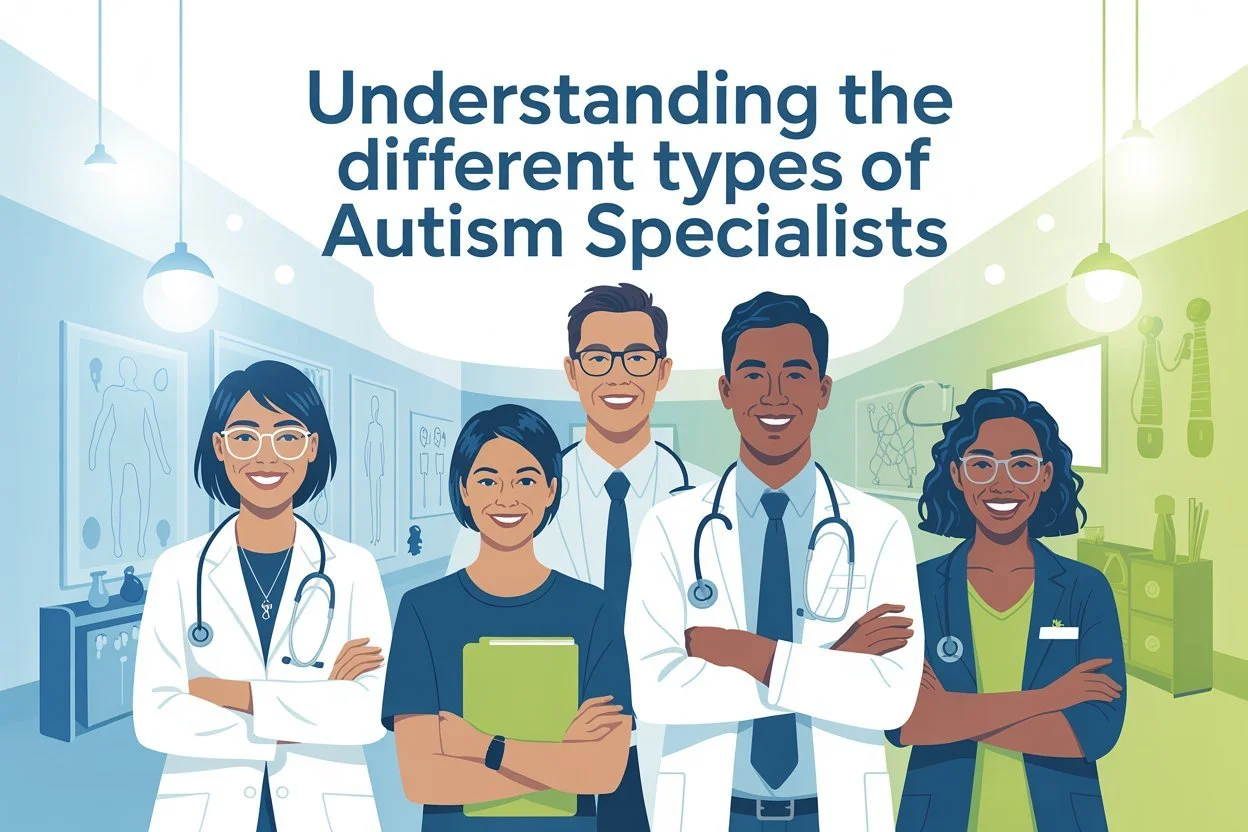
Understanding the Different Types of Autism Specialists
One of the most confusing parts of navigating autism support is the sheer number of professional titles. Here is a plain language breakdown of who does what:
Developmental Paediatrician
A medical doctor who specialises in child development. Often involved in the initial diagnosis and ongoing medical monitoring. Your first point of contact if you are still in the assessment stage.
Child Psychologist or Clinical Psychologist
Assesses and supports emotional, behavioural, and cognitive development. Can provide therapy for anxiety, emotional regulation, and mental health challenges that often accompany autism.
Speech and Language Therapist
Works on communication, both verbal and nonverbal, as well as the social use of language. Particularly important for children who are nonverbal, have limited speech, or struggle with conversation and social communication.
Occupational Therapist
Supports sensory processing, fine motor skills, and daily living tasks. Helps children manage sensory sensitivities and develop the practical skills needed for school and home life.
Behaviour Analyst or ABA Therapist
Specialises in Applied Behaviour Analysis, a structured approach to building skills and reducing challenging behaviours. This type of therapy is widely used but also debated within the autism community, so it is worth researching thoroughly before committing.
Educational Psychologist
Focuses specifically on learning and how to support a child in an educational setting. Often involved in the process of getting an Education, Health and Care Plan in the UK or an IEP in the US.
Autism Coach or Specialist Coach
Works outside the clinical framework to support individuals and families with practical strategies, emotional regulation, social skills, and confidence building. Particularly valuable when clinical waiting lists are long or when a child needs ongoing personalised support beyond what therapy sessions provide.
How to Find Autism Specialists in the US
In the US, the route to finding autism support depends on your child's age, your insurance, and your state. Here is where to start:
Talk to your paediatrician
Ask for a referral to a developmental paediatrician or a child neurologist who can conduct or coordinate a full autism evaluation.
Contact your state's early intervention programme
For children under three, early intervention services are available in every state and are free regardless of income. These services can include speech therapy, occupational therapy, and developmental support.
Request an evaluation through your school district
Under the Individuals with Disabilities Education Act, known as IDEA, every child has the right to a free and appropriate public education. Schools are required to evaluate children suspected of having a disability at no cost to parents.
Use the Autism Speaks Resource Guide
At autismspeaks.org to search for specialists, therapy providers, and support organisations by zip code. It is one of the most comprehensive directories available to US families.
Check your insurance coverage
Most states now require insurance plans to cover autism-related therapies including ABA, speech therapy, and occupational therapy. Contact your insurance provider directly to understand what is covered and how to access it.
What to Look for When Choosing a Specialist
Once you have a list of potential specialists, the next step is knowing how to evaluate them. Qualifications matter, but they are not the only thing that matters.
Look for someone who:
Has specific experience working with autistic children, not just general child development experience
Takes a neurodiversity affirming approach, meaning they support your child's differences rather than trying to eliminate them
Communicates clearly with parents and keeps you involved in the process
Listens to your child and adapts their approach based on what works
Has a clear framework for measuring progress that goes beyond surface level behaviour
Be cautious of anyone who:
Promises rapid results or guaranteed outcomes
Focuses exclusively on making your child appear more neurotypical
Dismisses your concerns or talks over your knowledge of your own child
Uses punishment-based approaches or relies on distress as a motivator
Trust your instincts. You know your child better than any specialist does. The right professional will make you feel like a partner in the process, not a bystander.
For a broader understanding of what genuinely supportive autism care looks like, the post on autism awareness vs autism acceptance explains why the approach a specialist takes matters just as much as their credentials.

Questions to ask
Questions to Ask Before You Commit
Before starting with any new specialist, ask these questions directly:
What is your specific experience with autistic children at my child's age and support level?
What approach do you use and why?
How do you involve parents in the process?
How do you measure progress and how often will we review it?
What does a typical session look like for a child like mine?
What happens if the approach is not working?
Are you familiar with the current thinking around neurodiversity and autistic identity?
The answers will tell you a great deal about whether this is someone who will genuinely support your child or simply go through the clinical motions.
When Traditional Routes Are Not Enough: Coaching as a Support Option
Clinical therapy is essential for many autistic children. But it does not cover everything. Therapy sessions are typically short, infrequent, and focused on specific clinical goals. What many autistic children and their families also need is ongoing, personalised support that addresses the everyday challenges that do not fit neatly into a therapy framework.
This is where coaching comes in.
Coaching sits alongside clinical support rather than replacing it. It is particularly valuable for:
Autistic children and young people who struggle with social interactions and do not know how to navigate friendships, group settings, or school dynamics
Children who have the language and cognitive ability to engage in conversation but lack the emotional tools to manage relationships and regulate their responses
Young people whose confidence has been eroded by years of feeling different, misunderstood, or left out
Families who need practical, personalised guidance to implement strategies at home that actually work for their specific child
The right coach does not work from a generic template. They meet the child where they are, build on their strengths, and give them tools they can use in real situations, not just in a therapy room.
Socio-Emotional and Self-Esteem Coaching With Sonia Chand
Sonia Chand is a licensed psychotherapist offering specialised coaching services designed specifically for neurodivergent individuals and the families who support them.
There are two core coaching services available:
Socio-Emotional Coaching
Many autistic children understand the world in deep and meaningful ways but struggle to navigate the social landscape around them. They find friendships confusing, group dynamics overwhelming, and social rules that seem obvious to others completely invisible to them.
Socio-emotional coaching addresses exactly this. Working directly with the individual, Sonia provides practical, personalized guidance on navigating social interactions, building meaningful connections, and developing the emotional literacy that helps autistic people understand and express what they are feeling. The goal is not to make an autistic person behave like a neurotypical one. The goal is to give them a genuine toolkit for the world they are actually living in.
Self-Esteem Coaching
Years of feeling different, being corrected, struggling in environments not designed for them, and watching peers move through the world with what looks like ease can take a serious toll on an autistic child's sense of self. By the time many autistic young people reach adolescence, their confidence has taken significant hits that no amount of academic achievement or therapy alone can fully address.
Self-esteem coaching works on the inside. It helps autistic individuals reconnect with their strengths, challenge the narratives they have built about themselves, and develop a stable, grounded sense of who they are regardless of how the world around them responds.
Both services are available for neurodivergent individuals and are delivered with the practical, empathetic approach that comes from being both a licensed psychotherapist and someone who has navigated the autism journey personally.
Book a socio-emotional or self-esteem coaching session with Sonia here and give your child the tools to truly thrive.
Final Thoughts
Finding the right autism specialist is rarely quick and rarely straightforward. The system in both the UK and the US was not built for ease of navigation, and the waiting times alone can feel demoralizing when your child needs support now.
But the right support exists. The right people are out there. And knowing what to look for, what questions to ask, and where to search puts you in a far stronger position than most parents have when they start this process.
Go in informed. Go in with a clear picture of your child's specific needs. And do not be afraid to keep looking until you find the professional who genuinely gets your child and works with you as a partner.
Your child deserves that. And so do you.
What Are the Levels of Autism? Guide for Parents
If your child has just been diagnosed with autism, one of the first things you will likely hear is a level. Level 1. Level 2. Level 3. And if you are like most parents in that moment, you will nod along while quietly wondering what any of it actually means for your child and your family.
The levels of autism are not a ranking of worth or potential. They are not a prediction of what your child's life will look like. They are simply a way for clinicians to describe how much support a person needs right now, based on what they are observing at the time of assessment.
That is it. That is all they are.
This post breaks down what each level means in plain, practical language, what the diagnostic process looks like, and what parents actually need to know beyond the label they were handed in that appointment room.
Table of Contents
Why Autism Is Described in Levels
Autism Level 1: What It Means
Autism Level 2: What It Means
Autism Level 3: What It Means
How Levels Are Assessed and Diagnosed
Can Autism Levels Change Over Time
What the Level Does Not Tell You
What to Focus on Instead of the Level
Final Thoughts
Autism in Levels
Why Autism Is Described in Levels
Before 2013, autism diagnoses came with different labels. You may have heard terms like Asperger Syndrome, Pervasive Developmental Disorder, or high functioning autism. These were separate diagnoses that clinicians used to describe different presentations of what we now understand to be the same condition.
In 2013, the Diagnostic and Statistical Manual of Mental Disorders, fifth edition, known as the DSM-5, brought all of those separate diagnoses under one umbrella: Autism Spectrum Disorder. Along with that change came the introduction of three support levels, Level 1, Level 2, and Level 3, to describe how much support an autistic person requires in two key areas: social communication and restricted or repetitive behaviours.
The levels exist to help clinicians, schools, and support services understand what kind of help a person needs. They are a communication tool, not a life sentence.
Autism Level 1: What It Means
Level 1 is described in clinical language as "requiring support." In everyday terms, this means the child can communicate verbally and manage many daily tasks, but struggles noticeably in social situations and may have difficulty with changes to routine or transitions.
A child at Level 1 might:
Speak in full sentences but find back and forth conversation difficult
Struggle to read social cues or understand unwritten social rules
Have one or two very intense areas of interest that dominate their attention
Find changes to routine distressing even when those changes seem minor to others
Appear to manage well in structured environments but become overwhelmed in unstructured ones like lunch breaks or free play
Level 1 is sometimes referred to informally as high functioning autism, though many autistic people and advocates dislike that term. The reason is simple: functioning labels can be misleading. A child who appears to cope well on the outside can be working extremely hard to hold it together, a process known as masking, and that effort has a real cost.
Just because a child at Level 1 seems fine does not mean they are not struggling. It often means they are struggling invisibly.
Autism Level 2: What It Means
Level 2 is described as "requiring substantial support." Children at this level have more noticeable challenges in social communication and more frequent or intense repetitive behaviours that can affect daily functioning.
A child at Level 2 might:
Use simple sentences or communicate in limited ways
Have significant difficulty with changes to routine, sometimes responding with distress or meltdowns
Engage in repetitive behaviours that are difficult to redirect
Need more structured support at school and at home to get through daily tasks
Find it hard to initiate or respond to social interaction even with familiar people
The support needs at Level 2 are more visible and more consistent. These children often benefit greatly from structured routines, visual supports, speech therapy, and occupational therapy, and the earlier those supports are in place the better.
Autism Level 3: What It Means
Level 3 is described as "requiring very substantial support." This is the most complex end of the spectrum in terms of support needs, and children at this level will need significant help across most areas of daily life.
A child at Level 3 might:
Have very limited verbal communication or be nonverbal
Use alternative communication methods such as picture exchange systems or AAC devices
Have repetitive behaviours that are intense and significantly impact daily functioning
Require support with basic self care tasks like dressing, eating, or personal hygiene
Experience significant sensory sensitivities that affect their ability to be in many environments
It is worth saying clearly here: Level 3 does not mean a child cannot learn, connect, communicate, or live a meaningful life. It means they need more support to do those things. Many nonverbal autistic people are deeply intelligent, creative, and communicative once the right tools and environment are in place. The level describes support needs, not human potential.
How Levels Are Assessed and Diagnosed
One of the most important things to understand about autism diagnosis is that there is no single test. There is no blood test, brain scan, or quick checklist that definitively confirms autism. Diagnosis is a process, and it draws on multiple sources of information gathered over time.
According to the Centers for Disease Control and Prevention, diagnostic tools for ASD usually rely on two main sources of information: parents' or caregivers' descriptions of their child's development, and a professional's observation of the child's behaviour. No single tool should be used as the basis for diagnosis.
Read more about clinical testing and diagnosis for Autism Spectrum Disorder on the CDC website.
In practice, a full autism assessment typically involves:
A detailed developmental history taken from parents or caregivers
Direct observation of the child by a trained clinician
Standardised assessment tools such as the ADOS-2 (Autism Diagnostic Observation Schedule)
Input from other professionals such as teachers or therapists who know the child
Sometimes additional assessments for speech, cognition, or sensory processing
The process can take time. Waiting lists are long in many places and the journey from first concern to confirmed diagnosis can stretch over months or even years. That is a frustrating reality for many families, and it is worth knowing so you can advocate effectively for your child during that waiting period.
If you are in the early stages of navigating this process, the post on what to do after your child gets an autism diagnosis walks through the practical next steps in detail.
Can Autism Levels Change Over Time?
Can Autism Levels Change Over Time?
This is one of the questions parents ask most often, and the honest answer is: yes, they can.
A level assigned at age three is based on what a clinician observed in that child at that point in time. As children grow, receive support, develop new skills, and move through different environments, their support needs can change. Some children who are diagnosed at Level 2 or Level 3 develop skills and strategies that mean they need less support as they get older. Others who are diagnosed at Level 1 find that the demands of adolescence and adulthood reveal support needs that were not visible earlier.
This is why the level is a snapshot, not a permanent stamp.
It is also why ongoing review matters. A child's support plan should be revisited regularly, not set once at diagnosis and forgotten. As your child grows, their needs will evolve, and the support around them should evolve too.
What the Level Does Not Tell You
The level tells you roughly how much support your child needs right now. It does not tell you:
How intelligent your child is
Whether your child will live independently as an adult
What your child's strengths are
How much your child will grow and develop with the right support
What kind of relationships your child will have
Whether your child will be happy
These are the questions parents really want answered, and they are the ones no diagnosis can address. The answers to those questions get written over years, through the choices you make, the support you put in place, the environment you create, and the way you see and celebrate your child.
Understanding what the level means and what it does not mean is one of the most important early reframes for any autism parent. For a deeper look at that reframe and the journey from diagnosis to acceptance, autism awareness vs autism acceptance explores exactly why the way we think about autism from the very beginning shapes everything that follows.
What to Focus on Instead of the Level
Rather than getting fixed on the number, here are the questions that will actually serve your child better:
What are my child's specific strengths? Every autistic child has them. Finding and building on strengths is far more powerful than only focusing on deficits.
What environments help my child thrive? Some children do better with lots of structure. Others need more flexibility. Learning what works for your specific child is more useful than any generalisation about their level.
What communication tools work best for my child? Whether that is verbal language, visual supports, sign language, or AAC devices, finding the right communication channel opens everything else up.
What sensory needs does my child have? Sensory processing differences affect almost every autistic child and understanding them helps you design a home and school environment that actually supports your child rather than overwhelming them.
What does my child love? Special interests are not just quirks to be managed. They are windows into how your child's brain works, and they can be powerful tools for connection, learning, and joy.
The book that covers this kind of practical, lived navigation in a way that no clinical guide quite manages is Dropped in a Maze by Sonia Chand. It is the story of finding your way through a system that does not always make it easy, written for the parents who are in the thick of it right now.
Get your copy of Dropped in a Maze here. It is the map many parents wish they had been handed on day one.
Wanting to Go Deeper
The early days after a diagnosis can feel very solitary. Most people around you, even the ones who love you, do not fully understand what you are carrying. The podcast is a space built for exactly that gap. Real conversations about the reality of autism parenting, the hard parts and the hopeful parts, with guests and perspectives that genuinely help.
Listen to the podcast here and find the community that gets it.
When you are ready for something more personal, one-on-one coaching sessions are available for parents who want support building a clear, sustainable plan around their child's needs and their own.
Book a coaching session here and get the focused support your family deserves.
Final Thoughts
The level your child was given at diagnosis is one piece of information. It is useful in the right context. But it is not the most important thing about your child, and it should never be the lens through which you see them.
What matters far more is understanding your specific child, their sensory world, their communication style, their strengths, their triggers, and their joy. That understanding comes from observation, from connection, from reading widely, and from surrounding yourself with people who see your child the way you do.
A diagnosis opens a door. What happens next is up to you, and you have far more power in this than the appointment room probably made you feel.
Does Autism Disqualify You From the Military? What You Need to Know
Does autism disqualify you from the military? It is one of those questions that deserves a straight answer before anything else.
And the straight answer is: in most cases, yes. A diagnosis of autism spectrum disorder is currently listed as a disqualifying condition for military enlistment in the United States and in many other countries around the world.
But the full picture is more layered than a simple yes or no. Because buried inside this question about military eligibility is a much bigger conversation about how society continues to treat autistic people when it comes to opportunity, access, and the right to be assessed on actual capability rather than a diagnostic label.
This post is for all of them. It answers the practical question of whether autism and military service can coexist under current policy. It explains the waiver process honestly. And it goes deeper into what military disqualification reveals about the systemic exclusion of autistic people across society, not just in uniform.
Table of Contents
The Short Answer
What the Current Military Policy Actually Says
Can You Get a Waiver?
The Concealment Problem
What Military Disqualification Reveals About Society
Autistic People Are Being Excluded From More Than the Military
The Systemic Pattern Worth Naming
What Autistic Young Adults and Families Can Do
Final Thoughts
The Short Answer
Does autism disqualify you from military service? Under current Department of Defense policy in the United States, yes.
Autism spectrum disorder is listed as a disqualifying medical condition during the enlistment process. An autistic person who discloses their diagnosis will typically be found medically ineligible for service without a waiver.
That is the baseline. But the baseline is not the whole story.
Waivers exist. Individual assessments happen. And the policy, while still largely restrictive, is not as absolute as it first appears.
What it is, however, is blunt. It applies the same standard to every autistic person regardless of their actual support needs, capabilities, or day-to-day functioning. And that bluntness is worth examining carefully.

What the Current Military Policy Actually Says
The Department of Defense medical standards for military service list autism spectrum disorder as a disqualifying condition.
The reasoning behind this policy centres on several concerns:
The unpredictability of deployment and combat environments
Limited access to support services or medications in the field
Sensory and communication demands specific to military service
Concerns about performance under extreme and sustained stress
These concerns are not entirely without basis. Military service involves genuinely demanding conditions that would challenge many people regardless of neurology.
But here is the problem with how the policy is currently written.
It makes no meaningful distinction between autistic individuals with vastly different profiles, needs, and capabilities. Whether autism disqualifies you from the military under this policy has nothing to do with who you actually are or what you can actually do. It has to do with the presence of a diagnosis on your medical record.
The World Health Organization is clear that the abilities and needs of autistic people vary enormously and can evolve over time. While some autistic people require lifelong support, others live and work completely independently in high-demand environments.
A policy that treats those two people identically is not a nuanced policy. It is a blunt instrument applied to a spectrum it was never designed to understand.
Can You Get a Waiver?
Yes. And this is where the answer to whether autism disqualifies you from military service becomes more complicated.
Waivers exist for many disqualifying medical conditions including autism. A waiver is a formal request for an exception to standard medical policy. It requires thorough documentation, medical evaluation, and approval from military medical authorities.
The likelihood of a waiver being approved depends on several factors:
The nature and severity of the diagnosis and current support needs
Whether the individual is currently on any medication related to autism
Their documented history of functioning in demanding environments
The specific branch of the military being applied to
The role being sought within that branch
Waivers are more commonly granted for technical, intelligence, and support roles than for frontline combat positions. The demand for skilled individuals in areas like cybersecurity, data analysis, and signals intelligence has led some branches to look more carefully at autistic candidates whose skills in those areas are genuinely exceptional.
The waiver process is not quick or simple. It requires persistence, detailed medical documentation, and ideally the support of professionals who can speak specifically to the individual's capabilities rather than the diagnosis in general terms.
It is also worth knowing that waiver approval rates vary significantly between branches and change over time depending on recruitment needs and policy shifts. Researching the current position of the specific branch being considered is essential before beginning the process.
Book a coaching session here and get personalised support for navigating the decisions and systems that matter most to your family.
The Concealment Problem
This section matters and it is worth reading carefully.
According toAutism Speaks, enlisting and knowingly concealing an autism diagnosis is considered fraudulent enlistment, which is a violation of federal law.
The consequences of fraudulent enlistment are serious. They can include discharge, criminal charges, and a permanent mark on a person's record that follows them long after their military ambitions have ended.
This puts some autistic people in a genuinely difficult position. Particularly those who were diagnosed later in life, those who have masked their autism so effectively that they may not consider it relevant, or those who are simply desperate for a path into service and willing to take risks they should not have to take.
The existence of this problem is itself a policy failure.
When the formal route to service is effectively closed and the only apparent alternative carries federal criminal risk, the policy has created a situation that punishes autistic people for wanting to serve. That is not a fair or reasonable outcome.
Full disclosure is always the right path. Not just legally but practically. Serving while concealing a diagnosis means serving without any of the accommodations or understanding that might make the experience sustainable. It means building a career on a foundation that could collapse at any moment.
Whatever the outcome of the enlistment process, honesty is the only viable starting point.

What Military Disqualification Reveals About Society
Here is where the conversation needs to go deeper than policy.
Whether autism disqualifies you from military service is a practical question. But what autism disqualification from military service reveals about how society views autistic people is a more important one.
It reveals a default assumption that autism means incompatibility. That a diagnosis, regardless of individual profile, is sufficient reason to exclude someone from a demanding environment without further assessment.
That assumption does not live only in military recruitment offices. It lives in boardrooms that do not hire autistic candidates. In schools that exclude rather than accommodate. In systems across society that treat autism as a ceiling rather than a characteristic.
The military policy is one expression of a much wider cultural default. And that default is what the shift from autism awareness to autism acceptance is directly challenging.
Understanding why that shift matters and what it looks like in practice is exactly what the post on autism awareness vs autism acceptance covers. It is worth reading alongside this one because the two conversations are deeply connected.
Dropped in a Maze by Sonia Chand is the honest account of navigating systems that were never built with autistic people in mind. The military is one of those systems. Employment is another. Education is another.
Order your copy here and read the story of finding a way through all of them.
Autistic People Are Being Excluded From More Than the Military
Autism and military disqualification is one chapter in a much longer story.
The exclusion of autistic people from full participation in society shows up across almost every major system.
In employment, the figures are stark. The post on why 40% of autistic adults are unemployed and how to change that breaks down exactly how and why that exclusion happens and what needs to change. The pattern is the same as in military recruitment. Systems designed without autistic people in mind producing outcomes that exclude them by default.
In education, autistic students are more likely to be excluded, suspended, or placed in restrictive settings than their neurotypical peers.
In healthcare, autistic people report being dismissed, misunderstood, and underserved at significantly higher rates than the general population.
In housing, in civic participation, in leadership, the pattern repeats.
Military disqualification is not an isolated policy failure. It is part of a cultural default that treats autism as disqualifying for full participation in society across the board.
The Systemic Pattern Worth Naming
There is a particular kind of exclusion that is especially difficult to challenge.
It is the kind that comes dressed as practicality.
The military does not say autistic people are less valuable. It says the environment makes service impractical. Employers do not say autistic people are less capable. They say the role requires certain social skills. Schools do not say autistic students do not belong. They say the curriculum requires certain kinds of engagement.
Practical. Reasonable. Nothing personal.
But the cumulative effect of all those practical, reasonable, nothing personal exclusions is a life lived on the outside of the opportunities that shape financial security, social belonging, and personal identity.
That is personal. Very personal.
And it is exactly why the conversation about autism cannot stay at the level of awareness. Awareness sees the exclusion and nods sympathetically. Acceptance asks what needs to change so the exclusion stops happening.
The question of whether autism disqualifies you from the military will eventually be answered differently as policy catches up with understanding. But the cultural shift that makes that happen starts long before any policy is rewritten.
It starts in families who decide to frame autism differently from the beginning. In advocates who refuse to accept that a diagnosis is the ceiling of what a person can achieve. In organisations that choose individual assessment over blanket exclusion.
What Autistic Young Adults and Families Can Do
If you or someone you love is autistic and considering military service, here is practical guidance for navigating the current landscape:
Get clear on your specific profile: Not all autism diagnoses carry the same weight in a medical evaluation. Being able to articulate your capabilities, your current support needs, and your history of functioning in demanding environments clearly and specifically is essential before beginning any enlistment process.
Research the waiver process for your specific branch: Each branch of the military has different waiver procedures and different track records on approvals. The Army, Navy, Air Force, Marines, and Coast Guard each approach this differently. Research the specific branch and role before making any decisions.
Work with a recruiter experienced in medical waivers: Not all recruiters are equally knowledgeable about the waiver process. Finding one who has successfully navigated medical waivers before makes a significant practical difference.
Never conceal a diagnosis: The legal risk is serious and the consequences of fraudulent enlistment can follow a person for the rest of their life. Whatever the outcome of the process, full disclosure is the only responsible and sustainable path.
Explore alternative service paths: Many of the values that draw autistic people to military service, structure, purpose, clear hierarchy, contribution to something larger than yourself, are available through other routes. Civil service, emergency services, healthcare, engineering, and community organisations offer many of the same things without the same barriers.
Connect with advocacy organisations: Groups working on neurodiversity inclusion are increasingly engaging with military policy specifically. Adding your voice to those efforts is both meaningful and practical for long-term change.
Book support for the journey: Navigating this decision, whether it leads into military service or toward an alternative path, is not something that needs to be done alone. Having someone who understands autism and the systems autistic people navigate in their corner makes a real difference.
Final Thoughts
Does autism disqualify you from the military? Under current policy, in most cases, yes.
But the more important question is what that disqualification reveals.
It reveals a system that still defaults to exclusion over individual assessment. That still treats a diagnostic label as sufficient reason to close a door without looking at who is standing behind it.
Autistic people deserve to be assessed on their actual capabilities. Not on a label. Not on assumptions. On who they actually are and what they can actually do.
Kirsten O'Connor on Grief, Truth, and Talking About the Unthinkable
Content note: This post discusses suicide, self-harm, sexual assault, and grief in depth. Please take care of yourself as you read. If you are in crisis, call or text 988 (US), or go to your nearest emergency room.
Some conversations are not easy to have. They are not meant to be. They are meant to crack something open — to say the things most people are too afraid to say out loud — so that the people who need to hear them the most know they are not alone.
Episode 61 of On the Spectrum with Sonia is one of those conversations. Host Sonia Krishna Chand sits down with Kirsten O'Connor, an author from New Zealand whose daughter Kalia died by suicide at 24 years old. Kirsten has since written The Year After Kalia, a memoir written from inside the wreckage of grief, and is currently working on a second book called Silence, which addresses suicidality directly.
This is a conversation about love, loss, the dangerous myths we hold about suicide, and what it actually looks like to hold space for someone in pain — without flinching, without turning away.
Table of Contents
Who Was Kalia?
The Face of Mental Health Nobody Shows You
Early Signs, and What Kirsten Didn't Know Yet
Escaping Abuse, Finding Each Other
The Assault That Changed Everything
What the Last Year Looked Like
Suicide Is Not a Choice — Not in the Way People Mean
Writing From the Wreckage
What to Say, What Not to Say, and Why Silence Is the Worst Option
What Kirsten Wants You to Know
Who Was Kalia?
Before anything else, Kirsten wants you to know who her daughter was. Not just the circumstances of her death, but the living, laughing, full-of-life person she was for 24 years.
Kalia was musical. Her grandfather taught her to play guitar, and she had an incredible voice. She wrote her own songs. She and her mum would watch Mamma Mia together and she would belt out The Winner Takes It All at the top of her lungs — it was her signature song. She was cremated with her guitar.
She was funny, fiercely loyal, and deeply empathetic. She had a psychology degree and worked in human resources right up until her death. She made elaborate chocolate cakes so rich you could only manage a small sliver. She had a close group of five girlfriends who had moved through life together since they were young and still do today.
"She was the better version of me," Kirsten says. "She was highly empathetic, she was loyal, she would always be with you in a crisis and stand by you. She was a very talented young girl."
She also called Kirsten her soul mate.
This matters. Because what this episode is really about — before it is about anything else — is a person. A whole, beloved, irreplaceable person.
The Face of Mental Health Nobody Shows You
One of the most important things Kirsten says early in this conversation is this: Kalia presented beautifully. She smiled. She laughed. She showed up for people. She was someone you would look at from the outside and never imagine was struggling.
"People that suffer from mental health can have a wonderful life and be amazing to be around," Kirsten says. "It's not always what it's depicted as. She always presented well. She always smiled and joked and laughed. But she was also depressed and also had anxiety and also had underlying mental health conditions."
This gap — between how someone appears and what they are carrying — is one of the reasons people miss the signs. It is also one of the reasons people don't reach out for help. If you always seem fine to everyone around you, asking for help can feel incongruent, even dishonest. And for Kalia, looking okay meant people often assumed she was.
If you love someone who always seems fine and you have a quiet worry in the back of your mind about them — this episode is for you.

Early Signs
Early Signs, and What Kirsten Didn't Know Yet
Kalia's first experience of mental health struggles began around age 12, though she didn't have the language for it then, and neither did Kirsten. By 15 or 16, Kirsten noticed self-harm marks on her daughter's body.
Her response at the time, she reflects with complete honesty, was shaped by ignorance rather than cruelty. She thought it was attention-seeking. She told Kalia to stop. She didn't yet understand that self-harm is often a coping mechanism for emotional pain that has nowhere else to go — and that simply telling someone to stop does nothing to address the pain underneath it.
Kirsten does not tell this story to shame herself. She tells it because it was the truth of what she knew then, and because so many parents, friends, and partners find themselves in the same position, seeing the signs without having the framework to understand what they are seeing.
By 16 to 18, things were harder. Kalia was withdrawing, had run away from home, and was struggling with anxiety. Part of this was rooted in the household environment at the time — Kirsten was in a controlling, emotionally abusive relationship, and the dynamic was affecting the whole family. Kalia's birth father was also largely absent, which contributed to a deep sense of abandonment.
Her school counsellor, however, was a turning point. He taught her chess — forward thinking, strategy, planning ahead — and she threw herself into songwriting and performance. At 18, she found her footing again. She went to university, got some distance from the household tension, and by her own account had moved into a much better place.
She felt proud of herself for getting through it. And she had. For a time.
Escaping Abuse, Finding Each Other
When Kalia was around 19, Kirsten finally left the relationship. It had been emotionally abusive, financially controlling, and deeply isolating. Kirsten didn't even know, she says, that what she had been living through counted as abuse — not until a counsellor named it plainly for her.
"She said to me, You know that you're in an abusive relationship, don't you? And I said, No, I didn't. I had no idea."
This is something both Kirsten and Sonia speak to with real understanding in the episode: emotional abuse doesn't announce itself. It happens gradually, layer by layer, until the person inside it genuinely cannot see what the person outside it can. And for Kalia, who had lived through this dynamic from age seven, the damage had been accumulating for years.
What followed Kirsten leaving was, by both their accounts, a genuinely good period. The two of them rebuilt. They talked. They uncovered what had really been happening. They made a pact: total honesty, complete openness, nothing left unsaid. No more silence enforced by someone else's need for control.
"We decided to become completely open with each other," Kirsten says, "and nothing would rupture us again."
That pact would matter enormously in the years that followed. It is also, in many ways, why this book exists at all.

The Assault That Changed Everything
Kalia was 22, had moved into a shared flat with friends her own age, had a boyfriend she loved, and was — by every outward measure — embracing her life. Then, at a joint birthday party, she was sexually assaulted.
It took a year to find a therapist through the New Zealand public system, even though sexual assault cases can be publicly funded. A year of carrying it, largely alone.
When she called her mum, she described it as being "taken advantage of." Kirsten gently but firmly corrected the language. You weren't taken advantage of. You were raped. She wanted the weight of what had happened named properly — not to be harsher, but to take the blame away. Kalia had been wondering: was I too friendly? Was I too nice? Kirsten's answer was immediate: you were not too anything.
Kalia never reported the assault. Kirsten, who had a legal background, made a clear-eyed and painful decision to advise against it. She knew what the court process would put her daughter through. She knew the statistics. She knew what "his word against hers" looked like in practice.
"Your responsibility," she told Kalia, "is your health and how you're feeling. It is not your responsibility to put yourself through something harmful to prevent it happening to someone else."
Some people pushed back on that choice. Kalia was told to her face that if she didn't report it, he would go on to do it again. Kirsten is direct on this point: placing the responsibility of a predator's future actions onto a traumatised young woman is wrong. Full stop.
It was a year after the assault that Kalia first told her mother she was having suicidal thoughts.
What the Last Year Looked Like
From Kalia's first attempt to her death was just over a year. In that time, she tried everything she could. Kirsten is emphatic about this — her daughter wanted to live. She wanted to get better.
She had a wonderful doctor who saw her regularly and genuinely cared for her. She was prescribed antidepressants and anti-anxiety medication, though the medication caused weight gain and stopped her from running — two things that had been important to her mental health and her sense of herself. She worked with an art therapist who used creative projects to help Kalia externalise the thoughts crowding her mind. She was a great overthinker, and expressing herself through art genuinely helped.
There were setbacks along the way. A job loss. A breakup. The growing sense — as Kirsten describes it with real pain — that her illness was pushing people away. Friends got busy. People didn't know how to respond to someone who had made multiple attempts. Some withdrew to protect themselves, which is human, but which Kalia — in the distorted thinking that severe depression creates — read as confirmation that she was a burden, that she was too much, that the people around her would be better off without her.
"After multiple attempts, people didn't know how to deal with her," Kirsten says. "Depression is very hard to sit around. So people were moving away from her life. She was feeling more and more isolated."
She did not die because she was not loved. She died because the pain became too much.
Suicide Is Not a Choice, Not in the Way People Mean
This is the part of the episode Kirsten most wants people to hear. It is why she is writing her second book, Silence. And it is the most important thing she has to say.
There is a narrative, still present and still damaging, that suicide is a choice. That people who die by suicide chose not to fight, chose not to stay, chose their family and friends less than they chose death. Kirsten has also sat with the grief of parents who have asked, agonisingly, why their child didn't choose them.
She dismantles this myth with the quiet authority of someone who has lived with it every day.
"Kalia didn't want to die," she says. "She just wanted to not have pain and to not feel trapped and not feel like she was a burden. That's not a choice. It's from a damaged brain. When you're in pain, you get out of it. That's what the brain is doing. It's not you and I sitting here today thinking, shall I do this? It's nothing like that. It's at a time where the pain becomes so much that survival becomes about death — because the survival is getting rid of the pain."
And to anyone carrying the weight of believing they were not enough to keep someone here: "If love could have saved her, I would have saved her. There is nothing I wouldn't have done. She always knew she was loved."
Love was not insufficient. The illness was that powerful. Those are not the same thing.
The Year After Kalia is available on Amazon, Barnes & Noble, Apple Books, Kindle, and as an audiobook. Find it and Kirsten's grief resources at thisisgrief.nz
What to Say, What Not to Say
One of the most practically useful parts of this conversation is when Kirsten and Sonia talk about how to actually show up for someone who is struggling — and what stops most people from doing it.
Fear. Almost always, it is fear. Fear of saying the wrong thing, of making it worse, of not knowing the right words. So people say nothing. They change the subject. They offer a platitude and close the conversation. They go quiet.
Kirsten's message is plain: silence is the worst option. It leaves people feeling unseen. It signals, however unintentionally, that their pain is too big to sit with.
On the question of whether to ask someone directly if they are thinking about suicide — yes. Ask. You can say it plainly: are you thinking about ending your life? Asking does not plant the idea. It does not push someone closer to the edge. What it does — often — is give someone permission to be honest for the very first time.
"By being direct with someone, and someone feels seen and then hopefully heard, that can actually help them," Kirsten says. "Ignoring it does nothing."
And if you say the wrong thing in the moment — which you might, because you are human and scared — you can correct yourself. You can say, I'm sorry, that came out wrong, can you tell me more? The conversation does not have to be perfect to be valuable. It just has to happen.
She also takes on some of the most harmful myths directly: that suicidal people are doing it for attention, that they are being selfish. "They get to the point where they actually feel they are a burden and that people would be better off," she says. "That is not selfishness. That is a damaged brain."
This is also work that Sonia brings into her emotion coaching practice — helping neurodivergent adults, and the people around them, develop the emotional vocabulary and relational safety to have the hard conversations before they become urgent ones. If that kind of support is something you are looking for, you can explore emotion coaching with Sonia here
What Kirsten Wants You to Know
There is no right way to grieve. There is no timeline. There are no stages to move through in order. You do not have to find purpose in loss, write a book, build something meaningful, or arrive anywhere in particular. You are allowed to simply survive it, in whatever form that takes for you.
"You can't do grieving wrong," Kirsten says. "There's no rule book. You do it the way you need to do it. And that is okay."
She also says something that might surprise people: she does not want her grief to go away. Her grief is her love for Kalia, still present and still moving. "I will grieve her until the day that I die. And that's okay."
What she has built since — the website, the books, the conversations — she describes as continuing the story Kalia started. Keeping her present. Honouring her. But she is careful not to frame this as the right way, or the only way, or the better way. It is her way.
What she does ask of all of us is simpler than that: don't look away. Don't go quiet. Don't let the fear of saying the wrong thing stop you from saying anything. Ask the person you are worried about how they really are. Use the word if you need to. Sit in the discomfort with them.
"The only thing you can do with someone that is suicidal," she says, "is to be there. Just sit in their space and listen to the uncomfortable."
That is enough. That matters. That can be the thing that makes the difference.
Listen to the full conversation with Kirsten O'Connor on Episode 61 of On the Spectrum with Sonia
To find Kirsten's books and grief resources, visit https://thisisgrief.nz/book-2. The Year After Kalia is available on Amazon, Barnes & Noble, Kindle, Apple Books, and as an audiobook.
If you or someone you know is in crisis: call or text 988 (US Suicide & Crisis Lifeline), or go to your nearest emergency room.

From Caregiver to Creator: Debbie Weiss on Finding Yourself After 50
What happens when you spend 40 years putting everyone else first, and then wake up one day and realise you have no idea who you are anymore?
That's the question at the heart of Episode 60 of On the Spectrum with Sonia, where host Sonia Krishna Chand sits down with author, speaker, and podcast host Debbie Weiss.
It's a conversation about caregiving, grief, identity, and — ultimately — reinvention. And if you've ever felt like your life has been shaped more by circumstances than by choice, Debbie's story might be exactly what you need to hear.
Table of Contents
A Life Defined by Caregiving
The Anger Nobody Talked About
The Wake-Up Call at 50
Small Steps, Big Shifts
What Self-Care Actually Means
Writing Through Grief
The Sprinkle Effect
The Creativity That Was Always There
What You Can Take Away
A Life Defined by Caregiving
Debbie Weiss's caregiving journey began at 17 years old, when her father suffered a stroke and was left permanently disabled. He survived, but for the next 30 years, Debbie was his primary caregiver. While her peers were living carefree lives in their twenties, she was learning what Medicaid was, navigating disability systems, and shouldering a level of responsibility most people don't encounter until midlife.
Then came her oldest son, diagnosed on the autism spectrum at age two. As Sonia — herself an autistic adult and neurodivergent mental health expert — understands deeply, caregiving for a neurologically different child is its own particular kind of advocacy. It demands not just love, but constant vigilance, research, and fighting for your child in systems that were never designed with them in mind.
Then came her husband: depression, anxiety, physical illness, and eventually a terminal blood disease that took his life just six months after diagnosis.
Layer upon layer, for more than four decades, Debbie's life was structured around the needs of others.
The Anger Nobody Talked About
Here's the part caregivers rarely say out loud: it can make you angry. Not at the people you love — Debbie was clear that she never blamed her father, her son, or her husband. But at the situation. At the unfairness of it. At the life you watch others living while you are perpetually in crisis mode.
"I kept looking at other people, comparing myself," Debbie shares in the episode, "and thinking, why me? It just seemed like I kept facing one big challenge after another that other people around me were not facing."
Year after year, that resentment built. She was exhausted and overwhelmed, waking up every morning and running through a list of who needed what before she'd even had a cup of coffee. She worked. She parented. She caregiving. She had no list for herself, because she was not on the list at all.
This is the part where many people reading this will recognise themselves. And this is exactly why this conversation is so worth listening to.
If you are a caregiver, or have ever been one, Episode 60 of On the Spectrum with Sonia is essential listening.
The Wake-Up Call at 50
The turning point came on a birthday weekend trip Debbie's friends insisted she take. At dinner one evening, someone asked a simple question around the table: "What are your hopes and dreams for the future?"
Debbie was stumped. She had hopes and dreams for her children. But for herself? At 50? She genuinely could not answer. She felt, as she puts it, that her story was already written.
"They all kind of looked at me," she recalls, "because the other three all had hopes and dreams. And that was the moment — the catalyst — that something's gotta give."
When she got home, she started paying attention. She began to recognise something she had never had a name for before: a victim mindset. Not a dramatic, visible victimhood, but the quiet everyday kind — the deep-seated belief that her life had been led by circumstances, not by her. That she had no real choices. That the hand she'd been dealt had written her story for her.
"When you blame circumstances or people for the outcome of your life, you are giving them your power," she says. "I didn't understand that — but that's what I was doing."
This realisation, she is careful to say, was not about self-blame. It was about reclaiming agency. There is a significant difference between the two.
Small Steps, Big Shifts
One of the most practically useful parts of this episode is how Debbie describes actually changing. Not through one dramatic moment of resolve, but through something much more accessible: embarrassingly small goals.
She wanted to lose weight — 100 pounds overweight at 50, having yo-yo dieted her entire life. This time, she gave herself one goal only: show up to the Weight Watchers meeting once a week. Not lose a certain amount. Not exercise a certain number of days. Just show up.
"I didn't lose weight at first," she says. "But it didn't matter, because in my mind I was achieving my goal."
Over three and a half years, she lost 90 pounds. Not through a stricter plan or a harder target, but through the complete opposite — a gentler one. And when she saw what had shifted, she asked herself a question that changed everything: if my mindset could change what has been the biggest struggle of my life, what else could it change?
The answer, as she eventually discovered, was everything.
Listen to the full conversation with Debbie Weiss - On the Spectrum with Sonia
What Self-Care Actually Means
There is a section of this episode that deserves its own essay, and it's the conversation about self-care. Not the wellness-industry version — the massages, the bubble baths — but the real version, which is often far more ordinary and far more radical.
For Debbie, the most meaningful form of self-care was learning to say no. She was, at her busiest, the treasurer of three different organisations simultaneously. She couldn't refuse because someone needed her, because it wouldn't take that long, because what kind of person says no?
The kind of person who survives, it turns out.
She started protecting three mornings a week for exercise. Her family pushed back. She held the line. "In the beginning there were growing pains," she says. "They got used to it. Everybody got used to it."
Self-care, as both Debbie and Sonia explore in this conversation, looks different for everyone. It might be journaling, meditating, praying, reading, or knitting. The specifics are less important than the underlying principle: that your needs are legitimate, that they belong on the list, and that meeting them makes you more present for everyone else — not less.
"When I did care for myself," Debbie reflects, "I showed up as such a better person for all of my loved ones."
This is the conversation Sonia has with clients in her emotion coaching work too — helping neurodivergent adults understand their emotional needs, recognise what depletes and restores them, and build a life that is sustainable rather than simply survivable.
If that work resonates with you, you can explore emotion coaching with Sonia here
Writing Through Grief
Debbie never intended to be a writer. She was a CPA. Then an insurance agent. She was, by her own cheerful admission, the student who checked the course syllabus specifically to make sure there were no papers before enrolling.
But people kept telling her: you need to get your story out. And somewhere in her fifties, she found a program for first-time authors — and enrolled, improbably, at the exact same moment her husband was diagnosed with terminal cancer.
Her therapist, when Debbie expressed doubt about whether she could manage it, offered advice that sounds deceptively simple: "Who cares if you miss a week? Who cares if you don't do the homework?"
It was permission for imperfection. It was also permission to begin.
Debbie wrote in hospital waiting rooms. She woke at five in the morning to write before her husband stirred. She wrote through one of the hardest seasons of her life — and that, her therapist had been right, was the point. The writing gave her something to look forward to. Something that was only hers.
"It saved me," she says.
She finished her memoir, On Second Thought, Maybe I Can, in the months after her husband died. It is a book about all of it — the childhood in which she developed her earliest limiting beliefs, the decades of caregiving and loss, and the painstaking, nonlinear process of becoming someone new.
You can get On Second Thought, Maybe I Can on Amazon or at debbierweiss.com
The Sprinkle Effect
After the memoir came out, readers loved it but kept asking the same question: "Okay, but what exactly did you do?" That question became her second book, The Sprinkle Effect.
The idea is exactly what it sounds like. Small, consistent sprinkles of intentional practice — perspective-taking, mindset shifts, curiosity, resilience, joy — worked into daily life over time. Not an overhaul. Not a complete reinvention from Monday. Sprinkles.
Each chapter tells a personal story, explores one of these practices, and ends with exercises and a journal prompt — because Debbie knows, from personal experience, that reading something and actually doing something with it are very different things. "You can read a million books," she says, "but unless you take the time to really apply it to your own life, it's going to sit on a shelf."
The formula she found most transformative comes from Jack Canfield's The Success Principles: E + R = O. Event plus Response equals Outcome. For most of her life, Debbie had been living as though E = O — as though the event alone determined everything, with no room for her own response to matter. Understanding that she had a role to play in the outcome was the equation that shifted her life.
The Sprinkle Effect is available on Amazon or at debbierweiss.com
The Creativity That Was Always There
One of the most joyful exchanges in this episode comes near the end, when Debbie talks about who she has become. A card deck. A gratitude journal. A free-form writing journal. A children's book series in development. All from a woman who, not long ago, insisted with total conviction that she did not have a creative bone in her body.
"And then all of a sudden," she says, laughing, "my brain just exploded. And all these ideas just keep coming."
Sonia names it precisely: "I think creativity is in us. But too often we think in order to be creative, you had to be really good at something — art, singing, the triple threat. But there's so much more to creativity than what people realise."
Debbie's story is proof of that. Creativity isn't a talent you either have or you don't. It's something that emerges when you finally give yourself the conditions to discover it — often later than expected, and usually when you least feel ready.
What You Can Take Away
Debbie Weiss is 62 years old. She has buried a father and a husband. She has raised children, one of whom navigates the world very differently from most. She has spent most of her adult life in service to other people. And she has also, somehow, written two books, launched a podcast, built a product line, and found — late, unexpectedly, completely — a part of herself she never knew existed.
If her story teaches anything, it's this: you are not too old, too overwhelmed, or too far behind. The second half of your life can look radically different from the first. But only if you decide it can.
"I'm 62 now," she says simply. "And it's a journey I'll continue on until I take my last breath."
Listen to the full conversation with Debbie Weiss on Episode 60 of On the Spectrum with Sonia
To find Debbie's books, podcast, and resources, visit debbierwiss.com and make sure to include the R, otherwise you'll end up on a realtor's website in California.
On the Spectrum with Sonia is a podcast hosted by Sonia Krishna Chand, adult autism and neurodivergent mental health expert.
Famous Autistic People Who Changed the World
There is a story that gets told about autism that is too small.
It is the story of limitation. Of struggle. Of a life that requires constant management and intervention just to function. And while the challenges of autism are real and deserve to be acknowledged honestly, that story is dangerously incomplete.
Because alongside every challenge in the autism story, there is also this: some of the most transformative minds in human history were almost certainly autistic. Scientists who rewired how we understand the universe. Artists who created work that outlasted their lifetimes by centuries. Activists who changed the course of civil rights. Innovators who built the technology that now shapes daily life for billions of people.
Autism does not limit potential. In many cases, the very traits associated with autism, the intense focus, the pattern recognition, the willingness to think differently from everyone else in the room, are exactly what made these individuals extraordinary.
This post celebrates those people. Across history and across fields. Because when a family receives an autism diagnosis, they deserve to know the full story.
Table of Contents
A Note on Retrospective Diagnosis
Science and Innovation
Art and Music
Technology and Business
Activism and Social Change
Literature and Writing
Sport
What These Lives Tell Us
Final Thoughts
A Note on Retrospective Diagnosis
Before diving in, one important clarification.
Many of the historical figures in this post were never formally diagnosed with autism in their lifetime. Autism as a diagnosis did not exist until the 1940s, and our understanding of the spectrum has continued to evolve significantly since then.
What historians, biographers, and researchers have done is look at documented behaviours, traits, and patterns in the lives of historical figures and note significant alignment with what we now understand autism to look like.
This is called retrospective or posthumous diagnosis. It is not an exact science. It is informed analysis rather than clinical fact.
For living public figures, the picture is different. Some have been formally diagnosed. Others have self-identified as autistic. A small number have been publicly identified by others, which is more complicated and worth approaching with care.
The goal of this post is not to label anyone. It is to show the breadth and depth of what autistic minds have contributed to the world.
Science and Innovation
Albert Einstein
Einstein is one of the most frequently cited examples of a likely autistic historical figure. He was a late talker, reportedly not speaking in full sentences until age five. He had intense, narrow areas of focus. He struggled significantly with social interaction and formal schooling. He thought in images rather than words, a cognitive style that aligns closely with how many autistic people describe their thinking.
His willingness to think completely differently from the scientific consensus of his time, to pursue ideas that seemed absurd to his contemporaries until the mathematics proved them right, reflects the kind of divergent thinking that many autistic people describe as central to how their minds work.
Isaac Newton
Newton showed many traits now associated with autism throughout his life. He was deeply solitary. He became so absorbed in his work that he frequently forgot to eat or sleep. He had significant difficulty in social relationships and communication. He often became so focused on a single problem that he would work on it for years without distraction.
His ability to sustain that level of focused attention over long periods produced some of the most significant scientific breakthroughs in human history.
Charles Darwin
Darwin spent decades in meticulous, obsessive observation of the natural world before publishing his theory of evolution. He struggled with social situations and preferred the company of his work to almost anything else. His capacity for sustained, detailed observation over a lifetime, noticing patterns that others overlooked entirely, is a hallmark of the kind of autistic thinking that changes how the world understands itself.
According to the World Health Organization, in 2021 about 1 in 127 persons had autism. The fact that autistic minds have shaped the scientific foundations of the modern world is not coincidental. It reflects what focused, divergent thinking can produce when given the right conditions.
Art and Music
Wolfgang Amadeus Mozart
Mozart showed traits consistent with autism from childhood. He had extreme sensitivity to sound, reportedly covering his ears at loud noises that others found unremarkable. He displayed repetitive behaviours and movements. He had difficulty with social norms and often behaved in ways his contemporaries found inappropriate or odd. And he had an extraordinary, obsessive relationship with music that consumed his entire existence from early childhood.
His ability to hear and hold entire symphonies in his mind, to compose with a depth and complexity that has never been equalled, reflects a relationship with sound and pattern that goes far beyond what most human brains are capable of.
Michelangelo
Michelangelo was known throughout his life for his profound difficulty with social relationships. He lived in almost complete isolation by choice. He became so intensely focused on his work that he would go days without sleeping or eating. He had rigid routines and found any disruption to them deeply distressing.
His work on the Sistine Chapel ceiling, a project of almost incomprehensible complexity and detail executed over four years, reflects exactly the kind of sustained, obsessive focus that autistic people often describe as their greatest strength.
Beethoven
Beethoven's social difficulties, his rages, his rigid routines, his extraordinary sensory relationship with music that persisted even after he lost his hearing, all align closely with autistic traits. His ability to hear music internally with a precision and complexity that did not depend on external sound is one of the most remarkable documented examples of the kind of internal processing that many autistic people experience.
Technology and Business
Alan Turing
Turing is one of the most important figures in the history of computing and one of the most widely discussed likely autistic historical figures.
He was highly literal in his communication. He struggled significantly with social conventions. He had intense, focused expertise in mathematical logic that went far beyond what his peers could access. And he thought about problems in ways that were so fundamentally different from conventional approaches that his work was not fully understood by most of his contemporaries until long after his death.
His work breaking the Enigma code during World War Two is estimated to have shortened the war by two years and saved millions of lives. And his foundational work on computing laid the intellectual groundwork for the technology that now shapes virtually every aspect of modern life.
Dropped in a Maze by Sonia Chand tells the story of navigating autism from the inside. The challenges, the discoveries, and the profound reframe that comes from truly understanding what an autistic mind is capable of.
Activism and Social Change
Greta Thunberg
Greta Thunberg has been open and direct about her autism diagnosis and has described it as one of her strengths rather than a limitation.
Her ability to focus with absolute clarity on a single issue, to communicate with a directness that cuts through political noise, and to sustain her activism in the face of enormous global scrutiny reflects the kind of autistic determination that does not bend to social pressure or conventional expectation.
She began her school strike for climate at age fifteen. Within two years she was addressing world leaders at the United Nations. Her impact on the global climate conversation has been significant and documented.
Her own words on autism are worth noting. She has said publicly that she does not see autism as an illness. She sees it as a difference. A superpower in the right context.
Temple Grandin
Temple Grandin is one of the most influential autistic advocates and scientists of the twentieth century. She was diagnosed with autism in early childhood at a time when the prognosis given to her parents was deeply pessimistic.
She went on to become one of the world's leading experts in animal behaviour and humane livestock handling. Her designs are used in approximately half of all livestock facilities in the United States. And her books and public speaking have done more to help neurotypical people understand autistic thinking than perhaps any other single person.
She describes thinking in pictures rather than words and has used that capacity to revolutionise an entire industry. Her life is one of the clearest documented examples of what autistic strengths look like when they are understood and supported rather than managed and suppressed.
The post on doing autism differently: how to stop managing autism and start understanding it explores exactly the philosophy that Temple Grandin's life embodies. Understanding autism rather than managing it changes everything.
Literature and Writing
Lewis Carroll
The author of Alice in Wonderland showed many traits consistent with autism throughout his life. He had a stammer that made conventional social interaction difficult. He had rigid routines. He had a profound, lifelong obsession with mathematics and logic. And his writing reflects a mind that found the rules of the so-called normal world arbitrary and worthy of examination.
Alice in Wonderland is, among other things, a meditation on a world where the rules keep changing without explanation and the only way to navigate it is to keep asking questions. That experience resonates deeply with many autistic readers.
George Orwell
Orwell was known for his extreme social difficulties, his rigid routines, his intensely literal relationship with language, and his capacity for sustained, focused work that produced some of the most important political writing of the twentieth century.
His directness, his refusal to obscure meaning with comfortable language, and his ability to see through the social consensus to the uncomfortable truth beneath it all reflect cognitive traits that many autistic people recognise in themselves.
What These Lives Tell Us
Looking across these lives, a few things stand out.
None of these people succeeded despite their neurology. Many of them succeeded because of it.
The intense focus. The pattern recognition. The willingness to think differently. The capacity to pursue an idea or a question or a craft with a dedication that most people cannot sustain. These are autistic traits. And in the right context, with the right support and the right environment, they produce extraordinary things.
Final Thoughts
The next time someone tells you that autism limits a life, remember these names.
Einstein. Newton. Darwin. Turing. Grandin. Thunberg.
Remember what their minds produced. Remember that the traits that made their lives harder in certain contexts are the same traits that made their contributions possible.
And remember that the autistic child in front of you right now is carrying a mind that the world has not yet seen the full potential of.
That potential does not need to be managed. It needs to be understood, supported, and given the conditions to grow.
Dropped in a Maze is the story of learning to see autism that way. Not as a problem to solve but as a different kind of mind that deserves a different kind of support.

ABA Therapy, Occupational Therapy and Speech Therapy for Autism Explained
When a child is diagnosed with autism, the word therapy comes up almost immediately.
Sometimes it comes up before the diagnosis is even confirmed. And for most parents, it arrives alongside a wave of acronyms, referral letters, and waiting lists that can feel completely overwhelming.
ABA. OT. SALT. SLT. Each one is a different discipline. Each one has its own philosophy, its own approach, and its own body of research. And each one means something different depending on who you ask.
The goal of this post is simple. To cut through the noise and explain what each therapy actually is, what it does, what the research says, and how to decide what is right for your child.
Because the decision about therapy is one of the most important ones a parent will make after diagnosis. And it deserves more than a rushed recommendation in a fifteen minute appointment.
Table of Contents
Why Therapy Decisions Matter So Much
ABA Therapy Explained
The Honest Debate Around ABA
Occupational Therapy Explained
What OT Actually Looks Like in Practice
Speech and Language Therapy Explained
What SALT Actually Looks Like in Practice
How the Three Therapies Work Together
How to Decide What Your Child Needs
Questions to Ask Before Starting Any Therapy
Helpful Resources
Final Thoughts
Why Therapy Decisions Matter So Much
Therapy is not neutral.
Every therapy your child receives communicates something to them about who they are and what is expected of them. Some approaches communicate that your child is capable and worthy of support. Others, unintentionally, communicate that your child's natural way of being is wrong and needs to be corrected.
That distinction matters enormously.
According to the World Health Organization, the abilities and needs of autistic people vary and can evolve over time. What works for one child may not work for another. And what looks like progress in one setting may not reflect genuine wellbeing in another.
According to data from the Centers for Disease Control and Prevention, about 1 in 31 children aged 8 years has been identified with autism spectrum disorder. That is a significant number of families navigating these decisions, often without enough information and often under enormous time pressure.
The earlier the right support is in place the better the outcomes tend to be. But earlier is only better if it is also the right kind of support.
That is why understanding what each therapy actually involves before committing to it is so important.
If your child was recently diagnosed and you are still finding your footing, the post on newly diagnosed: what to do after your child gets an autism diagnosis covers the broader landscape of first steps and is worth reading alongside this one.
ABA Therapy
ABA Therapy Explained
Applied Behaviour Analysis, known as ABA, is one of the most widely recommended and most heavily funded autism therapies in the world.
At its core, ABA is a science of behaviour. It applies principles of learning theory to understand why behaviours occur and to teach new skills or reduce behaviours that interfere with learning and daily life.
ABA works through a system of antecedents, behaviours, and consequences. In simple terms: something happens before a behaviour, the behaviour occurs, and something happens after that either reinforces or discourages the behaviour happening again.
In practice, ABA programmes typically involve:
Breaking skills down into small, teachable steps
Using positive reinforcement to encourage desired behaviours
Repeated practice of skills across different settings
Data collection to track progress over time
Individualised programmes based on each child's specific goals
ABA is delivered in different formats. Intensive programmes can involve up to forty hours per week. Less intensive programmes may involve a few hours per week. It can be delivered one-to-one, in small groups, at home, at school, or in specialist centres.
According to Autism Speaks, ABA is considered an evidence-based best practice treatment by the US Surgeon General and the American Psychological Association.
The Honest Debate Around ABA
ABA is also one of the most controversial topics in the autism community and that debate deserves an honest hearing.
Many autistic adults who experienced intensive ABA as children have spoken publicly about its impact. Some describe it positively. Others describe it as harmful, reporting that it taught them to suppress their natural autistic responses at significant psychological cost.
The criticism centres on a few key concerns:
Early ABA focused heavily on eliminating autistic behaviours like stimming rather than building genuine skills
The pressure to comply and perform can teach autistic children that their natural responses are wrong
The intense focus on normalisation can contribute to masking and the long-term costs that come with it
Some children experience ABA as stressful and coercive even when it is not intended to be
It is important to note that ABA has evolved significantly. Modern, naturalistic ABA looks very different from the intensive discrete trial training of earlier decades. The best ABA practitioners today focus on building functional skills, following the child's lead, and prioritising the child's quality of life rather than the reduction of autistic traits.
The key questions to ask of any ABA programme are: what is the goal of this therapy and does that goal centre the child's wellbeing or the comfort of the people around them?
Doing autism differently, which the post on doing autism differently: how to stop managing autism and start understanding it explores in depth, means applying that same question to every therapy decision you make.
Dropped in a Maze by Sonia Chand navigates exactly these kinds of decisions honestly. The moments of doubt, the wrong turns, and the clarity that eventually comes.
Order your copy here and read what most therapy leaflets will never tell you.

Occupational Therapy
Occupational Therapy Explained
Occupational therapy, known as OT, focuses on helping people participate in the activities of daily life.
For autistic children, that scope is broad. OT addresses the skills needed to function in everyday environments, at home, at school, and in the community.
The word occupational does not refer only to work. In this context, occupation means any meaningful activity. For a child, that includes playing, learning, dressing, eating, writing, and navigating sensory environments.
Occupational therapists who work with autistic children are trained to assess and support:
Sensory processing differences
Fine motor skills like writing, cutting, and fastening buttons
Gross motor skills like coordination, balance, and physical confidence
Self-care skills like dressing, toileting, and eating
Visual perceptual skills needed for reading and spatial awareness
Emotional regulation through a sensory lens
Participation in school and social environments
OT is often the therapy that makes the most visible difference to daily family life because it directly addresses the practical challenges that show up every single day.
What OT Actually Looks Like in Practice
An occupational therapy session for an autistic child might look very different from what most people expect.
It often looks like play.
A skilled OT uses carefully designed activities to build the skills they are targeting. Swinging, climbing, and movement-based play might be addressing sensory regulation. Building with blocks might be developing fine motor control. An obstacle course might be working on coordination and body awareness.
The child experiences it as fun. The therapist is simultaneously assessing, building, and monitoring the skills underneath.
OT also involves the family directly. A good occupational therapist will teach parents and carers how to carry strategies into daily routines so that progress is not limited to the therapy room.
Sensory processing is one of the areas where OT makes the biggest difference for many autistic children. Understanding your child's sensory profile, whether they are over-responsive, under-responsive, or seeking in different sensory channels, changes how you set up their environment, how you respond to their behavior, and how much unnecessary stress gets removed from their daily life.
The post on 7 common early signs of autism in infants and toddlers covers some of the early sensory signs worth watching for and why they matter for future support planning.
Speech and Language Therapy
Speech and Language Therapy Explained
Speech and language therapy, known as SALT or SLT, addresses communication in its broadest sense.
For autistic children, communication support goes far beyond helping a child produce words. It covers the full range of how a person sends and receives messages, verbally and nonverbally.
Speech and language therapists who work with autistic children focus on:
Developing spoken language where it is delayed or absent
Supporting nonverbal communication including gesture, facial expression, and body language
Building social communication skills including conversation, turn-taking, and understanding context
Introducing and developing augmentative and alternative communication systems for children who are nonverbal or minimally verbal
Addressing the literal processing of language that can make idioms, sarcasm, and implied meaning confusing
Supporting narrative skills, the ability to tell a story, explain an event, or describe an experience
Speech therapy is relevant for autistic children across the spectrum. It is not only for children who do not speak. Many verbal autistic children have significant support needs around the social use of language that speech therapy directly addresses.
What SALT Actually Looks Like in Practice
Like OT, speech therapy sessions for young children are typically play-based.
A speech therapist might use toys, books, games, and structured activities to target specific communication goals. They might work on back-and-forth interaction through play. They might model language without demanding it. They might introduce communication symbols or devices for a child who is nonverbal.
The best speech therapy is built around the child's interests and communication style rather than a generic programme applied to all autistic children equally.
It also extends beyond the therapy room. Parents and carers are taught strategies to use at home, at mealtimes, during play, and throughout daily routines. Because communication develops in relationship and context, not just in weekly appointments.
For a detailed look at communication strategies for nonverbal and minimally verbal autistic children, the post on nonverbal autism communication strategies and support goes deep on AAC, PECS, sign language, and technology-based communication tools.
The podcast also covers speech and communication regularly, with honest conversations about what progress really looks like and how families can support it at home.
Listen to the podcast here and get practical, experience-based insight on communication support for autistic children.
How the Three Therapies Work Together
ABA, OT, and speech therapy are not competing approaches. For many autistic children, they work best in combination.
Here is how they complement each other:
ABA provides the behavioural framework and skill-building structure. It can be used to teach the specific skills that OT and speech therapy identify as goals.
OT addresses the sensory and motor foundations that underpin learning and participation. A child who is in sensory overload cannot engage with ABA or speech therapy effectively. OT creates the conditions in which other therapies can work.
Speech therapy builds the communication skills that connect everything. A child who can communicate their needs, express discomfort, and engage with others has a fundamentally different experience of every other therapy they receive.
The key is coordination. The best outcomes happen when therapists are communicating with each other and with the family, working toward shared goals rather than operating in silos.
How to Decide What Your Child Needs
Every autistic child is different. The right combination of therapies depends on your child's specific profile, not on a standard post-diagnosis checklist.
Some starting questions worth asking:
What are my child's most significant areas of need right now? Communication, sensory processing, motor skills, and behaviour all point toward different therapy priorities.
What are my child's strengths? Good therapy builds on strengths rather than only targeting deficits. A therapist who cannot identify your child's strengths quickly is worth questioning.
What does my child enjoy? Therapy is most effective when it is motivating. A child who is distressed in therapy sessions is not learning effectively regardless of the approach.
What can our family sustain? Therapy schedules can become consuming. A realistic, sustainable programme that the family can implement consistently is more valuable than an intensive programme that burns everyone out within six months.
What are the goals? Every therapy goal should be clearly stated, measurable, and centred on your child's quality of life. If a goal is about making your child appear more neurotypical rather than genuinely improving their wellbeing, that is worth interrogating.
Questions to Ask Before Starting Any Therapy
Before committing to any therapy programme, these questions are worth asking directly:
What specific goals will this therapy target for my child?
How will progress be measured and how often will it be reviewed?
What does a typical session look like?
How will you involve me as a parent in carrying strategies into daily life?
What is your approach to autistic identity and acceptance?
What happens if my child is distressed during sessions?
Do you have experience working with children at my child's level of support need?
Can you provide references or connect me with other families you have worked with?
A good therapist will welcome these questions. They will answer them clearly and directly. And they will treat you as a genuine partner in your child's support rather than someone to be managed alongside the child.
Final Thoughts
Therapy is a tool. Like any tool, its value depends entirely on how it is used and whether it is the right tool for the job.
ABA, occupational therapy, and speech therapy each have genuine evidence behind them. Each can make a meaningful difference in an autistic child's life when implemented well, by skilled practitioners, with clear goals, and with the child's wellbeing genuinely at the centre.
None of them are magic. None of them work the same way for every child. And none of them replace the most important thing of all, a family that understands their child deeply and advocates loudly for what they need.
That understanding is what Dropped in a Maze is built around. Not a guide to therapies but an honest account of navigating the whole landscape, the decisions, the doubts, and the moments when everything finally begins to make sense.
Order your copy of Dropped in a Maze here. Because the therapy decisions are just one part of a much bigger journey and you deserve support for all of it.
Doing Autism Differently: How to Stop Managing Autism and Start Understanding It
Doing autism differently is not a radical idea. It is a necessary one.
For most families, the path after diagnosis looks the same. A list of therapies. A set of targets. A focus on reducing the behaviours that stand out. And an unspoken goal of helping the autistic person fit into a world that was never designed for them.
That approach is called managing autism. And while it comes from a genuine place of love, it often leads families to a wall they did not see coming.
The exhaustion is real. The child is struggling. And despite all the effort, something still feels fundamentally off.
That wall is usually the moment when a better question becomes possible.
What if the goal was never to manage autism? What if doing autism differently meant choosing to understand it instead?
This post is about that shift. What it means, why it matters, and what it actually looks like when families choose a different way.
Table of Contents
What Managing Autism Actually Looks Like
Why Managing Stops Working
What Understanding Autism Looks Like Instead
The Science Behind Doing Autism Differently
Doing Autism Differently at Home
Doing Autism Differently at School
Doing Autism Differently in Your Own Mind
What Happens When You Make the Shift
Final Thoughts
What Managing Autism Actually Looks Like
Managing autism is the default setting for most families after a diagnosis.
It looks like this:
Booking every available therapy as quickly as possible
Focusing heavily on reducing behaviours that stand out in public
Measuring progress by how much the child appears neurotypical
Trying to prepare the child for the world rather than preparing the world for the child
Treating meltdowns, shutdowns, and sensory responses as problems to be eliminated
None of this comes from a bad place. It comes from love, urgency, and the very human need to do something when your child is struggling.
But managing autism is fundamentally reactive.
It responds to what autism looks like on the outside without asking what is happening on the inside. It treats behaviour as the problem rather than asking what the behaviour is trying to communicate.
And over time, that approach takes a toll. On the child. On the family. And on the relationship between them.
Why Managing Stops Working
The World Health Organization is clear on something important. The abilities and needs of autistic people vary and can evolve over time. While some autistic people can live independently, others have severe disabilities and require lifelong care and support.
That variability matters enormously.
It means there is no single template for what autism looks like or what support should look like. Managing autism as though it follows a predictable script ignores that variability entirely.
It also means that what works at age four may not work at age ten. What reduces a behaviour in a therapy room may increase stress everywhere else. What looks like progress on a chart may not reflect how the child actually feels inside.
The WHO also notes that in 2021 about 1 in 127 persons had autism. That is a significant portion of the global population. Each with a unique neurological profile that a one-size management approach will never fully serve.
Managing also fails because it consistently targets the wrong thing.
According to the Autism Research Institute, approximately 59% of individuals with autism engage in self-injury, aggression, or destructiveness at some point. When those behaviours are managed without being understood, they tend to shift rather than resolve. Suppress one and another emerges. Because the underlying need was never addressed.
Understanding changes that entirely.
Understanding Autism
What Understanding Autism Looks Like Instead
Understanding autism starts with a simple but profound reframe.
The child is not the problem.
The mismatch between the child's needs and their environment is the problem.
That shift in perspective changes every question you ask.
Instead of asking how do we stop this behaviour, you ask what is this behaviour telling us.
Instead of asking how do we make this child fit in, you ask how do we make this environment work for this child.
Instead of asking what does this child need to change, you ask what do we need to change around this child.
Understanding is not passive. It is not accepting that things are hard and doing nothing. It is active, curious, and relentless in a completely different direction.
It looks like learning your child's sensory profile deeply enough to predict what will overwhelm them before it does.
It looks like reading their body language as a language rather than a problem.
It looks like building trust through consistency and genuine curiosity about who they are rather than who you hoped they would be.
Doing autism differently means choosing that path even when the other one feels more familiar.
Dropped in a Maze by Sonia Chand is the story of making exactly this shift. From managing to understanding. From fear to clarity. From surviving a diagnosis to building something that actually works.
The Science Behind Doing Autism Differently
The move from managing to understanding is not just philosophical. It is backed by research.
Studies consistently show that autistic individuals who experience environments built around understanding rather than compliance report significantly better mental health outcomes. Lower rates of anxiety. Lower rates of depression. Lower rates of autistic burnout.
The pressure to mask, to hide autistic traits in order to appear more neurotypical, is one of the most damaging aspects of a management-focused approach.
When a child is repeatedly taught that their natural responses are wrong, the cost shows up later. Sometimes much later. In burnout. In mental health crises. In a deep disconnection from their own sense of self.
Understanding-based approaches do the opposite.
They build self-knowledge. They build trust. They build the kind of internal foundation that allows an autistic person to navigate a world that is not always built for them without losing themselves in the process.
The earlier families make this shift the better. The post on 7 common early signs of autism in infants and toddlers is worth reading in this context because the earlier understanding begins, the stronger the foundation becomes.
Doing Autism Differently at Home
Home is where the shift matters most because it is where your child should feel safest.
Here is what doing autism differently at home actually looks like:
Follow their lead in play: Instead of directing play toward educational goals, join your child in whatever they are already doing. Their interests are not distractions. They are the doorway into connection.
Learn their sensory language: Every autistic person has a unique sensory profile. Some are overwhelmed by too much input. Others seek intense sensory experiences. Understanding your child's specific profile means you can reduce unnecessary stress before it builds rather than responding to meltdowns after they happen.
Replace commands with choices: Giving an autistic child two genuine options rather than a directive respects their need for autonomy and reduces the resistance that comes from feeling controlled.
Communicate clearly and literally: Many autistic children process language very literally. Sarcasm, vague instructions, and implied expectations create confusion and anxiety. Clear, direct, kind communication removes that barrier.
Celebrate what they can do: Not in comparison to other children. In comparison to where they were. Progress looks different for every autistic child and it deserves to be recognised on its own terms.
For families navigating communication as part of doing autism differently, the post on nonverbal autism communication strategies and support goes deep on practical tools and approaches that work.
Doing Autism Differently at School
School is often where the gap between managing and understanding is most visible.
A management-focused school environment looks like:
Targeting behaviours that disrupt the class
Measuring success by how well the child conforms to neurotypical expectations
Treating sensory responses as defiance
Expecting the autistic child to adapt to the environment rather than adapting the environment to the child
An understanding-focused school environment looks like:
Staff who know each autistic child's individual profile
Sensory accommodations built into the day rather than added as afterthoughts
Communication systems that work for the child rather than expecting the child to communicate like everyone else
Flexibility in how learning is demonstrated
A genuine belief that the autistic child belongs in that classroom exactly as they are
The difference between those two environments is not small. It is the difference between a child who dreads school and a child who can actually learn there.
Advocating for an understanding-focused school environment is one of the most important things a parent can do. And it starts with knowing what to ask for.
The podcast covers school advocacy in depth, with honest conversations about what works, what does not, and how to keep pushing when the system pushes back.
Listen to the podcast here and get the practical insight you need to advocate effectively for your child at school.
Doing Autism Differently in Your Own Mind
This is the section most parents skip. It is also one of the most important.
Doing autism differently is not just about changing strategies and environments. It is about changing the internal narrative that runs in the background of every decision you make.
That narrative often sounds like:
My child needs to learn to cope with the real world
I am failing if my child is struggling
Other children can do this so my child should be able to as well
If I just find the right therapy everything will get better
Those thoughts are understandable. They are also worth examining.
The real world is not a fixed thing. It is shaped by the people in it. Including parents who advocate for change. Including employers who redesign their hiring processes. Including schools that choose understanding over compliance.
Your child does not need to conform to the world as it currently is. They need support to navigate it and advocates working to make it more accommodating.
Shifting that internal narrative is slow work. It does not happen overnight. But it is the foundation of everything else.
It is also deeply personal work. The kind that is hard to do alone. Which is why coaching exists for exactly this moment.
Book a coaching session here and start working through the mindset shifts that make everything else possible.
What Happens When You Make the Shift
Families who move from managing to understanding describe a change that goes beyond strategies and techniques.
The relationship with their child changes.
Instead of being the person who corrects and redirects and targets behaviours, they become the person who genuinely sees their child. Who is curious about them. Who finds them interesting and worth understanding.
That shift is felt by the child. Deeply.
Autistic children who experience genuine understanding from their caregivers show lower levels of anxiety, more willingness to try new things, and stronger emotional regulation over time. Not because they have been trained to behave differently but because they feel safe enough to develop.
The environment changes too.
When a family stops trying to make an autistic child fit a mould and starts building a life that fits the child, the daily friction reduces significantly. There are still hard days. Autism does not disappear. But the constant battle against the child's nature stops. And in its place, something much more sustainable grows.
Doing autism differently is not a destination. It is a direction.
And it is available to every family willing to ask a different set of questions.
For more on what autism acceptance looks like at a global level and how this April's conversations are shaping the future for autistic people everywhere, the World Autism Awareness Day guide is worth reading and sharing.
Final Thoughts
Doing autism differently is a choice.
It is the choice to stop asking what is wrong with your child and start asking what your child needs.
It is the choice to stop measuring progress by neurotypical standards and start measuring it by your child's own journey.
It is the choice to build a life around who your child actually is rather than who the world expected them to be.
That choice is not always easy. The systems around autism were not designed to support it. The default path pulls hard in the other direction.
But the families who make that choice consistently describe something that managing never gave them.
Order your copy of Dropped in a Maze here. Because doing autism differently starts with understanding it more deeply.
Why 40% of Autistic Adults Are Unemployed and How to Change That
Every April, the world pauses for autism.
Campaigns go up. Lights turn blue. Social media fills with statistics and stories. And then April ends and most of those conversations go quiet again.
But one statistic deserves to stay in the room long after the awareness month wraps up.
Forty percent of autistic adults are unemployed.
Not because they lack skills. Not because they do not want to work. But because the systems designed to get people into employment were never built with them in mind.
That means millions of people with skills, intelligence, and the genuine desire to work are sitting outside an employment system that was not built with them in mind.
This post is about why that is happening. And more importantly, what can actually be done about it.
Table of Contents
The Scale of the Problem
Why Autistic Adults Struggle to Find Work
The Hiring Process Is Broken for Autistic Candidates
What Happens After They Get the Job
The Cost of Masking at Work
What Autistic Adults Actually Bring to the Workplace
What Employers Can Do Differently
What Autistic Adults and Their Families Can Do
What Needs to Change at a Systemic Level
Final Thoughts
The Scale of the Problem
The unemployment figure alone does not tell the full story.
Many autistic adults who are technically employed are underemployed. They are working jobs that sit far below their skill level. Not because they lack ability. But because they could not get past the hiring process for roles that matched their actual capabilities.
Others are working in environments so poorly suited to their needs that they burn out repeatedly. Cycling in and out of employment without ever finding something stable.
According toAdvanced Autism Services, the unemployment rate for autistic adults is approximately 40%, based on a 2021 study published in the National Library of Medicine.
According toAutism Speaks, 1 in 45 adults in the United States has autism. Boys are nearly four times more likely to be diagnosed than girls, though female autism remains significantly underdiagnosed.
And according todata from the Centers for Disease Control and Prevention, about 1 in 31 children aged 8 years has been identified with autism spectrum disorder. Those children grow up. They become autistic adults who need and deserve meaningful work.
This is not a small problem at the edges of society. It is a widespread failure affecting millions of people and their families.
Why Autistic Adults Struggle to Find Work
The reasons are not what most people assume.
It is not that autistic adults lack skills or work ethic. Most autistic adults who are unemployed want to work. They have skills. Many have qualifications.
What they do not have is a system designed to recognise and accommodate how they operate.
Here is what actually gets in the way:
The social performance of job seeking: Finding work requires networking, small talk, selling yourself in interviews, and reading unspoken social cues. These are areas where many autistic people face genuine challenges. Not because they are not capable workers. But because the process of getting a job rewards a very specific kind of social fluency.
Sensory environments: Many workplaces are open plan, loud, bright, and unpredictable. For autistic people with sensory sensitivities, these environments are not just uncomfortable. They are actively disabling.
Unspoken rules: Every workplace has an invisible social rulebook. Autistic adults often have to learn these rules explicitly rather than absorbing them intuitively. When nobody explains them, the consequences can be career-limiting.
Lack of disclosure support: Disclosing an autism diagnosis at work is a deeply personal decision with real professional risks. Many autistic people choose not to disclose, which means they do not access the adjustments they need, which means they struggle more than they should.
The Hiring Process Is Broken for Autistic Candidates
The standard hiring process was designed by neurotypical people for neurotypical candidates.
Think about what a typical interview involves:
Making strong eye contact
Projecting confidence through body language
Answering open-ended questions fluently under pressure
Reading the interviewer's reactions and adjusting in real time
Selling yourself through storytelling and self-promotion
Every single one of those things is harder for many autistic people. Not impossible. Just harder in ways that have nothing to do with whether they can actually do the job.
The result is that talented autistic candidates are screened out before anyone has seen what they can actually do.
Some companies are beginning to change their approach. They are offering written interviews, work trials, and task-based assessments. They are giving candidates questions in advance. They are being explicit about what the process involves so there are no unexpected surprises.
These are not special favours. They are reasonable adjustments that create a fairer process for everyone.
Understanding what genuine inclusion looks like beyond the hiring process is something the post on autism awareness vs autism acceptance covers in depth. Because hiring practices are one of the clearest places where the difference between those two things shows up.
Dropped in a Maze by Sonia Chand is the honest account of navigating systems that were not built for you. It is the book for every autistic adult, parent, and advocate who has ever felt like the maze has no exit.
What Happens After They Get the Job
Getting hired is only the first hurdle.
Many autistic adults who successfully navigate the hiring process then find themselves in workplace environments deeply unsuited to their needs.
Without adjustments, without understanding managers, and without a culture that values different ways of working, even the most capable autistic employee will struggle.
Common workplace challenges for autistic adults:
Sensory overload in open plan offices
Difficulty with ambiguous instructions or unclear expectations
Struggles with unplanned changes to routine or schedule
Communication differences that are misread as rudeness or disengagement
Social exhaustion from navigating neurotypical workplace culture all day
These are not character flaws. They are the predictable result of putting someone in an environment that was not designed for how their brain works.
Most of these challenges have straightforward solutions. Quiet spaces. Written instructions. Clear expectations. Regular check-ins. Flexible working arrangements.
None of these are expensive or complicated. They just require employers willing to think differently.
The Cost of Masking at Work
Masking is the process of suppressing or hiding autistic traits in order to fit into neurotypical social environments.
Many autistic adults mask extensively at work.
They force eye contact. They suppress stimming. They perform small talk they find exhausting. They spend enormous cognitive energy monitoring themselves rather than focusing on the actual work.
Masking works in the short term. It allows autistic people to pass as neurotypical. It protects them from discrimination and misunderstanding.
But the cost is significant.
Sustained masking is associated with higher rates of anxiety, depression, and autistic burnout. Burnout in this context is not ordinary tiredness. It is a deep, prolonged exhaustion that can take months or years to recover from. It often results in autistic people leaving employment entirely.
The cruel irony is that many autistic people are so good at masking that their employers never realise they are autistic. Never offer adjustments. And then are confused when a capable employee suddenly cannot function.
Preventing burnout is not just good for autistic employees. It is good for businesses. Losing a skilled employee to burnout that could have been prevented with simple adjustments is expensive and avoidable.
The podcast goes deep on masking and burnout in the workplace. Real conversations about what actually helps rather than what sounds good in a diversity policy.
What Autistic Adults Actually Bring to the Workplace
The conversation about autism and employment spends too much time on challenges and not nearly enough on strengths.
Autistic employees, when working in environments suited to their needs, consistently bring:
Exceptional attention to detail
Strong pattern recognition and analytical thinking
Deep focus and expertise in areas of genuine interest
Honesty and directness in communication
High standards and consistency in output
Innovative thinking that comes from processing the world differently
These are not consolation prizes. They are genuinely valuable professional qualities that many organisations are actively searching for.
Some of the world's most successful companies have launched neurodiversity hiring programmes specifically because they recognise what autistic employees bring to teams that is difficult to find elsewhere.
The problem is not that autistic adults lack what employers need.
The problem is that too many employers are still screening for social performance instead of actual capability.
What Employers Can Do Differently
Change here does not require a complete overhaul of how businesses operate. It requires a willingness to question what actually predicts good performance versus what has simply always been done.
Practical steps employers can take right now:
Review the hiring process: Offer written questions in advance. Allow work trials. Use task-based assessments alongside or instead of traditional interviews. Be explicit about what each stage involves.
Provide clear onboarding: Write things down. Be specific about expectations. Do not assume new employees will absorb unspoken rules by osmosis.
Create sensory-friendly options: Quiet spaces, flexible seating, reduced lighting options, and noise-cancelling headphones are low-cost accommodations that make a real difference.
Train managers: Understanding autism at a basic level should be standard management training. Most managers who fail autistic employees do so out of ignorance, not malice.
Normalise disclosure: Build a workplace culture where disclosing a diagnosis is genuinely safe. That means following through when adjustments are requested and not penalising people for being honest about their needs.
Be flexible: Remote work, flexible hours, and asynchronous communication benefit autistic employees enormously. Many businesses now know they can offer these. The question is whether they will.
What Autistic Adults and Their Families Can Do
Systemic change is slow. In the meantime there are things autistic adults and their supporters can do to navigate the current landscape more effectively.
Know your rights: In most countries, autism qualifies as a disability under employment law. Employers are legally required to make reasonable adjustments. Understanding those rights is the starting point.
Consider disclosure carefully: There is no single right answer. The decision depends on the workplace culture, the relationship with the manager, and the specific adjustments needed. It is worth thinking through with support rather than making the decision alone.
Build on strengths: Seek out roles and industries that align with genuine strengths and interests. Autistic people who work in areas they are deeply interested in tend to thrive in ways that are remarkable.
Get support: Navigating employment as an autistic adult is genuinely hard. Having a coach, advocate, or mentor who understands autism can make an enormous practical difference.
For parents of autistic children thinking about the road ahead, understanding communication foundations early creates options later including in employment. The post on nonverbal autism communication strategies and support is a useful and practical read.
For the full picture of what autism acceptance looks like across all areas of life including work, the World Autism Awareness Day guide covers the global conversation happening right now.
If you are navigating the employment piece of this journey and need more than general advice, coaching is available for autistic adults and families who want a clear, personalised plan rather than generic information.
Book a coaching session here and start building the path forward with someone who understands this journey from the inside.
What Needs to Change at a Systemic Level
Individual employers making better choices matters. But the scale of the problem requires systemic change too.
What needs to happen:
Policy change: Governments need employment policies that specifically address the barriers autistic adults face. Including funding for workplace adjustments and incentives for neurodiversity hiring.
Education system reform: The transition from school to work is one of the most critical and most poorly supported periods for autistic young people. Better transition planning and vocational support during school years would change outcomes significantly.
Autistic-led solutions: The most effective employment programmes for autistic adults are the ones designed with meaningful input from autistic people themselves. Nothing about us without us applies in employment just as much as everywhere else.
Cultural shift: Ultimately the 40% unemployment figure will not change until the broader culture stops treating autism as a problem to manage and starts treating autistic people as a genuine asset.
That is what Autism Acceptance Month is asking for. Not just awareness that the problem exists. Action to change it.
Final Thoughts
Forty percent unemployment is not inevitable.
It is the result of systems that were not designed with autistic people in mind and have not yet been changed to include them properly.
That can change. It is changing, slowly, in the companies and communities that have decided awareness is not enough.
Every employer who redesigns their hiring process is part of that change. Every manager who learns what autism actually looks like at work is part of that change. Every autistic adult who finds work that fits them is part of that change.
And every family that understands this journey deeply enough to advocate loudly is part of that change too.
Dropped in a Maze is for those families. The honest, clear-eyed account of navigating a world that was not built for you and finding your way through anyway.
Order your copy of Dropped in a Maze here. Because understanding the maze is the first step to finding the exit.
Does Autism Come From the Father? What the Research Actually Says
After an autism diagnosis, parents start looking back.
They scan family histories. They replay conversations. They try to make sense of where this came from and why it happened in their family.
One of the most searched questions in that process is a simple one: does autism come from the father?
It is a fair question. And the honest answer is that genetics and autism have a relationship that science is still working to fully understand.
What is clear is this. Autism does not have a single cause. It is not something one parent did or did not do. It is not caused by parenting style, vaccines, or any of the myths that keep circulating online.
What the research does show is that genetics play a significant role. That the father's contribution is part of that picture. And that new areas of science are adding layers of understanding that were not available even a decade ago.
This post walks through what the current science actually says, what it means for families, and what to do with that information once you have it.
Table of Contents
What Causes Autism? The Short Answer
The Role of Genetics in Autism
Does Autism Come From the Father Specifically?
What Is Epigenetics and Why Does It Matter?
The Johns Hopkins Sperm Study Explained
What About the Mother's Genetic Contribution?
Advanced Paternal Age and Autism Risk
Does This Mean Autism Is Inherited?
What This Research Means for Families
Helpful Resources
Final Thoughts
What Causes Autism? The Short Answer
Autism does not have one cause.
That is the starting point for any honest conversation about this topic and it is worth saying clearly before going any further.
According toAutism Speaks, research tells us that autism tends to run in families. A meta-analysis of seven twin studies found that 60 to 90% of the risk of autism comes from your genome.
That is a significant genetic contribution. But it still leaves room for environmental factors, developmental influences, and complex gene-environment interactions that researchers are only beginning to map.
No single gene causes autism. No single parent causes autism. No single decision or exposure causes autism.
It is the result of a combination of factors, many inherited, some not, all interacting in ways that vary from person to person.
According todata from the Centers for Disease Control and Prevention, about 1 in 31 children aged 8 years has been identified with autism spectrum disorder. This number reflects how common autism is. They also reflect how much genetic variation is involved.
Autism is not one thing happening for one reason. It is a spectrum of neurological differences with a complex and still unfolding genetic story.
The Role of Genetics in Autism
Autism is highly heritable. Studies of twins consistently show that if one identical twin is autistic, the other has a significantly higher chance of also being autistic compared to non-identical twins or siblings.
That points strongly to genetics.
Hundreds of genes have been associated with autism risk. These are not single mutations that cause autism in a direct, simple way. They are variations that increase or decrease the likelihood of autism developing, often in combination with other factors.
Some of these variations are inherited from parents. Others arise spontaneously. These are called de novo mutations and they are a significant part of the autism genetics picture.
What this means practically:
Two autistic siblings can have different genetic pathways to the same diagnosis
An autistic child can have parents with no diagnosis who still carry contributing variations
Having one autistic child increases statistical likelihood for future children but does not guarantee it
The complexity here matters. It is what makes autism genetics a field of ongoing research rather than a settled science.

Understanding genetic factors in Autism
Does Autism Come From the Father Specifically?
The research suggests that paternal genetics do play a meaningful role. But not in a simple or exclusive way.
Several studies have found that certain genetic variations associated with autism are more likely to be inherited from the father than the mother.
Part of the reason is biological. The cells that produce sperm divide continuously throughout a man's life. Each division carries a small risk of copying errors. The older a father is, the more divisions have occurred and the higher the accumulation of potential mutations.
This does not mean autism comes only from the father. It means paternal genetics are one significant part of a much larger picture.
There is also emerging research in epigenetics that adds another dimension entirely. That is where things get particularly interesting.

What Is Epigenetics?
What Is Epigenetics and Why Does It Matter?
Epigenetics is the study of changes in how genes are expressed without changes to the underlying DNA sequence itself.
Think of it this way. Your DNA is the script. Epigenetics is about which parts of the script get read, when, and how loudly.
Epigenetic changes can be influenced by environment, lifestyle, and age. And some epigenetic changes can be passed from parent to child.
This means that a father's biological environment can potentially influence how his genes are expressed in his children, without any change to the DNA code itself.
The research here is still developing. But it opens up important questions about how autism risk is transmitted across generations and what role paternal biology plays beyond DNA sequence alone.
The Johns Hopkins Sperm Study Explained
In April 2023, researchers at Johns Hopkins University published findings that added a significant new piece to the autism genetics puzzle.
The study, reported in the journal Molecular Psychiatry, examined families with children diagnosed with autism spectrum disorder. Researchers found a link between chemical marks on DNA in the sperm of fathers and autistic traits in their three-year-old children.
These chemical marks are epigenetic changes. They do not alter the genetic code itself. But they affect how that code is read and used by the body.
The study looked at 45 fathers and 31 children. The researchers are clear that the sample is small and the findings may not hold in the general population.
But the implications are significant.
Co-lead investigator Heather Volk, an associate professor of mental health at the Johns Hopkins Bloomberg School of Public Health, noted that if further research confirms these findings, the epigenetic signs identified could become potential markers for autism risk. They may also help families secure earlier intervention for children showing autistic traits.
Volk also pointed out something important. This research could reveal genetic contributions to autism that are currently being missed by gene sequencing that only looks at direct DNA code.
In other words, the code alone does not tell the whole story. How that code is expressed matters too.
What this study does not say is that autism is caused by fathers. What it suggests is that paternal biology is part of a complex picture that science is only beginning to understand fully.
Dropped in a Maze by Sonia Chand is an honest account of navigating autism from the inside. The questions, the research rabbit holes, the moments of clarity, and the ones that took much longer to come.
What About the Mother's Genetic Contribution?
It would be incomplete to talk about paternal genetics without acknowledging that maternal genetics are equally part of the picture.
Research has suggested that in some cases, genetic variants associated with autism are more likely to be inherited from mothers. This connects to what is sometimes called the female protective effect.
The theory proposes that females require a higher genetic load to develop autism. This means women can carry more autism-associated variants without being autistic themselves, and pass those variants on to their children.
This may partly explain why autism is diagnosed more frequently in males. Though it is increasingly recognised that autism in females is significantly underdiagnosed because of how differently it presents and how effectively girls learn to mask autistic traits.
Both parents contribute genetically. Asking whether autism comes from the father or the mother is a bit like asking which parent is responsible for a child's eye colour.
Both contribute. The outcome depends on the combination.
Advanced Paternal Age and Autism Risk
One of the more consistently replicated findings in autism genetics is the link between advanced paternal age and increased autism risk.
Children born to older fathers have a statistically higher risk of autism compared to children born to younger fathers. This is thought to relate to the accumulation of de novo mutations in sperm over time, as well as epigenetic changes that build up with age.
To be clear, the increased risk is real but modest in absolute terms.
The vast majority of children born to older fathers are not autistic. Many autistic children are born to young fathers. Age is one factor among many and it does not determine outcome.
What this research suggests is that paternal age is worth including in conversations about autism risk factors, alongside the many other contributors that researchers continue to study.
The podcast explores exactly these kinds of conversations regularly. The research, what it means in real life, and how families can make sense of it without spiralling into anxiety.
Listen to the podcast here and join a community navigating these questions together.
Does This Mean Autism Is Inherited?
In a general sense, yes.
Autism has a strong hereditary component. If you have an autistic child, there is a higher likelihood that other family members are also autistic or carry related traits, even without a formal diagnosis.
This is why many parents receive their own autism diagnosis after their child is diagnosed. They recognise themselves in what they are learning. Traits they always thought of as quirks suddenly have a framework.
That recognition can be profound. It can also be complicated.
Autism inheritance does not follow a simple dominant or recessive pattern. It is polygenic, meaning many genes contribute. And multifactorial, meaning non-genetic factors also play a role.
This makes predicting inheritance difficult. Genetic counselling, rather than internet research, is the right tool for families wanting personalised information about their specific situation.
For more on what autism means at a broader level and why the language used around it shapes the support that gets built, the post on autism awareness vs autism acceptance is worth reading alongside this one.
What This Research Means for Families
If you came to this post because your child was recently diagnosed and you are trying to understand where autism came from, here is what matters most.
Knowing the genetic contribution does not change what your child needs right now.
It does not change the support strategies. It does not change the therapy options. It does not change the love and advocacy your child deserves.
What it does is add context. And context can be genuinely helpful.
Understanding that autism has a strong genetic basis can help reduce guilt. No parent caused their child's autism by something they did or did not do.
It can also prompt families to look at older relatives with fresh eyes. To recognise autism traits in parents or grandparents who were never diagnosed. And to approach those family members with new understanding.
For practical support on what communication looks like for autistic children and how to build the right environment, the post on nonverbal autism communication strategies and support is a detailed and useful next read.
If you are ready for personalised support in navigating your family's autism journey, coaching is available for parents who want more than information. They want direction.
Book a coaching session here and get the support that actually moves things forward.
Final Thoughts
Does autism come from the father? Partly. Sometimes. In ways science is still mapping.
Does it come from the mother? Also partly. Also sometimes. In different ways.
Does it come from a combination of genetic, epigenetic, and environmental factors that interact uniquely in each family? Yes. That is the most accurate answer available right now.
What matters more than the origin is what comes next.
The diagnosis is the beginning of understanding. The genetics are context. The work is building a life that genuinely works for your autistic child and for your whole family.
That work is hard. It is also one of the most meaningful things a parent can do. And it does not have to be done without support.
Dropped in a Maze is the book for families in the thick of that work. Honest about the hard parts. Clear-eyed about the way through.
Nonverbal Autism: Communication Strategies and Support
When a child does not speak, the world tends to assume they have nothing to say.
That assumption is one of the most damaging myths in the autism conversation, and it is one that families navigating nonverbal autism come up against constantly. In waiting rooms, in classrooms, in family gatherings, the absence of spoken words is too often read as an absence of thought, feeling, or understanding.
It is not.
Nonverbal and minimally verbal autistic people have rich inner lives. They have preferences, opinions, humour, and deep emotional awareness. What they need is not a voice. What they need is a way to be heard, and the people around them to be willing to learn a different kind of listening.
This post is for parents, caregivers, educators, and anyone supporting a nonverbal or minimally verbal autistic person. It covers what nonverbal autism actually means, the communication strategies that genuinely work, and how to build an environment where a person can express themselves fully even without spoken words.
Table of Contents
What Does Nonverbal Autism Actually Mean?
How Common Is Nonverbal Autism?
Why Some Autistic People Are Nonverbal
Augmentative and Alternative Communication (AAC)
Picture Exchange Communication System (PECS)
Sign Language and Gesture-Based Communication
Technology and Communication Apps
Building Communication Through Play and Routine
What Not to Do When Supporting a Nonverbal Child
How to Advocate for Your Nonverbal Child
Final Thoughts
What Does Nonverbal Autism Actually Mean?
Nonverbal autism refers to autistic individuals who do not use spoken language as their primary or functional means of communication. Some nonverbal autistic people produce no speech at all. Others are minimally verbal, meaning they may use some words or sounds but not in a way that reliably communicates their needs, thoughts, or feelings.
It is important to understand that nonverbal does not mean non-communicating. Every human being communicates. Body language, facial expression, behaviour, gesture, written word, typing, drawing, and countless other forms of expression are all communication. The goal for nonverbal autistic individuals is not always to develop speech. The goal is always to develop reliable, functional communication in whatever form works best for that person.
It is also worth knowing that the boundary between nonverbal and verbal is not always fixed. Some autistic children who are nonverbal in early childhood develop speech later. Others find their most effective voice through typing or assistive technology rather than through spoken words. Neither outcome is better or worse. Both are valid paths toward communication and connection.
Nonverbal Autism
How Common Is Nonverbal Autism?
Nonverbal and minimally verbal autism is more common than many people realise. According to research published onPubMed via the National Institutes of Health, estimates of the proportion of children with autism spectrum disorder who are minimally verbal range from 25% to 35%.
And according toAutism Speaks, 1 in 45 adults in the United States has autism, with boys nearly four times more likely to be diagnosed than girls. That said, growing awareness of how autism presents differently in girls and women means that female autism is significantly underdiagnosed, a conversation worth having separately.
The point is this: nonverbal autism is not rare. It is not an extreme edge case. Millions of families around the world are navigating exactly what you are navigating, and there is a growing body of research, tools, and community knowledge to draw from.
Why Some Autistic People Are Nonverbal
There is no single explanation for why some autistic people do not develop spoken language. The reasons are neurological, and they vary from person to person. According todata published by the Centers for Disease Control and Prevention, about 1 in 31 children aged 8 years, which is 3.2% of children, has been identified with autism spectrum disorder. When you apply those minimally verbal estimates to that number, the scale of families navigating nonverbal autism becomes very clear.
For some, the motor planning required for speech, a process called apraxia of speech, is genuinely difficult. The brain struggles to coordinate the sequence of muscle movements needed to produce words, even when the person understands language fully and has things they want to say.
For others, the sensory experience of producing and hearing speech is overwhelming. The act of speaking may cause sensory distress that makes it inaccessible in most environments even if it is possible in some.
For others still, spoken language simply did not develop in the typical window and alternative communication pathways were not put in place early enough to build on.
What matters most is not the reason but the response. Understanding that a nonverbal child is not choosing silence, is not being stubborn, and is not less intelligent than a verbal child is the foundation of every strategy that actually works.
If you are still in the early stages of recognising signs in your child, the post on 7 common early signs of autism in infants and toddlers covers the communication red flags worth watching for and what to do when you spot them.
Augmentative and Alternative Communication (AAC)
AAC is the umbrella term for all the tools and strategies that support or replace spoken language. It includes everything from low-tech picture boards to high-tech speech generating devices, and it is one of the most evidence-based areas of autism support available.
AAC does not prevent speech from developing. This is one of the most persistent and damaging myths in this space, and it stops many families from pursuing AAC early enough. The research is clear: AAC supports communication development across the board, including for children who go on to develop spoken language.
AAC tools broadly fall into two categories:
Unaided AAC which uses the body without any external tools:
Sign language
Facial expression
Gesture
Body language
Aided AAC which uses external tools or technology:
Picture boards and communication books
PECS systems
Speech generating devices
Communication apps on tablets or phones
The right AAC system depends entirely on the individual. A good speech and language therapist with AAC experience is the best starting point for finding the right fit for your child.
Dropped in a Maze by Sonia Chand walks through the reality of finding the right communication tools and support for an autistic child, including the dead ends, the breakthroughs, and everything in between.
Picture Exchange Communication System (PECS)
PECS is one of the most widely used AAC approaches for nonverbal and minimally verbal autistic children. It teaches children to communicate by exchanging picture cards with a communication partner.
The system works in phases, starting with teaching the child to physically hand over a picture card to request a desired item, then gradually building toward more complex communication including sentence structure, commenting, and responding to questions.
PECS is typically implemented by a trained speech and language therapist but the strategies are designed to be used consistently across all environments, at home, at school, and in the community. Consistency is key. The more a child can use their communication system in all settings, the more quickly it becomes genuinely functional.
What makes PECS effective is that it starts with motivation. The child learns to communicate about things they actually want, which creates a genuine reason to communicate. That intrinsic motivation is the engine of progress.
Sign Language
Sign Language and Gesture-Based Communication
Sign language is another highly effective communication tool for nonverbal autistic children, particularly in the early years. It has the advantage of always being available, no device needed, no cards to find, just hands.
Many families use a simplified sign system rather than full British Sign Language or American Sign Language, borrowing the most functional signs for everyday communication. Common starting points include signs for:
More
Finished
Help
Eat
Drink
Yes and no
Please and thank you
The research on sign language and autism is positive. Even children who go on to develop spoken language often benefit from having signs as a bridge during the period when speech is developing.
One important note: sign language works best when everyone in the child's environment learns and uses it consistently. A child who signs at school but comes home to a family that does not know the signs loses half their communication environment immediately.
Technology and Communication Apps
Technology has transformed the landscape of AAC in the past decade. There are now sophisticated communication apps available on standard tablets and smartphones that give nonverbal autistic people access to a vast vocabulary and the ability to construct complex sentences.
Some of the most widely used communication apps include Proloquo2Go, Snap Core First, and TouchChat. These are robust, research-backed systems that are customisable to the individual's needs, vocabulary level, and communication goals.
For families who cannot access these through therapy services or funding, there are also free and lower-cost alternatives worth exploring with a speech and language therapist.
A few things worth knowing about technology-based AAC:
Children need to be taught to use these systems. Access alone is not enough
The device should be treated like a vital piece of equipment, always charged, always within reach
The goal is communication, not performance. A child using their device to request a snack is communicating successfully
Autistic people who use AAC devices have the same right to privacy as anyone else. Do not read through their device without permission
Building Communication Through Play and Routine
Formal AAC systems are important, but communication is also built in the small, repeated moments of daily life. Play and routine are two of the most powerful contexts for building communication with a nonverbal child.
In play:
Follow the child's lead. Whatever they are interested in, join them there. Narrate what they are doing without demanding a response. Offer choices using their communication system. Celebrate any communicative act, a look, a gesture, a reach, not just the ones that look like conventional communication.
Avoid over-questioning. A stream of questions puts a child in a constant position of being tested and creates pressure that shuts communication down rather than opening it up.
In routine:
Predictable routines create natural communication opportunities. The same sequence of events at the same time each day gives a nonverbal child the ability to anticipate what comes next and to communicate about it. Pause and wait within routines, giving the child a moment to initiate communication before you fill the silence.
Understanding how to build these environments well is one of the things the podcast covers in depth, with honest conversations about what actually works in real family life rather than just in therapy rooms.
Listen to the podcast here and get practical support for every stage of the communication journey.
What Not to Do When Supporting a Nonverbal Child
Knowing what to avoid is just as important as knowing what to do. Some well-intentioned approaches actively work against communication development:
Do not assume understanding is absent: Many nonverbal autistic people understand far more than they can express. Always speak to and about a nonverbal person with the same respect you would give anyone else.
Do not speak for them constantly: It is natural to want to fill in the gaps but doing so removes the need and opportunity for the child to communicate. Leave space.
Do not withhold AAC tools as a reward: Communication is a right, not a privilege. Restricting access to a communication device as a consequence for behaviour is harmful and counterproductive.
Do not make eye contact a requirement for communication: Many autistic people communicate better when they are not required to make eye contact simultaneously. Allow the child to look away while they communicate.
Do not compare progress to other children: Every nonverbal autistic person is on their own trajectory. Comparison creates anxiety and obscures the real gains being made.
How to Advocate for Your Nonverbal Child
Nonverbal autistic children are among the most vulnerable to having their needs overlooked or their intelligence underestimated. Advocacy is not optional. It is one of the most important things a parent or caregiver can do.
In schools, advocate for:
A communication system that is used consistently by all staff
Staff training in AAC and nonverbal communication
An environment where the child's communication attempts are recognised and responded to
Access to a qualified speech and language therapist with AAC expertise
In medical settings, advocate for:
The child being addressed directly, not talked over
Time and tools being made available for the child to communicate
Pain and discomfort being taken seriously even when it cannot be verbally reported
In the community, advocate for:
Patience from the people around your child
Awareness that silence is not the same as absence
Respect for your child's communication system whatever form it takes
The broader context of what genuine autism acceptance looks like and why it matters so much for nonverbal autistic people is covered in the post on autism awareness vs autism acceptance. It is worth reading and sharing widely.
If you are at the point where you need more than resources and reading, one-on-one coaching is available for parents who want personalised support navigating the communication journey and everything that comes alongside it.
Book a coaching session here and get the clarity and direction you need.
Final Thoughts
Nonverbal autism is not a barrier to a full, connected, meaningful life. It is a different path to communication, and like every path, it becomes clearer the more you walk it with the right tools and the right people beside you.
The families who find their way through this are not the ones who had it figured out from the beginning. They are the ones who stayed curious about their child, who kept learning, who refused to let the absence of speech be the end of the conversation.
Your child has something to say. The work is building the bridge that lets them say it.
Dropped in a Maze is the story of navigating exactly that, the uncertainty, the searching, and the moments when everything finally begins to make sense. It is the book to read when you need to know that someone else has been where you are and found their way through.
Order your copy of Dropped in a Maze here. You do not have to find the way alone.

#CelebrateDifferences: How to Participate on Social Media This April
Every April, something shifts online. Feeds fill with blue lights, awareness ribbons, and statistics. People share facts about autism. Organisations post infographics. And while all of that comes from a good place, there is a growing feeling in the autism community that April can do more than raise awareness.
This year, the theme for Autism Acceptance Month is Celebrate Differences. And that phrase is worth sitting with for a moment. Not tolerate differences. Not manage differences. Celebrate them.
That is a fundamentally different invitation. It is asking all of us, whether we are autistic, a parent of an autistic child, an educator, an employer, or simply someone who wants to show up better, to move beyond passive awareness and into active, joyful celebration of the neurodivergent minds around us.
Social media is one of the most powerful tools available for that kind of cultural shift. A single post, a single story, a single video shared at the right moment can reach thousands of people who have never thought deeply about autism before. And when those posts come from real people sharing real experiences, they land in a way that no awareness campaign ever could.
This post is a practical guide to participating in the #CelebrateDifferences movement this April in a way that is meaningful, respectful, and genuinely impactful.
Table of Contents
What Is the #CelebrateDifferences Campaign?
Why Social Media Matters for Autism Acceptance
How to Participate as a Parent or Caregiver
How to Participate as an Educator or Professional
How to Participate as a Business or Brand
Content Ideas for Every Platform
What to Avoid When Posting About Autism
Hashtags Worth Using This April
Final Thoughts
What Is the #CelebrateDifferences Campaign?
#CelebrateDifferences is the official theme and rallying hashtag for Autism Acceptance Month 2026. It was chosen to reflect a shift in how the autism community wants to be seen, not as a group of people with deficits to be managed, but as a community of individuals whose different ways of thinking, communicating, and experiencing the world have real value.
The campaign is not owned by one organisation. It belongs to everyone who uses it with intention. Parents, autistic individuals, teachers, therapists, employers, and allies are all invited to participate by sharing content that reflects genuine acceptance and celebration rather than pity or inspiration porn.
What makes this campaign different from previous awareness efforts is the centering of autistic voices. The most powerful #CelebrateDifferences content will not be about autistic people. It will be by them, from them, and with them.
Understanding the full history of why this shift from awareness to acceptance matters so much is worth your time. The post on autism awareness vs autism acceptance covers exactly that, and it will give important context for everything you share this month.
Why Social Media Matters for Autism Acceptance
Social media gets a mixed reputation and not without reason. But when it comes to shifting cultural narratives around disability and neurodiversity, it has been genuinely transformative.
Before social media, most public conversations about autism were controlled by medical professionals, large charities, and parents. Autistic people themselves had very little platform. Social media changed that completely. Autistic adults on TikTok, Instagram, YouTube, and Twitter have built enormous communities where they share their experiences, challenge harmful narratives, and educate millions of people who would never pick up an academic paper or attend a conference.
The ripple effects of that shift are real. More people now understand what masking is. More people know why the puzzle piece symbol is controversial. More people understand that autism looks different in girls than in boys, which has historically led to massive underdiagnosis. More people know what autistic burnout feels like because autistic people described it in their own words online.
That is the power of social media done well. And this April, every post you share with intention adds to that.
According to the Centers for Disease Control and Prevention, autism affects a significant portion of the population and early identification remains critical. The more conversations happen publicly and openly, the more parents recognise signs early and seek the support their children need. If you want to know more about those early signs, the post on 7 common early signs of autism in infants and toddlers is a useful place to start and worth sharing with your own network this April.
How to Participate as a Parent or Caregiver
Parents and caregivers are some of the most credible voices in the autism conversation because they are living it every single day. Here is how to show up on social media this April in a way that feels authentic and makes a real difference:
Share your story, with boundaries: You do not have to share everything. You do not owe the internet your most painful moments. But sharing honestly about your journey, the confusion after diagnosis, the small wins, the things you wish you had known earlier, connects with other parents in ways that feel like a lifeline.
Centre your child, not your feelings about your child: There is a meaningful difference between sharing your experience as a parent and making your child's diagnosis about your own emotions. Celebrate who your child is. Share their interests, their humour, their perspective. Let them be the subject of celebration, not just the reason for your struggles.
Ask for consent: If your child is old enough to understand, talk to them before posting about them or sharing photos. Building a practice of consent from early on sets a powerful example and protects your child's dignity.
Amplify autistic voices: Some of the best content you can share this April is not your own. Reposting content made by autistic creators, sharing articles written by autistic authors, and recommending books by autistic people is one of the most effective ways to shift the conversation.
The journey from diagnosis to genuine acceptance is not always straightforward. Dropped in a Maze by Sonia Chand is an honest account of navigating that journey, the uncertainty, the wrong turns, and the hard-won moments of clarity that come from living it rather than just reading about it.
Order your copy of Dropped in a Maze here. It is the book to read and the book to gift to every parent who is just starting out on this road.
How to Participate as an Educator or Professional
Teachers, therapists, school counsellors, and other professionals working with autistic children and adults have a particular kind of influence. When you speak publicly about autism acceptance, people listen in a different way.
Here is how to use that influence well this April:
Post about inclusion in practice: Not inclusion as a concept but inclusion as something you actually do in your classroom or clinic. What does a sensory-friendly environment look like? How do you adapt communication? What does a good day look like for an autistic student? These specifics are far more valuable than general statements about believing in inclusion.
Share professional resources alongside personal reflection: Combining credible information with your own honest experience as a professional creates content that is both trustworthy and human.
Acknowledge what you are still learning: The most respected professionals in this space are not the ones who present themselves as having all the answers. They are the ones who model ongoing curiosity and willingness to be corrected by autistic people.
Avoid inspiration narratives: Content that frames autistic achievements as surprising or exceptional, the autistic child who made the sports team, the autistic adult who got a job, subtly reinforces the idea that success is unexpected for autistic people. Celebrate achievements without the undertone of surprise.
How to Participate as a Business or Brand
More businesses are recognising that neurodiversity is not just a social issue. It is a business issue. Autistic employees bring skills in pattern recognition, attention to detail, systems thinking, and focused expertise that are genuinely valuable. And autistic consumers are a significant market whose needs are often overlooked.
Here is how to participate meaningfully rather than performatively this April:
Make a real commitment, not just a post: The autism community is very good at spotting performative allyship. If your brand posts about Autism Acceptance Month but has no accessibility accommodations, no neurodiversity hiring practices, and no autistic people in the room when decisions are made, the post does more harm than good.
Share what you are actually doing: Are you auditing your hiring process for neurodiversity? Are you creating sensory-friendly spaces? Are you consulting with autistic employees on workplace adjustments? Post about that. Specifics build trust.
Partner with autistic-led organisations: If you want to do something meaningful this April, find an autistic-led charity, social enterprise, or creator and put money and platform behind them.
Feature autistic employees or customers authentically: With their full consent and genuine involvement in how they are presented, not as tokens but as people with expertise and perspective worth listening to.

Content Ideas for Every Platform
Different platforms call for different types of content. Here is a practical breakdown:
Instagram and Facebook:
Photo carousels explaining the difference between awareness and acceptance
Quotes from autistic people about what celebration means to them
Behind the scenes of what your family's or classroom's acceptance practices look like
Book recommendations including titles written by autistic authors
TikTok and Reels:
Short videos explaining autism myths vs facts
Day in the life content that shows autism without dramatising it
Responses to common misconceptions using the duet or stitch feature
Honest, unscripted reflections on the parenting or professional journey
Twitter and Threads:
Thread posts walking through one aspect of autism in depth
Amplifying and retweeting autistic creators and advocates
Joining existing conversations around #CelebrateDifferences and #AutismAcceptanceMonth
LinkedIn:
Posts about neurodiversity in the workplace
Personal stories about how autism has shaped your professional perspective
Resources for employers wanting to build more inclusive hiring practices
The podcast is a ready-made resource to share across all of these platforms. Every episode is built around the real conversations that matter most to autistic people and their families, and each one is shareable content that adds genuine value to your followers.
Listen to the podcast here and share your favourite episodes this April as part of your own #CelebrateDifferences content.
What to Avoid When Posting About Autism
Just as important as what to share is what not to share. Some well-intentioned content does real harm in the autism community. Here is what to steer clear of:
Avoid the puzzle piece symbol: Many autistic people find it offensive. The gold infinity symbol is the preferred alternative for acceptance-focused content.
Avoid "Light It Up Blue." This campaign is associated with Autism Speaks, which has faced significant criticism from autistic self-advocates. If you are lighting anything up this April, red and gold are the colours chosen by and for the autistic community.
Avoid sharing your child's most difficult moments without their knowledge or consent: Meltdown videos and distressing content shared without consent violates your child's dignity, regardless of your intentions.
Avoid framing autism as a tragedy: Language like "suffering from autism" or "autism stole my child" is deeply harmful and rejected by most autistic people.
Avoid speaking over autistic voices: If you are neurotypical and you are posting about autism, make sure autistic people are also prominent in your content. Amplify, do not replace.
The National Autistic Society offers excellent guidance on respectful language and framing for anyone who wants to get this right. It is a resource worth reading before you start posting and worth sharing with others in your network.
Hashtags Worth Using This April
Using the right hashtags makes your content discoverable to the people who need it most. Here are the ones worth including:
#CelebrateDifferences
#AutismAcceptanceMonth
#AutismAcceptance
#ActuallyAutistic (used primarily by autistic people themselves, use with care if you are not autistic)
#NothingAboutUsWithoutUs
#Neurodiversity
#AutisticJoy
#WorldAutismAwarenessDay
Final Thoughts
Social media is not going to solve every challenge the autism community faces. But it is one of the places where culture actually changes, one post at a time, one conversation at a time, one person who reads something and thinks differently afterward.
#CelebrateDifferences is not just a hashtag. It is a genuine invitation to shift the way the world sees and responds to autistic people. To stop treating difference as something to be minimised and start treating it as something that makes the world richer, more interesting, and more human.
That shift starts in small, everyday moments. It starts in the content you choose to share, the voices you choose to amplify, and the stories you choose to tell.
This April, tell the ones that matter.
And if you are looking for a place to start, Dropped in a Maze is the story of one family's journey through the autism world, told honestly, told fully, and told in a way that will make you feel less alone wherever you are on this road.
Order Dropped in a Maze here and share it with someone who needs it this April.
7 Common Early Signs of Autism in Infants and Toddlers
There is a particular kind of worry that settles in quietly. It is not dramatic. It does not arrive all at once. It is the kind that builds slowly, in the small moments. The way your baby does not turn toward your voice. The way your toddler lines up toys instead of playing with them. The way certain sounds send them into a spiral that takes a long time to come back from.
Most parents who end up on this page are not panicking. They are paying attention. And paying attention early is one of the most powerful things a parent can do.
Autism can be identified as early as 18 months in some children, and in many cases, signs are present even earlier than that. The earlier a child receives the right support, the better the outcomes tend to be. Not because autism needs to be fixed, but because understanding how your child experiences the world means you can build an environment that actually works for them.
This post walks through seven of the most common early signs of autism in infants and toddlers. It is not a diagnostic tool. Only a qualified professional can diagnose autism. But it is a starting point for parents who want to understand what they are seeing and what to do next.
Table of Contents
What Are Some Common Early Signs of Autism in Infants and Toddlers?
Sign 1: Limited or No Eye Contact
Sign 2: Not Responding to Their Name
Sign 3: Delayed or Absent Speech and Language
Sign 4: Repetitive Movements or Behaviours
Sign 5: Difficulty With Changes in Routine
Sign 6: Unusual Sensory Responses
Sign 7: Limited Interest in Other Children or Social Play
What to Do If You Recognize These Signs
Helpful Resources to Bookmark
Final Thoughts
What Are Some Common Early Signs of Autism in Infants and Toddlers?
This is one of the most searched questions by parents who are beginning to notice something different about their child's development. And it is the right question to be asking.
According to the World Health Organization, in 2021 about 1 in 127 persons had autism, making it one of the most common neurodevelopmental conditions in the world. Yet many children are still not diagnosed until school age or later, often because the early signs were not recognised or were dismissed by well-meaning professionals.
The signs listed below are not a checklist where ticking three boxes means your child is autistic. They are patterns worth paying attention to, patterns that, if present consistently and across different settings, are worth discussing with your child's paediatrician.
Sign 1: Limited or No Eye Contact
Eye contact is one of the earliest forms of human connection. Most babies begin making meaningful eye contact from around six to eight weeks old. By three months, a baby will typically hold your gaze, smile back, and track your face as you move.
In many autistic infants and toddlers, eye contact is limited, inconsistent, or absent entirely. This does not mean the child is unaware of the people around them. Many autistic children are deeply attuned to their environment. But the natural pull toward a caregiver's eyes that most neurotypical babies show may not be there in the same way.
What to look for:
Baby rarely looks at your face during feeding or play
Toddler looks past you or through you rather than at you during conversation
Eye contact happens only briefly or seems to take effort
Child does not look toward where you are pointing
It is worth noting that some autistic children make plenty of eye contact. The absence of eye contact alone does not confirm autism. But combined with other signs, it is something to bring up with a professional.
Sign 2: Not Responding to Their Name
According to the Center for Disease Control and Prevention, by around nine months, most babies will reliably turn toward the sound of their own name. It is one of the earliest markers of social awareness and language development.
A common early sign of autism is a child who does not consistently respond when called by name. Parents often describe this as the child seeming to be in their own world. They may respond to other sounds, loud noises, music, or their favourite show, but not to a familiar voice calling their name directly.
This is important to note because it can be mistaken for a hearing issue. If you are concerned, a hearing test is a sensible first step. But if hearing is confirmed to be normal and your child still does not respond consistently to their name by twelve months, it is worth raising with your doctor.
Sign 3: Delayed or Absent Speech and Language
Speech and language development varies widely between children, and not all delays point to autism. But certain patterns of language development are more commonly associated with autism than with typical developmental variation.
These include:
No babbling by twelve months
No single words by sixteen months
No two-word phrases by twenty-four months
Loss of previously acquired language skills at any age
That last point is particularly significant. A child who was developing speech and then stops using words they previously had is showing a regression that should always be assessed promptly.
Some autistic children develop language on a typical timeline but use it in atypical ways. They may repeat phrases from television or books, a pattern called echolalia. They may speak in a very literal way, struggle with back-and-forth conversation, or use language to narrate rather than communicate with others.
According to Autism Speaks, around the world 1 in 100 children are diagnosed with autism, and communication differences are among the most consistent features across those diagnoses.
Dropped in a Maze by Sonia Chand walks through the reality of navigating communication differences and everything that comes with them in the early years. Order your copy today
Sign 4: Repetitive Movements or Behaviours
Repetitive movements, often called stimming, are one of the most recognised features of autism. These are movements or behaviours that are repeated consistently and often serve a self-regulating function for the child.
Common examples in infants and toddlers include:
Hand flapping, particularly when excited or distressed
Rocking back and forth while sitting or standing
Spinning in circles repeatedly
Toe walking
Lining up toys or objects rather than using them in play
Spinning wheels on toy cars and watching them closely rather than playing with the car itself
It is important to understand that stimming is not inherently harmful. For many autistic people, repetitive movements are a way of managing sensory input, expressing emotion, or simply finding comfort. The goal should never be to eliminate stimming. The goal is to understand what it communicates about how your child is experiencing their environment.
Sign 5: Difficulty With Changes in Routine
Many autistic children have a strong need for sameness and predictability. When routines are disrupted, even in ways that seem minor to a parent, the response can be intense and prolonged.
This might look like:
Significant distress when a usual route is changed
Meltdowns triggered by unexpected transitions, like leaving the park earlier than expected
Insistence on eating the same foods in the same order
Distress if furniture is moved or items are not in their usual place
Needing the same bedtime routine performed in exactly the same way every night
Understanding this as a neurological need rather than defiance or stubbornness changes everything about how you respond to it. A child who falls apart when the routine changes is not being difficult. They are experiencing genuine distress in a world that feels unpredictable.
This is one of the areas where the shift from autism awareness to autism acceptance makes the most practical difference in daily family life. If you have not yet read the post on autism awareness vs autism acceptance, it gives important context for understanding why the way we frame these behaviours matters so much.
Sign 6: Unusual Sensory Responses
The sensory world is experienced differently by many autistic children. Some are hypersensitive, meaning they are easily overwhelmed by sensory input that most people barely notice. Others are hyposensitive, meaning they seek out intense sensory experiences and seem to have a higher threshold for pain or discomfort.
Hypersensitive responses might include:
Covering ears at sounds that do not seem loud to others
Distress around certain textures in clothing or food
Extreme reactions to bright lights or busy visual environments
Refusing to walk on grass or sand barefoot
Hyposensitive responses might include:
Seeking out strong physical pressure, wanting to be squeezed or wrapped tightly
Appearing not to notice pain, like a fall that would make most children cry
Mouthing objects well beyond the typical age for this behaviour
Craving movement, spinning, or jumping constantly
Neither pattern is better or worse. They are simply different ways of processing the world. Once you understand your child's sensory profile, you can make adjustments that genuinely reduce their daily stress levels.
Sign 7: Limited Interest in Other Children or Social Play
Most toddlers begin showing interest in other children around the age of two. They may not play together in a fully interactive way yet, but they notice each other, imitate each other, and show curiosity about what other children are doing.
Autistic toddlers may show little interest in other children. They may prefer solitary play, seem unaware of other children in the room, or not engage in the imitative play that most toddlers naturally fall into.
Pretend play is another area worth watching. By around eighteen to twenty-four months, most children begin using objects symbolically, pretending a banana is a phone or feeding a doll. This kind of imaginative, symbolic play is often delayed or absent in autistic toddlers.
This does not mean autistic children do not want connection. Many autistic children are deeply affectionate and social in their own way. But the social instincts that develop automatically in neurotypical children may need to be taught, modelled, and supported deliberately in autistic children.
The podcast covers this topic in depth, including honest conversations about what social development really looks like for autistic children and how families can support it without forcing neurotypical behavior patterns.
Listen to the podcast here and join thousands of families navigating the same questions.

What to Do If You Recognize These Signs
If you have read through this post and several of these signs feel familiar, the most important thing you can do right now is act without waiting.
Here is a simple starting point:
Talk to your paediatrician at the next appointment: Bring specific examples of what you have been observing, written down if possible. Do not wait to be asked. Bring it up yourself.
Request a developmental screening: In many countries this is a standard part of well-child checks, but it is not always done automatically. Ask for it specifically.
Do not let anyone tell you to wait and see without a clear reason: Early intervention is consistently shown to make a meaningful difference. Waiting costs time that matters.
Start reading and learning now: Understanding autism before a formal diagnosis means you are already building the knowledge you need. The best selling autism books on this topic include titles written by autistic authors, parents, and clinicians that will give you a much fuller picture than any single blog post can.
Book a coaching session here if you want to talk through what you are seeing with someone who understands the journey from the inside.
Final Thoughts
Noticing these signs in your child does not mean something is wrong. It means you are paying close attention to someone you love deeply, and that attention is the foundation of everything good that comes next.
An autism diagnosis, if that is where this leads, is not the end of anything. It is the beginning of understanding. It is the moment when the guessing stops and the real support can begin.
The families who navigate this journey well are not the ones who had all the answers early. They are the ones who stayed curious, stayed connected, and kept showing up for their child even when the road was unclear.
That is exactly what you are already doing by being here.
Newly Diagnosed: What to Do After Your Child Gets an Autism Diagnosis
Getting an autism diagnosis for your child is one of those moments that splits life into before and after. One moment you are sitting in a doctor's office, the next you are walking out with a piece of paper that changes everything and nothing at the same time.
The questions come fast. What does this mean for my child's future? Where do we even start? Who do we call? What do we stop doing and what do we do more of? The noise inside your head can feel deafening.
This post is for that moment. It is for the parent sitting in the car park after the appointment, unsure of what the next step looks like. It is a practical, honest guide to what actually comes next, not a list of scary statistics or overwhelming medical jargon, but a real roadmap written by someone who has been exactly where you are standing right now.
Table of Contents
Let Yourself Feel It First
Understand What the Diagnosis Actually Means
Build Your Support Team
Learn About Available Therapies
Navigate School and Education Support
Take Care of Yourself Too
Connect With the Right Community
What Acceptance Actually Looks Like From Here
Final Thoughts
Let Yourself Feel It First
Before the appointments, the research, the therapy referrals, and the school meetings, there is this: permission to feel whatever you are feeling right now.
For some parents, a diagnosis brings relief. It gives a name to something they have been sensing for a long time. For others, it brings grief. Not grief for their child, but grief for the future they had imagined. Both of those responses are completely valid. So is everything in between.
The worst thing you can do in the days right after a diagnosis is bury the emotions under a mountain of action. Doing things feels productive. It feels like you are fighting for your child. And there will absolutely be a time for that. But right now, give yourself a few days to simply sit with what just happened.
Talk to your partner if you have one. Call a friend. Write it down. Cry if you need to. The parents who navigate this journey well are not the ones who skipped the hard feelings. They are the ones who moved through them.

Autism Diagnosis
Understand What the Diagnosis Actually Means
Once the initial wave settles, the next step is understanding what you have actually been told. Autism Spectrum Disorder, or ASD, is a neurodevelopmental condition that affects how a person communicates, processes information, and experiences the world around them.
The word "spectrum" is important here. Autism looks different in every single person who has it. Two children with the same diagnosis can have vastly different strengths, challenges, communication styles, and support needs. A diagnosis tells you the category. It does not tell you the full story of your child.
Some things worth understanding early:
Autism is not caused by parenting style, diet, vaccines, or anything you did or did not do
Autism is lifelong but it does not mean your child's life will be limited
Early support and the right environment make an enormous difference
Autistic people live full, meaningful, connected lives
Reading widely and from credible sources matters here. It also matters to read from autistic people themselves, not just medical literature. Their lived experience will teach you things no clinical document can.
The best selling autism books recommended in this space cover everything from early diagnosis to adult life, and many are written by autistic authors or parents who have walked this road. Start there before you start Googling at midnight.
Dropped in a Maze by Sonia Chand is one of those books. It is an honest account of navigating the autism journey without a map. Order your copy here and read it in those early weeks when everything feels uncertain.
Build Your Support Team
One of the most important things to do after a diagnosis is to build a team around your child and around your family. You are not meant to do this alone, and trying to will burn you out faster than anything else.
Your support team will likely include a mix of the following:
A developmental paediatrician or child psychiatrist who can monitor your child's development over time and adjust recommendations as your child grows.
A speech and language therapist especially if communication is an area of need. This does not only apply to children who are nonverbal. Many autistic children have language but struggle with the social use of it, and a good speech therapist works on both.
An occupational therapist who helps with sensory processing, fine motor skills, and the daily living tasks that can feel overwhelming for autistic children.
A clinical psychologist who can support your child's emotional regulation and also support you as a parent navigating complex feelings and decisions.
Your child's school or early years setting who need to know about the diagnosis so the right support can be put in place as early as possible.
Building this team takes time. Not everyone will be the right fit. It is completely acceptable to change therapists or seek second opinions. Think of yourself as the project manager of your child's care, and do not be afraid to ask questions, push back, or request different approaches.
Learn About Available Therapies
After a diagnosis, many parents are handed a list of therapy recommendations and left to figure out what they all mean. Here is a plain language breakdown of the most common ones:
Applied Behaviour Analysis (ABA): This is one of the most widely recommended and also one of the most debated therapies in the autism community. It focuses on behaviour and skill building. If it is recommended for your child, research both the evidence base and the critiques, particularly from autistic adults who have experienced it.
Speech and Language Therapy: Focuses on communication, both verbal and nonverbal, and on the social use of language.
Occupational Therapy: Addresses sensory processing, coordination, self-care skills, and daily routines.
Social Skills Groups: Structured settings where autistic children learn and practise social interaction with peers.
Play Therapy: Particularly useful for younger children, using play as a medium for communication and emotional development.
The goal of any therapy should not be to make your child appear less autistic. The goal should be to help your child communicate, connect, and navigate the world in a way that works for them. Keep that standard when evaluating any recommendation you receive.
Navigate School and Education Support
School is often where the biggest battles happen, and where the right support makes the most visible difference. Once you have a diagnosis, you have the right to request that your child's school puts formal accommodations in place.
Depending on where you live this might be called an Individual Education Plan, an Education Health and Care Plan, or a Special Educational Needs support plan. The name differs by country but the principle is the same: a documented, legally binding plan that outlines what support your child will receive in school.
Some things to push for when working with schools:
A named key worker or point of contact for your child
Sensory accommodations such as a quiet space or movement breaks
Clear and consistent communication between school and home
Staff who have received autism-specific training
Flexibility in how your child demonstrates learning, not every child does well in written tests
Do not wait for the school to come to you. Request a meeting as soon as the diagnosis is confirmed. Come prepared with what you know about your child's needs. You are the expert on your child. The school is the expert on education. The best outcomes happen when both of those things are respected.
To understand the broader context of autism support and what this month means for families like yours, the World Autism Awareness Day guide covers the global conversation around autism rights and inclusion happening right now.
Take Care of Yourself Too
This section gets skipped far too often and it is one of the most important ones on this list.
Parenting an autistic child can be joyful, profound, and deeply rewarding. It can also be exhausting, isolating, and emotionally complex in ways that are hard to explain to people who have not lived it. Both of those things are true at the same time.
Caregiver burnout is real. It looks like chronic exhaustion, emotional numbness, resentment, anxiety, and the feeling that you have completely lost yourself in your child's needs. It is not a sign of weakness or bad parenting. It is what happens when someone gives without ever refilling.
Some things that genuinely help:
Finding one thing each week that is entirely for you
Connecting with other autism parents who actually get it
Being honest with your partner, family, or close friends about what you need
Getting professional support if the anxiety or grief feels unmanageable
Accepting help when it is offered instead of insisting you are fine
The podcast is a space built for exactly this, for the conversations that are hard to have anywhere else, the ones about the grief and the guilt and the love and the impossible decisions. Thousands of families tune in every week because it helps to know you are not alone in this.

Community
Connect With the Right Community
The autism community is large, passionate, and full of people who will become some of the most important relationships in your life. Finding your corner of it early makes a significant difference.
Look for:
Parent support groups both local and online. Facebook groups, in-person meetups, and charity-run workshops can connect you with parents at every stage of the journey.
Autistic-led spaces where autistic adults share their experiences. Following autistic writers, advocates, and content creators gives you a perspective that no amount of clinical reading can replace.
Family organisations in your country that offer helplines, resources, and guidance on navigating diagnosis and support systems.
One thing to be mindful of: not all autism communities are created equal. Some spaces are led primarily by parents and focus heavily on challenges and deficits. Others centre autistic voices and focus on acceptance and empowerment. Seek out the latter. It will shape how you see your child and how your child eventually sees themselves.
Also, take a look at the discussion around autism awareness vs autism acceptance to understand why the language and framing you choose from the very beginning matters more than most people realise.
What Acceptance Actually Looks Like From Here
Here is something that takes most parents a while to arrive at: the goal is not to minimise your child's autism. The goal is to understand it deeply enough that you can build a life around it that genuinely works.
That means letting go of comparisons with neurotypical children. It means measuring your child's progress against their own journey, not against a developmental chart designed for a different kind of brain. It means celebrating the wins that other people might not even notice, the first time your child made eye contact with a stranger, the morning they got through a transition without a meltdown, the day they told you about something that made them happy.
It also means advocating loudly and consistently for a world that makes room for your child exactly as they are. In schools, in public spaces, in family gatherings, in every environment your child moves through.
That journey from diagnosis to acceptance is not linear and it is not quick. But it is absolutely possible. Sonia Chand's book Dropped in a Maze walks through exactly that journey, the confusion, the wrong turns, the moments of clarity, and the hard-won understanding that came from living it rather than just reading about it.
Order Dropped in a Maze today. It is the book so many parents wish they had in those first weeks after diagnosis.
Final Thoughts
A diagnosis is not a ceiling. It is a starting point.
It is the moment when the guessing stops and the understanding begins. It is the moment when the right support can finally be put in place, because now there is a name for what your child needs and a roadmap, however imperfect, for how to get there.
The road ahead will have hard days. There will be appointments that go nowhere and professionals who do not listen and systems that were not designed with your child in mind. There will also be breakthroughs, unexpected moments of connection, and a depth of love that is difficult to put into words.
You are not starting this journey because something is wrong with your child. You are starting it because your child deserves to be understood, supported, and celebrated for exactly who they are.
That is worth everything.
To find out more about global autism support and how to mark April 2nd this year, visit the full guide on World Autism Awareness Day.
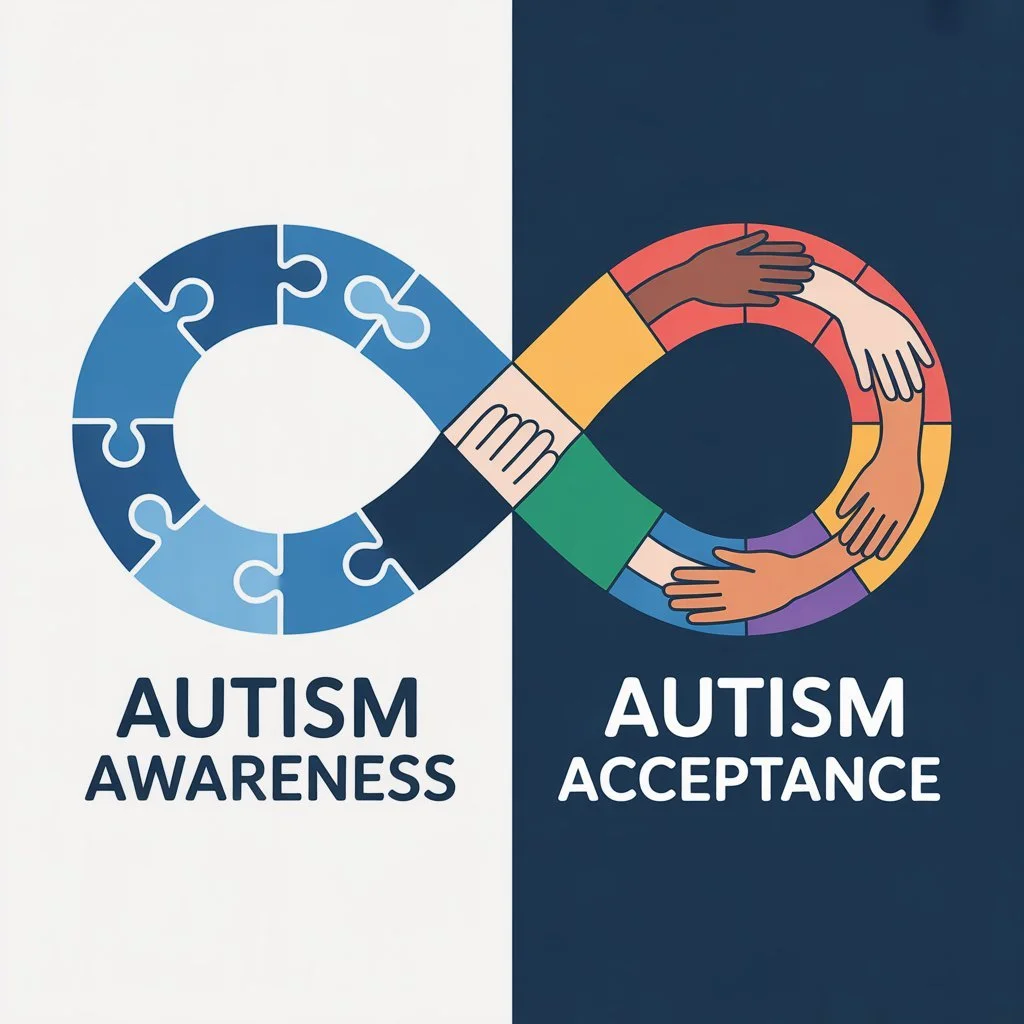
Autism Awareness vs. Autism Acceptance: What Is the Difference and Why It Matters
Every April, the conversation around autism picks up momentum. Social media fills with blue lights, puzzle pieces, and awareness campaigns. Schools send home flyers. Organizations run events. And while all of that comes from a genuine place, there is a question worth sitting with this month: is awareness actually enough?
The autism community has been asking that question for years. And the answer, increasingly, is no.
Autism awareness and autism acceptance are not the same thing. Understanding the difference between them is not just an exercise in language. It shapes the kind of support autistic people receive, the environments they are allowed to exist in, and the quality of life they get to live.
This post breaks down what each term means, why the shift from one to the other matters, and what autism acceptance actually looks like in practice.
Table of Contents
What is Autism Awareness?
What Autism Acceptance Is
Why the Language We Use Shapes the Support We Build
The History Behind the Shift
What the Research Says About Acceptance
What Autism Acceptance Looks Like in Real Life
The Symbols Debate: What It Reveals About Acceptance
Moving From Awareness to Acceptance: A Practical Starting Point
For Anyone Just Starting This Journey
Want to Keep Learning?
Final Thoughts
Autism Awareness
What is Autism Awareness?
Autism awareness is the effort to make the general public know that autism exists. It grew out of a time when autism was widely misunderstood, rarely discussed openly, and often handled with fear or shame. The goal was visibility: put autism on the public radar and make it something people could name and recognize.
That mission achieved a great deal. Today, most people have heard of autism. Most can name at least one autistic person in their life, even if they do not always realize it. Decades of awareness campaigns made autism a household word, and that was genuinely important.
But awareness has a ceiling.
It tells people autism exists without telling them what to do with that knowledge. It says "look" without saying "include." At its core, awareness is still rooted in a deficit model. It tends to focus on what autistic people cannot do, the challenges, the struggles, the ways autism makes daily life harder. It frames autism as a problem the world needs to solve rather than a difference the world needs to accommodate.
Knowing something exists and knowing how to make space for it are two very different things.
Autism Acceptance
What Autism Acceptance Is
Autism acceptance goes further. It does not just ask people to know that autism is real. It asks people to actively make room for it, in their schools, workplaces, families, and communities.
Acceptance operates from a fundamentally different starting point. It starts from the position that autistic people do not need to be fixed. They need to be included.
This shift changes everything. When a child grows up surrounded by awareness, they grow up hearing that they are a problem someone is working to solve. When they grow up surrounded by acceptance, they grow up knowing they belong exactly as they are.
The difference between those two experiences is not small. It is the difference between a life spent masking and shrinking and a life spent understanding and expressing who you actually are.
Why the Language We Use Shapes the Support We Build
Language is not just about being polite. The words used around autism directly influence the kind of support systems that get built.
Awareness thinking tends to produce interventions designed to make autistic people appear more neurotypical. The focus becomes reducing visible signs of autism rather than helping autistic individuals understand themselves and build lives that genuinely work for them.
Acceptance thinking asks different questions entirely. What does this person need to communicate effectively? What environment helps them learn and thrive? What sensory accommodations make them feel safe and focused? How do we support their strengths rather than only targeting their differences?
Those are better questions. And they lead to better outcomes.
The History Behind the Shift
World Autism Awareness Day was established by the United Nations in 2007. It was a significant milestone. Governments, schools, and organizations around the world began marking April 2nd in ways they never had before.
Over time, however, autistic self-advocates and their allies began pushing back against the framing. Awareness campaigns, they pointed out, were largely led by neurotypical people, often without meaningful input from autistic individuals themselves. And despite years of awareness, employment rates for autistic adults remained critically low, access to services remained inconsistent, and quality of life for many autistic adults had not meaningfully improved.
The Autistic Self Advocacy Network and other organizations began championing the phrase "nothing about us without us." They called for a shift from awareness to acceptance, from campaigns about autistic people to campaigns led by and centered on autistic people.
Today, many organizations including the Autism Society of America officially recognize April as Autism Acceptance Month. That is not a cosmetic change. It reflects an entire movement demanding more than visibility.
What the Research Says About Acceptance
The difference between awareness and acceptance is not just philosophical. It has measurable, documented outcomes.
Research has consistently shown that autistic individuals who experience greater social acceptance report significantly better mental health. Conversely, the pressure to mask, to suppress autistic traits in order to blend in with neurotypical peers, is strongly associated with higher rates of anxiety, depression, and autistic burnout.
A 2021 study published in the journal Autism found that autistic people who experienced higher levels of acceptance from those around them reported lower burnout and greater life satisfaction. The science confirms what autistic people have been saying for a long time: belonging is not a luxury. It is a fundamental human need. And autistic people flourish when that need is met.
What Autism Acceptance Looks Like in Real Life
Acceptance is a practice, not just a position. Here is what it looks like across everyday settings:
In schools: Sensory-friendly classrooms, flexible communication options, and educators trained to understand neurodiversity rather than simply manage behavior. An autistic student's value is not measured by how well they can mask.
In workplaces: Hiring processes that do not penalize people for stimming during interviews, offices designed with quiet spaces, and managers who communicate expectations directly and clearly.
In families: Letting go of the child you expected and getting genuinely curious about the child in front of you. Following their lead. Celebrating their interests. Building routines and environments that fit them rather than forcing them to fit a mold that was never designed for them.
In communities: Accessible events, sensory-friendly public spaces, and a culture where difference is not merely tolerated but genuinely welcomed.
Understanding what acceptance looks like inside a family, through the diagnosis, the confusion, the grief, and ultimately the clarity, is exactly what the best selling autism books in this space explore deeply. One worth starting with is Dropped in a Maze, Sonia Chand's honest account of navigating autism without a map.
Get your copy of Dropped in a Maze here and start finding your footing.
The Symbols Debate: What It Reveals About Acceptance
If you have spent time in autism spaces online, you have likely come across debates about symbols. The puzzle piece, long associated with autism awareness, has become deeply controversial. Many autistic people find it offensive, feeling it implies they are incomplete or missing something.
The gold infinity symbol has grown as an alternative, representing the infinite diversity of autistic experiences and the wholeness of autistic people.
Similarly, "Light It Up Blue" has faced criticism from autistic self-advocates, many of whom have chosen red as a symbol of their own making rather than one handed down by organizations that do not represent them.
These conversations are not just about logos and colours. They are about who gets to define what autism means. Acceptance means making room for autistic people to answer that question themselves.
Moving From Awareness to Acceptance: A Practical Starting Point
The shift from awareness to acceptance does not require a grand gesture. It is built in small, repeated choices.
Listen to autistic voices. Seek out books, podcasts, and content created by autistic people. Let their perspectives shape how you understand their experience rather than relying only on outside interpretations.
Examine your language. Do you describe autism as a tragedy? Do you talk about autistic people as "suffering from" their diagnosis? The frame matters more than most people realize.
Advocate in your immediate spaces. Does your child's school have sensory accommodations? Does your workplace have neurodiversity policies? Change does not always start at the top. It often starts exactly where you are.
Celebrate differences. The 2026 Autism Acceptance Month theme is Celebrate Differences. That is worth taking literally. What would it look like to not just accommodate but genuinely celebrate the ways autistic people experience and contribute to the world?
For anyone who wants support navigating this journey and building something sustainable around it, one-on-one coaching sessions are available for parents and caregivers who are ready to move from overwhelmed to equipped.
Book a coaching session here and get the clarity and tools you need.
For Anyone Just Starting This Journey
A new diagnosis, whether for a child or an adult, can feel completely disorienting. The system is complicated. The emotions are layered. And the advice coming from every direction is often contradictory.
Dropped in a Maze was written for exactly that moment. It is an honest account of navigating autism without a map, and it is filled with the kind of insight that only comes from having actually lived it. If you are in the early stages of this journey and you need something that speaks to the reality of what you are going through, this is the book to start with.
Order Dropped in a Maze today. You do not have to figure this out alone
Want to Keep Learning?
Reading is a great starting point. But ongoing conversation, community, and support make a lasting difference.
The podcast is where those deeper conversations happen, honest discussions about what it really looks like to move from fear to acceptance, from confusion to clarity, from surviving to building something that actually works.
Listen to the podcast here and join a community of families on the same path.
Final Thoughts
Awareness told the world that autism exists. Acceptance asks the world to do something meaningful with that knowledge.
The two are not opposites. Awareness was a starting point and it was a necessary one. But staying at the starting point is no longer good enough. Too many autistic people are sitting in classrooms, offices, and family homes waiting to be accepted, not just noticed.
This April, the goal is to go further. To build the kind of world where autistic people do not have to mask to belong, where their differences are not managed but genuinely welcomed, and where the first thing they hear about themselves is not a deficit but the full, complex, worthy truth of who they are.
That is the world worth building. And it starts with understanding the difference between knowing and accepting.

Signs Your Child Needs Emotion Coaching (and What to Do About It)
Does your child explode over small frustrations, shut down when upset, or struggle to say how they feel? You're not alone — and more importantly, there's a name for what they might need.
Research from the American Psychological Association shows that children who develop strong emotional regulation skills early in life experience better academic outcomes, healthier relationships, and improved mental health throughout adolescence and adulthood. The inverse is equally true: children who lack these skills often struggle in ways that compound over time.
That's where signs that a child needs emotion coaching become so important to recognise. Emotion coaching is a research-backed approach — developed by psychologist Dr. John Gottman — that teaches children to understand, name, and manage their feelings. When you know what to look for, you can step in early and make a real difference.
This guide will walk you through exactly what emotion coaching is, the clearest signs your child may need it, why it matters, and the practical steps you can start using today.
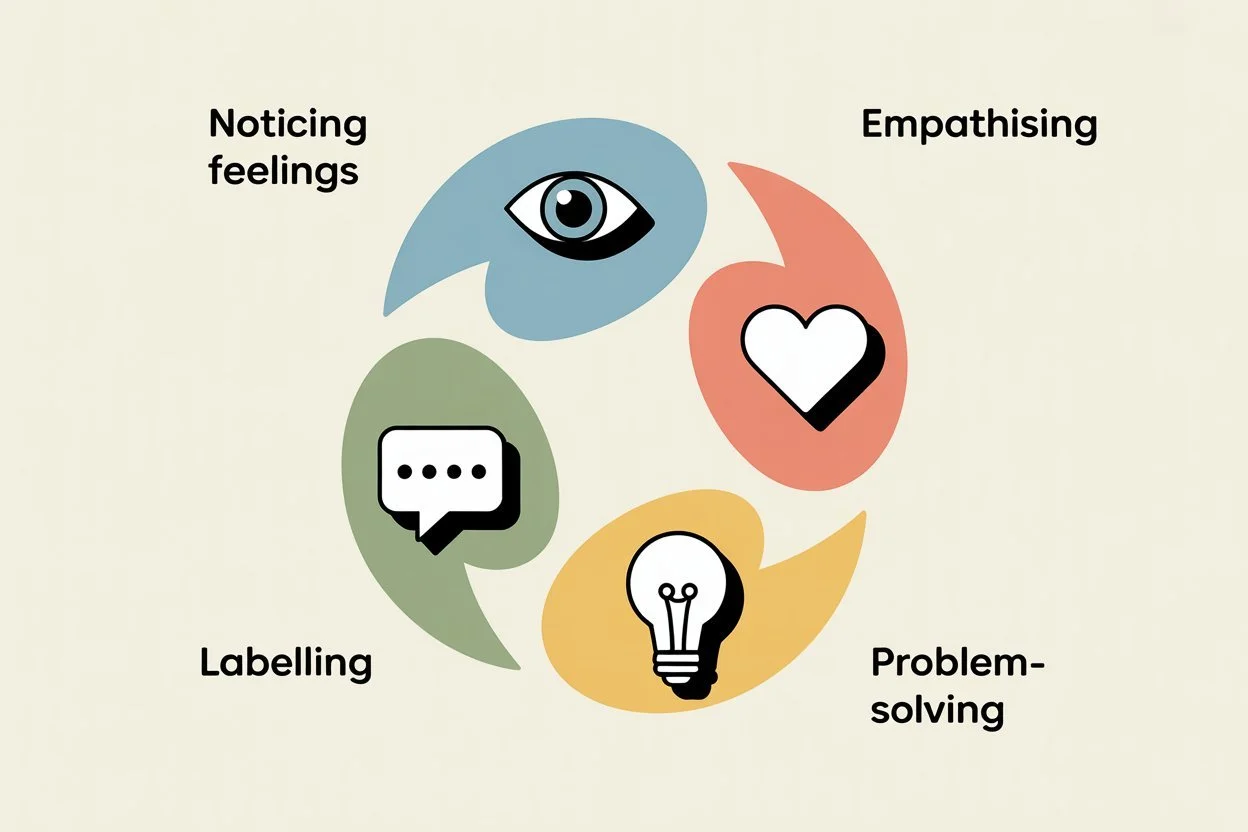
Infographic: The Emotion Coaching Cycle (Noticing feelings → Empathising → Labelling → Problem-solving)
What Is Emotion Coaching?
Emotion coaching is an approach to parenting that treats a child's difficult emotions not as problems to be silenced, but as opportunities to teach and connect. Rather than dismissing or punishing emotional outbursts, emotion-coached parents guide children through their feelings with empathy and language.
The concept was pioneered by Dr. John Gottman following decades of research into family dynamics. His studies found that children of emotion-coaching parents had fewer behavioural problems, performed better academically, and had stronger friendships — even when controlling for other variables.
At its core, emotion coaching involves four key steps: noticing the emotion, using it as an opportunity to connect, helping your child name the feeling, and then working together on limits and solutions.
"Emotion coaching is not just about managing a child's feelings. It's about helping them understand that feelings have value — and that you as the parent are their safe landing place. — Dr. John Gottman, The Heart of Parenting"
It's worth noting that emotion coaching isn't about being permissive. It's not about letting children do whatever they feel like. It's about validating the emotion while still setting firm limits on behaviour. That distinction is what makes it both compassionate and effective.
Want to understand the concept more deeply? Read our full guide on what emotion coaching is before diving into the signs.
How Emotion Coaching Works
Understanding the mechanics of emotion coaching helps you apply it consistently — especially in high-pressure moments when your child is mid-meltdown. It works through two interconnected processes: attunement and scaffolding.
Attunement: Tuning In Before You React
Attunement means noticing and acknowledging your child's emotional state before trying to fix anything. Most parenting instincts push us to immediately soothe, distract, or correct — but emotion coaching asks you to pause and reflect the feeling back first.
When a child feels genuinely seen and understood, their nervous system begins to settle. This is not a soft, feel-good concept — it is grounded in neuroscience. A child in emotional overwhelm cannot access rational thinking. Attunement helps them return to a regulated state where learning and problem-solving become possible.
In practice, this might sound like: "You're really angry that we had to leave the park. That makes sense — you were having such a good time." No fixing. No lecturing. Just being present with the feeling.
Scaffolding: Building Emotional Vocabulary and Skills
Scaffolding is the second phase — helping your child develop the tools to understand and navigate emotions over time. This includes building a feelings vocabulary, modelling calm emotional expression, and working through problems together once the emotional storm has passed.
Children are not born knowing the difference between feeling frustrated and feeling embarrassed. Emotion coaching builds this literacy brick by brick, over hundreds of small interactions. The more emotionally literate a child becomes, the better they can self-regulate — and the less explosive or withdrawn their reactions will be.
According to CASEL (Collaborative for Academic, Social, and Emotional Learning), social-emotional learning programmes that include emotional literacy components show an 11-percentile-point improvement in academic achievement, as well as significant reductions in behavioral problems.
Ready to take the next step?
Book an emotion coaching session with Sonia
Listen to Sonia's podcast for parents
Signs Your Child Needs Emotion Coaching — and How to Respond
If you've noticed your child struggling emotionally, this section is your practical roadmap. Below are the most common signs, paired with what you can actually do about each one.
What It Means & How to Respond
Frequent or intense meltdowns
Explosive reactions to small frustrations signal that a child's emotional toolkit is overwhelmed. Respond by staying calm yourself, naming the emotion, and resisting the urge to punish the feeling. "You're so frustrated right now. Let's figure this out together."
Difficulty naming feelings
If your child says "I don't know" when asked how they feel, they may lack emotional vocabulary. Build a feelings chart at home, read books with emotionally complex characters, and model labelling your own feelings aloud throughout the day.
Shutting down or withdrawing
Some children internalise their emotions rather than exploding. Watch for sulking, refusing to talk, or unexplained stomach aches. These children need a low-pressure invitation to share — try connection before conversation.
Social struggles with peers
Difficulty managing frustration in group settings, frequent conflict, or trouble sharing often signals a need for emotion coaching. Help your child practise perspective-taking through role play and debrief conflicts calmly after they happen.
Telling you feelings are stupid
Children who dismiss their own emotions have often been inadvertently taught that feelings are embarrassing or inconvenient. Normalise all emotions — including difficult ones like jealousy or fear — as part of being human.
Extreme sensitivity to criticism
Falling apart when corrected, or refusing to try things for fear of failure, often reflects poor emotional resilience. Use the language of "not yet" and separate a child's worth from their performance.
Difficulty transitioning between activities
Transitions require self-regulation. Children who struggle with them often need more advance warning, acknowledgement of their feelings about the change, and a predictable routine that creates emotional safety.
What unites all of these signs is that the child is struggling to process, express, or regulate their inner emotional world. They're not doing it to be difficult, they genuinely lack the tools.
The good news: emotion coaching builds those tools. And you don't need to be a perfect parent to do it, you just need to be a present one. For deeper guidance, explore Sonia's work on what emotion coaching is and how it translates into everyday moments.
Common Mistakes: What to Avoid When Your Child is Struggling
Even well-meaning parents can unknowingly make emotional regulation harder for their children. Here are the most common pitfalls and why they backfire:
Dismissing the emotion
Telling a child "You're fine" or "There's nothing to cry about" teaches them that their inner world doesn't matter. This drives feelings underground rather than resolving them, which increases anxiety and emotional outbursts over time.
Jumping straight to problem-solving
Children who feel unheard can't engage with solutions. Rushing to fix the situation before acknowledging the feeling leaves them feeling alone — even when your intentions are good.
Punishing the emotion
Sending a child to their room for crying or getting angry at them for being afraid creates shame around normal emotional experiences. Children learn to hide feelings rather than process them healthily.
Matching their intensity
When a parent escalates alongside an upset child, it pours petrol on the fire. Children co-regulate with adults — they need you to be calm in their storm, not another storm.
Over-reassuring without validating
Saying "Everything is fine, don't worry" bypasses the child's experience. Validation first: "I can see you're really worried." Then gentle reassurance, once they feel heard.
Emotion coaching only during crises
Emotion coaching is most effective when it's woven into everyday life — reading books together, debriefing small conflicts, noticing and naming feelings in calm moments. Crisis-only coaching doesn't build lasting skill.
Why Recognising the Signs of Emotion Coaching Need Matters
The stakes of unaddressed emotional struggles are high — but so is the potential when parents intervene early. Here's why identifying the signs your child needs emotion coaching is one of the most important things you can do as a parent.

Short-term vs Long-term outcomes of emotion coaching vs dismissing emotions
Emotional regulation is a foundational life skill
Just as children need to learn to read, they need to learn to manage their emotions. Research from Harvard's Centre on the Developing Child shows that the executive functioning skills tied to emotional regulation are predictive of success in school, relationships, and adult mental health. These skills don't develop automatically — they're built through interaction.
Early intervention prevents escalation
Emotional struggles that go unaddressed in early childhood tend to intensify. A child who can't name their feelings at age five becomes an adolescent who acts out without knowing why. Identifying the signs early and responding with emotion coaching breaks this cycle before it takes hold.
It strengthens your parent-child relationship
Emotion coaching is fundamentally about connection. When children feel safe to bring their messy, difficult feelings to you and know you won't dismiss or punish them for it — trust deepens. That trust becomes the foundation everything else is built on.
It protects mental health long-term
Children who are emotion-coached show lower rates of anxiety, depression, and behavioural disorders. The ability to identify, express, and regulate emotions is one of the most protective factors in mental health. You are literally building resilience with every coaching conversation.
It improves social outcomes
Emotionally literate children are better friends, more cooperative classmates, and more empathetic human beings. They can read social cues, manage conflict, and recover from setbacks — all of which are rooted in the emotional skills that emotion coaching develops.
It gives you tools, not just awareness
Many parents sense that something isn't right but don't know what to do. Emotion coaching gives you a framework — not a perfect script, but a way of responding that is grounded in your child's developmental needs. That shift from helplessness to action is itself transformative.
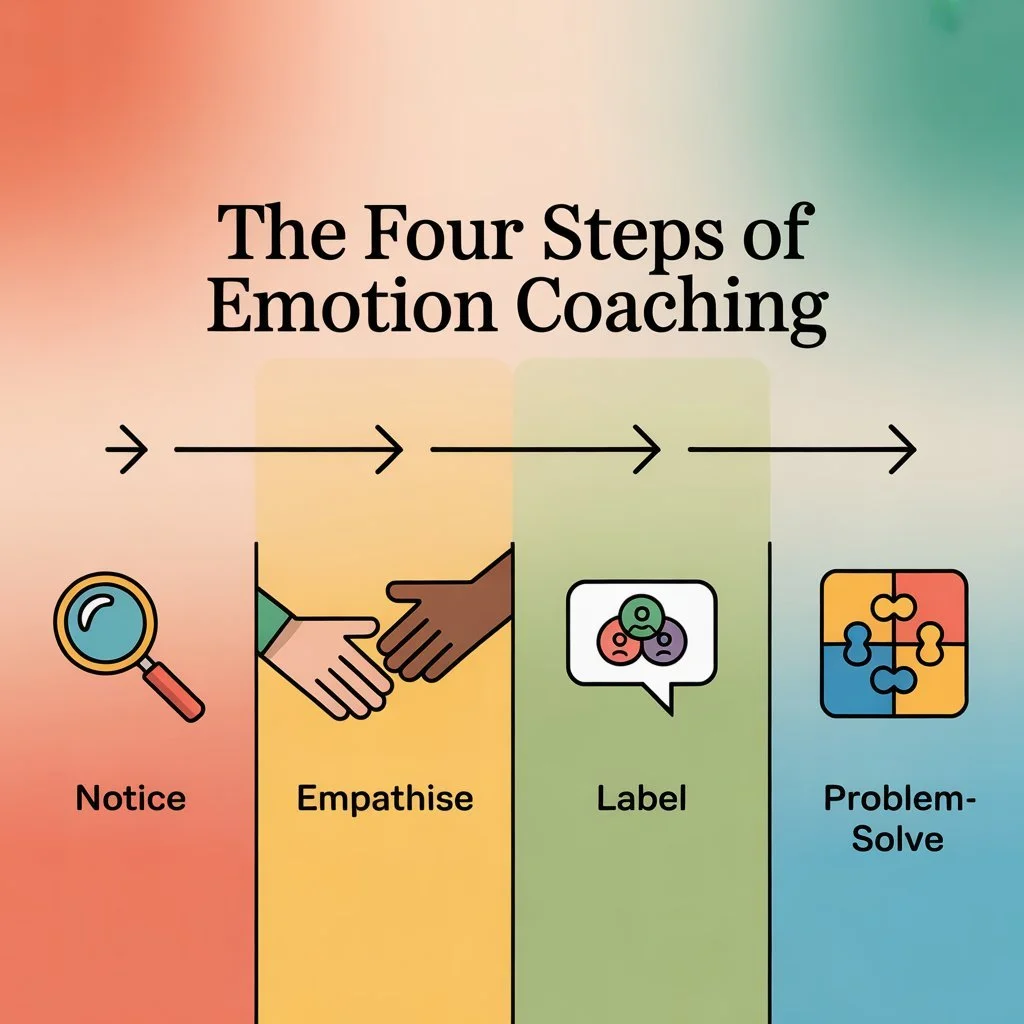
The four steps of emotion coaching (Notice → Empathise → Label → Problem-solve)
Think of emotion coaching the way you'd think of any other form of training. Athletes don't become resilient through talent alone — they're coached through difficulty, failure, and recovery. Your child's emotional life is no different. The moments of frustration, fear, and sadness are the training ground, and you are the coach.
The Growing Importance of Emotion Coaching — Trends and Future Outlook
As emotion coaching continues to evolve from a niche parenting concept into mainstream child development practice, the evidence base is growing rapidly. Schools, healthcare providers, and family therapists are increasingly incorporating emotion coaching principles into their work — a recognition that emotional literacy is as foundational as any academic skill.
The mental health landscape for children has shifted dramatically in recent years. Post-pandemic data from the World Health Organization indicates that anxiety and depression among children and adolescents have risen significantly, with emotional dysregulation identified as a key contributing factor. Parents who invest in emotion coaching now are not just responding to a trend — they're equipping their children for a world that increasingly demands emotional intelligence.
Practitioners who invest in this approach now — whether as parents, educators, or coaches — will be ahead of a curve that is rapidly becoming the new baseline expectation for child development support. The tools, research, and professional infrastructure around emotion coaching are maturing, making it more accessible than ever.
We also see growing integration of emotion coaching principles into school curricula through social-emotional learning frameworks, which further reinforces the skills that parents build at home. When home and school align on emotional literacy, children benefit exponentially. If you'd like to learn more about the foundational concepts underpinning this work, our guide on what emotion coaching is is the ideal starting point.
Frequently Asked Questions
1. What are the most obvious signs a child needs emotion coaching?
The most visible signs include frequent emotional meltdowns that seem disproportionate to the trigger, difficulty naming or describing how they feel, persistent social struggles with peers, emotional withdrawal or shutting down, and extreme sensitivity to correction or perceived failure. If your child regularly seems overwhelmed by their emotions or struggles to recover after an upset, emotion coaching is likely to help. These signs can appear as early as age three and become more complex as children grow.
2. At what age should emotion coaching start?
Emotion coaching can begin as soon as a child is forming emotional responses — which means from toddlerhood, around age 2–3. The language and approach will adapt to the child's developmental stage, but the core principle of acknowledging and naming feelings is appropriate from very early on. It's never too late to start either. Many parents begin emotion coaching with school-age children or even adolescents and see significant positive change.
3. What is the difference between emotion coaching and just being permissive?
Emotion coaching is not permissive parenting. It validates feelings while still holding firm on behaviour. You might say: "I can see you're furious that it's bedtime. That makes sense — you were in the middle of your game. AND bedtime is still at 7:30." The child's emotion is acknowledged; the limit is maintained. This is what makes emotion coaching effective — it's both empathetic and boundaried.
4. How long does it take to see results from emotion coaching?
Many parents notice a shift within a few weeks of consistent practice — particularly around the frequency and intensity of emotional outbursts. Deeper changes in emotional vocabulary, self-regulation, and social skills typically develop over several months. The key is consistency: emotion coaching works cumulatively, through many small interactions over time, not through a single breakthrough conversation.
5. Can I do emotion coaching without professional help?
Yes — and many parents do. Books, podcasts, and self-guided resources can give you a strong foundation. However, working with a specialist like Sonia Rossington offers personalised support that addresses your specific child's patterns and your specific parenting challenges. Many parents find that a few coaching sessions dramatically accelerate their progress compared to going it alone, particularly if their child's emotional struggles are intense or long-standing.
6. How is emotion coaching different from therapy?
Emotion coaching, as practiced by parents, is a preventive and developmental approach — it builds skills before or instead of clinical levels of struggle. Therapy, by contrast, addresses specific mental health concerns or trauma in a clinical context. They are complementary, not competing. If your child is experiencing significant anxiety, depression, or trauma symptoms, professional therapy is appropriate and important — and emotion coaching at home can support and reinforce that therapeutic work.
Next Steps — Work With Sonia Chand
If this guide has helped you see your child's emotional struggles in a new light — and given you a clearer sense of what they need — the next step is to take action. Recognizing the signs is the beginning; emotion coaching is the practice that creates lasting change.
Book a 1:1 Emotion Coaching Session with Sonia
Listen to Sonia's podcast for practical parenting guidance →
How to Find the Right Autism Therapist: A Neurodivergent Professional's Checklist
If you've spent any time in autistic communities online, you've heard the same story repeated: someone finally works up the courage to see a therapist, only to leave sessions feeling more broken than before. Maybe the therapist kept pushing eye contact. Maybe they framed every autistic trait as a problem to solve. Maybe they had never worked with an autistic person and it showed.
That experience is not uncommon. And it is not your fault.
Autistic people are up to three times more likely to experience anxiety and depression than neurotypical peers, and approximately three times more likely to die by suicide than non-autistic individuals, with autistic women facing even higher relative risk. The mental health stakes are high, and the cost of ending up with the wrong therapist is higher than most people realise.
The stakes of finding the right therapist are not abstract. They are life-altering.
This checklist gives you a practical framework for evaluating therapists before you commit, and for knowing when a therapeutic relationship simply is not working.
Table of Contents
What "Autism-Affirming" Therapy Actually Means
Red Flags: What to Watch Out For
Green Flags and Must-Ask Interview Questions
Where to Actually Find These Therapists
How to Evaluate Fit After the First Session
The Bottom Line
Autism-Affirming
What "Autism-Affirming" Therapy Actually Means
The phrase "autism-affirming" gets used a lot. It has also been adopted by practitioners who use it as a marketing term without understanding what it requires in practice.
At its core, autism-affirming therapy starts from the position that autism is a neurological difference, not a disorder or a collection of symptoms to be eliminated. A genuinely affirming therapist is not trying to make you appear neurotypical. They are helping you navigate a world that was not designed for your brain, while honouring who you actually are.
This means they understand:
Masking (the exhausting process of suppressing autistic traits to fit in) and the burnout it causes
Sensory processing differences and why they matter to daily functioning
Autistic burnout as distinct from (though often co-occurring with) depression
The double empathy problem: communication breakdowns are mutual, not a failure of the autistic person
Affirming therapy also means that your goals drive the work, not a standardised programme designed to make you more palatable to neurotypical environments.
The Autistic Self Advocacy Network (ASAN) has published clear guidance on what constitutes respectful, affirming support. It is worth reading before you start your search, so you can recognise the real thing when you encounter it.
If this topic resonates with you, the themes around navigating systems designed for neurotypical people are explored in depth inDropped in a Maze. Get your copy here.

Red Flags: What to Watch Out For
Many autistic people have finely tuned instincts. If something feels wrong in a therapy session, it probably is. Here are specific warning signs worth naming clearly.
Related reading: 7 Red Flags of Unethical Mental Health Practice
Compliance-Based Approaches
Therapists who rely heavily on ABA or ABA-adjacent methods, particularly those focused on eliminating behaviours rather than understanding their function, are a significant red flag. ABA's core mechanics involve reinforcing neurotypical-appearing behaviour and discouraging autistic behaviour. That is not the same as supporting someone's mental health.
TheAutistic Self Advocacy Network's position on ABA makes this case clearly and is worth sharing with anyone who pushes back on your concern about it.
Framing Autism as the Problem
If a therapist consistently frames your autism as the source of your difficulties rather than examining environmental factors, systemic barriers, or the impact of years of masking, they are working from an outdated and harmful model. Watch for language like "your autism is causing you to" rather than "the demands placed on you are creating".
Pushing Eye Contact or Social Scripts
A therapist who encourages you to make more eye contact, practise small talk, or perform social norms that exhaust you is not helping you. They are helping you mask more effectively. This increases burnout risk, not wellbeing.
Dismissing Sensory Needs
If a therapist minimises sensory sensitivities, treats stimming as a habit to break, or creates an office environment that is overwhelming without offering alternatives, that is a sign they have not done the foundational work of understanding autism.
Ignoring Your Language Preferences
Many autistic people strongly prefer identity-first language ("autistic person" rather than "person with autism"). A therapist who ignores your stated preference, especially after being corrected, is signaling that they are not actually listening to you.

Must-Ask Interview Questions for your Therapist
Green Flags and Must-Ask Interview Questions
Most therapists offer a free initial consultation. Use it. This is your interview of them, not the other way around.
Green Flags to Look For
They follow your lead on language (identity-first vs person-first)
They ask what you want from therapy, not what they think you need
They have experience with or lived proximity to neurodivergence
They understand masking and autistic burnout as distinct concepts
They can name specific frameworks they use, such as ACT or adapted CBT, rather than offering vague assurances
They are comfortable with directness and do not penalise blunt communication
Questions to Ask
"What is your approach to working with autistic adults?" (Listen for whether they focus on changing you or supporting you.)
"How do you view masking and what is your approach to working with it?"
"Do you have experience with autistic burnout specifically, as distinct from depression?"
"How do you handle communication differences, for example if I am very direct or need more processing time?"
"What is your position on ABA?" (A therapist who defends it uncritically is not the right fit for most autistic adults.)
For more honest, unfiltered conversations about neurodivergent mental health, tune into the podcast.https://www.buzzsprout.com/2307116/episodes.
Related reading: 5 Signs You've Found the Right Therapist
Where to Actually Find These Therapists
Standard directories likePsychology Today are a starting point, but their autism filters will surface many practitioners who list autism as a specialty without meaningful affirming practice. Here are more targeted strategies.
Specialist Directories
Inclusive Therapists: a directory specifically built around finding affirming, social-justice-informed therapists, with neurodivergent filters
Neurodivergent Therapist: a directory and resource hub focused specifically on ND-affirming practitioners
AANE (Autism Asperger Network): maintains a therapist referral list with detailed practitioner profiles
Community Recommendations
Ask in autistic community spaces such as Reddit'sr/AutisticAdults andr/autism, local Facebook groups, or Discord communities for late-diagnosed autistic adults. Personal recommendations from other autistic people carry more weight than any directory listing.
Telehealth Has Changed Access
If you are outside a major urban area or find in-person sessions difficult, telehealth dramatically widens your options. Many of the best affirming therapists work entirely online. Do not limit your search geographically if you can avoid it.
Ask Directly Before Booking
When you find a therapist who looks promising, email them first. A brief message asking about their approach to autistic adults will tell you a great deal from the response alone, both in content and in how they receive the question.
How to Evaluate Fit After the First Session
Finding a therapist who looks right on paper is step one. Knowing whether the relationship is actually working is harder, particularly for autistic people who may mask even within therapy sessions.
Here is what to check for yourself after the first few sessions.
Notice Your Body, Not Just Your Mind
Many autistic people are skilled at intellectualising their experiences and less connected to somatic signals. After a session, notice: are you exhausted in the familiar way that follows masking? Are you relieved it is over? Or do you feel genuinely lighter, even if the session was difficult?
Are Your Goals Driving the Sessions?
After two or three sessions, you should be able to clearly articulate what you are working on and why. If sessions feel directionless, or if the therapist consistently redirects toward their own agenda, that is worth naming directly. Notice how they respond to that directness.
Do You Feel Safer Being Yourself?
This is the clearest measure. Over time, good therapy with a genuinely affirming practitioner should mean you mask less in sessions, not more. If you are performing wellness or performing neurotypicality in the therapy room, that is important information.
Trust Your Instincts, Even If You Have Been Told Not To
Many autistic people have been socialised to distrust their own perceptions, told that they are too sensitive, misreading situations, or overreacting. This history can make it hard to trust a gut sense that something is wrong in therapy.
Trust it anyway. You do not owe any therapist your continued attendance. Leaving a poor therapeutic fit is not failure. It is self-advocacy.
Related reading: Breaking the Stigma of ABA
The experience of having your instincts dismissed is one of the threads running throughDropped in a Maze. If that resonates, grab a copy here.
The Bottom Line
You deserve a therapist who understands that autism is not a problem to be fixed, and who has the knowledge and humility to back that up in practice. The process of finding that person can be slow and frustrating, but it is worth the investment.
Use this checklist. Ask the hard questions in the consultation call. And when something feels wrong, believe yourself.
The right support exists. You are allowed to hold out for it.
Get your copy of Dropped in a Maze and Listen to the podcast for honest conversations about neurodivergence, mental health, and finding support that actually works
6 Ways to Support Your Autistic Friend
You care about your autistic friend. You want to be supportive. But you're not quite sure how to help without overstepping or coming across as condescending.
Maybe you've noticed they struggle in certain situations. Maybe they've opened up to you about their challenges. Or maybe you just want to be a better friend and create a more inclusive friendship.
The good news? Supporting an autistic friend doesn't require grand gestures or complicated strategies. It requires understanding, patience, and a willingness to see the world from their perspective.
April is Autism Acceptance Month, and there's no better time to learn how to show up for your autistic friends in meaningful ways. Here are six practical strategies that actually make a difference.
Table of Contents
Learn What Autism Actually Is (Beyond Stereotypes)
Respect Their Communication Style
Understand Sensory Sensitivities Are Real
Support Their Need for Routine and Predictability
Advocate Alongside Them, Not For Them
Educate Yourself Continuously
Acceptance is the first stage of support
1. Learn What Autism Actually Is (Beyond Stereotypes)
Move Beyond What You've Seen on TV
Most people's understanding of autism comes from movies like Rain Man or TV shows that portray autistic characters as either savants or completely non-verbal. The reality is much more nuanced.
Autism is a neurological difference that affects how people process information, communicate, and experience the world. It's a spectrum, which means it looks different for everyone.
Your autistic friend might:
Make excellent eye contact or avoid it entirely
Be highly verbal or prefer written communication
Excel in certain areas while struggling in others
Need accommodations that seem unusual to you but are essential for them
Start With Reliable Resources
Instead of relying on outdated stereotypes or random internet articles, educate yourself through credible sources.
TheAutism Self Advocacy Network (ASAN) is an excellent starting point. Run by autistic people themselves, ASAN provides accurate information about autism from those who actually live with it.
Another great resource is theAutistic Women & Nonbinary Network (AWN), which addresses the unique experiences of autistic women and nonbinary individuals who are often underdiagnosed and misunderstood.
Ask Your Friend About Their Experience
Every autistic person is different. What's true for one person might not be true for another.
The best way to understand your friend's specific experience? Ask them.
Questions you might consider:
"What does autism mean to you?"
"Are there things I do that make social situations harder for you?"
"How can I be a better friend to you?"
"What do you wish people understood about autism?"
Just make sure you're asking because you genuinely want to understand, not because you're treating them like a teaching opportunity. There's a difference between curiosity and interrogation.
2. Respect Their Communication Style
Not Everyone Communicates the Same Way
Your autistic friend might communicate differently than you're used to. They might:
Take longer to process what you've said before responding
Prefer texting over phone calls
Be very direct without social "softening" phrases
Struggle with open-ended questions
Need things explained explicitly rather than implied
None of these differences make their communication "wrong." It's just different from neurotypical communication patterns.
Direct Doesn't Mean Rude
One of the biggest misunderstandings about autistic communication is interpreting directness as rudeness.
If your autistic friend says "I don't want to go to that restaurant," they're not being difficult. They're being honest. Neurotypical people might say "Oh, I'm not sure, maybe we could go somewhere else?" to soften the message.
Autistic communication tends to be more straightforward. What you hear is what they mean. No hidden messages, no passive aggression, no reading between the lines.
This is actually refreshing once you get used to it. You always know where you stand.
Give Them Processing Time
If you ask your autistic friend a question and they don't respond immediately, don't assume they're ignoring you or didn't hear you.
They might be:
Processing what you said
Formulating their response
Dealing with sensory input that's distracting them
Managing internal thoughts before they can respond
Give them time. Don't fill the silence with more questions or rephrase what you just said. Just wait.
Accommodate Their Preferred Communication Method
Some autistic people find phone calls overwhelming but are great at texting. Others prefer in-person conversations where they can read body language.
Ask your friend how they prefer to communicate and respect that preference. If they say "Can we text about this instead of calling?" that's not rejection—it's them telling you how they communicate best.
To understand how autism affects communication and daily interactions, read How Autism Affects Daily Life.
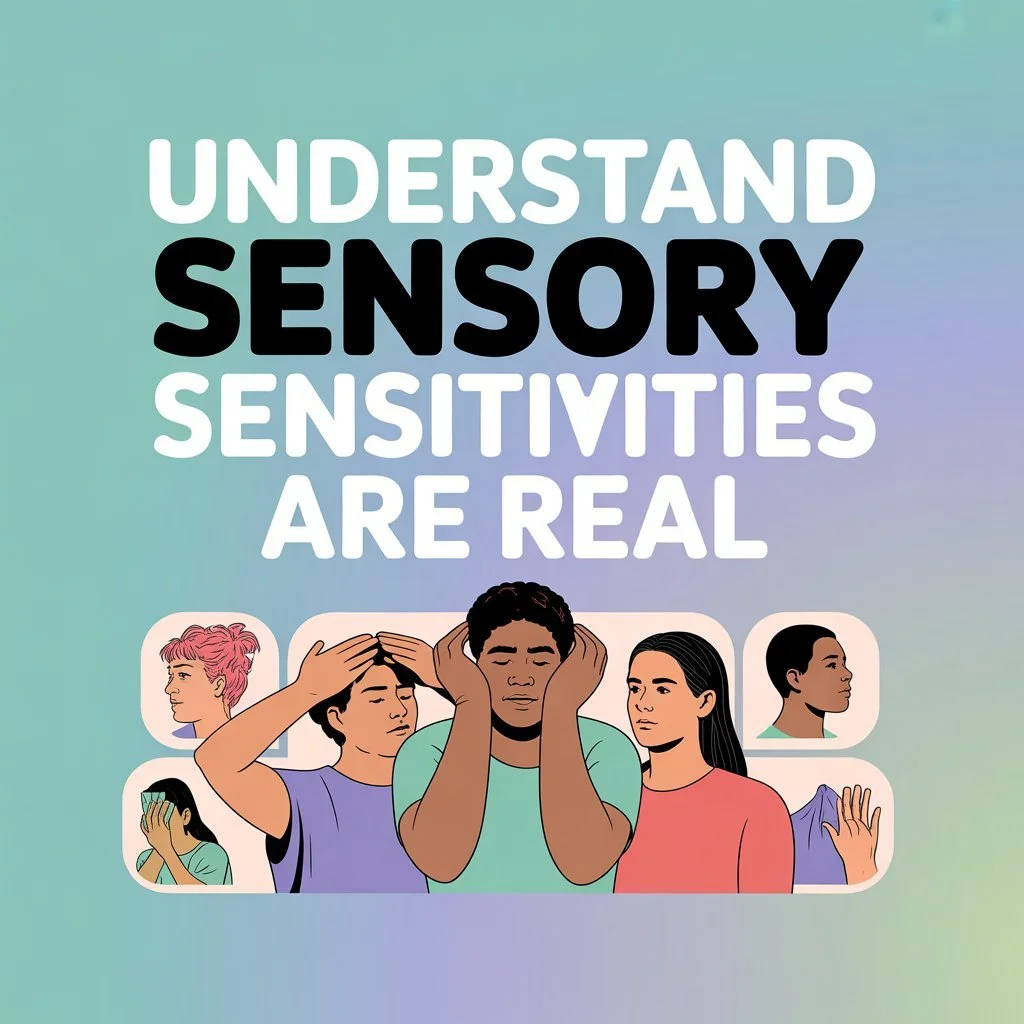
Understand Sensory Sensitivitie
3. Understand Sensory Sensitivities Are Real
The World Is Overwhelming
Imagine walking into a restaurant where the music is too loud, the lights are too bright, people are talking over each other, there are competing smells from the kitchen, and your clothes tag is scratching your neck.
For many autistic people, this isn't an occasional annoyance. This is daily life.
Sensory sensitivities mean that sounds, lights, textures, smells, and other stimuli that neurotypical people can filter out become overwhelming and sometimes painful.
Common Sensory Triggers
Your autistic friend might be sensitive to:
Sound: Background noise, multiple conversations at once, sudden loud noises, certain frequencies, humming lights or appliances
Light: Fluorescent lighting, bright sunlight, flashing lights, LED screens
Touch: Certain fabrics, tags in clothing, tight or loose clothing, unexpected physical contact, specific textures
Smell: Strong perfumes, cleaning products, food smells, air fresheners
Taste/Texture: Specific food textures, mixed textures, strong flavors
How to Be Supportive
Ask before making plans. Instead of picking a loud, crowded restaurant, ask "Is there a place you're comfortable with?" or suggest a quieter alternative.
Be understanding if they need to leave. If your friend says they need to go because they're getting overwhelmed, don't take it personally. Sensory overload is real and can be debilitating.
Don't dismiss their experience. "It's not that loud" or "Just ignore it" aren't helpful. What's manageable for you might be excruciating for them.
Respect their coping mechanisms. If they wear sunglasses indoors, use noise-canceling headphones, or stim (repetitive movements like hand-flapping or rocking), that's how they regulate their nervous system. Don't ask them to stop.
Sensory Overload Isn't Dramatic
When autistic people talk about sensory overload, they're not exaggerating for effect. It's a physiological response that can lead to:
Shutdowns (going non-verbal, unable to process information)
Meltdowns (emotional overwhelm that looks like a breakdown)
Physical pain
Exhaustion that lasts for days
Being a supportive friend means recognizing these aren't choices or tantrums. They're neurological responses to overstimulation.

Support your autistic friends always
4. Support Their Need for Routine and Predictability
Why Routines Matter
Many autistic people rely heavily on routines and predictability. This isn't about being inflexible or controlling—it's about managing a world that often feels chaotic and overwhelming.
Routines provide:
A sense of safety and control
Reduced anxiety about what's coming next
Mental energy conservation
Structure in an unpredictable world
How Last-Minute Changes Affect Them
What seems like a small, spontaneous change to you might completely derail your autistic friend's day.
"Let's grab dinner tonight instead of tomorrow" might seem fun and casual to you. For your autistic friend, it might mean:
Disrupting their planned routine for the evening
Not having time to mentally prepare for social interaction
Anxiety about the unexpected change
Needing to reorganize other commitments
This doesn't mean you can never be spontaneous. It just means understanding that what's easy for you might be difficult for them.
How to Be Considerate
Give advance notice when possible: If you're planning to get together, give your friend as much heads-up as you can. A week's notice is better than a day's notice.
Provide details: Instead of "Want to hang out Saturday?" try "Want to get coffee at that café on Main Street Saturday at 2pm? We could stay for about an hour."
Specific details help autistic people prepare mentally and reduce anxiety about unknowns.
Understand if they decline last-minute invitations: It's not that they don't want to spend time with you. They might just not have the capacity to adjust their day on short notice.
Stick to plans when you make them: Constantly changing or canceling plans is exhausting for everyone, but especially for someone who has already mentally prepared for the original plan.
5. Advocate Alongside Them, Not For Them
The Difference Between Support and Speaking Over
There's a crucial difference between advocating alongside your autistic friend and speaking for them.
Advocating alongside means:
Amplifying their voice, not replacing it
Supporting their decisions, even if you'd choose differently
Standing up against ableism when you see it
Creating space for them to self-advocate
Speaking for them means:
Deciding what's best for them without asking
Answering questions directed at them
Making assumptions about what they need
Treating them as incapable of speaking for themselves
How to Advocate Effectively
Listen to what they're telling you: If your autistic friend says something is a problem, believe them. Don't dismiss or minimize their experience.
Challenge ableist language and attitudes: When someone uses "autistic" as an insult or says something offensive about autism, speak up. You don't have to give a lecture—sometimes a simple "That's not cool" is enough.
Support their self-advocacy: If your friend is trying to explain their needs to someone (a boss, teacher, service provider), be their backup. Your presence alone can make them feel more confident.
Educate others, but don't burden your friend: If someone has questions about autism, you can direct them to resources rather than expecting your autistic friend to constantly explain themselves.
Understand the importance of advocacy. The autistic community has long fought for acceptance, accommodations, and basic respect. The Importance of Advocacy in Autism explores why this work matters and how you can contribute to creating a more inclusive world.
Respect Their Autonomy
Your autistic friend is the expert on their own experience. Even if you think you know what's best for them, check yourself.
They have the right to:
Make their own decisions
Decline help they don't want
Choose how they navigate the world
Define what support looks like for them
Good intentions don't override autonomy. Always ask before assuming what kind of support someone needs.
One powerful way to advocate is by sharing resources that increase understanding. The On the Spectrum Empowerment Stories podcast features real conversations with autistic individuals and experts, providing authentic perspectives that challenge stereotypes. Listening to episodes together or recommending specific episodes to your friend shows you're committed to understanding their experience.
6. Educate Yourself Continuously
Your Friend Isn't Your Teacher
Yes, asking your autistic friend questions can be part of building understanding. But it's not their job to educate you about everything autism-related.
Constantly asking them to explain autism, justify their needs, or teach you about accommodations puts an unfair burden on them.
Instead, take initiative to educate yourself through books, articles, podcasts, and resources created by autistic people.
Seek Out Autistic Voices
The best autism education comes from autistic people themselves—not from parents of autistic children, not from therapists, not from organizations that don't include autistic leadership.
Look for content created by actually autistic individuals. Their lived experience provides insight that no amount of clinical training can match.
Sonia Chand's book offers exactly this kind of firsthand perspective. Get your copy here to understand the autistic experience from someone who's lived it. Reading books like this not only educates you but also shows your friend you're willing to put in the work to understand their world.
Stay Current on Autism Research and Advocacy
Our understanding of autism continues to evolve. What was considered "best practice" ten years ago might be considered harmful today.
Stay updated on:
Current research about autism
Advocacy movements led by autistic people
Changes in terminology and language
Critiques of harmful therapies or approaches
Follow autistic advocates on social media. Read blogs written by autistic adults. Listen to podcasts hosted by autistic individuals.
Recognize Your Own Biases
We all absorb ableist messages from society. Part of being a good friend is recognizing when those biases show up in your thinking.
Ask yourself:
Am I treating my friend as less capable because they're autistic?
Am I making assumptions about what they can or can't do?
Am I viewing their differences as deficits rather than just differences?
Am I trying to "fix" them instead of accepting them?
This isn't about beating yourself up for having biases. It's about recognizing them so you can actively work against them.
Keep Learning, Keep Growing
Supporting your autistic friend isn't a one-time thing. It's an ongoing commitment to understanding, respecting, and valuing who they are.
Another way to deepen your understanding is by gifting your autistic friend resources that validate their experience. Purchase Sonia's book as a thoughtful gesture that says "I see you, I value your perspective, and I want to understand your world better." Many autistic individuals find comfort in reading about others' experiences—it reminds them they're not alone.
Dropped in a Maze
Being a True Friend
At the end of the day, supporting your autistic friend comes down to the same principles that define any good friendship: respect, communication, empathy, and genuine care.
The difference is being willing to expand your understanding of what those things look like. Respect might mean honoring their need to leave a loud environment. Communication might mean texting instead of calling. Empathy might mean recognizing that their brain processes the world differently than yours.
You don't have to be perfect. You'll make mistakes. What matters is that you're willing to learn, adjust, and show up consistently.
Small Actions Make a Big Difference
You don't need to become an autism expert overnight. Small, consistent actions matter more than grand gestures:
Believe them when they tell you something is hard
Don't force eye contact
Accept their stims without comment
Choose quieter venues when possible
Give them advance notice about plans
Don't take it personally when they need space
Challenge ableism when you encounter it
Keep educating yourself
These aren't difficult things. They just require awareness and intention.
This Autism Acceptance Month, Go Deeper
April is Autism Month—a time to move beyond simple "awareness" and into genuine understanding and inclusion.
Here are three concrete actions you can take this month:
1. Listen to autistic voices: Start with the On the Spectrum Empowerment Stories podcast, which features real conversations about the autistic experience. Share episodes that resonate with your autistic friend—it might spark meaningful conversations between you.
2. Educate yourself: Read books written by autistic authors. Sonia's book provides invaluable firsthand perspective on navigating the world as an autistic person. Understanding her journey will help you understand your friend's.
3. Have a conversation: Use what you've learned as a starting point to ask your friend how you can be more supportive. Listen without defensiveness. Adjust your behavior based on what they tell you.
Autism Month isn't just about posting blue puzzle pieces (which many autistic people actually find offensive). It's about doing the real work of creating a world where your autistic friend feels safe, valued, and fully accepted for who they are.
That work starts with you. It starts with education, empathy, and a willingness to see the world through their eyes.
Be the friend who says "You don't have to mask with me. You don't have to pretend. You're perfect exactly as you are."
That's what real support looks like. And that's what every autistic person deserves.
NeuroWell: 7 Ways to Create Safer and Happier Classrooms
Classrooms are struggling. Teachers are exhausted. Students are disengaged. And despite countless new initiatives, programs, and technology, things seem to be getting worse, not better.
The problem isn't lack of effort. Teachers are working harder than ever. The problem is we're focused on the wrong things. What if instead of teaching content, we started teaching kids? What if we aligned our classrooms with actual brain science instead of outdated models that treat students like information receptacles?
Dr. Lisa Riegel's NeuroWell framework does exactly that. By combining neuroscience with practical classroom strategies, NeuroWell creates environments where students feel safe, engaged, and ready to learn—and where teachers don't burn out trying to make it happen.
Here are seven core principles from the NeuroWell approach that can transform any classroom into a space where both students and teachers actually want to be.
Table of Contents
Build Belonging First, Everything Else Second
Transform Your Classroom Into a True Learning Community
Give Every Student a Role That Matters
Use Learning Sprints to Match Actual Attention Spans
Make Learning Relevant or Lose Your Students
Understand Behavior Through Brain Science, Not Punishment
Measure What Actually Matters for the Future
1. Build Belonging First, Everything Else Second
The Invisible Student Problem
There's a hidden crisis happening in schools right now. Students are physically present but emotionally absent. They come in, sit down, stay quiet, and leave—completely unseen by the adults around them.
These aren't just the "troubled" kids acting out. They're often the quiet ones who slip through the cracks because they don't cause disruptions.
When students don't feel like they belong, their bodies respond as if they're in danger. They shut down emotionally. They disengage mentally. And no amount of "rigorous instruction" will reach a brain that's in survival mode.
The Science of Collective Identity
Research on collective identity reveals something important: humans are wired for belonging. When we feel part of something bigger than ourselves, we're more engaged, more motivated, and more willing to contribute.
Think about sports teams, military units, or tight-knit companies. People wear the gear, adopt the language, and identify with the group—even if they've never officially been part of it.
Schools can create this same sense of belonging, but most don't. Instead, students feel isolated, alone in a sea of desks, competing rather than collaborating.
Creating Your Classroom's Collective Identity
Building belonging starts with intentional practices:
Create a class name, mascot, and mantra: Yes, even in high school. The NFL does it. Sororities do it. Ted Lasso's "Believe" sign works because it creates shared identity.
Develop rituals and traditions: Weekly celebrations, inside jokes, specific phrases that only your class uses—these build familiarity and connection.
Use nicknames appropriately: When a teacher uses a friendly nickname, it signals relationship and trust. It says "we know each other."
Make "we" language the default: "We're a learning community" beats "I'm the teacher and you're my students" every time.
2. Transform Your Classroom Into a True Learning Community
The Hierarchy Problem
Traditional classrooms operate on a power structure: teacher at the top, students as subordinates who follow orders.
This creates compliance at best, resistance at worst. It doesn't create engagement.
A learning community operates differently. Everyone has a role. Everyone contributes. The mission isn't "do what the teacher says"—it's "we're all here to learn together."
Defining Good Learning Together
Start by asking students to define what makes a good learner. Not what the textbook says, but what they think.
Then identify characteristics of good community members. What does it look like to support each other's learning? What behaviors help versus hurt the group?
Make these definitions concrete. "Be respectful" is too vague. "Let people finish talking before interrupting" is specific and observable.
Goal-Setting With Peer Support
Once you've defined what good learning looks like, have students set personal goals.
Maybe someone struggles with coming to class prepared. Maybe another person interrupts constantly. Maybe someone else has trouble getting started on assignments.
Group students so they can support each other's goals. This builds accountability without punishment. It creates a culture where we help each other improve rather than compete to be the best.
Want to hear Dr. Riegel explain exactly how she builds these learning communities from day one? Listen to her full interview on the On the Spectrum Empowerment Stories podcast where she walks through specific scripts and strategies.
3. Give Every Student a Role That Matters
Jobs Create Purpose
Right now, most students have one job: sit down, be quiet, absorb information, regurgitate it on tests.
That's not engaging. It's not purposeful. And for neurodivergent students or those who learn differently, it's often completely disconnected from how they actually function.
What if every student had a specific role in the classroom that contributed to the community?
Practical Classroom Jobs
Sound Manager: Turns lights off when the room gets too loud. Clicks a doorbell to signal volume control.
Tech Manager: Passes out and collects devices. Troubleshoots basic tech issues.
Previewer: Starts class by reviewing the day's learning targets.
Reviewer: Ends class by summarizing what was covered and what's coming next.
Supply Manager: Distributes and organizes materials.
Cleaner: Wipes tables before the end of class.
These aren't busywork. They're legitimate responsibilities that keep the classroom running smoothly.
Adapting Roles for Different Needs
Not every student is comfortable with every role. A neurodivergent student who struggles with public speaking might not want to be the previewer, but they might excel as the supply manager.
Some teachers have students apply for the jobs they want. Others rotate roles so everyone gets different experiences.
The key is making sure everyone has something—a reason to show up, a way to contribute, a sense of "this classroom needs me."
When students have purpose, engagement follows.
Want to hear Dr. Riegel explain Neurowell in detai? Listen to her full interview on the On the Spectrum Empowerment Stories podcast where she walks through specific scripts and strategies.
4. Use Learning Sprints to Match Actual Attention Spans
The 45-Minute Lecture Myth
Teachers still design lessons as if students can sit and absorb information for 45 straight minutes.
They can't. Adults can't either.
Our brains aren't built for sustained passive attention. We need movement, social interaction, and mental breaks.
The Learning Sprint Model
Instead of lecturing for extended periods, chunk instruction into sprints:
10 minutes of direct instruction: Then a 2-5 minute break for unstructured conversation or a positivity prompt.
Another 10 minutes of learning: Then another brief social break.
This pattern continues throughout the class period.
Positivity Prompts That Build Connection
During those short breaks, use prompts like:
"Turn to your neighbor and tell them one thing you really like about them"
"Share one good thing that happened today"
"Tell someone next to you something people don't know about you that makes you special"
These aren't wasted time. They're teaching social skills, building relationships, and giving brains the break they need to consolidate learning.
Plus, they address the complaint that "kids today don't know how to socialize." They'll never learn if we don't give them safe opportunities to practice.
5. Make Learning Relevant or Lose Your Students
The Disengagement Crisis Isn't About Laziness
Absenteeism is skyrocketing. Students are checked out. And the usual response is to blame kids for not caring or being disrespectful.
But what if the problem isn't disengagement—it's irrelevance?
Students today have access to all information instantly through the internet. They can ask ChatGPT any factual question and get an answer in seconds.
So when we ask them to memorize dates, definitions, and formulas they could look up in five seconds, they rightfully ask: why?
Reframing Assignments for the AI Era
Instead of asking "Can ChatGPT do this assignment?" and then punishing students who use it, ask "How can I design this assignment so ChatGPT is a tool, not the answer?"
Focus on:
Application of knowledge, not regurgitation
Creative problem-solving with multiple possible solutions
Collaboration that requires human interaction
Reflection on the learning process itself
Projects that connect to students' actual lives and interests
When learning has relevance, students engage. When it doesn't, they check out—and we can't blame them.
6. Understand Behavior Through Brain Science, Not Punishment
When a student "misbehaves," our instinct is often to punish, correct, or remove them from the situation.
But behavior isn't about defiance. It's the intersection of biology and context.
Every behavior a student exhibits is their brain's response to their entire life experience up to that moment—their home situation, past trauma, neurological wiring, current stress levels, and the environment you've created.
The Regulated Teacher Creates Regulated Students
If you're dysregulated—stressed, anxious, frustrated, exhausted—your students will mirror that energy.
If you're calm, centered, and emotionally safe, students can access that calm too.
This is especially critical for neurodivergent students who may already be managing sensory overload, executive function challenges, or social anxiety.
Creating Emotional and Intellectual Safety
Safety isn't just about locked doors and security protocols. It's about:
Emotional safety: Students can express feelings without judgment. They can make mistakes without shame. They can ask for help without being labeled "needy."
Intellectual safety: It's okay to not understand something. Questions are welcomed, not punished. Struggle is part of learning, not a sign of failure.
When you understand that the kid acting out is actually a kid in pain, you respond differently.
You don't take it personally. You don't escalate. You create a context so different from what they experience outside school that their brain makes new, positive associations.
You become the safe oasis in their otherwise chaotic world. And that changes everything.
7. Measure What Actually Matters for the Future
The Testing Trap
Right now, schools measure math scores and reading scores. Maybe some end-of-course exams on specific content.
That's it. That's what determines whether teachers are "effective" and schools are "successful."
The problem? Those metrics measure the things AI can do better than humans.
What we're not measuring:
Can students think critically?
Can they communicate effectively?
Can they work collaboratively?
Can they resolve conflicts?
Can they self-regulate?
Can they show empathy?
These are the skills that will matter in the future. But because we don't measure them, we don't prioritize them.
What You Measure Matters
If you want students to be happy, healthy, and successful, you can't only measure their ability to recall facts.
You need observable, measurable indicators of the skills that actually matter:
Critical thinking: What does it look like? What does it sound like? How do we assess it beyond just the final product?
Communication: Are students learning to express ideas clearly? To listen actively? To adapt their message for different audiences?
Community contribution: Are they supporting each other's learning? Taking responsibility for the group's success?
Self-awareness and regulation: Can they identify when they're dysregulated? Do they have strategies to calm themselves?
The Equity Gap in "Teaching"
Teachers often say "I teach collaboration by putting students in groups."
But the students who already know how to collaborate do great. The ones who don't? They're never actually taught.
That's an equity issue. We assume skills rather than explicitly teaching them.
The same goes for critical thinking, communication, and all the "soft skills" that are actually the hardest to develop.
To hear Dr. Riegel's complete framework for measuring what matters and creating systems-level change, check out the full podcast episode. She breaks down exactly how leaders can shift from aspirational goals to operational reality.
Why NeuroWell Matters Right Now
Education is at a crossroads. With potential cuts to the Department of Education, increased scrutiny on teachers, and rapid changes from AI, schools need a framework that actually works.
NeuroWell isn't about adding more to teachers' plates. It's about reframing what's already happening through a brain-science lens.
It's about recognizing that:
Belonging comes before learning
Community beats hierarchy
Purpose drives engagement
Relevance matters more than rigor
Behavior is communication, not defiance
What we measure determines what we value
For Teachers
You don't have to become Hollywood's version of the heroic teacher who sacrifices everything. You can make a massive difference in 45 minutes a day by creating a space where students feel safe, seen, and valued.
For Parents
If your child is struggling in school, it might not be about their ability or effort. It might be about a system that isn't designed for how their brain actually works.
Advocate for environments that prioritize belonging, safety, and relevance over compliance and test scores.
For Leaders
Culture eats strategy for breakfast. You can implement all the programs you want, but if teachers don't feel supported and students don't feel safe, nothing will stick.
Start with the conditions that allow brains to learn, then build from there.
Taking the First Step
You don't have to overhaul your entire classroom or school overnight. Small shifts create big changes when they're aligned with how brains actually work.
The NeuroWell framework isn't about perfection. It's about progress. It's about creating classrooms where both teachers and students can thrive—not just survive.
Ready to transform your classroom or school? Check out the full podcast episode here