
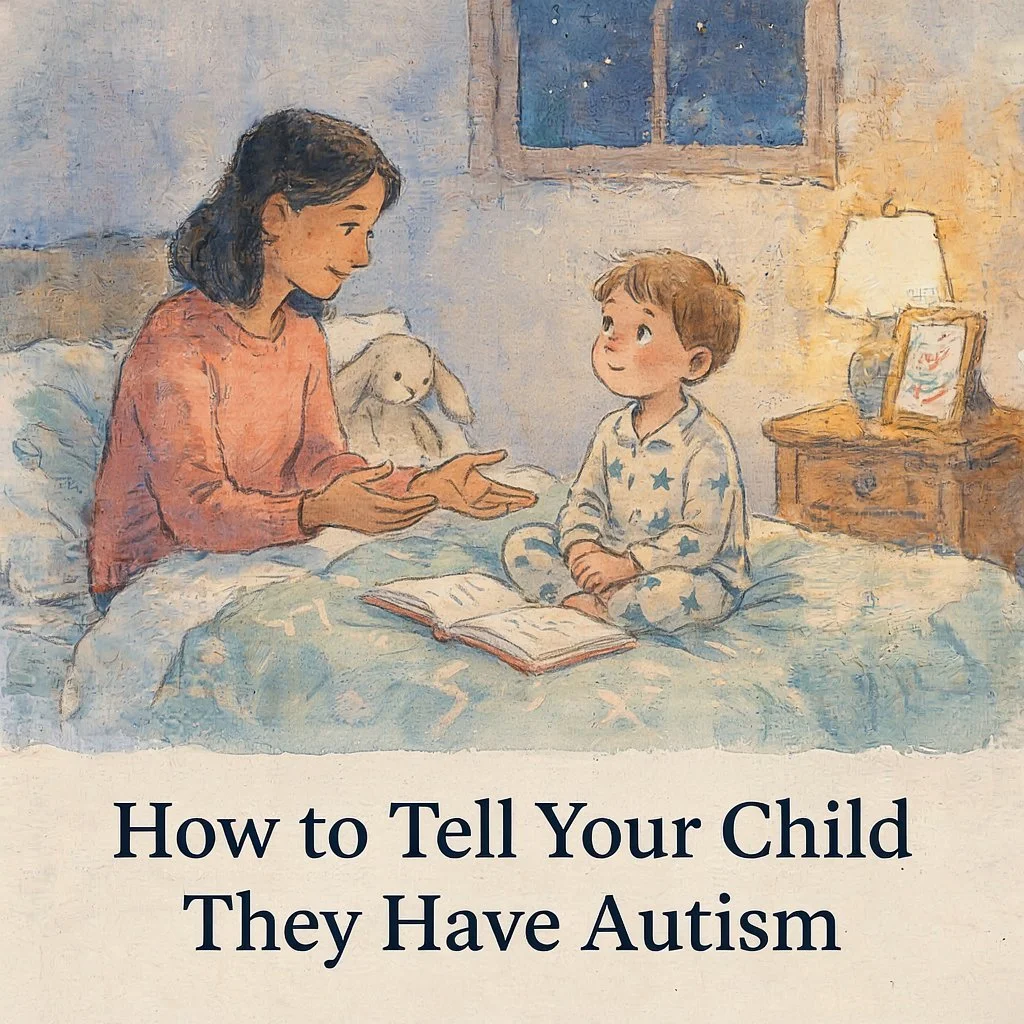
How to Tell Your Child They Have Autism
How to tell your child they have autism is one of the most emotionally loaded questions a parent faces after a diagnosis. You have processed your own feelings, or you are still in the middle of processing them, and now you are trying to figure out how to hand this information to your child in a way that helps rather than harms.
How to tell your child they have autism is not a conversation that has one right script. But it does have principles that consistently produce better outcomes than the alternatives, and understanding those principles before you sit down with your child makes an enormous practical difference to how the conversation goes and what your child takes from it.
This post covers when to tell your child, how to frame the conversation at different ages, what language to use, what to avoid, and how to keep the conversation going long after the first disclosure.
Table of Contents
Should You Tell Your Child They Have Autism?
When Is the Right Time to Tell Your Child They Have Autism?
How to Tell Your Child They Have Autism: The Core Principles
How to Tell Your Child They Have Autism at Different Ages
What Language to Use and What to Avoid
How to Frame Autism as a Difference Not a Deficit
What to Do When Your Child Reacts With Distress
Keeping the Conversation Going After the First Disclosure
Final Thoughts
References
Should You Tell Your Child They Have Autism?
Before addressing how to tell your child they have autism, it is worth addressing the question that sits behind it for many parents: should you tell them at all?
The answer from both research and from the autistic community is consistently and clearly yes. Autistic children who are told about their diagnosis early and in a supportive, affirming way consistently fare better than those who are not told or who find out accidentally or later in life.
The reasons are practical and emotional. An autistic child who does not know they are autistic still experiences the world as harder to navigate than it appears to be for everyone else. They still feel the social friction, the sensory overload, the confusion about why things that seem easy for peers feel so difficult for them. Without the autism framework, the story they tell themselves about why this is happening is almost always some version of: something is wrong with me. I am broken. I am not trying hard enough.
Telling your child they have autism replaces that damaging internal narrative with an accurate one. It gives them language for their experience. It explains why certain strategies help them and others do not. And it opens the door to a community of people who understand their experience from the inside.
The question is never really whether to tell. It is how to tell your child they have autism in a way that serves them well.
When Is the Right Time to Tell Your Child They Have Autism?
Most autism experts and advocates agree that earlier is better, and that there is no minimum age at which the conversation becomes appropriate. The way you have the conversation changes significantly with age, but the principle of honest, age-appropriate disclosure applies from the earliest years.
Many developmental psychologists and autism specialists recommend that parents begin using autism-related language naturally from the point of diagnosis, so that the word autism is never a shocking revelation but simply a familiar part of the family's vocabulary around how the child experiences the world.
Research has it that autistic individuals who were told about their diagnosis earlier in childhood reported better psychological adjustment and more positive autism identity as adults than those who found out later. The earlier the disclosure, within an affirming and supportive family context, the better the long-term outcomes.
The worst time to tell your child they have autism is when they find out accidentally, through overhearing a conversation, reading a document, or being told by someone other than their parents. Accidental disclosure removes the parent's ability to frame the information supportively and is associated with significantly more negative emotional responses.
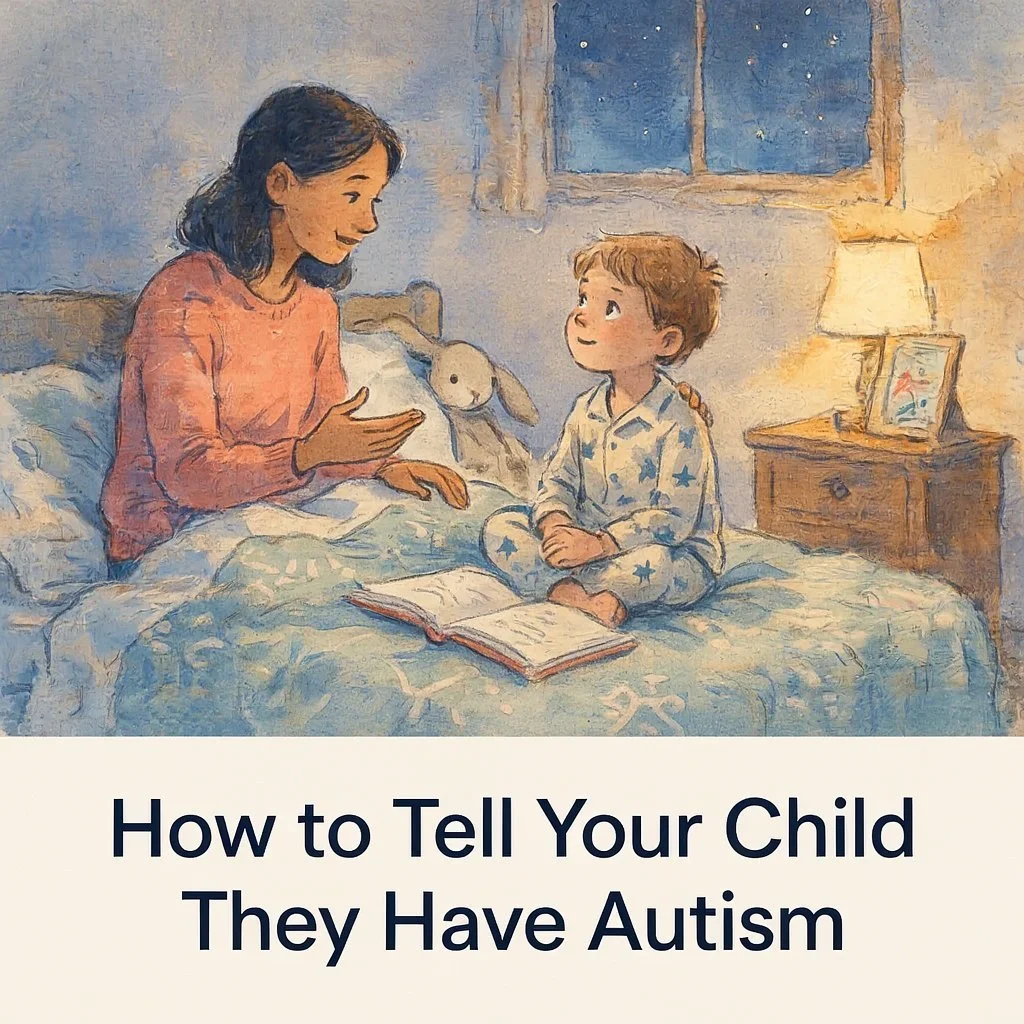
How to Tell Your Child They Have Autism: The Core Principles
However old your child is when you have this conversation, these core principles apply consistently.
Lead with the positive: The first thing your child should hear is not that something is wrong with them. It is that their brain works differently, and that that difference explains a lot of things they have already noticed about themselves. Start from strength, not deficit.
Be honest and simple: Use clear, direct language that matches your child's developmental level. Do not hedge or use so many qualifications that the core message gets lost. Autism is a word that describes how your brain is wired. That is the message.
Make it a conversation, not a lecture: How to tell your child they have autism is not a presentation you deliver. It is a conversation you start. Ask what they already know. Ask what they have noticed about themselves. Let their questions guide where the conversation goes.
Normalize it: Make clear that autism is not something to be ashamed of, not something that defines their worth, and not something that limits what they can do or become. Many people are autistic. Famous scientists, artists, athletes, and thinkers are autistic. Their brain is a good brain that works differently.
Keep the door open: The first conversation about how to tell your child they have autism is not the last one. It is the beginning of an ongoing dialogue that will evolve as your child grows and their understanding deepens.
How to Tell Your Child They Have Autism at Different Ages
Toddlers and preschoolers (ages 2 to 5): At this age, abstract explanations are less effective than concrete, sensory-based language. You might say something like: your brain notices sounds really loudly, and that is just how your brain works. Or: some things are harder for your brain and some things your brain is really brilliant at. Use picture books about brain differences and neurodiversity. The word autism can be introduced simply and without drama, as one word among many that describe who they are.
Early school age (ages 6 to 10): Children at this age are beginning to notice more clearly that they are different from peers, and often the autism conversation comes in response to their own questions about why. How to tell your child they have autism at this age involves being more explicit about what autism means, why certain things are harder, and why certain supports are in place. Use analogies: every brain has its own operating system. Yours runs on a different one than most people's, and that means some things work differently.
Tweens (ages 10 to 12): At this age, identity is becoming more salient and the stakes of the autism conversation increase. Your child is more likely to have complex emotional responses including relief, anger, grief, or resistance. How to tell your child they have autism at this age needs to make space for all of those responses without rushing toward a tidy resolution. Acknowledge that it is a lot to take in. Answer questions honestly. Connect them with autistic role models and community.
Teenagers: Adolescence is the most complicated time for autism disclosure because identity, peer relationships, and self-concept are all in flux simultaneously. If your teenager does not already know, they have almost certainly already sensed their difference and may have built up significant shame or confusion around it. How to tell your child they have autism as a teenager requires particular sensitivity to the narrative they have already constructed about themselves and a willingness to sit with their emotional response without trying to fix it immediately.
What Language to Use and What to Avoid
Language that helps:
Your brain is wired differently, and that is why some things feel harder and some things you are exceptionally good at
Autism is the name for how your brain works
Lots of brilliant, creative, interesting people are autistic
This explains why certain environments feel overwhelming and why certain strategies help you
Being autistic is part of who you are, not something wrong with you
Language to avoid:
You have a disorder
There is something wrong with your brain
You are different in a bad way
This is why you struggle
You need to try harder to be like other children
The language you use when figuring out how to tell your child they have autism shapes the internal narrative they build about themselves. Choose words that build identity rather than erode it.
How to Frame Autism as a Difference Not a Deficit
One of the most important aspects of how to tell your child they have autism is the frame you use to present what autism means.
The deficit frame says: you have autism, which means you have difficulties with social communication, sensory processing, and flexible thinking. These are challenges you will need to work on.
The difference frame says: you have autism, which means your brain processes the world differently. That means some things are harder in environments designed for neurotypical brains. It also means some things come more naturally to you than to most people, including depth of focus, attention to detail, and the ability to pursue things you care about with extraordinary commitment.
Both frames are accurate. But the difference frame produces better self-concept, better mental health, and better long-term outcomes. It is also more honest, because autism genuinely does involve both challenges and strengths, and presenting only the challenges is an incomplete picture.
For a deeper understanding of why the language and frame around autism matter so profoundly, the post onautism awareness vs autism acceptance explores this in full and is worth reading alongside this one as you prepare for the conversation with your child.
Preparing for this conversation while also navigating your own emotional response to the diagnosis is genuinely complex, and having skilled, informed support alongside that process makes a real difference.
Book a coaching session with Sonia here and get the support that helps you have this conversation from a place of clarity, confidence, and genuine acceptance.
What to Do When Your Child Reacts With Distress
Not every child responds to the autism disclosure with immediate acceptance or relief. Some children respond with grief, anger, denial, or intense distress. All of these responses are valid and none of them mean you did anything wrong.
When your child responds with distress:
Stay present and calm without rushing to fix the feeling
Validate the emotion without reinforcing a negative framing of autism
Avoid minimizing: it is not that bad is not helpful, but neither is catastrophizing alongside them
Give them time and space to process before continuing the conversation
Connect them with other autistic children or adults whose lived experience reflects what is possible
The distress is almost never really about the word autism. It is about the fear of what the word means for their future, their relationships, and how other people will see them. Addressing those fears directly and honestly, with genuine reassurance grounded in reality rather than false promises, is the most effective response.
Keeping the Conversation Going After the First Disclosure
How to tell your child they have autism is really a question about how to begin a lifelong conversation rather than how to have a single defining moment. The first disclosure is important, but what happens after it matters just as much.
Keep autism a normal part of family conversation. Reference it when it is relevant, not as a label that explains every difficulty but as a context that explains specific experiences. Allow your child to bring it up themselves. Answer their questions honestly as they evolve. Connect them with autistic community, books, media, and role models as they grow.
According to research. autistic individuals who grew up in families where autism was discussed openly and positively had significantly better autistic identity and mental health outcomes in adulthood than those for whom it was a topic that was avoided or discussed primarily in terms of challenges.
The conversation you start when you figure out how to tell your child they have autism is the first chapter of a much longer story. Make it a good one.
Dropped in a Maze by Sonia Chand is one of the most honest and practically grounded accounts of navigating the autism journey as a family, and it is exactly the kind of reading that helps parents find the words for conversations that feel impossibly hard before you start them.
Final Thoughts
How to tell your child they have autism is one of the most important conversations you will have as a parent. Not because it is the hardest, though it can feel that way, but because it is the beginning of your child's relationship with their own identity. The frame you use, the language you choose, and the ongoing conversation you commit to after the first disclosure all shape who your child believes themselves to be and what they believe is possible for them.
Get it right and you give your child the most powerful gift available: an accurate understanding of their own mind, offered with love, so they can spend their life building on who they actually are rather than apologizing for it.
References
Cooper K, Russell AJ, Lei J, Smith LGE. The impact of a positive autism identity and autistic community solidarity on social anxiety and mental health in autistic young people. Autism. 2023;27(3):848-857. Available from: https://pmc.ncbi.nlm.nih.gov/articles/PMC10074754/
Wheeler M. Getting Started: Introducing Your Child to His or Her Diagnosis of Autism [Internet]. Indiana Resource Center for Autism; 2020 May. Available from: https://iidc.indiana.edu/irca/resources/learn-about-autism/getting-started-introducing-your-child-to-his-or-her-diagnosis-of-autism.html

How to Test for Autism: A Complete Guide for Parents
If you are wondering how to test for autism, you are probably not reading this out of idle curiosity. You are reading it because something has shifted. A developmental checkup raised a concern. A teacher said something. A friend mentioned it. Or you have been watching your child and quietly noting things that do not quite add up, and you have finally decided to find out what is going on.
Knowing how to test for autism is the first practical step in a process that can feel overwhelming before you understand how it actually works. This post walks you through everything, from the earliest screening tools to the full diagnostic process, what to expect at each stage, how to advocate effectively, and what comes after a diagnosis.
How to test for autism is a question with a real, practical answer. And having that answer puts you in a far stronger position than most parents have when they start this process.
So, let’s get into it.
Table of Contents
How to Test for Autism: The Short Answer
The Difference Between Autism Screening and Autism Testing
Early Signs That Prompt Autism Testing
Step One: Developmental Screening at Your Pediatrician
Step Two: Formal Autism Evaluation
Who Can Diagnose Autism
What Happens During an Autism Evaluation
The Main Diagnostic Tools Used to Test for Autism
Online Autism Tests: Are They Reliable
What Happens After an Autism Diagnosis
How to Advocate for Testing When You Are Being Dismissed
Final Thoughts
How to Test for Autism: The Short Answer
How to test for autism involves a two-stage process. The first stage is screening, which identifies children who may be at risk for autism and need further evaluation. The second stage is a comprehensive diagnostic evaluation, which is a detailed, multi-professional assessment that either confirms or rules out an autism diagnosis.
There is no single test for autism. No blood test, no brain scan, no genetic test, and no quick checklist can diagnose autism on its own. Autism is diagnosed through a combination of developmental history, behavioral observation, standardized assessment tools, and clinical judgment from trained professionals.
This two-stage process is how to test for autism in the most accurate and reliable way currently available. Understanding both stages and what happens within them helps parents navigate the process with confidence rather than confusion.
The Difference Between Autism Screening and Autism Testing
Before going further, it helps to understand that screening and testing are different things and the distinction matters practically.
Autism screening: Screening is a quick, low-burden process designed to identify children who may need further evaluation. It does not diagnose autism. It flags a concern and prompts the next step. Screening tools are typically used by pediatricians at routine developmental checkups and take only a few minutes to complete.
Autism testing or evaluation: A full autism evaluation is a comprehensive, multi-session process conducted by trained specialists. It involves direct observation of the child, standardized assessment tools, detailed developmental history, and input from multiple sources including parents, teachers, and other professionals who know the child. It results in either a diagnosis or a ruling out of autism, along with a full picture of the child's strengths and support needs.
The screening identifies who needs testing. The testing provides the diagnosis.
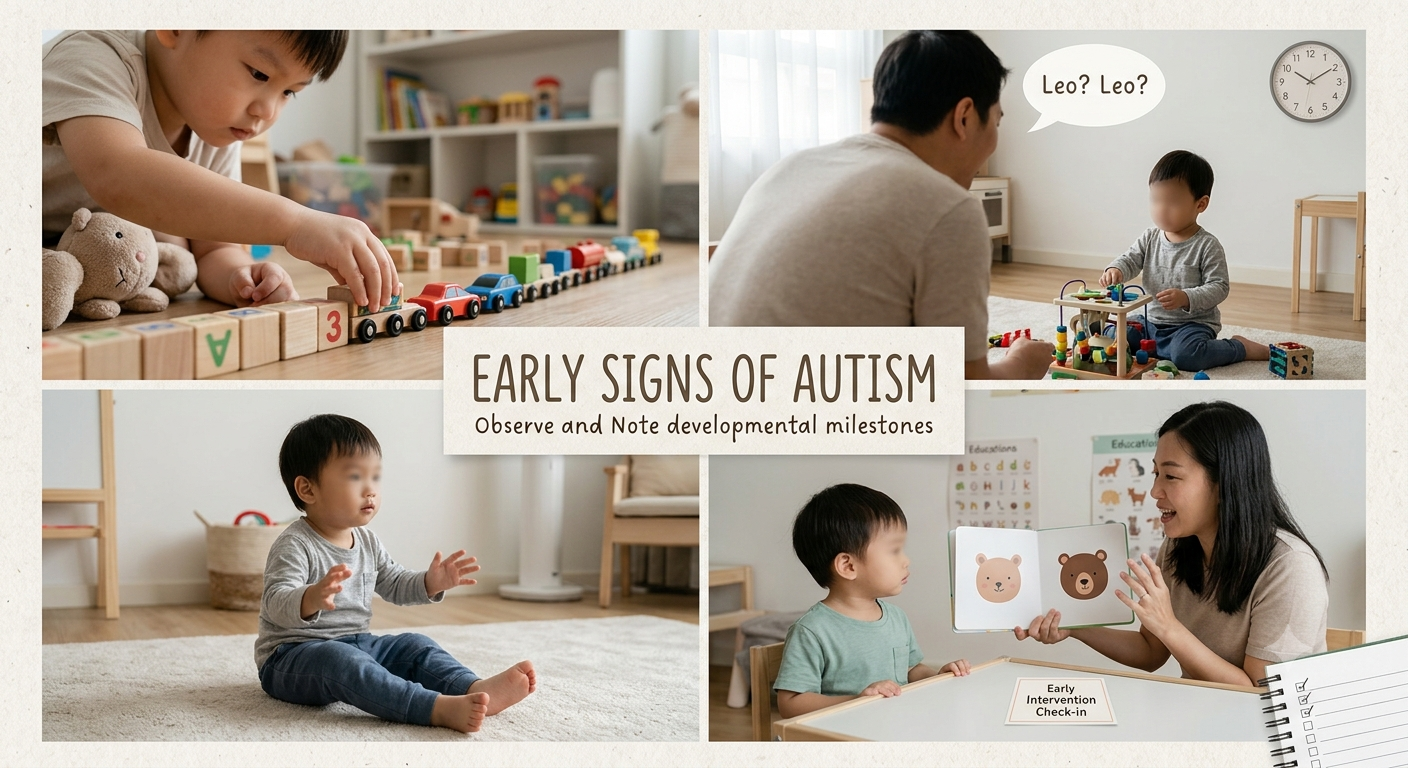
early signs of autism to know
Early Signs That Prompt Autism Testing
Most parents begin thinking about how to test for autism because they have noticed something specific about their child's development. Here are the signs that most commonly prompt parents and professionals to pursue autism testing:
In infants and toddlers:
Not responding to their name by 12 months
Not pointing or waving by 12 months
No babbling by 12 months
No two-word phrases by 24 months
Loss of previously acquired language or social skills at any age
Limited or absent eye contact
Not smiling in response to smiling faces
Appearing not to hear even though hearing tests are normal
In preschool age children:
Significant difficulty with social interaction with peers
Strong preference for routine with extreme distress at changes
Repetitive movements including hand flapping, rocking, or spinning
Intense, narrow interests that dominate play and conversation
Unusual sensory responses including strong reactions to sounds, textures, or lights
Delayed or unusual language development
Difficulty with pretend play
In school age children:
Social difficulties that are becoming more visible as peer expectations increase
Difficulty understanding unwritten social rules
Challenges with executive functioning including organization and task initiation
Sensory sensitivities that affect participation in school activities
Intense special interests that differ significantly from peers
Difficulty with transitions and unexpected changes
In teenagers:
Social isolation increasing as peer relationships become more complex
Anxiety and depression emerging alongside social difficulty
Academic performance inconsistent with cognitive ability
Fatigue and burnout from sustained social effort
Questioning their own identity and neurological difference
If you are seeing several of these signs in your child, pursuing autism testing is the right next step. Waiting to see if they grow out of it is rarely the best approach. Earlier identification means earlier support, and earlier support produces better outcomes.
Step One: Developmental Screening at Your Pediatrician
The first step in how to test for autism for most families is a conversation with their child's pediatrician.
The American Academy of Pediatrics recommends autism-specific screening for all children at their 18 and 24 month well-child visits, regardless of whether any concerns have been raised. Many pediatricians also screen at other routine visits if developmental concerns are present.
The most widely used screening tool at this stage is the M-CHAT-R, which stands for Modified Checklist for Autism in Toddlers, Revised. It is a 20-item parent-report questionnaire that takes about five minutes to complete and identifies toddlers who may need further evaluation.
What to do at this stage:
Be honest and specific when completing screening questionnaires. Describe what your child actually does, not what you hope or expect they will do
Come prepared with specific examples of the behaviors that concern you
Ask directly whether your child's screening results suggest further evaluation is needed
Request a referral for a full evaluation if the screening is positive or if you have concerns even when the screening is negative
It is worth knowing that a negative screening result does not rule out autism, particularly in children who have developed effective compensatory strategies or whose autism presents in ways that are less visible on standard screening tools. If you have concerns, advocate for further evaluation regardless of screening results.
Step Two: Formal Autism Evaluation
If screening raises concerns or if you have requested a full evaluation based on your own observations, the next step in how to test for autism is a comprehensive diagnostic evaluation.
This evaluation can be requested through several pathways:
Through your pediatrician: Ask for a referral to a developmental pediatrician, child psychologist, or autism specialist for a full evaluation.
Through your school district: Under the Individuals with Disabilities Education Act, you have the right to request a free educational evaluation through your child's school district. This evaluation is not the same as a clinical diagnosis but can identify educational support needs and sometimes contributes to the diagnostic process.
Through a specialist center: Many children's hospitals and university medical centers have dedicated autism evaluation programs. These programs typically offer the most comprehensive evaluations but often have longer waiting lists.
Privately: Private autism evaluations are available through clinical psychologists and developmental pediatricians in private practice. These can be faster than public pathways but involve out of pocket costs that vary significantly.

Professionals who can diagnose autism
Who Can Diagnose Autism
Knowing who can diagnose autism is part of understanding how to test for autism effectively.
In the United States, autism can be diagnosed by:
Developmental pediatricians: Medical doctors who specialize in child development and developmental disorders
Child psychiatrists: Medical doctors who specialize in mental health conditions in children including neurodevelopmental conditions
Clinical psychologists: Doctoral level psychologists with training in psychological assessment and neurodevelopmental conditions
Pediatric neurologists: Medical doctors specializing in neurological conditions in children, particularly relevant when epilepsy or other neurological conditions are also present
The most comprehensive autism evaluations are typically conducted by multidisciplinary teams that include several of these professionals working together. A team approach produces a more complete picture of the child's profile than a single professional assessment.
What Happens During an Autism Evaluation
Understanding what happens during an autism evaluation helps parents prepare effectively and know what to expect. Here is a typical sequence:
Developmental history interview: A detailed interview with parents covering the child's developmental history from birth, including milestones, early language development, social development, behavioral patterns, medical history, and family history. This usually takes one to two hours and is one of the most important parts of the evaluation.
Direct assessment of the child: The evaluator spends direct time with the child conducting standardized observations and assessments. The child may participate in structured play activities, respond to social prompts, complete cognitive tasks, and engage in conversation depending on their age and language level.
Cognitive and language assessment: Most comprehensive autism evaluations include assessment of cognitive ability and language development. This helps identify co-occurring conditions including intellectual disability and language disorders and provides a complete picture of the child's profile.
Behavior rating scales: Standardized questionnaires completed by parents and teachers that assess behavior across different settings. These provide information about how the child functions across environments rather than only in the assessment room.
Sensory processing assessment: Many evaluations include assessment of sensory processing, either through standardized tools or through clinical observation.
Feedback session: After the evaluation is complete, the evaluating team meets with parents to share findings, explain the diagnosis or ruling out of autism, and discuss recommendations for support.
If this section resonated with you, this is exactly what coaching sessions with Sonia are built around. Book here.
The Main Diagnostic Tools Used to Test for Autism
Several standardized tools are commonly used as part of how to test for autism in clinical practice. Knowing what these are helps parents understand the process:
ADOS-2 (Autism Diagnostic Observation Schedule, Second Edition): This is considered the gold standard observational assessment for autism. It is a structured, semi-structured interaction between the evaluator and the child that is scored according to specific criteria. It provides direct observational data on social communication and restricted or repetitive behaviors.
ADI-R (Autism Diagnostic Interview, Revised):A structured interview with parents covering developmental history and current behavior. It is often used alongside the ADOS-2 to provide a comprehensive picture combining observational and historical data.
M-CHAT-R:The screening tool used at pediatric well-child visits for toddlers aged 16 to 30 months.
CARS-2 (Childhood Autism Rating Scale, Second Edition): A rating scale used to assess autism severity across multiple behavioral domains.
Vineland Adaptive Behavior Scales:Assesses adaptive functioning including communication, daily living skills, and socialization across age groups.
Online Autism Tests: Are They Reliable
Parents searching for how to test for autism will inevitably come across online autism tests and screening tools. It is worth being clear about what these are and what they are not.
What online autism tests can do:
Provide an informal indication of whether an autism evaluation might be worthwhile
Help parents organize their observations and concerns before a professional consultation
Give autistic adults a framework for understanding their own experience before seeking formal diagnosis
What online autism tests cannot do:
Diagnose autism
Replace a comprehensive clinical evaluation
Provide a reliable ruling out of autism
The most widely used and most validated online screening tools include the Autism Spectrum Quotient, known as the AQ, developed by Simon Baron-Cohen and colleagues at Cambridge University, and the Ritvo Autism Asperger Diagnostic Scale, known as the RAADS-R. These are research-grade tools that can provide useful information but are not diagnostic instruments.
If an online screening raises concerns, the appropriate next step is a full clinical evaluation with a qualified professional. Online tools are a starting point, not an endpoint.
What Happens After an Autism Diagnosis
Understanding what comes after autism testing and diagnosis is part of knowing how to test for autism effectively because the diagnosis is only the beginning of the process.
After a diagnosis, the immediate priorities are:
Getting the right support in place: Use the diagnosis to access services including speech therapy, occupational therapy, behavioral support, and school accommodations. The diagnosis is the key that unlocks these services.
Educating yourself: Read widely from credible sources including autistic authors and advocates. The more you understand your child's specific profile, the better you can advocate for them and support them.
Connecting with community: Find other families who are navigating similar experiences. The autism parenting community is one of the most generous and knowledgeable communities you will ever encounter.
Processing the emotional response: A diagnosis brings up complex emotions for most parents. Giving yourself space to process those emotions, with support if needed, is important before diving entirely into action mode.
For a comprehensive guide to the practical steps that follow a diagnosis, the post on newly diagnosed autism parent guide covers everything in detail.
For the broader context of what acceptance looks like beyond diagnosis, the post on autism awareness vs autism acceptance is worth reading early in the journey because the framework you use to understand your child's diagnosis will shape every decision you make from here.
How to Advocate for Testing When You Are Being Dismissed
One of the most frustrating experiences parents describe in the autism testing process is being dismissed by professionals who minimize their concerns. Here is how to advocate effectively when that happens:
Document everything: Keep a written record of specific behaviors you have observed, with dates, contexts, and details. Specific documented observations are harder to dismiss than general concerns.
Request things in writing: If a professional declines to refer for evaluation, ask them to put that decision in writing with their clinical reasoning. This often prompts a more careful reconsideration.
Seek a second opinion: You are not obligated to accept a single professional's judgment. If your concerns are being dismissed, seek another opinion from a professional with specific autism expertise.
Use your school district rights: Under IDEA you have the right to request a free educational evaluation through your school district. You do not need your pediatrician's agreement to do this. Submit the request in writing and the school district has 60 days to respond.
Trust your observations: You know your child better than any professional who has spent one hour with them. Your observations are valid data. Do not let a dismissive response convince you otherwise.
Final Thoughts
Knowing how to test for autism puts you ahead of where most parents are when they start this process. The testing itself is not something to fear. It is the process of finally getting accurate information about your child that you can use to get them the support they deserve.
How to test for autism is a question with a clear practical answer. Two stages. Multiple professionals. Standardized tools combined with developmental history and direct observation. A process that takes time but produces a picture of your child that opens doors to genuine support.
If you have concerns about your child, pursue them. Document what you are seeing. Request the evaluation. Advocate when you need to. And trust that the clarity that comes from knowing is almost always better than the uncertainty of not knowing.
Your child is worth finding out.
References:
American Academy of Pediatrics. Autism Spectrum Disorder [Internet]. Last updated October 2025. Available from: https://www.aap.org/en/patient-care/autism/
Robins DL, Fein D, Barton M. M-CHAT-R/F: Modified Checklist for Autism in Toddlers, Revised with Follow-Up [Internet]. 2009. Available from: https://www.mchatscreen.com/
U.S. Department of Education. Individuals with Disabilities Education Act, Section 1414: Evaluations, Eligibility Determinations, Individualized Education Programs, and Educational Placements [Internet]. Available from: https://sites.ed.gov/idea/statute-chapter-33/subchapter-ii/1414/
Global Autism Interactive Network (GAIN), University of Kansas Life Span Institute. Autism Diagnostic Interview – Revised (ADI-R) [Internet]. Available from: https://gain.ku.edu/autism-diagnostic-interview-revised-adi-r
Massachusetts General Hospital, Lurie Center for Autism. Autism Diagnostic Observation Schedule, Second Edition (ADOS-2) [Internet]. Available from: https://www.massgeneral.org/children/autism/lurie-center/autism-diagnostic-observation-schedulesecond-edition-ados2
Ji SI, Park H, Yoon SA, Hong SB. A Validation Study of the CARS-2 Compared With the ADOS-2 in the Diagnosis of Autism Spectrum Disorder: A Suggestion for Cutoff Scores. J Korean Acad Child Adolesc Psychiatry. 2023 Jan;34(1):45-50. Available from: https://pmc.ncbi.nlm.nih.gov/articles/PMC9816003/
ScienceDirect Topics. Vineland Adaptive Behavior Scale [Internet]. Elsevier. Available from: https://www.sciencedirect.com/topics/medicine-and-dentistry/vineland-adaptive-behavior-scale
Baron-Cohen S, Wheelwright S, Skinner R, Martin J, Clubley E. The Autism-Spectrum Quotient (AQ): Evidence from Asperger Syndrome/High-Functioning Autism, Males and Females, Scientists and Mathematicians. J Autism Dev Disord. 2001;31(1):5-17. Available from: https://psychology-tools.com/test/autism-spectrum-quotient
Ritvo RA, et al. Ritvo Autism Asperger Diagnostic Scale – Revised (RAADS-R) [Internet]. NovoPsych. 2011. Available from: https://novopsych.com/assessments/diagnosis/ritvo-autism-asperger-diagnostic-scale-revised-raads-r/
What Is High Functioning Autism?
What is high functioning autism is one of the most searched questions about autism in the United States, and it is also one of the most poorly answered. Parents type it into search engines after a diagnosis, after a school meeting, after a conversation with a professional who used the term without explaining it. They want a clear, honest answer that helps them understand their child.
What is high functioning autism is a question that deserves a real answer, not a clinical definition that leaves you more confused than when you started. This post gives you that answer, explains why the term is both widely used and widely criticized, and tells you what actually matters for your child beyond the label.
Table of Contents
What Is High Functioning Autism
Where the Term High Functioning Autism Comes From
What High Functioning Autism Looks Like in Children
What High Functioning Autism Looks Like in Girls
Why High Functioning Autism Is Often Missed
The Problem With the Term High Functioning Autism
High Functioning Autism vs Asperger Syndrome
High Functioning Autism and Mental Health
High Functioning Autism at School
How High Functioning Autism Connects to Autism Regression
FAQs
Final Thoughts
What Is High Functioning Autism
High functioning autism is an informal term used to describe autistic individuals who have average or above average intelligence and functional spoken language. It is not a formal diagnosis in the DSM-5. There is no clinical definition that all professionals agree on. It is a descriptive term that has been widely used in both clinical and everyday settings to distinguish autistic people who appear to manage daily life independently from those who require more visible support.
When people ask what is high functioning autism, they are usually trying to understand how autism can look so different from one person to the next. How can two people both be autistic when one is nonverbal and requires round the clock support while the other holds a job, maintains relationships, and moves through the world in ways that most people around them never identify as autistic?
The answer is that autism is a spectrum with enormous variability. High functioning autism sits at one end of that variability, describing autistic people whose cognitive and language abilities allow them to navigate many everyday demands independently even while their autistic neurology continues to shape every aspect of how they experience the world.
What is high functioning autism in practical terms: it is autism that is often invisible to the people around the autistic person, which creates its own very specific set of challenges.
Where the Term High Functioning Autism Comes From
The term high functioning autism emerged in the clinical literature in the 1980s as researchers and clinicians began to recognize that autism presented very differently across individuals. Before that time, autism was largely associated with significant intellectual disability and limited or absent spoken language.
As understanding of the spectrum expanded, it became clear that many people who were not intellectually disabled and who had functional language were also autistic. The term high functioning autism was used informally to describe this population, distinguishing them from the more severe presentations that had previously dominated the clinical picture.
The term became more widely used after the inclusion of Asperger Syndrome in the DSM-4 in 1994, which gave a formal diagnostic home to many people who would previously have been described informally as having high functioning autism.
When the DSM-5 replaced all previous autism diagnoses with the single category of Autism Spectrum Disorder in 2013, Asperger Syndrome was removed as a separate diagnosis and high functioning autism lost its closest formal equivalent. Today the term continues to be widely used in everyday conversation despite having no official diagnostic status.

What High Functioning Autism Looks Like in Children
Understanding what high functioning autism looks like in children helps parents recognize it, particularly when their child does not fit the stereotypical image of autism that is still prevalent in public understanding.
Language and communication:
Typically develops spoken language on time or close to it
May have advanced vocabulary and speak in a formal or unusually precise way
Struggles with the social use of language including conversation, turn taking, and understanding implied meaning
May talk extensively about specific interests without noticing the listener's engagement level
Literal interpretation of language causing confusion with jokes, sarcasm, and idioms
Social interaction:
Wants social connection but struggles to navigate social rules
May have one or two close friendships but difficulty with broader peer groups
Can appear socially awkward or out of step with peers
May not understand unwritten social rules that other children pick up naturally
Often more comfortable with adults or younger children than same-age peers
Sensory processing:
Sensory sensitivities that may not be immediately visible but significantly affect daily functioning
Strong reactions to specific textures, sounds, lights, or smells
Sensory overload that builds throughout the day and releases at home
Behavior and interests:
Intense focus on specific areas of interest
Deep knowledge in areas of interest that exceeds what is typical for their age
Strong preference for routine and predictability
Significant distress when routines are disrupted
Repetitive behaviors that may be subtle such as finger tapping, rocking, or specific verbal scripts
Academic functioning:
Often academically strong in areas of interest
May struggle significantly with subjects outside areas of interest
Executive functioning challenges including organization, planning, and task initiation
Strong performance in structured academic tasks but difficulty with open-ended or creative assignments
Why High Functioning Autism Is Often Missed
High functioning autism is one of the most commonly missed autism diagnoses for several reasons that are worth understanding as a parent:
The comparison problem: When most people picture autism they picture a more significantly impaired presentation. A child who is verbal, academically capable, and socially engaged, however imperfectly, does not match that image. Professionals and parents alike may overlook high functioning autism because the child does not look autistic enough by the standards of a definition that was developed around more visible presentations.
The compensation effect: Children with high functioning autism are often highly intelligent and work hard to compensate for their challenges. They figure out workarounds. They develop scripts. They observe and imitate. The compensation can be so effective that the underlying difficulty is invisible until the demand level exceeds the child's capacity to compensate.
The late manifestation: High functioning autism sometimes does not become clearly visible until demands increase significantly. Primary school may be manageable. Secondary school, with its increased social complexity and academic independence requirements, is often where high functioning autism becomes undeniable.
The wrong referral pathway: Children with high functioning autism frequently receive referrals for anxiety, ADHD, depression, or social skills difficulties before the underlying autism is recognized. These diagnoses are not wrong but they are incomplete if the autism driving them is not identified.
If you are an adult with High functioning autism, Sonia’s coaching class is what you need.
The Problem With the Term High Functioning Autism
This is one of the most important parts of this post and one that parents often find genuinely helpful to understand.
The term high functioning autism has significant problems that affect how autistic people with this profile are understood and supported.
It implies functioning is fixed: High functioning autism suggests a stable level of functioning. In reality, functioning in autistic individuals is highly variable and context dependent. A child who functions well in a structured, familiar, low demand environment may be completely unable to function in a novel, high demand, or socially complex one. The label does not capture this variability.
It creates an expectation that masks real needs: When a child is labeled high functioning, the implication is that they do not need as much support. Schools, services, and sometimes families use the label to justify reduced support. But high functioning autism does not mean low support needs. It means the support needs are less visible, not absent.
It dismisses genuine struggle: Autistic people with high functioning autism frequently report that their label was used to dismiss their difficulties. You are too high functioning to need help. You are too high functioning for that support. The label that was meant to describe their relative ability became a barrier to the support they genuinely needed.
It is based on neurotypical standards: The high in high functioning is defined by how closely the autistic person's outward presentation resembles neurotypical functioning. This centers neurotypical behavior as the standard against which autistic people are measured, which is a framework most autistic advocates and researchers now reject.
It is not an official diagnosis: Because high functioning autism is not in the DSM-5, it is used inconsistently across professionals, schools, and services. Two children described as having high functioning autism may have very different presentations, support needs, and experiences.
High Functioning Autism vs Asperger Syndrome
Before 2013, many people who would now be described informally as having high functioning autism received a formal diagnosis of Asperger Syndrome. The two terms are closely related but not identical.
Asperger Syndrome was defined in the DSM-4 as autism without significant language delay or intellectual disability. It was characterized by significant social difficulties, restricted interests, and repetitive behaviors in the presence of typical language development and average or above average intelligence.
High functioning autism was used more broadly and did not require the absence of early language delay. Some researchers used it to describe people who had shown early language delay but whose language had caught up to typical levels by school age.
High Functioning Autism and Mental Health
Mental health is one of the most significant concerns for autistic individuals with high functioning autism and it is one that is frequently underaddressed because the outward functioning masks the internal struggle.
Research consistently shows that autistic individuals with high functioning autism have significantly higher rates of:
Anxiety disorders, with estimates suggesting 40 to 60 percent of this population meets diagnostic criteria
Depression, which often develops secondary to the social isolation and masking demands of high functioning autism
Autistic burnout, which can present as sudden and dramatic loss of functioning in someone who appeared to be managing well
Suicidal ideation, which occurs at significantly higher rates in autistic individuals than in the neurotypical population
The mental health risks associated with high functioning autism are directly related to the demands of masking. Autistic people who are expected to function like neurotypical people because their autism is not visibly obvious are carrying a hidden cognitive and emotional load that accumulates over time.
Recognizing this and responding with genuine support rather than the assumption that high functioning means fine is one of the most important things parents and professionals can do for autistic individuals with this profile.

High Functioning Autism at School
School is often where high functioning autism is both most challenging and most invisible. The combination of academic demands, social complexity, and sensory environment creates conditions that are particularly difficult for children with high functioning autism.
Common school challenges for children with high functioning autism:
Social isolation and peer relationship difficulties despite wanting connection
Executive functioning challenges with organization, homework, and project management
Sensory overload in busy, loud, or visually complex school environments
Difficulty with unstructured time including lunch, recess, and free periods
Strong performance in areas of interest and significant underperformance elsewhere
Anxiety that builds throughout the school day and releases at home
What to advocate for in school:
Children with high functioning autism are entitled to support under Section 504 or through an IEP depending on how significantly their autism affects their educational functioning. The fact that a child is academically capable does not mean they do not need support. It means their support needs look different from those of a child with more visible challenges.
Specific accommodations worth requesting include extended time on assessments, a quiet workspace option, explicit social skills support, flexibility around sensory needs, and clear written instructions for assignments and expectations.
How High Functioning Autism Connects to Autism Regression
High functioning autism and autism regression have a specific and important relationship that parents need to understand.
Because children with high functioning autism are often expected to function at a high level, their regression can be more dramatic and more alarming than regression in children whose support needs were already more visible. A child who was managing school, maintaining friendships, and developing skills who suddenly appears to lose all of that functioning is experiencing autism regression, and the high functioning label is one of the factors that makes this regression more likely rather than less.
The sustained masking demands placed on children with high functioning autism, the expectation that they will manage because they appear to be managing, creates exactly the conditions in which autism regression is most likely to occur.
For a full understanding of what autism regression is, why it happens, and what to do when it occurs, the post on autism regression covers the topic comprehensively and is essential reading for any parent of a child with high functioning autism.
FAQs
What is high functioning autism?
High functioning autism is an informal term for autistic individuals with average or above average intelligence and functional spoken language who can manage many daily tasks independently.
Is high functioning autism an official diagnosis?
No. It is not in the DSM-5. The closest official diagnosis is Autism Spectrum Disorder Level 1.
What is the difference between high functioning autism and Asperger Syndrome? Asperger Syndrome was a formal diagnosis discontinued in 2013. High functioning autism is an informal term. Both describe a similar population but with some differences in historical definition.
Can a child with high functioning autism need significant support?
Yes. High functioning describes outward presentation not internal experience or support needs. Many children with high functioning autism have significant support needs that are not visible from the outside.
Will my child with high functioning autism be able to live independently as an adult?
Many autistic adults with high functioning autism live independently or semi-independently. The right support during childhood and adolescence significantly improves adult outcomes.
Final Thoughts
What is high functioning autism is a question that deserves a real, honest answer and the real honest answer is this: high functioning autism is autism that is harder to see, which makes it both easier to miss and easier to dismiss.
The children and adults living with high functioning autism are carrying a hidden load. They are working harder than most people around them realize to navigate a world that was not designed for their neurology. They are masking, compensating, performing, and exhausting themselves in the process.
What they need is not the assumption that high functioning means fine. They need the recognition that invisible struggles are still struggles, that hidden support needs are still support needs, and that the effort required to appear to function is itself something that deserves acknowledgment and support.
Understanding what is high functioning autism, really understanding it, beyond the label and into the lived experience it describes, is the first step toward giving autistic people with this profile the genuine support they deserve.
References:
Roybal B. High-Functioning Autism: What Is It and How Is It Diagnosed? [Internet]. WebMD. Medically reviewed August 2025. https://www.webmd.com/brain/autism/high-functioning-autism
Cleveland Clinic. Asperger's Syndrome [Internet]. Last updated May 2026. https://my.clevelandclinic.org/health/articles/asperger-syndrome
Sullivan R. Neurodiversity: High Functioning Autism (Asperger's Syndrome) [Internet]. Metis Center for Psychological Services. 2020 Jan 3. https://www.metiscenter.net/news/neurodiversity-high-functioning-autism-aspergers-syndrome/
Lindenblatt A. IEP vs 504 Plan for Autism: Which Does Your Child Actually Need? [Internet]. Achievement Behavior Services. 2026 Apr 7. https://abcachieve.com/iep-vs-504-plan-for-autism/

Profound Autism vs Autism Level 3
If you have been researching your child's diagnosis and keep running into both terms, you are not alone. Profound autism and autism Level 3 are related but they are not the same thing. And the difference between them matters more than most people realize when it comes to getting the right support, asking the right questions, and understanding what your child's diagnosis actually means in practice.
This post explains both terms clearly, compares them directly, and answers the questions parents ask most often about the distinction.
For the full background on what profound autism is and why it is currently one of the most debated terms in autism research, read the complete guide on what is profound autism here.
Table of Contents
Quick Answer: The Core Difference
What Autism Level 3 Means
What Profound Autism Means
Side by Side Comparison
Why the Distinction Matters for Support
Why This Debate Is Happening Now
What This Means for Your Child's Diagnosis
FAQs
Final Thoughts
Quick Answer: The Core Difference
Before going into detail, here is the simplest version of the distinction:
Autism Level 3 is the official diagnostic category used in the United States. It describes autistic individuals who require very substantial support across social communication and restricted or repetitive behaviors. It is part of the formal DSM-5 diagnostic system.
Profound autism is not an official diagnosis. It is a research and advocacy term used to describe a specific subset of people within Level 3 who also have a significant intellectual disability and little to no functional spoken language.
Put simply: all profoundly autistic individuals would be diagnosed at Level 3, but not all people diagnosed at Level 3 meet the criteria researchers use for profound autism.
Level 3 is the official box. Profound autism describes a more specific group within that box.
What Autism Level 3 Means
Autism Level 3 is the highest support needs designation within the current Autism Spectrum Disorder diagnostic framework. It is described in the DSM-5 as requiring very substantial support.
A person diagnosed at Level 3 will have significant challenges in both of the core autism domains:
Social communication:
Very limited initiation of social interaction
Minimal response to social overtures from others
Severe difficulties with verbal and nonverbal communication
Communication may be limited to meeting immediate needs only
Restricted and repetitive behaviors:
Repetitive behaviors that cause significant interference with functioning across multiple contexts
Extreme difficulty coping with change
Restricted interests and behaviors that significantly impact daily life
What Level 3 looks like in practice:
People diagnosed at Level 3 have a wide range of presentations. Some are nonverbal. Others have functional speech but significant social and behavioral challenges. Some have intellectual disabilities. Others have average or above average intelligence. The level describes support needs across two specific domains, not the full picture of a person's cognitive or communicative capacity.
This is exactly why many researchers felt the Level 3 category was not specific enough to capture the full range of needs within it, which is where the profound autism conversation began.
Profound Autism
What Profound Autism Means
Profound autism is a term proposed by researchers including Dr. Catherine Lord in 2021 to describe a specific subset of autistic individuals whose needs are distinct enough to warrant separate consideration in research, policy, and clinical practice.
The criteria researchers use to identify profound autism are:
An IQ below 50, placing the individual in the moderate to severe range of intellectual disability
Minimal or no functional spoken language, meaning speech that cannot reliably be used to communicate needs
Significant support needs across most or all areas of daily living
Profound autism is not currently in the DSM-5. It is not a diagnosis a clinician will formally give. It is a descriptive term being used in research literature and increasingly in advocacy and policy conversations.
The population it describes represents approximately 26 percent of all autistic individuals according to recent research, making it a significant group that many researchers argue has been underrepresented in the broader autism conversation.
Side by Side Comparison
Here is a direct comparison of the two terms across the dimensions that matter most for parents:
Official diagnostic status: Level 3 is an official DSM-5 diagnosis. Profound autism is a research and advocacy term, not a formal diagnosis.
Who it includes: Level 3 includes autistic individuals with a wide range of intellectual abilities and communication levels who require very substantial support. Profound autism specifically includes those with significant intellectual disability and minimal or no functional spoken language.
Intellectual disability: Level 3 does not require intellectual disability. Profound autism specifically requires an IQ below 50.
Language: Level 3 can include people with limited functional speech, people who are minimally verbal, and people who are nonverbal. Profound autism specifically describes those with little to no functional spoken language.
Support needs: Both involve significant support needs. Profound autism involves pervasive, lifelong support needs across nearly all areas of daily functioning, which is more specific than the Level 3 designation.
Medical complexity: Both populations can have co-occurring conditions. Profound autism is associated with significantly higher rates of epilepsy, gastrointestinal disorders, and sleep disorders than the broader Level 3 population.
Research representation: Level 3 individuals are included in broader autism research but often underrepresented relative to higher functioning presentations. The profound autism term was specifically proposed to increase research focus on this population.
What it means for services: A Level 3 diagnosis is the basis for accessing services and IEP provisions in the US educational system. Profound autism as a term does not currently unlock additional formal services but may influence clinical recommendations and advocacy.
Why the Distinction Matters for Support
Understanding where your child sits within this landscape matters practically, not just academically.
For IEP and educational planning: A Level 3 diagnosis is the formal designation that drives educational entitlements. When you go into an IEP meeting, the Level 3 designation is what your legal rights are built around. Knowing that your child also fits the research criteria for profound autism helps you articulate the specific depth of support they need and push back against generic Level 3 provisions that may have been developed with a less complex presentation in mind.
For communication support: The distinction matters enormously for AAC access. A child who is nonverbal and has significant intellectual disability needs communication support that looks very different from a child who is Level 3 but has functional speech. Knowing and naming the distinction helps you advocate for the right communication tools from the right specialists.
For medical monitoring: The higher rates of epilepsy, gastrointestinal issues, and sleep disorders associated with profound autism mean that families in this part of the spectrum need more proactive medical monitoring than a general Level 3 diagnosis might suggest to a new pediatrician.
For realistic planning: Understanding the distinction helps families plan realistically for their child's future including residential support, transition planning, and adult services without either over or underestimating their child's needs and capacities.
The emotional and logistical weight of navigating this level of complexity is real and significant. Having support that understands the specific demands of caring for a profoundly autistic child makes a genuine difference.
Book a coaching session with Sonia here and get the focused support that helps families not just cope but build something sustainable.
Why This Debate Is Happening Now
The conversation about profound autism versus Level 3 is happening now for a specific reason: the 2013 decision to collapse all autism diagnoses into a single ASD spectrum created a more inclusive diagnostic framework but also created a very broad category that many researchers and families feel is not serving everyone equally.
The spectrum now includes autistic individuals who live independently, hold advanced degrees, and need minimal support, alongside individuals who require around the clock care, cannot communicate verbally, and have significant medical complexity. Both groups are autistic. But their needs, their research questions, and their policy implications are so different that using the same framework for both has created real gaps.
The profound autism debate is essentially a question about how to fix those gaps without creating new problems. Specifically without creating a two-tier system that diminishes the personhood or potential of the most significantly affected individuals.
It is a debate worth following because its outcome will shape how research funding, clinical guidelines, and service provision are organized for years to come.
What This Means for Your Child's Diagnosis
If your child has been diagnosed at Level 3 and you are wondering whether the profound autism framework applies to them, here is the practical guidance:
Ask your child's developmental pediatrician or psychologist whether intellectual disability has been formally assessed and what the findings were
Ask specifically about your child's functional communication level and what AAC evaluation has been done or recommended
Use the profound autism research and criteria as a framework for advocating for the depth of support your child needs even if the formal diagnosis remains Level 3
Stay informed about the evolving research because diagnostic criteria and funding frameworks may shift as the profound autism debate continues
And remember: whatever label your child carries, they are a whole person with a unique profile of strengths, needs, and capacities. The label is a tool for accessing support. It is not a definition of who your child is or what their life can hold. In addition, reading books written by an Autistic individual will teach you ways to navigate through diagnosis.
FAQs
Is profound autism an official diagnosis in the US?
No. It is a research and advocacy term. The official diagnosis remains Autism Spectrum Disorder Level 3.
Can a child be Level 3 without having profound autism?
Yes. Many children diagnosed at Level 3 have average intelligence and functional speech, which means they would not meet the research criteria for profound autism.
Does profound autism mean my child will never speak?
No. Many nonverbal autistic individuals develop communication through AAC and some develop spoken language later than expected.
Is profound autism the same as severe autism?
They are often used interchangeably but profound autism has more specific research criteria including IQ below 50 and minimal functional speech.
What is the most important support for a profoundly autistic child? AAC and communication support consistently show the most significant impact on quality of life and long-term outcomes for nonverbal and minimally verbal autistic individuals.
Where can I find other families navigating profound autism?
Online communities, the Autism Society of America, and local parent advocacy groups are the most reliable starting points for connecting with families in similar situations.
Final Thoughts
Profound autism and autism Level 3 are related but distinct concepts. Level 3 is the official diagnosis. Profound autism is the research term that describes the most significantly affected individuals within that diagnosis.
Understanding the difference helps you ask better questions, advocate more effectively, and access the right support for your child's specific needs rather than settling for generic provisions designed for a much broader population.
The labels matter because they shape what support gets built. But they are not the whole story. Your child is.
References:
Autism Science Foundation. ASF Launches First-of-Its-Kind 'Profound Autism' Funding Mechanism [Internet]. 2022 Jul 18. https://autismsciencefoundation.org/press_releases/asf-launches-profound-autism-funding-mechanism/
Congressional Research Service. The Individuals with Disabilities Education Act (IDEA), Part B: Key Statutory and Regulatory Provisions. CRS Report No. R41833 [Internet]. Last updated February 13, 2026. https://www.congress.gov/crs-product/R41833
Autism Science Foundation. CDC Reports Profound Autism Statistics For The First Time [Internet]. 2023 Apr 19. https://autismsciencefoundation.org/press_releases/cdc-profound-autism-statistics/
What Is Profound Autism?
If your child has recently been diagnosed with autism, or if you are somewhere in the middle of trying to understand what their diagnosis actually means for their daily life and future, you may have come across the term profound autism and wondered what it means, how it differs from other autism diagnoses, and whether it applies to your child.
This post answers those questions directly, in plain language, without the clinical jargon that makes most medical literature so difficult to read when you are already carrying a lot.
Profound autism is a relatively new term in the diagnostic landscape. It is also one of the most debated. Understanding what it means, why it was introduced, and what the research actually says about it will help you have better conversations with the professionals supporting your child and make more informed decisions about the care and support you pursue.
Table of Contents
What Is Profound Autism
How Profound Autism Differs From Other Autism Diagnoses
Why the Term Was Introduced
What the Research Says
The Debate Around Profound Autism as a Separate Category
Signs and Characteristics Parents Should Know
How Profound Autism Is Diagnosed
What Support Looks Like for Profound Autism
What Profound Autism Does Not Mean
For Parents: What to Focus On
Final Thoughts
What Is Profound Autism
Profound autism is a term used to describe autistic individuals who have both a significant intellectual disability and little to no spoken language. It sits at the most complex end of the autism spectrum in terms of support needs and daily functioning.
The term was formally proposed in 2021 by a group of researchers including Dr. Catherine Lord, one of the most respected autism researchers in the world, and has since been the subject of significant scientific and community discussion.
In practical terms, profound autism describes autistic individuals who:
Have an IQ below 50, which places them in the range of moderate to severe intellectual disability
Have minimal or no functional spoken language, meaning they are unable to use speech to reliably communicate their needs
Require substantial support with most or all activities of daily living
Often have significant co-occurring conditions including epilepsy, gastrointestinal issues, and sleep disorders
It is important to understand from the outset that profound autism is not currently an official diagnosis in the DSM-5, the diagnostic manual used by clinicians in the United States. It is a descriptive term being used in research and advocacy contexts to draw attention to a population that many researchers and parents feel has been underserved by the broader autism conversation.
How Profound Autism Differs From Other Autism Diagnoses
Since 2013, all autism diagnoses in the United States have been given under the single umbrella of Autism Spectrum Disorder, or ASD, with support levels ranging from Level 1 to Level 3. Profound autism is not a separate diagnosis within that system. It is a way of describing a specific subset of people diagnosed at Level 3, the highest support needs level.
The key distinctions between profound autism and other autism presentations are:
Intellectual disability
Not all autistic people have intellectual disabilities. Research suggests that approximately 30 to 40 percent of autistic individuals have an intellectual disability. Profound autism specifically involves significant intellectual disability, not just learning differences or processing differences.
Spoken language
Many autistic people are fully verbal. Some are minimally verbal, meaning they have some spoken words but not enough for reliable functional communication. Profound autism specifically involves little to no functional spoken language, though this does not mean the person cannot communicate through other means.
Support needs While all autistic people have varying support needs, profound autism involves support needs that are pervasive and lifelong across nearly all areas of daily functioning, including self-care, safety, communication, and community participation.
Co-occurring conditions
People with profound autism have significantly higher rates of epilepsy, gastrointestinal disorders, sleep disorders, and other medical conditions that require ongoing medical management alongside autism-specific support.
Why the Term Was Introduced
The proposal to use the term profound autism came from a specific concern that was growing in the research and parent advocacy communities: that the autism umbrella had become so broad that the most significantly affected individuals were becoming invisible within it.
The argument, made by researchers including Dr. Lord and colleagues in a 2022 paper in The Lancet Neurology, was that policy, research funding, and public conversation about autism had become dominated by the experiences of autistic people with average or above average intelligence and functional communication skills. While that population absolutely deserves support and representation, the researchers argued that individuals with profound autism have fundamentally different support needs, different research questions that apply to them, and different policy implications that were not being adequately addressed.
In short: the term was introduced to make a population visible that had been getting lost in the broader conversation.
Whether that is the right solution to that problem is where the debate begins.
What the Research Says
The peer-reviewed research on profound autism is growing and worth understanding before forming an opinion on the debate.
A 2024 study published in PubMed examined the characteristics and prevalence of profound autism within the broader autism population. The research found that individuals meeting the criteria for profound autism represent a meaningful and distinct subgroup with specific support needs that differ significantly from the broader ASD population. The study highlighted that this group faces some of the highest rates of caregiver burden, medical complexity, and unmet service needs of any population within the autism spectrum. You can read the full study here.
Medical News Today has also covered the profound autism debate in depth, noting that proponents argue the term could lead to better targeted research, more appropriate funding allocation, and clinical guidelines that actually reflect the reality of caring for profoundly autistic individuals.Read their full coverage here.
The research broadly supports the idea that there is a meaningfully distinct population within the autism spectrum whose needs are not being fully met by current systems. Where researchers and advocates disagree is on whether a new label is the right way to address that gap.
The Debate Around Profound Autism as a Separate Category
This is the part of the conversation that gets heated, and it is worth understanding both sides clearly because both have legitimate points.
The case for using the term profound autism:
It draws attention to a population that has been underrepresented in autism research, which has historically over-indexed on higher functioning presentations
It could lead to more targeted funding for the specific support needs of this population
It helps families and clinicians communicate more precisely about support needs
It acknowledges that the experiences of profoundly autistic individuals and their families are genuinely different from other autism presentations in ways that matter for policy and practice
It may help develop clinical guidelines that are actually relevant to this population rather than applying guidelines developed for a very different group
The case against:
Many autistic self-advocates and disability rights organizations argue that creating a separate category risks stigmatizing the most vulnerable autistic people further
There are concerns that it could lead to a two-tier system where profoundly autistic individuals are seen as less capable of growth, communication, and participation than they actually are
Some advocates argue it echoes historical patterns of separating and institutionalizing people with significant disabilities under the guise of better serving them
The boundaries of the category are not universally agreed upon and diagnostic criteria could be applied inconsistently
Some researchers argue that better funding and support for high-need individuals can be achieved without creating a new diagnostic category
Both sides of this debate are motivated by genuine concern for the wellbeing of autistic people. Understanding the tension helps parents engage more critically with the information they encounter about their child's diagnosis and care.
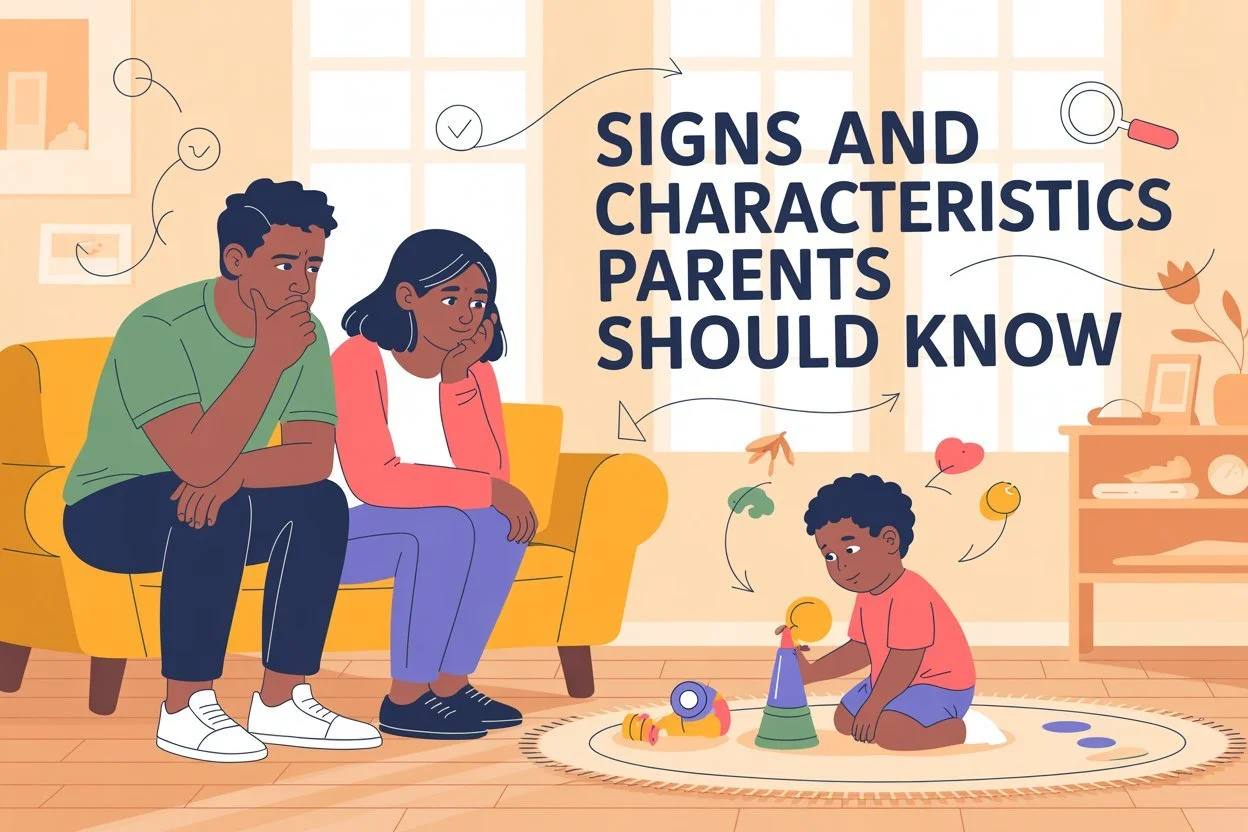
Signs and Characteristics Parents Should Know
For parents trying to understand whether the term profound autism applies to their child's situation, here are the characteristics that researchers and clinicians typically associate with it:
Communication:
Little to no functional spoken language
May use some words or sounds but not in a way that reliably communicates needs
May communicate through behavior, gestures, facial expression, or alternative communication methods
Often benefits significantly from Augmentative and Alternative Communication, known as AAC
Cognitive:
Significant intellectual disability, typically an IQ below 50
Difficulty with abstract thinking and complex problem solving
Learning happens but often at a different pace and through different modalities than neurotypical development
Daily living:
Requires support with most self-care tasks including dressing, hygiene, and eating
May have difficulty understanding safety risks
Needs structured, supported environments to function safely
Behavioral:
May engage in repetitive behaviors that are intense and difficult to redirect
Sensory sensitivities are often significant and affect daily functioning
Emotional regulation challenges may be significant and expressed through behavior
Medical:
Higher rates of epilepsy than the general autism population
Gastrointestinal issues are common
Sleep disorders affect a significant proportion of this population
Regular medical monitoring is an important part of overall care
How Profound Autism Is Diagnosed
Profound autism is not diagnosed separately from ASD in the current US diagnostic system. A child will receive a diagnosis of Autism Spectrum Disorder, Level 3, with additional notations about intellectual disability and language level.
The diagnostic process for a child who may have profound autism typically involves:
A comprehensive developmental evaluation by a developmental pediatrician or child psychiatrist
Cognitive and intellectual assessment by a psychologist
Speech and language evaluation to assess current communication level and needs
Occupational therapy assessment for sensory and daily living skills
Medical evaluation for co-occurring conditions including epilepsy screening
Input from parents, caregivers, and teachers who know the child well
The process is thorough and involves multiple professionals. It takes time. And it often begins long before parents have language for what they are observing, which is why knowing what to look for and how to advocate effectively in the early stages matters so much.
For parents who are in the early stages of this journey and need a clear roadmap for what to do after a diagnosis, the newly diagnosed autism parent guide covers the practical first steps in detail.
What Support Looks Like for Profound Autism
The support needs for profoundly autistic individuals are significant, lifelong, and span multiple domains. Here is an overview of what comprehensive support typically involves:
Communication support: AAC devices and systems are often transformative for nonverbal and minimally verbal autistic individuals. These range from simple picture exchange systems to high-tech speech generating devices. Speech and language therapy focused on AAC implementation is one of the most impactful interventions available.
Educational support: Children with profound autism are entitled to a Free Appropriate Public Education under IDEA, with an IEP that addresses their specific communication, cognitive, behavioral, and daily living needs. Specialized classrooms, one-to-one support, and highly structured learning environments are often necessary.
Behavioral support: Positive behavior support approaches that focus on understanding the function of behavior and meeting underlying needs are more effective and more ethical than punitive approaches. A good behavioral support plan starts with the question: what is this behavior communicating?
Medical management: Regular monitoring for epilepsy, gastrointestinal health, sleep, and other common co-occurring conditions is an important part of overall care. Building a medical team that understands the intersection of autism and these conditions matters.
Family support: The caregiving demands for families of profoundly autistic individuals are significant. Respite care, family therapy, caregiver support groups, and access to coaching and counseling are not luxuries. They are necessities for sustainable family functioning.
What Profound Autism Does Not Mean
This section matters as much as everything above, because some of the most harmful assumptions about profoundly autistic individuals come from what people believe the diagnosis implies.
Profound autism does not mean:
That the person has no inner life, preferences, or experiences worth attending to
That communication is impossible, only that spoken language may not be the right channel
That the person cannot learn, develop, or make meaningful progress with the right support
That relationships, connection, and joy are not available to this person
That their life has less value than the life of an autistic person with more functional independence
That families should lower their expectations for their child's quality of life
Research on AAC and alternative communication has shown repeatedly that many nonverbal autistic individuals have far more to communicate than their verbal output suggests. When the right communication tools are found and supported, the results can be profound in the truest sense of the word.
The person is always there. What changes with the right support is how clearly they can be seen and heard.
For Parents: What to Focus On
If you are parenting a child who has been diagnosed at the more complex end of the autism spectrum, or if you are wondering whether profound autism is a useful framework for understanding your child's needs, here is what matters most:
Focus on communication above everything else
Whatever form it takes, supporting your child's ability to communicate their needs, preferences, and experiences is the highest leverage intervention available. Pursue AAC evaluation early and persistently.
Build your team deliberately
You need professionals who have specific experience with significantly autistic individuals, not just general autism experience. The difference in quality of support is substantial.
Know your legal rights
Your child is entitled to a free and appropriate public education with the supports they need. Budget constraints are not a legal reason to deny services. The post onautism and the legal system rights and protections covers what you are entitled to and how to advocate for it.
Take care of yourself
Caring for a profoundly autistic child is one of the most demanding things a human being can do. Your wellbeing is not separate from your child's wellbeing. It is the foundation of it.
Connect with other families
The families who are thriving are almost never doing it alone. Find your community, whether online or in person, of families who understand the specific reality you are living.
Final Thoughts
Profound autism is a term that is generating significant debate in the autism research and advocacy community. That debate is worth following because it has real implications for how support, funding, and policy are organized around the most significantly affected autistic individuals and their families.
What is not debatable is this: the families and individuals at the most complex end of the autism spectrum deserve fully resourced, genuinely informed, deeply compassionate support. Whether that support is organized under the label of profound autism or under the existing Level 3 framework matters less than whether it actually arrives, in the right form, at the right time, for the right child.
Your child's diagnosis is a starting point. It is not a ceiling. And the support you build around them, the team, the tools, the community, and the belief that they deserve every resource available to help them thrive, is the thing that actually shapes what their life looks like.
That work is worth everything. And you do not have to do it alone.
References:
Autism Science Foundation. ASF Launches First-of-Its-Kind 'Profound Autism' Funding Mechanism [Internet]. 2022 Jul 18. Available from: https://autismsciencefoundation.org/press_releases/asf-launches-profound-autism-funding-mechanism/
Autism Science Foundation. CDC Reports Profound Autism Statistics For The First Time [Internet]. 2023 Apr 19. Available from: https://autismsciencefoundation.org/press_releases/cdc-profound-autism-statistics/
Child Mind Institute. What Is Profound Autism? [Internet]. Available from: https://childmind.org/article/what-is-profound-autism/
Waizbard-Bartov E, Fein D, Lord C, Amaral DG. Autism Severity and Its Relationship to Disability. Autism Res. 2023 Apr;16(4):685-696. Available from: https://pmc.ncbi.nlm.nih.gov/articles/PMC10500663/
Wachtel LE, Escher J, Halladay A, Lutz A, Satriale GM, Westover A, Lopez-Arvizu C. Profound Autism: An Imperative Diagnosis. Pediatr Clin North Am. 2024 Apr;71(2):301-313. Available from: https://pubmed.ncbi.nlm.nih.gov/38423722/
Kripke-Ludwig R. "Profound Autism" Label Does Not Predict Strengths or Help Plan Supports. Public Health Rep. 2023 Nov-Dec;138(6):849-850. Available from: https://pmc.ncbi.nlm.nih.gov/articles/PMC10576471/
Can Autistic Special Interests Become Careers?
There is a question that sits quietly in the back of a lot of autistic people's minds. Sometimes it surfaces in a therapist's office. Sometimes it comes up late at night when the day job has drained everything and the special interest is the only thing that still feels alive.
Can this actually become something?
Can the thing that has absorbed countless hours, generated encyclopedic knowledge, and been the most reliable source of joy and regulation in an autistic person's life actually become the foundation of a career?
The answer is yes. More often than most people expect, and in more ways than most people know about.
But it does not happen by accident. It happens when the right conditions come together, when the autistic person understands their own strengths, when they have the right support, and when they stop treating their special interest as a secret they need to manage rather than an asset they need to leverage.
This post is about how that happens in practice.
Listen to the On the Spectrum podcast with Sonia here.
Table of Contents
Why Special Interests Are a Career Advantage Not a Liability
The Four Conditions That Turn a Special Interest Into a Career
Types of Careers That Grow From Special Interests
How to Map Your Special Interest to a Career Path
Building a Portfolio Around Your Special Interest
The Disclosure Question: Should You Tell Employers About Your Autism
What to Do When the Special Interest Does Not Translate Directly
For Parents: How to Support Your Child's Special Interest as a Future Asset
When the Career Becomes the Special Interest
The Role of Coaching in Making This Transition
Final Thoughts

Why Special Interests Are a Career Advantage Not a Liability
The professional world tends to reward generalists who can do many things adequately. But at the highest levels of almost every field, what actually drives impact and innovation is depth. The person who has gone further into a subject than anyone else in the room. The one who has been thinking about a specific problem for years before anyone else recognized it was a problem.
That is the autistic special interest in professional form.
When an autistic person has spent thousands of hours absorbed in a subject, the knowledge they accumulate is not casual. It is comprehensive, layered, and connected in ways that someone who learned the same subject through a structured curriculum often cannot replicate. They have not just learned the facts. They have internalized the patterns. They have noticed the anomalies. They have asked the questions that most people never think to ask because most people stop long before they get deep enough to find them.
What autistic special interest engagement produces professionally:
Expert-level knowledge that develops naturally rather than through forced study
Pattern recognition that goes beyond what most training programs teach
Sustained focus on complex problems that others find too demanding to maintain
Genuine intrinsic motivation that does not require external incentives to sustain
The ability to communicate with unusual depth and precision about the subject
These are not soft advantages. They are the foundations of expertise. And expertise is what the most valuable careers are built on.
The Four Conditions That Turn a Special Interest Into a Career
Not every special interest automatically becomes a career. But when the following four conditions come together, the transition becomes genuinely possible:
1. There is a market need that the interest meets
The question is not just what do you know deeply but who needs that knowledge and what would they pay or benefit from having access to it. Sometimes this is obvious. A special interest in coding maps directly to software development. A special interest in animals maps to veterinary work, zoology, or wildlife conservation. Sometimes it requires more creative thinking, which the next sections cover.
2. The depth of knowledge creates real expertise
Genuine expertise means being able to solve problems, answer questions, and make connections that less knowledgeable people cannot. If the special interest has been cultivated over years and the autistic person can demonstrate real mastery, that is the raw material of professional value.
3. The working environment accommodates the autistic person's needs
This is the condition that most career advice leaves out entirely, and it is often the one that determines whether the career actually works. An autistic person with extraordinary expertise in a field will not thrive if the work environment is sensorially overwhelming, socially exhausting, or structured in ways that make it impossible to do the deep focused work the job requires. Finding or building the right environment matters as much as finding the right subject.
4. There is support in translating expertise into professional context
Deep knowledge and professional fluency are not the same thing. Many autistic people need support in communicating their expertise in ways the professional world recognizes, building portfolios, navigating interviews, understanding workplace norms, and advocating for the accommodations that make sustained employment possible.
Types of Careers That Grow From Special Interests
Here is a practical overview of the career pathways that most commonly emerge from autistic special interests, organized by the type of interest rather than a specific subject:
Detail and Systems Interests
Special interests in how things work, in rules and structures, in patterns and systems translate well into careers in engineering, architecture, data analysis, quality assurance, research, accounting, law, and software development.
Nature and Animals
Deep engagement with animals, plants, ecosystems, and the natural world connects to veterinary medicine, zoology, marine biology, conservation, environmental science, botany, and wildlife photography.
History, Culture and Language
Special interests in historical periods, languages, cultures, and human societies translate into careers in academia, museum work, translation and interpretation, writing, archaeology, anthropology, and cultural consulting.
Technology and Computing
Special interests in computers, gaming, programming, and digital systems connect to software engineering, cybersecurity, game design, UX research, and artificial intelligence development.
Creative and Artistic Interests
Special interests in music, visual art, film, animation, and design connect to professional creative careers when combined with the right portfolio building and business skills.
People and Psychology
Some autistic people develop deep special interests in human behavior, psychology, social dynamics, and mental health, often born from years of studying neurotypical behavior in order to navigate it. These interests translate into careers in psychology, counseling, research, and advocacy.
Collecting and Categorizing
Special interests that involve collecting, cataloguing, and organizing information or objects translate into careers in library science, archiving, museum curation, taxonomy, and information management.
This list is not exhaustive. The point is that almost every special interest has a professional analog if you look at the underlying cognitive skills rather than the surface subject matter.

How to Map Your Special Interest to a Career Path
If you are an autistic adult trying to figure out how your special interest connects to a career, this framework helps:
Step 1: Name what you actually know
Write down everything your special interest has taught you. Not just the subject matter but the skills. Research skills. Pattern recognition. Technical knowledge. Communication within the domain. Problem-solving approaches. Most people are surprised by how extensive this list is when they actually write it out.
Step 2: Identify the transferable skills
Look at that list and ask: which of these skills are valuable outside the specific context of my interest? Attention to detail. Deep research. Systems thinking. Sustained focus. These are not niche abilities. They are professionally valuable across many fields.
Step 3: Research who needs what you know
Look at job listings, industries, and organizations that work in or adjacent to your special interest area. What problems are they trying to solve? What expertise are they looking for? Where does your knowledge overlap with their needs?
Step 4: Find the intersection
The career lives at the intersection of what you know deeply, what skills you have built, and what the market needs. That intersection is rarely obvious at first glance but it almost always exists.
Step 5: Get the right support
This is where coaching makes a practical difference. Mapping a special interest to a career path is not always something that can be done alone, particularly for autistic adults who may struggle with self-advocacy, executive function around planning, or the social navigation that professional transitions require.
Building a Portfolio Around Your Special Interest
For many autistic people, the most effective way to translate a special interest into a career is not through a traditional resume but through a portfolio that demonstrates the depth of their engagement.
What a strong special interest portfolio includes:
Examples of work produced within the interest, writing, projects, analyses, creative output, technical builds
Evidence of expertise, depth of knowledge demonstrated through documented work
Problem-solving examples that show how the interest has been applied
Community involvement, forums, groups, or organizations related to the interest where the person has contributed
Any formal or informal recognition of expertise within the interest community
For many autistic people, this kind of portfolio already exists in some form. The forum posts, the fan wikis, the personal projects, the documentation they have created for their own use. The work is often already done. It simply needs to be organized and framed in a professional context.
The Role of Coaching in Making This Transition
The gap between knowing your special interest could become a career and actually making that happen is often a practical and emotional one.
Practically, it involves career mapping, portfolio building, understanding workplace rights, and navigating professional environments that were not designed for autistic brains.
Emotionally, it involves believing that your interest is worth building on, that your expertise is real, that you deserve a career that works for your brain, and that the version of yourself that comes most alive in your special interest is the version worth investing in professionally.
Both of those gaps are exactly what Sonia's coaching is designed to address.
Socio-emotional coaching helps autistic individuals navigate the social and professional landscape that surrounds a career transition, including how to communicate their expertise, advocate for accommodations, and build the professional relationships that open doors.
Self-esteem coaching works on the deeper layer, the belief that the authentic, absorbed, deeply engaged version of you is not too much, is not excessive, and is absolutely worth building a life around.
Book a coaching session with Sonia here and start turning your special interest into the career foundation it was always meant to be.
The Disclosure Question: Should You Tell Employers About Your Autism
This is one of the questions autistic adults face most often in career contexts and there is no single right answer. But there are some clear principles worth knowing.
You are not legally required to disclose your autism diagnosis at any point in the hiring process in the United States.
Under the Americans with Disabilities Act, employers cannot ask about disability before making a conditional job offer.
However, to request formal workplace accommodations, some level of disclosure is typically necessary.
You do not have to name the diagnosis specifically but you do need to communicate the functional need.
Many autistic adults choose a middle pat
Disclosing the functional impact of their needs without necessarily naming the diagnosis. For example, communicating that they do their best work in quieter environments or with written rather than verbal instructions, without framing it as an autism disclosure.
Timing matters
Many autistic people find that disclosing after a job offer has been made, rather than during the application process, reduces the risk of discrimination while still allowing them to advocate for the accommodations they need.
For a deeper look at workplace rights under the ADA and what reasonable accommodations autistic employees are entitled to, the post on autism and the legal system rights and protections covers this in full detail.
What to Do When the Special Interest Does Not Translate Directly
Not every special interest has an obvious professional pathway. A deep engagement with a very niche historical period, a specific fictional universe, or a highly specialized technical system may not map directly to an existing job title.
In these cases, the approach shifts from finding the career that matches the interest to finding the career that matches the cognitive style the interest has developed.
Questions to ask:
What cognitive skills has this interest built in me?
What kind of thinking does this interest require that I do naturally and well?
What environments allow me to use those thinking styles most fully?
Which industries value those skills even if they have no connection to my specific interest?
The interest is the training ground. The skills it built are what transfer.
It is also worth noting that having a special interest that is separate from your career is not a failure. For some autistic people, keeping the special interest outside of work preserves its regulatory and restorative function. When the interest becomes a job, the pressure and performance expectations that come with employment can change the relationship with it. That is worth weighing honestly.
For parents thinking about their child's future, the post on autism awareness vs autism acceptance is worth reading alongside this one because the framework you use to see your child's interests will shape every conversation you have with them about their future.
For Parents: How to Support Your Child's Special Interest as a Future Asset
If you are a parent reading this, the practical question is: what can you do now that sets your child up for this kind of future?
What genuinely helps:
Document and celebrate your child's growing expertise. Keep examples of their work, their knowledge, their questions
Connect them with adults who share their interest, mentors, community members, professionals in related fields
Expose them to careers that connect to their interest area without pressuring them toward a specific path
Help them build a portfolio of work from their special interest over time
Advocate for school projects and assessments that allow them to engage their special interest
Talk about the interest as a strength explicitly and repeatedly so they internalize that framing
What to move away from:
Treating the interest as something to be balanced against more practical pursuits
Assuming the interest is a phase that will pass and does not need to be taken seriously
Comparing their interests unfavorably to what their neurotypical peers are interested in
The child who spends hours every day absorbed in something that genuinely captivates them is not wasting time. They are building the foundation of expertise that their career may one day stand on.
When the Career Becomes the Special Interest
One more thing worth naming because it happens and it matters.
Sometimes the relationship runs in the opposite direction. An autistic person finds a job, and through that job discovers a subject that becomes a special interest. The work generates the depth of engagement that the interest usually produces. The career and the interest become the same thing.
When this happens, the results are often remarkable. The sustained focus, the depth of engagement, the genuine intrinsic motivation that characterizes special interest engagement gets applied directly to the work. Output quality goes up. Satisfaction goes up. The career stops feeling like something to endure and starts feeling like something to inhabit.
Finding or creating that kind of alignment is one of the most valuable things an autistic person can do for their professional life. And it is absolutely worth pursuing deliberately rather than leaving to chance.
Final Thoughts
The question is not whether an autistic special interest can become a career. It can, and it does, more often than the world gives credit for.
The real question is whether the autistic person in the middle of that interest has ever been told clearly enough, consistently enough, and early enough that what they are doing is not excessive, is not a symptom, and is not something to hide.
Because the expertise is already being built. The focus is already being applied. The depth is already there.
What most autistic people need is not more ability. They need the belief that their ability is worth something, the right support to translate it into a professional context, and an environment that makes room for the kind of brain they have.
That is the career. And it has been there all along, inside the very thing everyone kept telling them was just a quirk.
References:
American Autism Association. How Special Interests Can Become Careers [Internet]. 2022 Aug 2. Available from: https://www.myautism.org/news-features/how-special-interests-can-become-careers
U.S. Department of Justice, Civil Rights Division. The Americans with Disabilities Act [Internet]. ADA.gov. Available from: https://www.ada.gov/
Paula J. Yost on Advocating for Your Child in a Failing System
There are moments that stay with you forever as a parent.
For Paula J. Yost, attorney and licensed psychotherapist, that moment was pulling out of her son's IEP meeting, driving to a CVS parking lot, and crying so hard she threw up in a coffee cup.
Paula is not someone who falls apart easily. She is a practicing attorney who also holds a master's degree in clinical mental health. She is tough, experienced, and deeply informed about the law. And the school system still left her sitting alone in a parking lot, overwhelmed and furious.
If that resonates with where you are right now, this post is for you.
Paula joined Sonia on the On the Spectrum podcast for one of the most honest conversations about navigating the special education system that you will find anywhere. This post pulls out the key moments, the practical advice, and the parts of that conversation that every special needs parent needs to hear.
Listen to the full episode with Paula J. Yost on the On the Spectrum podcast here.
Table of Contents
Who Is Paula J. Yost
The IEP Meeting That Broke Her
Why the System Fails Parents
Skip the Lawyer: What Paula Actually Recommends
How to Walk Into an IEP Meeting Prepared
What to Do When the School Says They Cannot Afford It
Building Your Village
Celebrating the Wins Other People Miss
The Trauma Schools Leave Behind
What Paula Wants for Every Special Needs Child
About Paula's Book Tumbleweeds
Final Thoughts
Who Is Paula J. Yost
Paula is not your average guest. She brings two professional lenses to the table that most people never combine:
A practicing attorney specializing in estate planning and intellectual property
A licensed psychotherapist working primarily with adults
A survivor of preeclampsia
A mother to a son born with a complete cleft lip and palate
An adoptive mother
The upcoming author of Tumbleweeds: How to Be an Advocate for Your Children and Yourself in a Failing System
Her path to becoming both a lawyer and a therapist started with her own experience of clinical depression, first at 17 and again in law school, and a professor who noticed she was not okay and got her the help she needed.
That counselor, she says, changed her life. He taught her coping skills, helped her understand what she was experiencing, and gave her the foundational building blocks her upbringing had not.
That experience is exactly why she eventually went back to school for her counseling degree on top of her law degree. Because she kept running into people in her legal practice who needed more than the law could give them.
As she said in the episode: the law can only help you so far. It has real limitations on what it is able to do.
The IEP Meeting That Broke Her
Paula's son was born with a complete cleft lip and palate, meaning he came into the world without a roof in his mouth. His doctors were clear from the start: he needed significant speech therapy.
Paula did what any determined mother would do. She read everything. She estimates she has read around 800 medical journals on cleft palate. She knew her son's condition better than most clinicians she encountered. She came into that IEP meeting informed, prepared, and focused on one thing: getting her son the speech therapy he needed.
What happened instead:
She felt ganged up on by people who did not know her son
His medical history was effectively dismissed
Everything she had to say was discredited
She left feeling like no one in that room cared about her child
She drove to pick him up from preschool. She pulled into a CVS parking lot. And she cried until she threw up.
Her first thought leaving that meeting was pure fury: fine, she would just make enough money to pay for private speech therapy herself and work around the system entirely.
Her second thought stopped her cold: what about the mother who cannot do that? What happens to the stay at home mom with a cleft palate child who does not have that option? What happens to the parents whose children have far more profound needs?
That question is what drove everything that followed.
For parents who are in the middle of navigating these exact moments, the work Sonia does in coaching sessions is specifically designed to help you process the emotional weight of advocating in systems that were not built for your family.
Book a coaching session with Sonia here and get the support you need to keep going.
Why the System Fails Parents
Paula was direct about this throughout the conversation. The system is not failing by accident. It is failing because of a combination of factors that stack up against parents:
Budget pressure: Schools use budget constraints as a reason to deny services, even when those services are legally required.
Power imbalance: School districts hold significant institutional power. Most parents walk in alone, emotional, and without a clear understanding of what they are legally entitled to.
Insurance gaps: If insurance covered therapies like speech, occupational therapy, and physical therapy properly, parents would never need to fight the school system for them. The fight exists largely because insurance is not covering what it should.
Lack of legal literacy: Special education law is not widely taught in law school. It is an elective if it is taught at all. Most attorneys, let alone parents, do not have a working knowledge of what the law actually requires.
Time: When parents do escalate through legal channels, the scheduling delays alone can burn through an entire school year. And for young children, that lost time is not recoverable. First and second grade are when children learn to read. Missing those foundational years has lifelong consequences.
As Paula said clearly in the episode: telling a parent you cannot afford to provide what their child is legally entitled to is not an acceptable answer. It is not the parent's problem to solve. It is the school system's problem to solve.
Skip the Lawyer: What Paula Actually Recommends
This is the part of the conversation that surprised people the most, because it came from an actual attorney.
Paula's advice to parents who call her in crisis after an IEP or 504 meeting: do not get a lawyer first.
Here is why, at least in her experience in North Carolina:
If you bring an attorney to an IEP or 504 meeting, the school district will stop the meeting
They will refuse to continue without their own attorney present
Getting both attorneys' schedules aligned can take three to four months
By the time that happens, the school year is over
Your child has lost months of services they needed now
Her recommended path instead:
Step 1: Look for a nonprofit advocate in your community first
Paula mentioned two organizations in her area: Amazing Grace Advocacy and Mental Health America. These nonprofits are often run by retired special needs educators and parents whose own children are now grown. They have spent years in IEP and 504 meetings. They know what to ask for. They know when the school system is trying to get away with something it should not. And they are free.
Step 2: Take the advocate with you into the meeting
Do not go alone. Having someone there who knows the system, who can stay calm when you cannot, and who knows exactly what the child is entitled to changes the dynamic entirely.
Step 3: Use a lawyer only if no advocate resource exists in your area
Paula is not saying never use a lawyer. She is saying exhaust the free, faster, more effective options first. If your community genuinely has no advocate resource, then yes, a lawyer may be necessary.
Her bottom line: if you have the money to spend on a lawyer, you are probably better off using that money to pay privately for the therapy your child needs right now while you continue to fight the system in parallel.
How to Walk Into an IEP Meeting Prepared
Paula was clear that preparation is everything. Going in without a clear goal is one of the biggest mistakes parents make.
Before you walk through the door:
Identify the specific goal. What does your child need? ABA therapy? Speech therapy? Occupational or physical therapy? More time on tests? A sensory room? A school counselor twice a week? Get specific before you arrive.
Know why you need it. Be ready to explain the goal and argue for it with documentation from your child's doctors, therapists, and specialists.
Bring your advocate. Sit with them beforehand and go through the goal together so you are aligned before the meeting starts.
Know your rights. Your child is legally entitled to a Free Appropriate Public Education, known as FAPE. Budget constraints do not override that legal entitlement.
Ask for the goal and keep asking. Paula's advice is simple: walk in, state the goal, ask for it, explain why you need it, and continue to sit there and ask for it.
What to Do When the School Says They Cannot Afford It
This is the response that makes Paula, in her own words, sick of hearing it.
Her framework for responding:
What they say: We do not have the budget for that.
What that means legally: Nothing. Budget constraints do not negate a child's legal right to FAPE.
What to say back: That is not my problem to solve. My child is legally entitled to these services. Your job is to figure out how to provide them.
What to do next:
Document every meeting, every refusal, every communication in writing
Follow up every verbal conversation with an email summarizing what was said
Request everything in writing from the school as well
Contact your state's Parent Training and Information Center, which provides free advocacy support
File a state complaint with your state's department of education if the school continues to refuse
Request mediation through your school district
Consider a due process hearing under IDEA if necessary
Paula also addressed the controversial topic of opportunity scholarships, which in North Carolina provide around $9,000 per year for families with children on IEPs to use toward private school tuition or homeschooling. Her view: it is not a perfect solution and it does create funding challenges for public schools, but for some families, particularly those whose children would thrive in a smaller, more flexible environment, it may be worth exploring.
Every state is different. Every community is different. The key is knowing all the options available to you in your specific location.

Building Your Village
One of the most powerful themes running through this entire conversation is the village. Not as a cliche but as a genuine, practical strategy.
Paula's village looked like this:
A developmental specialist friend who answered the phone after the CVS parking lot moment and told her she was a good mother over and over until it landed
A principal she knew the moment she met that her children would be safe with
Nonprofit advocates who knew the IEP system inside out
Community members who controlled early childhood education funding in her area
Fellow parents who understood the celebrations that other people did not see
Her advice for building your own:
Think about who in your life speaks truth to you in a way you can actually receive
If that person does not exist yet, finding them is worth prioritizing
Therapy can be a genuine part of that support structure, not a last resort but an ongoing resource
Look for people who celebrate the wins that other people miss entirely
Paula was clear that special needs parents are some of the most remarkable people she has ever encountered. Driven entirely by love. Determined in ways that do not quit.
And all of them need someone in their corner.
If you are navigating this journey and you need a space to process the emotional weight of it, to build your own resilience and sense of self alongside all the advocacy work, [listen to the On the Spectrum podcast here] where these conversations happen regularly and honestly.
Celebrating the Wins Other People Miss
This moment in the episode stopped everything.
Paula shared the story of a mother in her community whose son is five years old and has been nonverbal. One day, he started singing. Not just any song but the entire Happy Birthday song, memorized and sung out loud.
To the outside world, that might sound like a small thing. To that mother, it was a miracle. It was proof that her son was in there, communicating, growing, reaching.
Someone in her circle said, well, it was not perfect.
Paula's response: it does not matter. That is a massive win and it deserves to be celebrated exactly as it is.
This is what the autism and special needs parenting community understands that the outside world often does not. Progress does not always look the way other people expect it to. Milestones are personal. Wins are relative to the child and the journey.
You need people in your village who get that. People who will celebrate with you without qualification. People who understand why a song sung imperfectly by a five-year-old who was nonverbal last month is worth every tear of joy it brings.
As Sonia shared in the conversation, she experienced this firsthand growing up, and as a therapist she has sat with countless parents who carry both the grief of the hard days and the profound joy of those breakthrough moments simultaneously.
That combination of grief and joy is something that deserves real support. Not just cheerleading but genuine, skilled, empathetic guidance. The self-esteem coaching work Sonia does is built for exactly that, helping parents and individuals hold both the hard and the hopeful without losing themselves in either.
Book a self-esteem coaching session with Sonia here and build the inner foundation that carries you through both.
What Paula Wants for Every Special Needs Child
Toward the end of the conversation, Paula brought it back to the simplest and most important point of all.
Every child deserves the tools they need to be successful. Not just special needs children. Every child.
Her reasoning is not just humanitarian. It is practical. Children who get what they need grow up to be more successful, more stable, more contributing adults. Children who are failed by the system do not disappear. Their unmet needs become society's problem later, at far greater cost than the early intervention would ever have been.
Her call for legislative change:
Pour money into early childhood education
Fund preschool universally, the way Georgia has done with lottery funding
Invest in early intervention before problems become entrenched
Stop treating special education funding as a line item to cut when budgets get tight
And until the system catches up: keep fighting. Keep showing up. Keep being the troublemaker if that is what it takes.
Because as both Paula and Sonia said in this conversation, the parents who refuse to give up are the ones who change things. Not just for their own children but for every child who comes after them.
About Paula's Book Tumbleweeds
Paula's upcoming book, Tumbleweeds: How to Be an Advocate for Your Children and Yourself in a Failing System, is the written form of everything she has carried for years and finally needed to get out.
She was clear that she did not write it to become a bestseller. She wrote it because it was inside her and needed to come out. Because she hopes that other mothers in whatever situation they are in will read it and feel less alone.
The book is available on Amazon. Search Paula J. Yost or Tumbleweeds to find it.
You can also connect with Paula on Instagram and Facebook at Paula Yost Author and send her a direct message there.
Final Thoughts
Paula J. Yost cried until she threw up in a CVS parking lot after her son's IEP meeting. And then she got back in her car, picked up her son, and kept going.
That is not a story about weakness. That is a story about what it takes to be a special needs parent in a system that was not designed to make it easy.
The good news is that you do not have to navigate it alone. There are advocates. There are communities. There are people who have been exactly where you are and found a way through.
And there are conversations like this one that make you feel less alone in the middle of it.
Homeschooling an Autistic Child: Is It the Right Choice?
For many parents of autistic children, there comes a moment when the question stops being theoretical. The school calls again. The meltdowns after pickup are getting longer. Your child is masking so heavily during the school day that they come home completely depleted. Or the IEP promises are not being kept and the environment that was supposed to support your child is quietly making things worse.
And the thought surfaces: what if we just did this at home?
Homeschooling an autistic child is not a decision to make lightly. But it is also not the radical, last-resort option it is sometimes treated as. For many autistic children, learning at home is not just a viable alternative to traditional school. It is genuinely the better fit.
This post looks honestly at both sides. The real advantages of homeschooling for autistic learners, the genuine challenges it brings, how to know whether it is the right choice for your specific child, and how to build something that actually works if you decide to go that route.
Table of Contents
Why Parents of Autistic Children Consider Homeschooling
The Real Advantages of Homeschooling for Autistic Learners
The Honest Challenges of Homeschooling an Autistic Child
How to Know if Homeschooling Is Right for Your Child
How to Get Started With Homeschooling
Building a Structure That Works for an Autistic Learner
Keeping Therapies and Specialist Support in Place
Socialisation: Addressing the Biggest Concern
Taking Care of Yourself as the Homeschooling Parent
Final Thoughts
Why Parents of Autistic Children Consider Homeschooling
The decision to homeschool rarely comes from nowhere. Most parents who seriously consider it have already spent months or years trying to make traditional school work. They have attended IEP meeting after IEP meeting. They have advocated, compromised, pushed back, and tried again. And somewhere along the way, they have begun to wonder whether the energy spent fighting a system might be better invested in building something entirely different.
The most common reasons parents of autistic children move toward homeschooling include:
A school environment with sensory demands the child cannot sustain across a full day
Bullying or social difficulties that are affecting the child's mental health and self-esteem
A pace of learning that does not match how the child actually processes and retains information
Rigid curriculum structures that fail to accommodate the child's learning style
The cumulative exhaustion of masking throughout the school day leaving the child consistently dysregulated at home
A breakdown in trust between the family and the school around how the child's needs are being met
Geographic isolation or a lack of appropriate specialist school provision locally
None of these are small concerns. And for many families, homeschooling is not a choice made from fear or overprotection. It is a strategic decision made by parents who know their child well and have concluded that a different environment will serve them better.

The Real Advantages of Homeschooling for Autistic Learners
When it works well, homeschooling offers autistic children things that even the best traditional school struggles to provide consistently.
A fully sensory controlled environment
At home, the lighting, sound level, temperature, seating, and overall sensory landscape can be calibrated to the child's specific needs. There are no fluorescent lights that cannot be turned off, no lunch halls that cannot be avoided, no corridors full of unpredictable noise and movement. The environment works for the child rather than the child spending all their energy managing the environment.
Learning at the child's actual pace
Traditional schooling moves at a pace determined by curriculum requirements and the needs of a whole class. Autistic learners often have uneven skill profiles, areas of exceptional ability alongside areas that need significantly more time and support. Homeschooling allows the pace to be set by the child's genuine readiness rather than an external timetable.
Following special interests as a learning vehicle
Special interests are one of the most powerful learning tools available for autistic children and they are almost entirely unusable in a traditional classroom setting. At home, a child's deep interest in trains, animals, history, coding, or any other subject can become the vehicle through which literacy, numeracy, science, and critical thinking are taught. Learning through genuine passion is not a soft option. It is one of the most effective pedagogical approaches available.
No masking pressure
At home, an autistic child does not have to perform neurotypicality for eight hours a day. They can stim freely, take breaks when they need them, communicate in the ways that work for them, and be exactly who they are. The energy saved from not masking is energy that goes directly into learning and regulation.
Flexible scheduling
Homeschooling allows learning to happen at the time of day when the child is most alert and receptive. For many autistic children, that is not nine in the morning. It also allows therapy appointments, medical visits, and rest periods to be built into the week without the disruption that comes from pulling a child out of school.
A calmer home environment after learning hours
One of the most consistent things parents report after transitioning to homeschooling is that the after-school meltdowns reduce significantly. When a child has not spent the day masking, suppressing, and managing an overwhelming environment, they arrive at the end of their learning day with more regulation than they had before.
The autism journey is easier when someone has walked it first and written it down. Get Dropped in a Maze here.

Dropped in a Maze
The Honest Challenges of Homeschooling an Autistic Child
Homeschooling is not a solution that removes all challenges. It replaces some challenges with different ones, and being clear-eyed about those is essential before making the decision.
The responsibility is significant
When you homeschool, you become responsible for your child's entire educational experience. The curriculum, the pacing, the resources, the assessment, the social opportunities, and the overall quality of what is being delivered. That is a substantial undertaking even for the most capable and committed parent.
It requires a significant time commitment
Homeschooling is not just the hours spent teaching. It is the planning, the resource gathering, the record keeping, the evaluating, and the constant adaptation required when something is not working. For working parents or single parents carrying the full caregiving load, the time demands can be genuinely prohibitive.
Specialist support requires more active coordination
In a school setting, speech therapy, occupational therapy, and other specialist services are often delivered on site. At home, those services need to be sourced, scheduled, and transported to, or accessed online. Keeping all of the specialist support in place while homeschooling requires active coordination that adds to the overall load.
Social opportunities require deliberate planning
Autistic children who homeschool do not automatically lose social opportunities, but those opportunities no longer arrive automatically either. They have to be built and maintained intentionally, which takes ongoing effort.
Parent wellbeing is directly connected to outcomes
When you are the teacher, the advocate, the therapist coordinator, and the parent all at once, your own wellbeing is not separate from how well the homeschooling works. It is directly connected. A parent who is burned out cannot deliver good home education. This is not a criticism. It is simply true.
If you are a single parent considering homeschooling, the post on single parenting an autistic child addresses the specific challenges and support strategies relevant to carrying this kind of load alone, and is worth reading alongside this one.
How to Know if Homeschooling Is Right for Your Child
There is no universal answer to whether homeschooling is the right choice. But there are questions worth sitting with honestly before deciding:
Is the current school environment causing your child genuine distress, or is it hard in the way that most challenging environments are hard?
Does your child learn better in calm, one-to-one or small group settings than in larger classroom environments?
Are there specific aspects of school that are the problem, such as the sensory environment, the social demands, or the pace, that could potentially be addressed without leaving school entirely?
Do you have the time, energy, and capacity to take on the role of primary educator without burning out?
Are there homeschooling communities or co-operatives in your area that could provide social connection and shared teaching?
Is homeschooling a long-term plan or a temporary measure while a better school placement is found?
Being honest about the answers, particularly the ones about your own capacity, is as important as being honest about your child's needs.

Homeschooling
How to Get Started With Homeschooling
If you decide homeschooling is the right path, here is how to begin:
Understand the legal requirements in your area
Homeschooling laws vary significantly by country, state, and region. In most places, you are required to notify your local education authority and in some places to register formally. Research the specific requirements where you live before withdrawing your child from school.
Take a decompression period seriously
Many families who move from traditional school to homeschooling find that their child needs several weeks, sometimes longer, to decompress before they are ready to engage with formal learning again. This is normal and healthy. Resist the urge to fill every hour immediately.
Start with what you know about your child
Before choosing a curriculum or approach, start with what you already know. What does your child love? When are they most alert? How do they learn best? What sensory environment helps them focus? Build from there rather than trying to replicate school at home.
Research different homeschooling approaches
There is no single right way to homeschool. Approaches range from structured curriculum-based methods to unschooling, which follows the child's interests entirely, to everything in between. Many autism families find that a relaxed, interest-led approach works best, particularly in the early stages.
Connect with other homeschooling autism families
Other parents who are homeschooling autistic children are your most practical resource. They know what works, what does not, which resources are worth the money, and how to handle the hard days. Finding that community early makes the whole experience more sustainable.
The autism journey is easier when someone has walked it first and written it down. Get Dropped in a Maze here.
Building a Structure That Works for an Autistic Learner
Structure is important for most autistic children, but structure in a homeschool environment looks different from the rigid bell-schedule structure of a traditional school day.
Effective homeschool structure for autistic learners tends to include:
Predictable daily rhythms rather than rigid timetables. Knowing that maths always happens before lunch and reading always happens after is often enough structure without minute-by-minute scheduling that creates pressure.
Visual schedules. A visual representation of the day helps many autistic learners know what is coming and transition between activities with less resistance.
Built-in movement and sensory breaks. Regular breaks for movement, sensory input, or simply doing nothing are not interruptions to learning. They are what makes sustained learning possible.
Clear beginnings and endings to learning sessions. Knowing when something starts and when it will finish reduces the anxiety that can come from open-ended activities.
Flexibility within the structure. On hard days, the structure should be able to flex without collapsing entirely. Having a minimum viable version of the day, the things that will always happen even on difficult days, alongside the full version, gives both parent and child something to fall back on.
Keeping Therapies and Specialist Support in Place
One of the most important things to maintain during homeschooling is the specialist support your child receives. Leaving school does not reduce the need for speech therapy, occupational therapy, or other specialist input. In many cases, it makes coordinating that support easier because it no longer has to work around a school timetable.
Options for maintaining specialist support while homeschooling include:
Continuing with existing therapists and adjusting appointment times to fit the new schedule
Accessing online therapy options, which remove travel time and make appointments easier to fit around learning
Working with therapists to integrate therapeutic strategies directly into the homeschool day
Connecting with a specialist who can advise on how to structure learning in ways that support the child's specific sensory, communication, and regulatory needs
For guidance on finding the right specialist support outside of a school setting, the post on how to find an autism specialist in your area covers exactly how to source, evaluate, and maintain specialist support as an independent family rather than through a school system.
Socialisation: Addressing the Biggest Concern
The socialisation question is almost always the first one raised when homeschooling comes up. And it deserves a real answer rather than a defensive one.
It is true that homeschooled children do not have automatic access to the social environment that school provides. But it is also worth asking honestly whether that social environment was actually serving your autistic child in the first place.
For many autistic children, the social environment at school is a source of significant stress, confusion, and pain rather than genuine connection. Removing that environment does not automatically reduce social opportunity. It removes a specific kind of forced, unstructured social interaction that many autistic children find overwhelming.
Intentional social opportunities for homeschooled autistic children can include:
Homeschool co-operatives where children learn and socialise with other homeschooled peers
Interest-based clubs, groups, and classes where social connection forms around shared passion rather than forced proximity
Regular playdates or meetups with one or two known children rather than large group settings
Community activities such as sports, arts, or faith-based groups
Online communities where autistic children can connect with peers in lower-pressure environments
The goal is not to replicate school socialisation at home. It is to find the kinds of social connection that actually work for your specific child.
Taking Care of Yourself as the Homeschooling Parent
Homeschooling an autistic child is genuinely demanding. The parents who sustain it well over the long term are not the ones who give the most. They are the ones who also invest in their own support systems.
This means:
Having regular contact with other homeschooling parents who understand the specific challenges
Maintaining your own interests, relationships, and identity outside of the homeschooling role
Getting professional support when the emotional weight becomes more than you can process alone
Being honest when something is not working and being willing to change the approach or reconsider the decision
Sonia Chand is a licensed psychotherapist offering specialised online coaching for parents navigating the autism journey. For homeschooling parents who are carrying significant emotional weight alongside the practical demands of home education, both socio-emotional coaching and self-esteem coaching offer a dedicated space to process, recalibrate, and build the confidence and tools needed to sustain this demanding and deeply important work.
Book a coaching session with Sonia here and get the personalised support that makes homeschooling sustainable for both you and your child.
Final Thoughts
Homeschooling an autistic child is not the right choice for every family. But for many families, it is genuinely the best one available, and the children who thrive in home education settings often do so in ways that would never have been possible in a traditional classroom.
The decision deserves to be made with clear eyes. An honest assessment of your child's specific needs. An honest assessment of your own capacity and support system. And a willingness to build something intentional rather than simply replicating school at home.
If the traditional system is not working for your child and you have the capacity to try something different, homeschooling is a legitimate, well-established, and for many autistic learners genuinely transformative option.
Your child deserves an education that actually fits them. That is what this decision is really about.
If you are navigating the autism journey without a map, this book was written for you. Order Dropped in a Maze here.
Single Parenting an Autistic Child: Finding Support
There is a particular kind of exhaustion that single parents of autistic children know. It is not just the physical tiredness of doing everything yourself. It is the weight of being the only one who shows up to every appointment, fights every battle, fills out every form, absorbs every meltdown, and then gets up the next morning and does it all over again.
There is no one to hand it off to at the end of a hard day. No one to sit across the dinner table and share the worry with. No one who loves your child the way you do and understands what this life actually costs.
And yet, somehow, single parents of autistic children do it. Not perfectly. Not without breaking sometimes. But they do it, with a level of love and determination that is genuinely extraordinary.
This post is written for those parents. Not to tell you what you already know about how hard this is, but to give you something practical. Real strategies, real resources, and an honest conversation about finding support when the default assumption of the system is that there are two of you.
Table of Contents
The Unique Challenges Single Autism Parents Face
Give Yourself Permission to Need Help
Building Your Village From Scratch
Navigating Schools and Appointments Alone
Managing the Financial Pressure
Taking Care of Your Own Mental Health
How to Talk to Your Child About Your Family Structure
Finding Your Community Online and Offline
When You Need More Than Information
Final Thoughts
The Unique Challenges Single Autism Parents Face
Two parent families navigating autism have their own significant challenges. But single parenting adds layers that are worth naming honestly, because pretending they do not exist does not help anyone.
There is no backup
When your child has a three hour meltdown on a Tuesday night before a school meeting Wednesday morning, there is no one to take over while you recover. You absorb it and you keep going.
Every decision lands on you
Therapy choices, school placements, medication decisions, financial trade-offs. The weight of getting it right falls entirely on one set of shoulders.
Appointments multiply the problem
Autistic children often have multiple therapy appointments, school meetings, medical visits, and assessment reviews every month. Attending all of them while maintaining employment is a logistical challenge that two parent families split. Single parents carry it alone.
The emotional load has nowhere to go
Parenting an autistic child brings up complex emotions. Grief, guilt, fierce love, fear about the future, pride at every breakthrough. Without a partner to process with, those emotions can build up quietly until they become something harder to manage.
Self care feels impossible
When you are the only caregiver, taking time for yourself feels selfish at best and logistically impossible at worst. But the absence of self care is exactly what leads to the kind of burnout that makes everything harder.
None of this is said to overwhelm. It is said because the first step to finding support is being honest about what you actually need it for.
Give Yourself Permission to Need Help
This sounds simple. It is not.
Many single parents of autistic children carry a quiet shame about needing support. A sense that asking for help is an admission that they are not enough. That a good parent would manage. That the struggles they feel are a sign of failure rather than a completely reasonable response to an objectively hard situation.
That story is not true. And it is worth saying clearly.
Needing help is not a character flaw. It is a logical response to carrying more than one person was designed to carry alone. The parents who build the best lives for their autistic children are not the ones who white-knuckle it in isolation. They are the ones who are honest about their limits and strategic about getting support.
Giving yourself permission to need help is not the end of something. It is the beginning of building something better.
Building Your Village From Scratch
The phrase "it takes a village" gets thrown around a lot. For single parents of autistic children, building that village is not a nice-to-have. It is a survival strategy.
The village looks different for everyone. Here is how to start building one even when it feels like there is nothing there yet:
Start with who already exists
Family members, friends, neighbours, people from your faith community or social circle. Not everyone will understand autism. Not everyone will show up the way you need. But some will, if you ask directly and specifically rather than hoping they will figure out what you need on their own.
Be specific when you ask for help
Saying "I am struggling" often results in sympathetic words and no action. Saying "Could you pick my child up from school on Thursdays so I can make it to their therapy appointment?" gives someone a concrete, manageable way to show up.
Look for respite care options
Many countries and states have respite care programmes specifically for families of children with disabilities. Respite care provides temporary relief for caregivers, giving you scheduled time away from caregiving responsibilities. It is not abandonment. It is maintenance.
Connect with other single autism parents
There is a particular kind of understanding that only comes from someone who is living the same life. Other single parents of autistic children are not just a source of emotional support. They are a practical resource, people who know which services actually work, which professionals to avoid, and how to navigate the system with one set of hands.
Navigating Schools and Appointments Alone
School meetings and therapy appointments are where single parents most acutely feel the absence of a second person. Here is how to navigate them as effectively as possible on your own:
Bring an advocate to IEP meetings
Parent Training and Information Centers, available in every US state, provide free advocacy support to families. Having a knowledgeable advocate in the room means you are not alone at the table even when you are literally the only family member there.
Record meetings where permitted
Check the rules in your area, but in many places you are allowed to record school meetings. Having a record means you do not have to rely solely on your memory when you are processing a lot of information under pressure.
Ask for written summaries
After any significant appointment or meeting, request a written summary of what was discussed and agreed. This protects you when verbal commitments are later forgotten or disputed.
Batch appointments where possible
If your child sees multiple therapists or specialists, ask whether any of them can coordinate their scheduling. Even reducing the number of separate trips per week by one or two makes a meaningful difference to your capacity.
Use telehealth wherever available
Online therapy and appointments remove travel time entirely and allow you to be present without the logistical challenge of getting to a physical location. For single parents, this is not a convenience. It is often the difference between accessing support and not accessing it at all.
For a deeper look at what autism awareness vs autism acceptance means in practice and how to advocate effectively within systems that were not designed with your family in mind, that post covers the broader context every autism parent needs.
Managing the Financial Pressure
Single parenting is expensive. Single parenting an autistic child, with therapy costs, specialist equipment, additional childcare needs, and potentially reduced working hours to manage appointments, adds significant financial pressure to an already stretched budget.
Some practical steps that help:
Know what you are entitled to
Many families do not claim all the financial support available to them simply because they do not know it exists. Depending on where you live, this might include disability living allowance, carer's allowance, supplemental security income, Medicaid waivers, or local authority support funds. Research what is available in your specific location and apply for everything you qualify for.
Ask about sliding scale fees
Many therapists and coaches offer sliding scale pricing for families with financial constraints. It is always worth asking directly rather than assuming a service is out of reach.
Look into charitable grants
Several autism charities and foundations offer grants to families for therapy costs, specialist equipment, and other needs. These grants are underused because families do not know they exist. A quick search for autism family grants in your country or state is worth doing.
Connect with a financial advisor who understands disability
Some financial advisors specialise in working with families of children with disabilities and can help you navigate benefits, plan for your child's future, and make the most of the resources available to you.
Taking Care of Your Own Mental Health
This section is not optional. It is the most important one on this list.
Caregiver burnout does not announce itself dramatically. It creeps in quietly. It looks like chronic exhaustion that sleep does not fix. Emotional numbness. A growing inability to feel joy even in the moments that used to bring it. Resentment that frightens you because you love your child fiercely and the resentment feels like a betrayal of that love.
It is not a betrayal. It is a warning signal. And it deserves to be taken seriously.
Some things that genuinely help:
Therapy or coaching for yourself
Not for your child. For you. Single parents of autistic children carry enormous emotional weight and having a regular space to process that weight with someone trained to help is not a luxury. It is maintenance.
Scheduled time that belongs to you
Even thirty minutes a week that is entirely yours, a walk, a bath, a phone call with a friend, something that has nothing to do with caregiving. It sounds small. It adds up.
Honest conversations with your support network
The people around you cannot help with what they do not know about. Being willing to say "I am not okay right now" to someone who can respond is one of the bravest and most practical things a single parent can do.
The podcast is a space built for exactly the moments when you need to hear from someone who understands what this life actually looks like. Real conversations about the emotional reality of the autism parenting journey, including the parts that do not make it onto the highlight reel.
Listen to the podcast here and find the honest conversation you have been looking for.

How to Talk to Your Child About Your Family Structure
Autistic children often have a deep need for clear, honest, consistent information about their world. Uncertainty and vagueness are frequently more distressing than difficult truths delivered with love and clarity.
Some guidance for talking to your autistic child about your family structure:
Use clear, direct language
Autistic children tend to be literal thinkers. Metaphors and vague reassurances can create more confusion than comfort. Simple, honest, age-appropriate explanations work better.
Answer the questions they actually ask
Rather than pre-emptively delivering a full explanation, follow your child's lead. Answer what they ask, check for understanding, and make space for more questions as they come.
Normalise your family structure without over-explaining
Many family structures exist. Yours is one of them. Communicating that your family is complete and valid, rather than treating it as a deficit to be explained away, gives your child a healthier framework for understanding their own life.
Be consistent
Autistic children often return to the same questions repeatedly, not because they forgot the answer but because consistency and repetition are part of how they process and integrate information. Answer the same question with the same calm, clear answer as many times as it is asked.
Finding Your Community Online and Offline
Isolation is one of the most damaging things about single parenting an autistic child. And community, even imperfect community, is one of the most protective.
Some of the best places to find it:
Online single parent autism groups
Facebook groups, Reddit communities, and dedicated forums for single parents of autistic children exist and are genuinely active. These spaces offer something that is hard to find elsewhere: people who know exactly what your Tuesday night felt like.
Local autism family groups
Many areas have local autism family support groups that meet regularly. Being in a room with other autism parents, even those in two parent families, offers a level of understanding that friends and family outside the autism world often cannot.
Autism charity events and workshops
Many autism charities run events, workshops, and training sessions for families. These are practical, but they are also places where community forms naturally around shared experience.
School communities
Other parents in your child's school, particularly in special education settings, can become some of your most important relationships. They are navigating similar systems, facing similar challenges, and often willing to share information, support, and occasionally childcare.
The best selling autism books recommended for autism families include powerful accounts from parents and advocates who have navigated this road and documented what they learned along the way. Reading them will not solve everything, but it will remind you that you are not the first person to be standing where you are standing, and that people have found their footing from exactly this place.
When You Need More Than Information
There is a point in the single autism parent journey where information stops being what is needed. Where what is actually needed is a real conversation with someone who understands both the autism world and the emotional landscape of trying to navigate it alone.
That is where coaching makes a difference that no blog post can replicate.
Sonia Chand is a licensed psychotherapist offering specialised online coaching for parents and individuals navigating the autism journey. Two services are particularly relevant for single parents:
Socio-Emotional Coaching helps you develop the practical tools to navigate the complex social and institutional interactions that single autism parenting demands. IEP meetings, difficult conversations with family members who do not understand, advocating for your child in systems that push back. Coaching builds the skills and the confidence to show up in those moments effectively, even when you are showing up alone.
Self-Esteem Coaching works on something deeper. The chronic self-doubt that comes from carrying this much alone. The voice that tells you you are not doing enough, not getting it right, not enough full stop. Self-esteem coaching challenges that narrative directly and rebuilds the foundation of self-worth that makes every part of this journey more sustainable.
Both services are delivered entirely online, which means no commute, no childcare to arrange, and no barrier between you and the support you need.
Book a socio-emotional/self-esteem coaching session with Sonia here and build the tools to navigate this journey with more confidence and less isolation.
Final Thoughts
Single parenting an autistic child is one of the hardest things a person can do. That is not an exaggeration and it is not said to be dramatic. It is simply true.
But it is also true that the single parents who navigate this journey well are not superhuman. They are not doing it perfectly. They are doing it by being honest about what they need, strategic about finding support, and willing to ask for help even when everything in them wants to insist they are fine.
You are allowed to not be fine. You are allowed to need support. You are allowed to build a life that works for both you and your child, not just your child at the complete expense of yourself.
Your child needs many things. But one of the things they need most is a parent who is still standing. Who has not burned out completely. Who has enough left to be present, curious, and connected.
Taking care of yourself is not separate from taking care of your child. It is part of the same thing.
You are not doing this alone, even when it feels that way. The community exists. The support exists. And you deserve to find it.
Autism and the Legal System: Rights, Protections and What Parents Need to Know
Most parents of autistic children become accidental experts in a lot of things they never planned to learn. Sensory processing. Therapy approaches. School accommodation plans. But there is one area that catches nearly every autism family off guard, and that is the law.
Not because the laws protecting autistic people do not exist. They do, and in the United States, they are actually quite strong. The problem is that knowing your rights and knowing how to use them are two completely different things. And the families who get the best outcomes for their children are almost always the ones who came to the table informed.
This post covers the key federal laws that protect autistic individuals across education, healthcare, employment, and the legal system. It is written in plain language, because legal information should not require a law degree to understand. And it is written for both parents navigating these systems on behalf of their children and autistic adults who need to understand their own protections.
Consider this your starting point.
Table of Contents
The Federal Laws You Need to Know
Education Rights: IDEA and the IEP Process
Rights Under Section 504 of the Rehabilitation Act
Healthcare and Insurance Protections
Autism and Employment Rights Under the ADA
Autism in Court and Legal Settings
Guardianship, Supported Decision Making and Turning 18
What to Do When Your Rights Are Violated
How Coaching Supports Autistic Individuals Through Legal and Social Challenges
Final Thoughts

The Federal Laws You Need to Know
The Federal Laws You Need to Know
The United States has several federal laws that specifically protect autistic individuals and people with disabilities more broadly. Understanding which law applies to which situation is the foundation of effective advocacy.
Here are the four most important ones:
The Individuals with Disabilities Education Act (IDEA)
This law guarantees every child with a disability, including autism, the right to a free and appropriate public education in the least restrictive environment possible. It covers children from birth through age 21 and is the legal backbone of the IEP process.
Section 504 of the Rehabilitation Act
This law prohibits discrimination against people with disabilities in any program or activity that receives federal funding, which includes public schools, colleges, and many healthcare providers. It is broader than IDEA and applies even when a child does not qualify for special education services.
The Americans with Disabilities Act (ADA)
One of the most wide-reaching disability rights laws in the world, the ADA prohibits discrimination against people with disabilities in employment, public accommodations, transportation, and state and local government services. It covers autistic children and adults.
The Affordable Care Act (ACA)
This law includes significant protections for autistic individuals around health insurance, including prohibiting insurers from denying coverage based on pre-existing conditions and requiring many insurance plans to cover autism-related therapies.
Knowing which law applies to your specific situation is the first step to knowing how to advocate effectively. The sections below break down how each of these laws works in practice.
Education Rights: IDEA and the IEP Process
Education is often where autism families first encounter the legal system, and it is where knowing your rights makes the most immediate difference.
Under IDEA, every autistic child is entitled to:
A free and appropriate public education tailored to their individual needs
An Individualized Education Program, known as an IEP, developed by a team that includes parents as equal members
Placement in the least restrictive environment, meaning alongside non-disabled peers to the maximum extent appropriate
Related services such as speech therapy, occupational therapy, and counselling if those services are necessary for the child to benefit from education
Procedural safeguards that protect parents' rights throughout the process
What parents need to know about IEPs
The IEP is a legally binding document. Every commitment made in that document, every service, every accommodation, every goal, is something the school is legally required to deliver. If the school fails to implement what is written in the IEP, that is a legal violation, not just an administrative oversight.
Parents have the right to:
Request an IEP meeting at any time, not just at the annual review
Disagree with the school's evaluation and request an independent educational evaluation at the school's expense
Bring an advocate or attorney to any IEP meeting
Refuse to sign an IEP they disagree with
File a formal complaint or request mediation if the school is not meeting its legal obligations
One of the most common mistakes parents make is treating the IEP meeting as a collaboration where everyone is on the same side. Sometimes that is true. Sometimes it is not. Going in knowing your rights changes the dynamic entirely.
Section 504 of the Rehabilitation Act
Rights Under Section 504 of the Rehabilitation Act
Not every autistic child qualifies for an IEP under IDEA, but many of those same children are still entitled to protections and accommodations under Section 504.
Section 504 applies to any school or program that receives federal funding and covers any student whose disability substantially limits one or more major life activities. For autistic students, that might include learning, concentrating, communicating, or managing sensory input.
Under a 504 Plan, a school might provide:
Extended time on tests and assignments
A quiet testing environment
Preferential seating
Permission to use noise-cancelling headphones
Modified homework loads
Regular check-ins with a trusted staff member
Section 504 also extends beyond school. It applies to colleges and universities, meaning autistic students transitioning to higher education can request accommodations through their school's disability services office. It applies to healthcare providers who receive federal funding. And it applies to any federally funded program or activity.
If your child does not qualify for an IEP but is still struggling in school because of their autism, a 504 Plan is often the next step to pursue.
Healthcare and Insurance Protections
Healthcare access is one of the most pressing concerns for autism families, and the legal landscape here has shifted significantly in recent years.
Under the Affordable Care Act, insurance companies cannot:
Deny coverage to autistic individuals based on their diagnosis as a pre-existing condition
Set lifetime or annual dollar limits on essential health benefits
Charge autistic individuals higher premiums than non-disabled individuals for the same plan
All 50 states now have autism insurance mandates, meaning most private insurance plans are required to cover autism-related treatments and therapies. The specifics vary by state, including which therapies are covered, age limits, and annual caps, so it is worth checking your state's specific mandate requirements.
Medicaid also provides significant coverage for autism-related services for eligible families, including Applied Behaviour Analysis, speech therapy, occupational therapy, and personal care services. Many autistic adults also receive Medicaid coverage, particularly those who qualify through Supplemental Security Income.
If an insurance claim for autism-related treatment is denied, parents and individuals have the right to appeal that decision. Many denials are overturned on appeal, particularly when supported by documentation from treating clinicians.
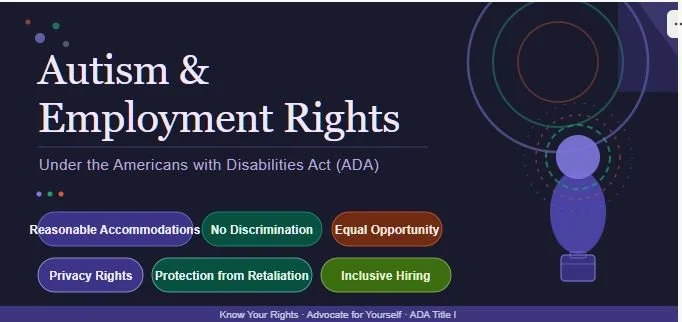
Autism and Employment Rights
Autism and Employment Rights Under the ADA
For autistic adults in the workforce, the Americans with Disabilities Act provides critical protections that are not widely enough understood.
Under the ADA, employers with 15 or more employees are prohibited from:
Discriminating against a qualified individual with a disability in hiring, firing, pay, job assignments, or any other term of employment
Asking about a disability before making a job offer
Requiring a medical examination before a conditional job offer is made
Autistic employees are also entitled to reasonable accommodations, meaning changes to the work environment or the way a job is performed that allow them to do their job effectively. Reasonable accommodations for autistic employees might include:
Written rather than verbal instructions
A quieter workspace or permission to use noise-cancelling headphones
Flexible scheduling to accommodate therapy appointments or sensory needs
Clear and explicit communication of expectations and feedback
Permission to work remotely when possible
An employer is required to provide reasonable accommodations unless doing so would cause undue hardship to the business. The standard for undue hardship is high, and most common accommodations do not meet it.
Disclosing an autism diagnosis at work is a personal decision and there is no legal requirement to do so. However, to request formal accommodation, some level of disclosure is typically necessary. Many autistic employees choose to disclose the functional impact of their needs without necessarily naming the diagnosis.
Autism in Court and Legal Settings
This is an area that does not get nearly enough attention in the autism community, and it is one where the stakes are very high.
Autistic individuals interact with the legal system in many different ways. As witnesses. As victims of crime. As defendants. As parties in family court proceedings. And in each of those situations, the characteristics of autism can be profoundly misunderstood by legal professionals who have not received adequate training.
Some of the specific challenges autistic individuals face in legal settings include:
Difficulty with direct eye contact being misread as dishonesty or lack of credibility
Literal communication style being misinterpreted in a legal context where language is often indirect and layered
Sensory sensitivities making courtroom environments overwhelming
Difficulty understanding the implications of waiving rights, particularly Miranda rights during police interactions
Responses to stress or anxiety that may appear unusual to untrained observers
The Washington State Courts Disability Justice Task Force has produced a detailed guide on supporting autistic individuals in court settings, covering everything from communication adjustments to environmental accommodations. It is a valuable resource for legal professionals, advocates, and families.
You can access that guide here.
For parents, being proactive about this is important. If your autistic child ever comes into contact with law enforcement or the court system, having documentation of their diagnosis and a clear explanation of how their autism presents can make a significant difference to how they are treated and understood.
For autistic adults, understanding your rights in legal settings before you ever need them is far better than trying to figure it out in a moment of crisis.
Guardianship, Supported Decision Making and Turning 18
One of the most significant and least discussed legal transitions for autism families happens when a child turns 18. In the eyes of the law, they become an adult. And that has real legal implications.
At 18, parents no longer have automatic legal authority to make decisions on behalf of their child, access their medical records, speak to their school or college, or manage their finances. Many parents are caught completely off guard by this.
There are several legal options available depending on the individual's needs and level of independence:
Full guardianship gives a parent or appointed guardian legal authority to make decisions on behalf of an adult with a disability. It is a significant legal step that removes many of the individual's legal rights and should only be pursued when truly necessary.
Limited guardianship grants authority in specific areas only, such as medical decisions or financial management, while preserving the individual's autonomy in other areas.
Supported decision making is a less restrictive alternative to guardianship that is gaining recognition across the US. Rather than transferring legal decision-making authority to another person, supported decision making allows the autistic adult to make their own decisions with the support of trusted people. Several states now have formal supported decision making agreements in law.
Power of attorney and healthcare proxies are legal documents that allow an autistic adult to designate someone to act on their behalf in specific situations, while retaining their own legal rights.
The right option depends entirely on the individual. Many autistic adults are fully capable of making their own decisions and guardianship would be both unnecessary and harmful to their autonomy and self-determination. It is worth consulting a disability rights attorney well before your child's 18th birthday to understand the options available.
What to Do When Your Rights Are Violated
Knowing your rights is only useful if you also know what to do when those rights are not being respected. Here is a plain language overview of the options available:
For education rights violations: File a state complaint with your state's department of education. Request mediation through your school district. File for a due process hearing under IDEA. Contact your state's Parent Training and Information Center, which provides free advocacy support to families.
For discrimination under the ADA or Section 504: File a complaint with the Office for Civil Rights at the US Department of Education for school-based violations. File a complaint with the Equal Employment Opportunity Commission for workplace discrimination. Contact a disability rights attorney for advice on civil litigation.
For insurance denials: File an internal appeal with your insurance company. Request an external review if the internal appeal is unsuccessful. Contact your state's insurance commissioner. Seek support from a patient advocate or attorney who specialises in insurance law.
For legal system issues: Contact a disability rights organisation in your state. Reach out to the Autism Society of America's legal resources page, which provides guidance and referrals for autistic individuals and families navigating legal challenges.
You can access those resources here.
Document everything. Keep records of every communication, every meeting, every decision, and every incident. When it comes to asserting legal rights, documentation is everything.
How Coaching Supports Autistic Individuals Through Legal and Social Challenges
Understanding your legal rights is one thing. Having the confidence, communication skills, and emotional grounding to actually assert them is another.
Many autistic adults and the parents of autistic children find that the moments where legal rights matter most, IEP meetings, workplace accommodation requests, court appearances, transition planning, are also the moments where socio-emotional challenges are most acute. The pressure is high. The stakes are real. And the ability to communicate clearly, advocate calmly, and hold your ground under stress makes an enormous practical difference.
This is where coaching fills a gap that legal information alone cannot.
Sonia Chand is a licensed psychotherapist offering specialised online coaching for neurodivergent individuals. Her two core coaching services are particularly relevant for autistic adults and families navigating complex systems:
Socio-Emotional Coaching: helps autistic individuals develop the practical tools to navigate high-stakes social and institutional interactions, including how to communicate needs clearly, how to manage the emotional weight of advocacy, and how to build the kind of confident, grounded presence that gets results in rooms that were not designed for them.
Self-Esteem Coaching: works on the deeper layer. Years of being dismissed, misunderstood, or overridden by systems that did not see you clearly can erode the belief that your voice matters. Self-esteem coaching rebuilds that foundation, so that when it counts, you show up knowing your rights are worth fighting for and that you are the right person to fight for them.
Book a socio-emotional coaching session with Sonia here and build the skills to advocate effectively for yourself
Final Thoughts
The legal protections available to autistic individuals and their families in the United States are genuinely substantial. IDEA, the ADA, Section 504, and state-level insurance mandates together create a framework of rights that, when understood and used effectively, can make a real and lasting difference to the quality of life, education, healthcare, and opportunity available to autistic people.
But those rights do not enforce themselves. They require parents and autistic individuals who know what they are entitled to, who document carefully, who ask the right questions, and who are willing to push back when the system falls short.
That is not always easy. It takes energy, confidence, and a clear sense that your needs and your child's needs are worth advocating for. Building that capacity is part of the work. And it is work that nobody should have to do entirely alone.

ABA Therapy, Occupational Therapy and Speech Therapy for Autism Explained
When a child is diagnosed with autism, the word therapy comes up almost immediately.
Sometimes it comes up before the diagnosis is even confirmed. And for most parents, it arrives alongside a wave of acronyms, referral letters, and waiting lists that can feel completely overwhelming.
ABA. OT. SALT. SLT. Each one is a different discipline. Each one has its own philosophy, its own approach, and its own body of research. And each one means something different depending on who you ask.
The goal of this post is simple. To cut through the noise and explain what each therapy actually is, what it does, what the research says, and how to decide what is right for your child.
Because the decision about therapy is one of the most important ones a parent will make after diagnosis. And it deserves more than a rushed recommendation in a fifteen minute appointment.
Table of Contents
Why Therapy Decisions Matter So Much
ABA Therapy Explained
The Honest Debate Around ABA
Occupational Therapy Explained
What OT Actually Looks Like in Practice
Speech and Language Therapy Explained
What SALT Actually Looks Like in Practice
How the Three Therapies Work Together
How to Decide What Your Child Needs
Questions to Ask Before Starting Any Therapy
Helpful Resources
Final Thoughts
Why Therapy Decisions Matter So Much
Therapy is not neutral.
Every therapy your child receives communicates something to them about who they are and what is expected of them. Some approaches communicate that your child is capable and worthy of support. Others, unintentionally, communicate that your child's natural way of being is wrong and needs to be corrected.
That distinction matters enormously.
According to the World Health Organization, the abilities and needs of autistic people vary and can evolve over time. What works for one child may not work for another. And what looks like progress in one setting may not reflect genuine wellbeing in another.
According to data from the Centers for Disease Control and Prevention, about 1 in 31 children aged 8 years has been identified with autism spectrum disorder. That is a significant number of families navigating these decisions, often without enough information and often under enormous time pressure.
The earlier the right support is in place the better the outcomes tend to be. But earlier is only better if it is also the right kind of support.
That is why understanding what each therapy actually involves before committing to it is so important.
If your child was recently diagnosed and you are still finding your footing, the post on newly diagnosed: what to do after your child gets an autism diagnosis covers the broader landscape of first steps and is worth reading alongside this one.
ABA Therapy
ABA Therapy Explained
Applied Behaviour Analysis, known as ABA, is one of the most widely recommended and most heavily funded autism therapies in the world.
At its core, ABA is a science of behaviour. It applies principles of learning theory to understand why behaviours occur and to teach new skills or reduce behaviours that interfere with learning and daily life.
ABA works through a system of antecedents, behaviours, and consequences. In simple terms: something happens before a behaviour, the behaviour occurs, and something happens after that either reinforces or discourages the behaviour happening again.
In practice, ABA programmes typically involve:
Breaking skills down into small, teachable steps
Using positive reinforcement to encourage desired behaviours
Repeated practice of skills across different settings
Data collection to track progress over time
Individualised programmes based on each child's specific goals
ABA is delivered in different formats. Intensive programmes can involve up to forty hours per week. Less intensive programmes may involve a few hours per week. It can be delivered one-to-one, in small groups, at home, at school, or in specialist centres.
According to Autism Speaks, ABA is considered an evidence-based best practice treatment by the US Surgeon General and the American Psychological Association.
The Honest Debate Around ABA
ABA is also one of the most controversial topics in the autism community and that debate deserves an honest hearing.
Many autistic adults who experienced intensive ABA as children have spoken publicly about its impact. Some describe it positively. Others describe it as harmful, reporting that it taught them to suppress their natural autistic responses at significant psychological cost.
The criticism centres on a few key concerns:
Early ABA focused heavily on eliminating autistic behaviours like stimming rather than building genuine skills
The pressure to comply and perform can teach autistic children that their natural responses are wrong
The intense focus on normalisation can contribute to masking and the long-term costs that come with it
Some children experience ABA as stressful and coercive even when it is not intended to be
It is important to note that ABA has evolved significantly. Modern, naturalistic ABA looks very different from the intensive discrete trial training of earlier decades. The best ABA practitioners today focus on building functional skills, following the child's lead, and prioritising the child's quality of life rather than the reduction of autistic traits.
The key questions to ask of any ABA programme are: what is the goal of this therapy and does that goal centre the child's wellbeing or the comfort of the people around them?
Doing autism differently, which the post on doing autism differently: how to stop managing autism and start understanding it explores in depth, means applying that same question to every therapy decision you make.
Dropped in a Maze by Sonia Chand navigates exactly these kinds of decisions honestly. The moments of doubt, the wrong turns, and the clarity that eventually comes.
Order your copy here and read what most therapy leaflets will never tell you.
Occupational Therapy
Occupational Therapy Explained
Occupational therapy, known as OT, focuses on helping people participate in the activities of daily life.
For autistic children, that scope is broad. OT addresses the skills needed to function in everyday environments, at home, at school, and in the community.
The word occupational does not refer only to work. In this context, occupation means any meaningful activity. For a child, that includes playing, learning, dressing, eating, writing, and navigating sensory environments.
Occupational therapists who work with autistic children are trained to assess and support:
Sensory processing differences
Fine motor skills like writing, cutting, and fastening buttons
Gross motor skills like coordination, balance, and physical confidence
Self-care skills like dressing, toileting, and eating
Visual perceptual skills needed for reading and spatial awareness
Emotional regulation through a sensory lens
Participation in school and social environments
OT is often the therapy that makes the most visible difference to daily family life because it directly addresses the practical challenges that show up every single day.
What OT Actually Looks Like in Practice
An occupational therapy session for an autistic child might look very different from what most people expect.
It often looks like play.
A skilled OT uses carefully designed activities to build the skills they are targeting. Swinging, climbing, and movement-based play might be addressing sensory regulation. Building with blocks might be developing fine motor control. An obstacle course might be working on coordination and body awareness.
The child experiences it as fun. The therapist is simultaneously assessing, building, and monitoring the skills underneath.
OT also involves the family directly. A good occupational therapist will teach parents and carers how to carry strategies into daily routines so that progress is not limited to the therapy room.
Sensory processing is one of the areas where OT makes the biggest difference for many autistic children. Understanding your child's sensory profile, whether they are over-responsive, under-responsive, or seeking in different sensory channels, changes how you set up their environment, how you respond to their behavior, and how much unnecessary stress gets removed from their daily life.
The post on 7 common early signs of autism in infants and toddlers covers some of the early sensory signs worth watching for and why they matter for future support planning.
Speech and Language Therapy
Speech and Language Therapy Explained
Speech and language therapy, known as SALT or SLT, addresses communication in its broadest sense.
For autistic children, communication support goes far beyond helping a child produce words. It covers the full range of how a person sends and receives messages, verbally and nonverbally.
Speech and language therapists who work with autistic children focus on:
Developing spoken language where it is delayed or absent
Supporting nonverbal communication including gesture, facial expression, and body language
Building social communication skills including conversation, turn-taking, and understanding context
Introducing and developing augmentative and alternative communication systems for children who are nonverbal or minimally verbal
Addressing the literal processing of language that can make idioms, sarcasm, and implied meaning confusing
Supporting narrative skills, the ability to tell a story, explain an event, or describe an experience
Speech therapy is relevant for autistic children across the spectrum. It is not only for children who do not speak. Many verbal autistic children have significant support needs around the social use of language that speech therapy directly addresses.
What SALT Actually Looks Like in Practice
Like OT, speech therapy sessions for young children are typically play-based.
A speech therapist might use toys, books, games, and structured activities to target specific communication goals. They might work on back-and-forth interaction through play. They might model language without demanding it. They might introduce communication symbols or devices for a child who is nonverbal.
The best speech therapy is built around the child's interests and communication style rather than a generic programme applied to all autistic children equally.
It also extends beyond the therapy room. Parents and carers are taught strategies to use at home, at mealtimes, during play, and throughout daily routines. Because communication develops in relationship and context, not just in weekly appointments.
For a detailed look at communication strategies for nonverbal and minimally verbal autistic children, the post on nonverbal autism communication strategies and support goes deep on AAC, PECS, sign language, and technology-based communication tools.
The podcast also covers speech and communication regularly, with honest conversations about what progress really looks like and how families can support it at home.
Listen to the podcast here and get practical, experience-based insight on communication support for autistic children.
How the Three Therapies Work Together
ABA, OT, and speech therapy are not competing approaches. For many autistic children, they work best in combination.
Here is how they complement each other:
ABA provides the behavioural framework and skill-building structure. It can be used to teach the specific skills that OT and speech therapy identify as goals.
OT addresses the sensory and motor foundations that underpin learning and participation. A child who is in sensory overload cannot engage with ABA or speech therapy effectively. OT creates the conditions in which other therapies can work.
Speech therapy builds the communication skills that connect everything. A child who can communicate their needs, express discomfort, and engage with others has a fundamentally different experience of every other therapy they receive.
The key is coordination. The best outcomes happen when therapists are communicating with each other and with the family, working toward shared goals rather than operating in silos.
How to Decide What Your Child Needs
Every autistic child is different. The right combination of therapies depends on your child's specific profile, not on a standard post-diagnosis checklist.
Some starting questions worth asking:
What are my child's most significant areas of need right now? Communication, sensory processing, motor skills, and behaviour all point toward different therapy priorities.
What are my child's strengths? Good therapy builds on strengths rather than only targeting deficits. A therapist who cannot identify your child's strengths quickly is worth questioning.
What does my child enjoy? Therapy is most effective when it is motivating. A child who is distressed in therapy sessions is not learning effectively regardless of the approach.
What can our family sustain? Therapy schedules can become consuming. A realistic, sustainable programme that the family can implement consistently is more valuable than an intensive programme that burns everyone out within six months.
What are the goals? Every therapy goal should be clearly stated, measurable, and centred on your child's quality of life. If a goal is about making your child appear more neurotypical rather than genuinely improving their wellbeing, that is worth interrogating.
Questions to Ask Before Starting Any Therapy
Before committing to any therapy programme, these questions are worth asking directly:
What specific goals will this therapy target for my child?
How will progress be measured and how often will it be reviewed?
What does a typical session look like?
How will you involve me as a parent in carrying strategies into daily life?
What is your approach to autistic identity and acceptance?
What happens if my child is distressed during sessions?
Do you have experience working with children at my child's level of support need?
Can you provide references or connect me with other families you have worked with?
A good therapist will welcome these questions. They will answer them clearly and directly. And they will treat you as a genuine partner in your child's support rather than someone to be managed alongside the child.
Final Thoughts
Therapy is a tool. Like any tool, its value depends entirely on how it is used and whether it is the right tool for the job.
ABA, occupational therapy, and speech therapy each have genuine evidence behind them. Each can make a meaningful difference in an autistic child's life when implemented well, by skilled practitioners, with clear goals, and with the child's wellbeing genuinely at the centre.
None of them are magic. None of them work the same way for every child. And none of them replace the most important thing of all, a family that understands their child deeply and advocates loudly for what they need.
That understanding is what Dropped in a Maze is built around. Not a guide to therapies but an honest account of navigating the whole landscape, the decisions, the doubts, and the moments when everything finally begins to make sense.
Order your copy of Dropped in a Maze here. Because the therapy decisions are just one part of a much bigger journey and you deserve support for all of it.

Does Autism Come From the Father? What the Research Actually Says
After an autism diagnosis, parents start looking back.
They scan family histories. They replay conversations. They try to make sense of where this came from and why it happened in their family.
One of the most searched questions in that process is a simple one: does autism come from the father?
It is a fair question. And the honest answer is that genetics and autism have a relationship that science is still working to fully understand.
What is clear is this. Autism does not have a single cause. It is not something one parent did or did not do. It is not caused by parenting style, vaccines, or any of the myths that keep circulating online.
What the research does show is that genetics play a significant role. That the father's contribution is part of that picture. And that new areas of science are adding layers of understanding that were not available even a decade ago.
This post walks through what the current science actually says, what it means for families, and what to do with that information once you have it.
Table of Contents
What Causes Autism? The Short Answer
The Role of Genetics in Autism
Does Autism Come From the Father Specifically?
What Is Epigenetics and Why Does It Matter?
The Johns Hopkins Sperm Study Explained
What About the Mother's Genetic Contribution?
Advanced Paternal Age and Autism Risk
Does This Mean Autism Is Inherited?
What This Research Means for Families
Helpful Resources
Final Thoughts
What Causes Autism? The Short Answer
Autism does not have one cause.
That is the starting point for any honest conversation about this topic and it is worth saying clearly before going any further.
According toAutism Speaks, research tells us that autism tends to run in families. A meta-analysis of seven twin studies found that 60 to 90% of the risk of autism comes from your genome.
That is a significant genetic contribution. But it still leaves room for environmental factors, developmental influences, and complex gene-environment interactions that researchers are only beginning to map.
No single gene causes autism. No single parent causes autism. No single decision or exposure causes autism.
It is the result of a combination of factors, many inherited, some not, all interacting in ways that vary from person to person.
According todata from the Centers for Disease Control and Prevention, about 1 in 31 children aged 8 years has been identified with autism spectrum disorder. This number reflects how common autism is. They also reflect how much genetic variation is involved.
Autism is not one thing happening for one reason. It is a spectrum of neurological differences with a complex and still unfolding genetic story.
The Role of Genetics in Autism
Autism is highly heritable. Studies of twins consistently show that if one identical twin is autistic, the other has a significantly higher chance of also being autistic compared to non-identical twins or siblings.
That points strongly to genetics.
Hundreds of genes have been associated with autism risk. These are not single mutations that cause autism in a direct, simple way. They are variations that increase or decrease the likelihood of autism developing, often in combination with other factors.
Some of these variations are inherited from parents. Others arise spontaneously. These are called de novo mutations and they are a significant part of the autism genetics picture.
What this means practically:
Two autistic siblings can have different genetic pathways to the same diagnosis
An autistic child can have parents with no diagnosis who still carry contributing variations
Having one autistic child increases statistical likelihood for future children but does not guarantee it
The complexity here matters. It is what makes autism genetics a field of ongoing research rather than a settled science.
Understanding genetic factors in Autism
Does Autism Come From the Father Specifically?
The research suggests that paternal genetics do play a meaningful role. But not in a simple or exclusive way.
Several studies have found that certain genetic variations associated with autism are more likely to be inherited from the father than the mother.
Part of the reason is biological. The cells that produce sperm divide continuously throughout a man's life. Each division carries a small risk of copying errors. The older a father is, the more divisions have occurred and the higher the accumulation of potential mutations.
This does not mean autism comes only from the father. It means paternal genetics are one significant part of a much larger picture.
There is also emerging research in epigenetics that adds another dimension entirely. That is where things get particularly interesting.

What Is Epigenetics?
What Is Epigenetics and Why Does It Matter?
Epigenetics is the study of changes in how genes are expressed without changes to the underlying DNA sequence itself.
Think of it this way. Your DNA is the script. Epigenetics is about which parts of the script get read, when, and how loudly.
Epigenetic changes can be influenced by environment, lifestyle, and age. And some epigenetic changes can be passed from parent to child.
This means that a father's biological environment can potentially influence how his genes are expressed in his children, without any change to the DNA code itself.
The research here is still developing. But it opens up important questions about how autism risk is transmitted across generations and what role paternal biology plays beyond DNA sequence alone.
The Johns Hopkins Sperm Study Explained
In April 2023, researchers at Johns Hopkins University published findings that added a significant new piece to the autism genetics puzzle.
The study, reported in the journal Molecular Psychiatry, examined families with children diagnosed with autism spectrum disorder. Researchers found a link between chemical marks on DNA in the sperm of fathers and autistic traits in their three-year-old children.
These chemical marks are epigenetic changes. They do not alter the genetic code itself. But they affect how that code is read and used by the body.
The study looked at 45 fathers and 31 children. The researchers are clear that the sample is small and the findings may not hold in the general population.
But the implications are significant.
Co-lead investigator Heather Volk, an associate professor of mental health at the Johns Hopkins Bloomberg School of Public Health, noted that if further research confirms these findings, the epigenetic signs identified could become potential markers for autism risk. They may also help families secure earlier intervention for children showing autistic traits.
Volk also pointed out something important. This research could reveal genetic contributions to autism that are currently being missed by gene sequencing that only looks at direct DNA code.
In other words, the code alone does not tell the whole story. How that code is expressed matters too.
What this study does not say is that autism is caused by fathers. What it suggests is that paternal biology is part of a complex picture that science is only beginning to understand fully.
Dropped in a Maze by Sonia Chand is an honest account of navigating autism from the inside. The questions, the research rabbit holes, the moments of clarity, and the ones that took much longer to come.
What About the Mother's Genetic Contribution?
It would be incomplete to talk about paternal genetics without acknowledging that maternal genetics are equally part of the picture.
Research has suggested that in some cases, genetic variants associated with autism are more likely to be inherited from mothers. This connects to what is sometimes called the female protective effect.
The theory proposes that females require a higher genetic load to develop autism. This means women can carry more autism-associated variants without being autistic themselves, and pass those variants on to their children.
This may partly explain why autism is diagnosed more frequently in males. Though it is increasingly recognised that autism in females is significantly underdiagnosed because of how differently it presents and how effectively girls learn to mask autistic traits.
Both parents contribute genetically. Asking whether autism comes from the father or the mother is a bit like asking which parent is responsible for a child's eye colour.
Both contribute. The outcome depends on the combination.
Advanced Paternal Age and Autism Risk
One of the more consistently replicated findings in autism genetics is the link between advanced paternal age and increased autism risk.
Children born to older fathers have a statistically higher risk of autism compared to children born to younger fathers. This is thought to relate to the accumulation of de novo mutations in sperm over time, as well as epigenetic changes that build up with age.
To be clear, the increased risk is real but modest in absolute terms.
The vast majority of children born to older fathers are not autistic. Many autistic children are born to young fathers. Age is one factor among many and it does not determine outcome.
What this research suggests is that paternal age is worth including in conversations about autism risk factors, alongside the many other contributors that researchers continue to study.
The podcast explores exactly these kinds of conversations regularly. The research, what it means in real life, and how families can make sense of it without spiralling into anxiety.
Listen to the podcast here and join a community navigating these questions together.
Does This Mean Autism Is Inherited?
In a general sense, yes.
Autism has a strong hereditary component. If you have an autistic child, there is a higher likelihood that other family members are also autistic or carry related traits, even without a formal diagnosis.
This is why many parents receive their own autism diagnosis after their child is diagnosed. They recognise themselves in what they are learning. Traits they always thought of as quirks suddenly have a framework.
That recognition can be profound. It can also be complicated.
Autism inheritance does not follow a simple dominant or recessive pattern. It is polygenic, meaning many genes contribute. And multifactorial, meaning non-genetic factors also play a role.
This makes predicting inheritance difficult. Genetic counselling, rather than internet research, is the right tool for families wanting personalised information about their specific situation.
For more on what autism means at a broader level and why the language used around it shapes the support that gets built, the post on autism awareness vs autism acceptance is worth reading alongside this one.
What This Research Means for Families
If you came to this post because your child was recently diagnosed and you are trying to understand where autism came from, here is what matters most.
Knowing the genetic contribution does not change what your child needs right now.
It does not change the support strategies. It does not change the therapy options. It does not change the love and advocacy your child deserves.
What it does is add context. And context can be genuinely helpful.
Understanding that autism has a strong genetic basis can help reduce guilt. No parent caused their child's autism by something they did or did not do.
It can also prompt families to look at older relatives with fresh eyes. To recognise autism traits in parents or grandparents who were never diagnosed. And to approach those family members with new understanding.
For practical support on what communication looks like for autistic children and how to build the right environment, the post on nonverbal autism communication strategies and support is a detailed and useful next read.
If you are ready for personalised support in navigating your family's autism journey, coaching is available for parents who want more than information. They want direction.
Book a coaching session here and get the support that actually moves things forward.
Final Thoughts
Does autism come from the father? Partly. Sometimes. In ways science is still mapping.
Does it come from the mother? Also partly. Also sometimes. In different ways.
Does it come from a combination of genetic, epigenetic, and environmental factors that interact uniquely in each family? Yes. That is the most accurate answer available right now.
What matters more than the origin is what comes next.
The diagnosis is the beginning of understanding. The genetics are context. The work is building a life that genuinely works for your autistic child and for your whole family.
That work is hard. It is also one of the most meaningful things a parent can do. And it does not have to be done without support.
Dropped in a Maze is the book for families in the thick of that work. Honest about the hard parts. Clear-eyed about the way through.
Nonverbal Autism: Communication Strategies and Support
When a child does not speak, the world tends to assume they have nothing to say.
That assumption is one of the most damaging myths in the autism conversation, and it is one that families navigating nonverbal autism come up against constantly. In waiting rooms, in classrooms, in family gatherings, the absence of spoken words is too often read as an absence of thought, feeling, or understanding.
It is not.
Nonverbal and minimally verbal autistic people have rich inner lives. They have preferences, opinions, humour, and deep emotional awareness. What they need is not a voice. What they need is a way to be heard, and the people around them to be willing to learn a different kind of listening.
This post is for parents, caregivers, educators, and anyone supporting a nonverbal or minimally verbal autistic person. It covers what nonverbal autism actually means, the communication strategies that genuinely work, and how to build an environment where a person can express themselves fully even without spoken words.
Table of Contents
What Does Nonverbal Autism Actually Mean?
How Common Is Nonverbal Autism?
Why Some Autistic People Are Nonverbal
Augmentative and Alternative Communication (AAC)
Picture Exchange Communication System (PECS)
Sign Language and Gesture-Based Communication
Technology and Communication Apps
Building Communication Through Play and Routine
What Not to Do When Supporting a Nonverbal Child
How to Advocate for Your Nonverbal Child
Final Thoughts
What Does Nonverbal Autism Actually Mean?
Nonverbal autism refers to autistic individuals who do not use spoken language as their primary or functional means of communication. Some nonverbal autistic people produce no speech at all. Others are minimally verbal, meaning they may use some words or sounds but not in a way that reliably communicates their needs, thoughts, or feelings.
It is important to understand that nonverbal does not mean non-communicating. Every human being communicates. Body language, facial expression, behaviour, gesture, written word, typing, drawing, and countless other forms of expression are all communication. The goal for nonverbal autistic individuals is not always to develop speech. The goal is always to develop reliable, functional communication in whatever form works best for that person.
It is also worth knowing that the boundary between nonverbal and verbal is not always fixed. Some autistic children who are nonverbal in early childhood develop speech later. Others find their most effective voice through typing or assistive technology rather than through spoken words. Neither outcome is better or worse. Both are valid paths toward communication and connection.
Nonverbal Autism
How Common Is Nonverbal Autism?
Nonverbal and minimally verbal autism is more common than many people realise. According to research published onPubMed via the National Institutes of Health, estimates of the proportion of children with autism spectrum disorder who are minimally verbal range from 25% to 35%.
And according toAutism Speaks, 1 in 45 adults in the United States has autism, with boys nearly four times more likely to be diagnosed than girls. That said, growing awareness of how autism presents differently in girls and women means that female autism is significantly underdiagnosed, a conversation worth having separately.
The point is this: nonverbal autism is not rare. It is not an extreme edge case. Millions of families around the world are navigating exactly what you are navigating, and there is a growing body of research, tools, and community knowledge to draw from.
Why Some Autistic People Are Nonverbal
There is no single explanation for why some autistic people do not develop spoken language. The reasons are neurological, and they vary from person to person. According todata published by the Centers for Disease Control and Prevention, about 1 in 31 children aged 8 years, which is 3.2% of children, has been identified with autism spectrum disorder. When you apply those minimally verbal estimates to that number, the scale of families navigating nonverbal autism becomes very clear.
For some, the motor planning required for speech, a process called apraxia of speech, is genuinely difficult. The brain struggles to coordinate the sequence of muscle movements needed to produce words, even when the person understands language fully and has things they want to say.
For others, the sensory experience of producing and hearing speech is overwhelming. The act of speaking may cause sensory distress that makes it inaccessible in most environments even if it is possible in some.
For others still, spoken language simply did not develop in the typical window and alternative communication pathways were not put in place early enough to build on.
What matters most is not the reason but the response. Understanding that a nonverbal child is not choosing silence, is not being stubborn, and is not less intelligent than a verbal child is the foundation of every strategy that actually works.
If you are still in the early stages of recognising signs in your child, the post on 7 common early signs of autism in infants and toddlers covers the communication red flags worth watching for and what to do when you spot them.
Augmentative and Alternative Communication (AAC)
AAC is the umbrella term for all the tools and strategies that support or replace spoken language. It includes everything from low-tech picture boards to high-tech speech generating devices, and it is one of the most evidence-based areas of autism support available.
AAC does not prevent speech from developing. This is one of the most persistent and damaging myths in this space, and it stops many families from pursuing AAC early enough. The research is clear: AAC supports communication development across the board, including for children who go on to develop spoken language.
AAC tools broadly fall into two categories:
Unaided AAC which uses the body without any external tools:
Sign language
Facial expression
Gesture
Body language
Aided AAC which uses external tools or technology:
Picture boards and communication books
PECS systems
Speech generating devices
Communication apps on tablets or phones
The right AAC system depends entirely on the individual. A good speech and language therapist with AAC experience is the best starting point for finding the right fit for your child.
Dropped in a Maze by Sonia Chand walks through the reality of finding the right communication tools and support for an autistic child, including the dead ends, the breakthroughs, and everything in between.
Picture Exchange Communication System (PECS)
PECS is one of the most widely used AAC approaches for nonverbal and minimally verbal autistic children. It teaches children to communicate by exchanging picture cards with a communication partner.
The system works in phases, starting with teaching the child to physically hand over a picture card to request a desired item, then gradually building toward more complex communication including sentence structure, commenting, and responding to questions.
PECS is typically implemented by a trained speech and language therapist but the strategies are designed to be used consistently across all environments, at home, at school, and in the community. Consistency is key. The more a child can use their communication system in all settings, the more quickly it becomes genuinely functional.
What makes PECS effective is that it starts with motivation. The child learns to communicate about things they actually want, which creates a genuine reason to communicate. That intrinsic motivation is the engine of progress.
Sign Language
Sign Language and Gesture-Based Communication
Sign language is another highly effective communication tool for nonverbal autistic children, particularly in the early years. It has the advantage of always being available, no device needed, no cards to find, just hands.
Many families use a simplified sign system rather than full British Sign Language or American Sign Language, borrowing the most functional signs for everyday communication. Common starting points include signs for:
More
Finished
Help
Eat
Drink
Yes and no
Please and thank you
The research on sign language and autism is positive. Even children who go on to develop spoken language often benefit from having signs as a bridge during the period when speech is developing.
One important note: sign language works best when everyone in the child's environment learns and uses it consistently. A child who signs at school but comes home to a family that does not know the signs loses half their communication environment immediately.
Technology and Communication Apps
Technology has transformed the landscape of AAC in the past decade. There are now sophisticated communication apps available on standard tablets and smartphones that give nonverbal autistic people access to a vast vocabulary and the ability to construct complex sentences.
Some of the most widely used communication apps include Proloquo2Go, Snap Core First, and TouchChat. These are robust, research-backed systems that are customisable to the individual's needs, vocabulary level, and communication goals.
For families who cannot access these through therapy services or funding, there are also free and lower-cost alternatives worth exploring with a speech and language therapist.
A few things worth knowing about technology-based AAC:
Children need to be taught to use these systems. Access alone is not enough
The device should be treated like a vital piece of equipment, always charged, always within reach
The goal is communication, not performance. A child using their device to request a snack is communicating successfully
Autistic people who use AAC devices have the same right to privacy as anyone else. Do not read through their device without permission
Building Communication Through Play and Routine
Formal AAC systems are important, but communication is also built in the small, repeated moments of daily life. Play and routine are two of the most powerful contexts for building communication with a nonverbal child.
In play:
Follow the child's lead. Whatever they are interested in, join them there. Narrate what they are doing without demanding a response. Offer choices using their communication system. Celebrate any communicative act, a look, a gesture, a reach, not just the ones that look like conventional communication.
Avoid over-questioning. A stream of questions puts a child in a constant position of being tested and creates pressure that shuts communication down rather than opening it up.
In routine:
Predictable routines create natural communication opportunities. The same sequence of events at the same time each day gives a nonverbal child the ability to anticipate what comes next and to communicate about it. Pause and wait within routines, giving the child a moment to initiate communication before you fill the silence.
Understanding how to build these environments well is one of the things the podcast covers in depth, with honest conversations about what actually works in real family life rather than just in therapy rooms.
Listen to the podcast here and get practical support for every stage of the communication journey.
What Not to Do When Supporting a Nonverbal Child
Knowing what to avoid is just as important as knowing what to do. Some well-intentioned approaches actively work against communication development:
Do not assume understanding is absent: Many nonverbal autistic people understand far more than they can express. Always speak to and about a nonverbal person with the same respect you would give anyone else.
Do not speak for them constantly: It is natural to want to fill in the gaps but doing so removes the need and opportunity for the child to communicate. Leave space.
Do not withhold AAC tools as a reward: Communication is a right, not a privilege. Restricting access to a communication device as a consequence for behaviour is harmful and counterproductive.
Do not make eye contact a requirement for communication: Many autistic people communicate better when they are not required to make eye contact simultaneously. Allow the child to look away while they communicate.
Do not compare progress to other children: Every nonverbal autistic person is on their own trajectory. Comparison creates anxiety and obscures the real gains being made.
How to Advocate for Your Nonverbal Child
Nonverbal autistic children are among the most vulnerable to having their needs overlooked or their intelligence underestimated. Advocacy is not optional. It is one of the most important things a parent or caregiver can do.
In schools, advocate for:
A communication system that is used consistently by all staff
Staff training in AAC and nonverbal communication
An environment where the child's communication attempts are recognised and responded to
Access to a qualified speech and language therapist with AAC expertise
In medical settings, advocate for:
The child being addressed directly, not talked over
Time and tools being made available for the child to communicate
Pain and discomfort being taken seriously even when it cannot be verbally reported
In the community, advocate for:
Patience from the people around your child
Awareness that silence is not the same as absence
Respect for your child's communication system whatever form it takes
The broader context of what genuine autism acceptance looks like and why it matters so much for nonverbal autistic people is covered in the post on autism awareness vs autism acceptance. It is worth reading and sharing widely.
If you are at the point where you need more than resources and reading, one-on-one coaching is available for parents who want personalised support navigating the communication journey and everything that comes alongside it.
Book a coaching session here and get the clarity and direction you need.
Final Thoughts
Nonverbal autism is not a barrier to a full, connected, meaningful life. It is a different path to communication, and like every path, it becomes clearer the more you walk it with the right tools and the right people beside you.
The families who find their way through this are not the ones who had it figured out from the beginning. They are the ones who stayed curious about their child, who kept learning, who refused to let the absence of speech be the end of the conversation.
Your child has something to say. The work is building the bridge that lets them say it.
Dropped in a Maze is the story of navigating exactly that, the uncertainty, the searching, and the moments when everything finally begins to make sense. It is the book to read when you need to know that someone else has been where you are and found their way through.
Order your copy of Dropped in a Maze here. You do not have to find the way alone.
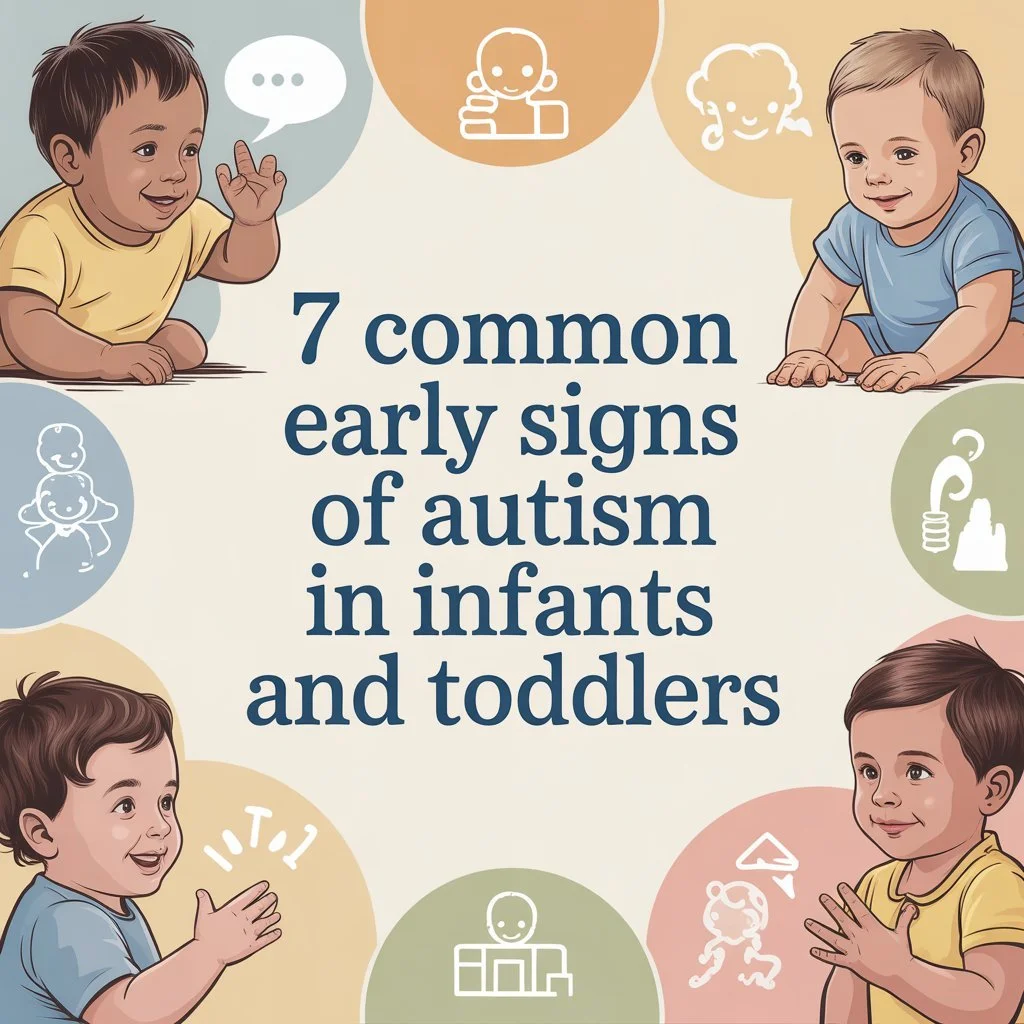
7 Common Early Signs of Autism in Infants and Toddlers
There is a particular kind of worry that settles in quietly. It is not dramatic. It does not arrive all at once. It is the kind that builds slowly, in the small moments. The way your baby does not turn toward your voice. The way your toddler lines up toys instead of playing with them. The way certain sounds send them into a spiral that takes a long time to come back from.
Most parents who end up on this page are not panicking. They are paying attention. And paying attention early is one of the most powerful things a parent can do.
Autism can be identified as early as 18 months in some children, and in many cases, signs are present even earlier than that. The earlier a child receives the right support, the better the outcomes tend to be. Not because autism needs to be fixed, but because understanding how your child experiences the world means you can build an environment that actually works for them.
This post walks through seven of the most common early signs of autism in infants and toddlers. It is not a diagnostic tool. Only a qualified professional can diagnose autism. But it is a starting point for parents who want to understand what they are seeing and what to do next.
Table of Contents
What Are Some Common Early Signs of Autism in Infants and Toddlers?
Sign 1: Limited or No Eye Contact
Sign 2: Not Responding to Their Name
Sign 3: Delayed or Absent Speech and Language
Sign 4: Repetitive Movements or Behaviours
Sign 5: Difficulty With Changes in Routine
Sign 6: Unusual Sensory Responses
Sign 7: Limited Interest in Other Children or Social Play
What to Do If You Recognize These Signs
Helpful Resources to Bookmark
Final Thoughts
What Are Some Common Early Signs of Autism in Infants and Toddlers?
This is one of the most searched questions by parents who are beginning to notice something different about their child's development. And it is the right question to be asking.
According to the World Health Organization, in 2021 about 1 in 127 persons had autism, making it one of the most common neurodevelopmental conditions in the world. Yet many children are still not diagnosed until school age or later, often because the early signs were not recognised or were dismissed by well-meaning professionals.
The signs listed below are not a checklist where ticking three boxes means your child is autistic. They are patterns worth paying attention to, patterns that, if present consistently and across different settings, are worth discussing with your child's paediatrician.
Sign 1: Limited or No Eye Contact
Eye contact is one of the earliest forms of human connection. Most babies begin making meaningful eye contact from around six to eight weeks old. By three months, a baby will typically hold your gaze, smile back, and track your face as you move.
In many autistic infants and toddlers, eye contact is limited, inconsistent, or absent entirely. This does not mean the child is unaware of the people around them. Many autistic children are deeply attuned to their environment. But the natural pull toward a caregiver's eyes that most neurotypical babies show may not be there in the same way.
What to look for:
Baby rarely looks at your face during feeding or play
Toddler looks past you or through you rather than at you during conversation
Eye contact happens only briefly or seems to take effort
Child does not look toward where you are pointing
It is worth noting that some autistic children make plenty of eye contact. The absence of eye contact alone does not confirm autism. But combined with other signs, it is something to bring up with a professional.
Sign 2: Not Responding to Their Name
According to the Center for Disease Control and Prevention, by around nine months, most babies will reliably turn toward the sound of their own name. It is one of the earliest markers of social awareness and language development.
A common early sign of autism is a child who does not consistently respond when called by name. Parents often describe this as the child seeming to be in their own world. They may respond to other sounds, loud noises, music, or their favourite show, but not to a familiar voice calling their name directly.
This is important to note because it can be mistaken for a hearing issue. If you are concerned, a hearing test is a sensible first step. But if hearing is confirmed to be normal and your child still does not respond consistently to their name by twelve months, it is worth raising with your doctor.
Sign 3: Delayed or Absent Speech and Language
Speech and language development varies widely between children, and not all delays point to autism. But certain patterns of language development are more commonly associated with autism than with typical developmental variation.
These include:
No babbling by twelve months
No single words by sixteen months
No two-word phrases by twenty-four months
Loss of previously acquired language skills at any age
That last point is particularly significant. A child who was developing speech and then stops using words they previously had is showing a regression that should always be assessed promptly.
Some autistic children develop language on a typical timeline but use it in atypical ways. They may repeat phrases from television or books, a pattern called echolalia. They may speak in a very literal way, struggle with back-and-forth conversation, or use language to narrate rather than communicate with others.
According to Autism Speaks, around the world 1 in 100 children are diagnosed with autism, and communication differences are among the most consistent features across those diagnoses.
Dropped in a Maze by Sonia Chand walks through the reality of navigating communication differences and everything that comes with them in the early years. Order your copy today
Sign 4: Repetitive Movements or Behaviours
Repetitive movements, often called stimming, are one of the most recognised features of autism. These are movements or behaviours that are repeated consistently and often serve a self-regulating function for the child.
Common examples in infants and toddlers include:
Hand flapping, particularly when excited or distressed
Rocking back and forth while sitting or standing
Spinning in circles repeatedly
Toe walking
Lining up toys or objects rather than using them in play
Spinning wheels on toy cars and watching them closely rather than playing with the car itself
It is important to understand that stimming is not inherently harmful. For many autistic people, repetitive movements are a way of managing sensory input, expressing emotion, or simply finding comfort. The goal should never be to eliminate stimming. The goal is to understand what it communicates about how your child is experiencing their environment.
Sign 5: Difficulty With Changes in Routine
Many autistic children have a strong need for sameness and predictability. When routines are disrupted, even in ways that seem minor to a parent, the response can be intense and prolonged.
This might look like:
Significant distress when a usual route is changed
Meltdowns triggered by unexpected transitions, like leaving the park earlier than expected
Insistence on eating the same foods in the same order
Distress if furniture is moved or items are not in their usual place
Needing the same bedtime routine performed in exactly the same way every night
Understanding this as a neurological need rather than defiance or stubbornness changes everything about how you respond to it. A child who falls apart when the routine changes is not being difficult. They are experiencing genuine distress in a world that feels unpredictable.
This is one of the areas where the shift from autism awareness to autism acceptance makes the most practical difference in daily family life. If you have not yet read the post on autism awareness vs autism acceptance, it gives important context for understanding why the way we frame these behaviours matters so much.
Sign 6: Unusual Sensory Responses
The sensory world is experienced differently by many autistic children. Some are hypersensitive, meaning they are easily overwhelmed by sensory input that most people barely notice. Others are hyposensitive, meaning they seek out intense sensory experiences and seem to have a higher threshold for pain or discomfort.
Hypersensitive responses might include:
Covering ears at sounds that do not seem loud to others
Distress around certain textures in clothing or food
Extreme reactions to bright lights or busy visual environments
Refusing to walk on grass or sand barefoot
Hyposensitive responses might include:
Seeking out strong physical pressure, wanting to be squeezed or wrapped tightly
Appearing not to notice pain, like a fall that would make most children cry
Mouthing objects well beyond the typical age for this behaviour
Craving movement, spinning, or jumping constantly
Neither pattern is better or worse. They are simply different ways of processing the world. Once you understand your child's sensory profile, you can make adjustments that genuinely reduce their daily stress levels.
Sign 7: Limited Interest in Other Children or Social Play
Most toddlers begin showing interest in other children around the age of two. They may not play together in a fully interactive way yet, but they notice each other, imitate each other, and show curiosity about what other children are doing.
Autistic toddlers may show little interest in other children. They may prefer solitary play, seem unaware of other children in the room, or not engage in the imitative play that most toddlers naturally fall into.
Pretend play is another area worth watching. By around eighteen to twenty-four months, most children begin using objects symbolically, pretending a banana is a phone or feeding a doll. This kind of imaginative, symbolic play is often delayed or absent in autistic toddlers.
This does not mean autistic children do not want connection. Many autistic children are deeply affectionate and social in their own way. But the social instincts that develop automatically in neurotypical children may need to be taught, modelled, and supported deliberately in autistic children.
The podcast covers this topic in depth, including honest conversations about what social development really looks like for autistic children and how families can support it without forcing neurotypical behavior patterns.
Listen to the podcast here and join thousands of families navigating the same questions.

What to Do If You Recognize These Signs
If you have read through this post and several of these signs feel familiar, the most important thing you can do right now is act without waiting.
Here is a simple starting point:
Talk to your paediatrician at the next appointment: Bring specific examples of what you have been observing, written down if possible. Do not wait to be asked. Bring it up yourself.
Request a developmental screening: In many countries this is a standard part of well-child checks, but it is not always done automatically. Ask for it specifically.
Do not let anyone tell you to wait and see without a clear reason: Early intervention is consistently shown to make a meaningful difference. Waiting costs time that matters.
Start reading and learning now: Understanding autism before a formal diagnosis means you are already building the knowledge you need. The best selling autism books on this topic include titles written by autistic authors, parents, and clinicians that will give you a much fuller picture than any single blog post can.
Book a coaching session here if you want to talk through what you are seeing with someone who understands the journey from the inside.
Final Thoughts
Noticing these signs in your child does not mean something is wrong. It means you are paying close attention to someone you love deeply, and that attention is the foundation of everything good that comes next.
An autism diagnosis, if that is where this leads, is not the end of anything. It is the beginning of understanding. It is the moment when the guessing stops and the real support can begin.
The families who navigate this journey well are not the ones who had all the answers early. They are the ones who stayed curious, stayed connected, and kept showing up for their child even when the road was unclear.
That is exactly what you are already doing by being here.
Newly Diagnosed: What to Do After Your Child Gets an Autism Diagnosis
Getting an autism diagnosis for your child is one of those moments that splits life into before and after. One moment you are sitting in a doctor's office, the next you are walking out with a piece of paper that changes everything and nothing at the same time.
The questions come fast. What does this mean for my child's future? Where do we even start? Who do we call? What do we stop doing and what do we do more of? The noise inside your head can feel deafening.
This post is for that moment. It is for the parent sitting in the car park after the appointment, unsure of what the next step looks like. It is a practical, honest guide to what actually comes next, not a list of scary statistics or overwhelming medical jargon, but a real roadmap written by someone who has been exactly where you are standing right now.
Table of Contents
Let Yourself Feel It First
Understand What the Diagnosis Actually Means
Build Your Support Team
Learn About Available Therapies
Navigate School and Education Support
Take Care of Yourself Too
Connect With the Right Community
What Acceptance Actually Looks Like From Here
Final Thoughts
Let Yourself Feel It First
Before the appointments, the research, the therapy referrals, and the school meetings, there is this: permission to feel whatever you are feeling right now.
For some parents, a diagnosis brings relief. It gives a name to something they have been sensing for a long time. For others, it brings grief. Not grief for their child, but grief for the future they had imagined. Both of those responses are completely valid. So is everything in between.
The worst thing you can do in the days right after a diagnosis is bury the emotions under a mountain of action. Doing things feels productive. It feels like you are fighting for your child. And there will absolutely be a time for that. But right now, give yourself a few days to simply sit with what just happened.
Talk to your partner if you have one. Call a friend. Write it down. Cry if you need to. The parents who navigate this journey well are not the ones who skipped the hard feelings. They are the ones who moved through them.

Autism Diagnosis
Understand What the Diagnosis Actually Means
Once the initial wave settles, the next step is understanding what you have actually been told. Autism Spectrum Disorder, or ASD, is a neurodevelopmental condition that affects how a person communicates, processes information, and experiences the world around them.
The word "spectrum" is important here. Autism looks different in every single person who has it. Two children with the same diagnosis can have vastly different strengths, challenges, communication styles, and support needs. A diagnosis tells you the category. It does not tell you the full story of your child.
Some things worth understanding early:
Autism is not caused by parenting style, diet, vaccines, or anything you did or did not do
Autism is lifelong but it does not mean your child's life will be limited
Early support and the right environment make an enormous difference
Autistic people live full, meaningful, connected lives
Reading widely and from credible sources matters here. It also matters to read from autistic people themselves, not just medical literature. Their lived experience will teach you things no clinical document can.
The best selling autism books recommended in this space cover everything from early diagnosis to adult life, and many are written by autistic authors or parents who have walked this road. Start there before you start Googling at midnight.
Dropped in a Maze by Sonia Chand is one of those books. It is an honest account of navigating the autism journey without a map. Order your copy here and read it in those early weeks when everything feels uncertain.
Build Your Support Team
One of the most important things to do after a diagnosis is to build a team around your child and around your family. You are not meant to do this alone, and trying to will burn you out faster than anything else.
Your support team will likely include a mix of the following:
A developmental paediatrician or child psychiatrist who can monitor your child's development over time and adjust recommendations as your child grows.
A speech and language therapist especially if communication is an area of need. This does not only apply to children who are nonverbal. Many autistic children have language but struggle with the social use of it, and a good speech therapist works on both.
An occupational therapist who helps with sensory processing, fine motor skills, and the daily living tasks that can feel overwhelming for autistic children.
A clinical psychologist who can support your child's emotional regulation and also support you as a parent navigating complex feelings and decisions.
Your child's school or early years setting who need to know about the diagnosis so the right support can be put in place as early as possible.
Building this team takes time. Not everyone will be the right fit. It is completely acceptable to change therapists or seek second opinions. Think of yourself as the project manager of your child's care, and do not be afraid to ask questions, push back, or request different approaches.
Learn About Available Therapies
After a diagnosis, many parents are handed a list of therapy recommendations and left to figure out what they all mean. Here is a plain language breakdown of the most common ones:
Applied Behaviour Analysis (ABA): This is one of the most widely recommended and also one of the most debated therapies in the autism community. It focuses on behaviour and skill building. If it is recommended for your child, research both the evidence base and the critiques, particularly from autistic adults who have experienced it.
Speech and Language Therapy: Focuses on communication, both verbal and nonverbal, and on the social use of language.
Occupational Therapy: Addresses sensory processing, coordination, self-care skills, and daily routines.
Social Skills Groups: Structured settings where autistic children learn and practise social interaction with peers.
Play Therapy: Particularly useful for younger children, using play as a medium for communication and emotional development.
The goal of any therapy should not be to make your child appear less autistic. The goal should be to help your child communicate, connect, and navigate the world in a way that works for them. Keep that standard when evaluating any recommendation you receive.
Navigate School and Education Support
School is often where the biggest battles happen, and where the right support makes the most visible difference. Once you have a diagnosis, you have the right to request that your child's school puts formal accommodations in place.
Depending on where you live this might be called an Individual Education Plan, an Education Health and Care Plan, or a Special Educational Needs support plan. The name differs by country but the principle is the same: a documented, legally binding plan that outlines what support your child will receive in school.
Some things to push for when working with schools:
A named key worker or point of contact for your child
Sensory accommodations such as a quiet space or movement breaks
Clear and consistent communication between school and home
Staff who have received autism-specific training
Flexibility in how your child demonstrates learning, not every child does well in written tests
Do not wait for the school to come to you. Request a meeting as soon as the diagnosis is confirmed. Come prepared with what you know about your child's needs. You are the expert on your child. The school is the expert on education. The best outcomes happen when both of those things are respected.
To understand the broader context of autism support and what this month means for families like yours, the World Autism Awareness Day guide covers the global conversation around autism rights and inclusion happening right now.
Take Care of Yourself Too
This section gets skipped far too often and it is one of the most important ones on this list.
Parenting an autistic child can be joyful, profound, and deeply rewarding. It can also be exhausting, isolating, and emotionally complex in ways that are hard to explain to people who have not lived it. Both of those things are true at the same time.
Caregiver burnout is real. It looks like chronic exhaustion, emotional numbness, resentment, anxiety, and the feeling that you have completely lost yourself in your child's needs. It is not a sign of weakness or bad parenting. It is what happens when someone gives without ever refilling.
Some things that genuinely help:
Finding one thing each week that is entirely for you
Connecting with other autism parents who actually get it
Being honest with your partner, family, or close friends about what you need
Getting professional support if the anxiety or grief feels unmanageable
Accepting help when it is offered instead of insisting you are fine
The podcast is a space built for exactly this, for the conversations that are hard to have anywhere else, the ones about the grief and the guilt and the love and the impossible decisions. Thousands of families tune in every week because it helps to know you are not alone in this.

Community
Connect With the Right Community
The autism community is large, passionate, and full of people who will become some of the most important relationships in your life. Finding your corner of it early makes a significant difference.
Look for:
Parent support groups both local and online. Facebook groups, in-person meetups, and charity-run workshops can connect you with parents at every stage of the journey.
Autistic-led spaces where autistic adults share their experiences. Following autistic writers, advocates, and content creators gives you a perspective that no amount of clinical reading can replace.
Family organisations in your country that offer helplines, resources, and guidance on navigating diagnosis and support systems.
One thing to be mindful of: not all autism communities are created equal. Some spaces are led primarily by parents and focus heavily on challenges and deficits. Others centre autistic voices and focus on acceptance and empowerment. Seek out the latter. It will shape how you see your child and how your child eventually sees themselves.
Also, take a look at the discussion around autism awareness vs autism acceptance to understand why the language and framing you choose from the very beginning matters more than most people realise.
What Acceptance Actually Looks Like From Here
Here is something that takes most parents a while to arrive at: the goal is not to minimise your child's autism. The goal is to understand it deeply enough that you can build a life around it that genuinely works.
That means letting go of comparisons with neurotypical children. It means measuring your child's progress against their own journey, not against a developmental chart designed for a different kind of brain. It means celebrating the wins that other people might not even notice, the first time your child made eye contact with a stranger, the morning they got through a transition without a meltdown, the day they told you about something that made them happy.
It also means advocating loudly and consistently for a world that makes room for your child exactly as they are. In schools, in public spaces, in family gatherings, in every environment your child moves through.
That journey from diagnosis to acceptance is not linear and it is not quick. But it is absolutely possible. Sonia Chand's book Dropped in a Maze walks through exactly that journey, the confusion, the wrong turns, the moments of clarity, and the hard-won understanding that came from living it rather than just reading about it.
Order Dropped in a Maze today. It is the book so many parents wish they had in those first weeks after diagnosis.
Final Thoughts
A diagnosis is not a ceiling. It is a starting point.
It is the moment when the guessing stops and the understanding begins. It is the moment when the right support can finally be put in place, because now there is a name for what your child needs and a roadmap, however imperfect, for how to get there.
The road ahead will have hard days. There will be appointments that go nowhere and professionals who do not listen and systems that were not designed with your child in mind. There will also be breakthroughs, unexpected moments of connection, and a depth of love that is difficult to put into words.
You are not starting this journey because something is wrong with your child. You are starting it because your child deserves to be understood, supported, and celebrated for exactly who they are.
That is worth everything.
To find out more about global autism support and how to mark April 2nd this year, visit the full guide on World Autism Awareness Day.