
Autism and the Legal System: Rights, Protections and What Parents Need to Know
Most parents of autistic children become accidental experts in a lot of things they never planned to learn. Sensory processing. Therapy approaches. School accommodation plans. But there is one area that catches nearly every autism family off guard, and that is the law.
Not because the laws protecting autistic people do not exist. They do, and in the United States, they are actually quite strong. The problem is that knowing your rights and knowing how to use them are two completely different things. And the families who get the best outcomes for their children are almost always the ones who came to the table informed.
This post covers the key federal laws that protect autistic individuals across education, healthcare, employment, and the legal system. It is written in plain language, because legal information should not require a law degree to understand. And it is written for both parents navigating these systems on behalf of their children and autistic adults who need to understand their own protections.
Consider this your starting point.
Table of Contents
The Federal Laws You Need to Know
Education Rights: IDEA and the IEP Process
Rights Under Section 504 of the Rehabilitation Act
Healthcare and Insurance Protections
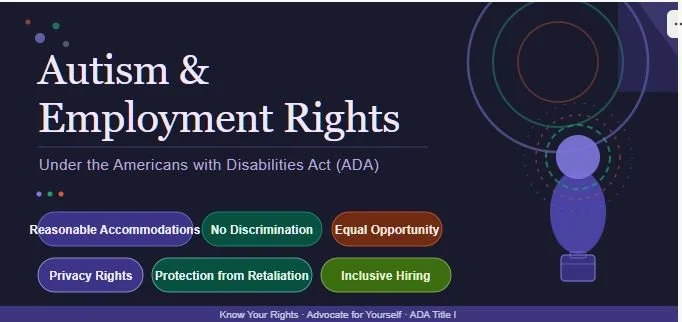
Autism and Employment Rights Under the ADA
Autism in Court and Legal Settings
Guardianship, Supported Decision Making and Turning 18
What to Do When Your Rights Are Violated
How Coaching Supports Autistic Individuals Through Legal and Social Challenges
Final Thoughts

The Federal Laws You Need to Know
The Federal Laws You Need to Know
The United States has several federal laws that specifically protect autistic individuals and people with disabilities more broadly. Understanding which law applies to which situation is the foundation of effective advocacy.
Here are the four most important ones:
The Individuals with Disabilities Education Act (IDEA)
This law guarantees every child with a disability, including autism, the right to a free and appropriate public education in the least restrictive environment possible. It covers children from birth through age 21 and is the legal backbone of the IEP process.
Section 504 of the Rehabilitation Act
This law prohibits discrimination against people with disabilities in any program or activity that receives federal funding, which includes public schools, colleges, and many healthcare providers. It is broader than IDEA and applies even when a child does not qualify for special education services.
The Americans with Disabilities Act (ADA)
One of the most wide-reaching disability rights laws in the world, the ADA prohibits discrimination against people with disabilities in employment, public accommodations, transportation, and state and local government services. It covers autistic children and adults.
The Affordable Care Act (ACA)
This law includes significant protections for autistic individuals around health insurance, including prohibiting insurers from denying coverage based on pre-existing conditions and requiring many insurance plans to cover autism-related therapies.
Knowing which law applies to your specific situation is the first step to knowing how to advocate effectively. The sections below break down how each of these laws works in practice.
Education Rights: IDEA and the IEP Process
Education is often where autism families first encounter the legal system, and it is where knowing your rights makes the most immediate difference.
Under IDEA, every autistic child is entitled to:
A free and appropriate public education tailored to their individual needs
An Individualized Education Program, known as an IEP, developed by a team that includes parents as equal members
Placement in the least restrictive environment, meaning alongside non-disabled peers to the maximum extent appropriate
Related services such as speech therapy, occupational therapy, and counselling if those services are necessary for the child to benefit from education
Procedural safeguards that protect parents' rights throughout the process
What parents need to know about IEPs
The IEP is a legally binding document. Every commitment made in that document, every service, every accommodation, every goal, is something the school is legally required to deliver. If the school fails to implement what is written in the IEP, that is a legal violation, not just an administrative oversight.
Parents have the right to:
Request an IEP meeting at any time, not just at the annual review
Disagree with the school's evaluation and request an independent educational evaluation at the school's expense
Bring an advocate or attorney to any IEP meeting
Refuse to sign an IEP they disagree with
File a formal complaint or request mediation if the school is not meeting its legal obligations
One of the most common mistakes parents make is treating the IEP meeting as a collaboration where everyone is on the same side. Sometimes that is true. Sometimes it is not. Going in knowing your rights changes the dynamic entirely.
Section 504 of the Rehabilitation Act
Rights Under Section 504 of the Rehabilitation Act
Not every autistic child qualifies for an IEP under IDEA, but many of those same children are still entitled to protections and accommodations under Section 504.
Section 504 applies to any school or program that receives federal funding and covers any student whose disability substantially limits one or more major life activities. For autistic students, that might include learning, concentrating, communicating, or managing sensory input.
Under a 504 Plan, a school might provide:
Extended time on tests and assignments
A quiet testing environment
Preferential seating
Permission to use noise-cancelling headphones
Modified homework loads
Regular check-ins with a trusted staff member
Section 504 also extends beyond school. It applies to colleges and universities, meaning autistic students transitioning to higher education can request accommodations through their school's disability services office. It applies to healthcare providers who receive federal funding. And it applies to any federally funded program or activity.
If your child does not qualify for an IEP but is still struggling in school because of their autism, a 504 Plan is often the next step to pursue.
Healthcare and Insurance Protections
Healthcare access is one of the most pressing concerns for autism families, and the legal landscape here has shifted significantly in recent years.
Under the Affordable Care Act, insurance companies cannot:
Deny coverage to autistic individuals based on their diagnosis as a pre-existing condition
Set lifetime or annual dollar limits on essential health benefits
Charge autistic individuals higher premiums than non-disabled individuals for the same plan
All 50 states now have autism insurance mandates, meaning most private insurance plans are required to cover autism-related treatments and therapies. The specifics vary by state, including which therapies are covered, age limits, and annual caps, so it is worth checking your state's specific mandate requirements.
Medicaid also provides significant coverage for autism-related services for eligible families, including Applied Behaviour Analysis, speech therapy, occupational therapy, and personal care services. Many autistic adults also receive Medicaid coverage, particularly those who qualify through Supplemental Security Income.
If an insurance claim for autism-related treatment is denied, parents and individuals have the right to appeal that decision. Many denials are overturned on appeal, particularly when supported by documentation from treating clinicians.
Autism and Employment Rights
Autism and Employment Rights Under the ADA
For autistic adults in the workforce, the Americans with Disabilities Act provides critical protections that are not widely enough understood.
Under the ADA, employers with 15 or more employees are prohibited from:
Discriminating against a qualified individual with a disability in hiring, firing, pay, job assignments, or any other term of employment
Asking about a disability before making a job offer
Requiring a medical examination before a conditional job offer is made
Autistic employees are also entitled to reasonable accommodations, meaning changes to the work environment or the way a job is performed that allow them to do their job effectively. Reasonable accommodations for autistic employees might include:
Written rather than verbal instructions
A quieter workspace or permission to use noise-cancelling headphones
Flexible scheduling to accommodate therapy appointments or sensory needs
Clear and explicit communication of expectations and feedback
Permission to work remotely when possible
An employer is required to provide reasonable accommodations unless doing so would cause undue hardship to the business. The standard for undue hardship is high, and most common accommodations do not meet it.
Disclosing an autism diagnosis at work is a personal decision and there is no legal requirement to do so. However, to request formal accommodation, some level of disclosure is typically necessary. Many autistic employees choose to disclose the functional impact of their needs without necessarily naming the diagnosis.
Autism in Court and Legal Settings
This is an area that does not get nearly enough attention in the autism community, and it is one where the stakes are very high.
Autistic individuals interact with the legal system in many different ways. As witnesses. As victims of crime. As defendants. As parties in family court proceedings. And in each of those situations, the characteristics of autism can be profoundly misunderstood by legal professionals who have not received adequate training.
Some of the specific challenges autistic individuals face in legal settings include:
Difficulty with direct eye contact being misread as dishonesty or lack of credibility
Literal communication style being misinterpreted in a legal context where language is often indirect and layered
Sensory sensitivities making courtroom environments overwhelming
Difficulty understanding the implications of waiving rights, particularly Miranda rights during police interactions
Responses to stress or anxiety that may appear unusual to untrained observers
The Washington State Courts Disability Justice Task Force has produced a detailed guide on supporting autistic individuals in court settings, covering everything from communication adjustments to environmental accommodations. It is a valuable resource for legal professionals, advocates, and families.
You can access that guide here.
For parents, being proactive about this is important. If your autistic child ever comes into contact with law enforcement or the court system, having documentation of their diagnosis and a clear explanation of how their autism presents can make a significant difference to how they are treated and understood.
For autistic adults, understanding your rights in legal settings before you ever need them is far better than trying to figure it out in a moment of crisis.
Guardianship, Supported Decision Making and Turning 18
One of the most significant and least discussed legal transitions for autism families happens when a child turns 18. In the eyes of the law, they become an adult. And that has real legal implications.
At 18, parents no longer have automatic legal authority to make decisions on behalf of their child, access their medical records, speak to their school or college, or manage their finances. Many parents are caught completely off guard by this.
There are several legal options available depending on the individual's needs and level of independence:
Full guardianship gives a parent or appointed guardian legal authority to make decisions on behalf of an adult with a disability. It is a significant legal step that removes many of the individual's legal rights and should only be pursued when truly necessary.
Limited guardianship grants authority in specific areas only, such as medical decisions or financial management, while preserving the individual's autonomy in other areas.
Supported decision making is a less restrictive alternative to guardianship that is gaining recognition across the US. Rather than transferring legal decision-making authority to another person, supported decision making allows the autistic adult to make their own decisions with the support of trusted people. Several states now have formal supported decision making agreements in law.
Power of attorney and healthcare proxies are legal documents that allow an autistic adult to designate someone to act on their behalf in specific situations, while retaining their own legal rights.
The right option depends entirely on the individual. Many autistic adults are fully capable of making their own decisions and guardianship would be both unnecessary and harmful to their autonomy and self-determination. It is worth consulting a disability rights attorney well before your child's 18th birthday to understand the options available.
What to Do When Your Rights Are Violated
Knowing your rights is only useful if you also know what to do when those rights are not being respected. Here is a plain language overview of the options available:
For education rights violations: File a state complaint with your state's department of education. Request mediation through your school district. File for a due process hearing under IDEA. Contact your state's Parent Training and Information Center, which provides free advocacy support to families.
For discrimination under the ADA or Section 504: File a complaint with the Office for Civil Rights at the US Department of Education for school-based violations. File a complaint with the Equal Employment Opportunity Commission for workplace discrimination. Contact a disability rights attorney for advice on civil litigation.
For insurance denials: File an internal appeal with your insurance company. Request an external review if the internal appeal is unsuccessful. Contact your state's insurance commissioner. Seek support from a patient advocate or attorney who specialises in insurance law.
For legal system issues: Contact a disability rights organisation in your state. Reach out to the Autism Society of America's legal resources page, which provides guidance and referrals for autistic individuals and families navigating legal challenges.
You can access those resources here.
Document everything. Keep records of every communication, every meeting, every decision, and every incident. When it comes to asserting legal rights, documentation is everything.
How Coaching Supports Autistic Individuals Through Legal and Social Challenges
Understanding your legal rights is one thing. Having the confidence, communication skills, and emotional grounding to actually assert them is another.
Many autistic adults and the parents of autistic children find that the moments where legal rights matter most, IEP meetings, workplace accommodation requests, court appearances, transition planning, are also the moments where socio-emotional challenges are most acute. The pressure is high. The stakes are real. And the ability to communicate clearly, advocate calmly, and hold your ground under stress makes an enormous practical difference.
This is where coaching fills a gap that legal information alone cannot.
Sonia Chand is a licensed psychotherapist offering specialised online coaching for neurodivergent individuals. Her two core coaching services are particularly relevant for autistic adults and families navigating complex systems:
Socio-Emotional Coaching: helps autistic individuals develop the practical tools to navigate high-stakes social and institutional interactions, including how to communicate needs clearly, how to manage the emotional weight of advocacy, and how to build the kind of confident, grounded presence that gets results in rooms that were not designed for them.
Self-Esteem Coaching: works on the deeper layer. Years of being dismissed, misunderstood, or overridden by systems that did not see you clearly can erode the belief that your voice matters. Self-esteem coaching rebuilds that foundation, so that when it counts, you show up knowing your rights are worth fighting for and that you are the right person to fight for them.
Book a socio-emotional coaching session with Sonia here and build the skills to advocate effectively for yourself
Final Thoughts
The legal protections available to autistic individuals and their families in the United States are genuinely substantial. IDEA, the ADA, Section 504, and state-level insurance mandates together create a framework of rights that, when understood and used effectively, can make a real and lasting difference to the quality of life, education, healthcare, and opportunity available to autistic people.
But those rights do not enforce themselves. They require parents and autistic individuals who know what they are entitled to, who document carefully, who ask the right questions, and who are willing to push back when the system falls short.
That is not always easy. It takes energy, confidence, and a clear sense that your needs and your child's needs are worth advocating for. Building that capacity is part of the work. And it is work that nobody should have to do entirely alone.