
Is Autism an Intellectual Disability? What Parents Need to Know
Is autism an intellectual disability is one of the most commonly searched questions about autism and one of the most frequently misunderstood. Parents hear the term intellectual disability in the same conversation as their child's autism diagnosis and immediately wonder whether the two are the same thing, whether one causes the other, and what it means for their child's future.
Is autism an intellectual disability deserves a clear, direct answer because the confusion between the two has real consequences for how autistic children are seen, how they are supported, and what opportunities they are given access to.
This post answers the question is autism an intellectual disability honestly and completely, explains what both terms actually mean, looks at where they overlap and where they do not, and gives parents the practical information they need to advocate effectively for their child.
Table of Contents
Is Autism an Intellectual Disability?
What Is Autism?
What Is an Intellectual Disability?
Where Autism and Intellectual Disability Overlap
Where Autism and Intellectual Disability Differ
How Common Is Intellectual Disability in Autism?
Why Is Autism So Often Confused With Intellectual Disability?
The Problem With Assuming Intellectual Disability in Autism
How This Connects to Profound Autism
The Role of Coaching and Support
FAQs
Final Thoughts
Is Autism an Intellectual Disability?
Is autism an intellectual disability? No. Autism and intellectual disability are two separate conditions. They can co-occur in the same person but they are not the same thing and one does not cause the other.
Autism is a neurodevelopmental condition characterized by differences in social communication, sensory processing, and restricted or repetitive behaviors. Intellectual disability is a separate condition characterized by significant limitations in both intellectual functioning and adaptive behavior that originate before the age of 18.
Is autism an intellectual disability in the sense that autism always involves limited intellectual functioning? No. The majority of autistic people do not have an intellectual disability. Many autistic people have average, above average, or exceptional intellectual abilities.
Is autism an intellectual disability in the sense that intellectual disability and autism share some features? Yes, in limited ways. Both are neurodevelopmental conditions. Both are present from early childhood. And in some autistic individuals, both occur together. But having one does not mean having the other.
The confusion between the two is understandable given how frequently they are discussed together and how significantly intellectual disability affects the autism presentation when it is present. But the confusion has real costs when it leads to autistic children being underestimated, placed in inappropriate settings, or denied opportunities because someone assumed their autism meant intellectual disability.
What Is Autism?
Before going deeper into the question of is autism an intellectual disability, it helps to be clear about what each term actually means.
Autism, formally known as Autism Spectrum Disorder or ASD, is a neurodevelopmental condition that affects how a person communicates, processes information, experiences sensory input, and relates to others. It is present from birth and it is lifelong.
The core features of autism are:
Differences in social communication and social interaction across multiple contexts
Restricted, repetitive patterns of behavior, interests, or activities
Sensory processing differences that affect how the person experiences and responds to sensory input
Autism presents very differently across individuals. Some autistic people are nonverbal and require significant support across all areas of daily life. Others are highly verbal, academically capable, and manage many daily tasks independently. The spectrum is genuinely wide and the variability within it is enormous.
What autism does not inherently involve is limited intellectual functioning. Intellectual ability in autism ranges across the full spectrum from significant intellectual disability to exceptional intellectual gifts. Autism describes a neurological profile. It does not specify intelligence.
For a comprehensive understanding of what autism is at a neurological level and why the brain works differently in autistic people, the post on is autism a neurological disorder covers neuroscience in depth.

Dropped in a Maze, one of the bestselling books on Autism
What Is an Intellectual Disability?
Intellectual disability, formerly known as mental retardation in older clinical literature, is defined by three criteria that must all be present:
Significant limitations in intellectual functioning: An IQ score approximately two standard deviations below the mean, which typically means an IQ below 70, along with clinical judgment confirming significant cognitive limitations.
Significant limitations in adaptive behavior: Difficulty with the practical skills needed for everyday life including conceptual skills such as language and literacy, social skills such as interpersonal relationships and following rules, and practical skills such as personal care, managing money, and managing routines.
Onset during the developmental period: The limitations must be present before the age of 18, distinguishing intellectual disability from acquired cognitive impairments that develop in adulthood through injury or disease.
Intellectual disability ranges in severity from mild to moderate to severe to profound. The majority of people with intellectual disability, around 85 percent, have mild intellectual disability and can develop significant life skills with appropriate support.
Is autism an intellectual disability by this definition? No. Autism does not inherently involve significant limitations in intellectual functioning. An autistic person with an IQ of 120 has no intellectual disability. An autistic person with an IQ of 45 may have both autism and intellectual disability as co-occurring conditions.
Where Autism and Intellectual Disability Overlap
While is autism an intellectual disability has a clear no answer, autism and intellectual disability do overlap in some important ways that are worth understanding.
They can co-occur: Autism and intellectual disability are separate conditions but they frequently occur together in the same individual. Research suggests that somewhere between 30 and 40 percent of autistic people also have an intellectual disability. This co-occurrence is real and significant and it shapes the support needs and life experiences of those individuals in profound ways.
They are both neurodevelopmental: Both autism and intellectual disability are classified as neurodevelopmental conditions in the DSM-5. Both originate in differences in brain development during the prenatal and early postnatal period. Both are present from birth even when not identified until later.
They both affect learning: Both autism and intellectual disability can affect how a person learns, though they affect learning differently. Autism affects learning through differences in social communication, sensory processing, and information processing style. Intellectual disability affects learning through limitations in cognitive processing speed, working memory, and abstract reasoning.
They are both lifelong: Neither autism nor intellectual disability is something a person grows out of. Both are permanent aspects of the person's neurology. Support needs may change over time but the underlying conditions remain.
They both qualify for educational support: Both autism and intellectual disability qualify children for Individualized Education Programs under IDEA and for special education services. When they co-occur, the educational planning needs to address both conditions.
Where Autism and Intellectual Disability Differ
Understanding where autism and intellectual disability differ is just as important as understanding where they overlap, particularly when answering the question of is autism an intellectual disability.
Intellectual functioning: The most fundamental difference is that autism does not inherently involve limited intellectual functioning while intellectual disability does by definition. Autistic people can have IQs at any point on the full range of human cognitive ability.
Social communication: Autism specifically involves differences in social communication that are not explained by intellectual disability alone. An autistic person without intellectual disability has specific social communication differences that a person with intellectual disability of the same cognitive level would not necessarily have.
Sensory processing: Sensory processing differences are a core feature of autism and are not a defining feature of intellectual disability. Many autistic people have significant sensory sensitivities that profoundly affect their daily functioning in ways that are distinct from the challenges of intellectual disability.
Restricted and repetitive behaviors: The restricted and repetitive behaviors that characterize autism, including special interests, insistence on sameness, and repetitive movements, are not defining features of intellectual disability.
Cause: The genetic and neurological underpinnings of autism and intellectual disability differ significantly even though both involve differences in brain development. They represent distinct developmental pathways that happen to co-occur more frequently than chance would predict.
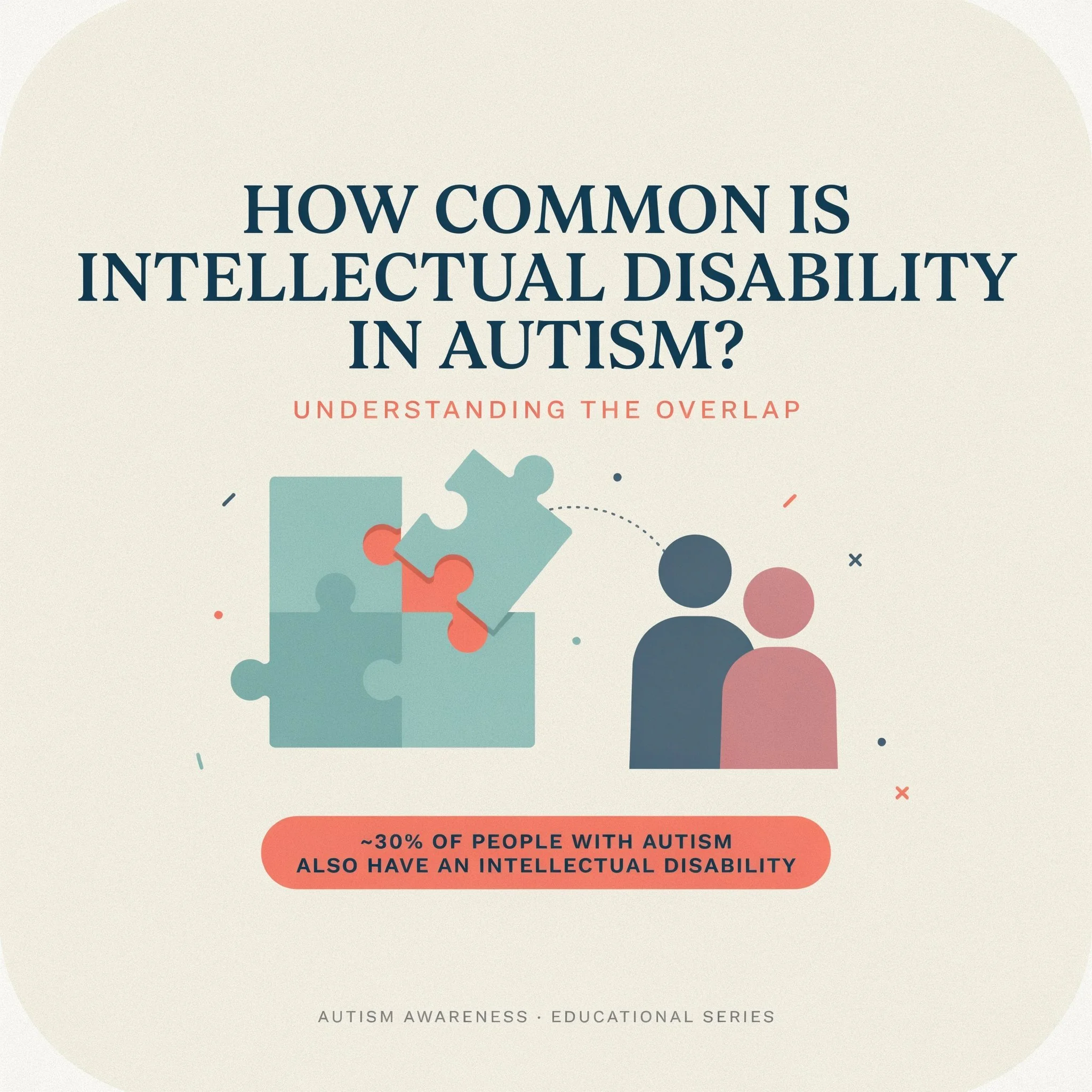
Common intellectual disability in autism
How Common Is Intellectual Disability in Autism?
The research on how common intellectual disability is in autism has produced varying estimates over the years, and understanding those variations helps parents make sense of conflicting information.
Earlier estimates suggested that around 70 to 75 percent of autistic people had intellectual disability. More recent research puts the figure significantly lower, at around 30 to 40 percent. This shift reflects several things.
First, diagnostic criteria for autism have broadened significantly since the 1990s, particularly with the inclusion of Asperger Syndrome in the DSM-4 and the subsequent shift to a single autism spectrum diagnosis in the DSM-5. The broader the diagnostic criteria, the more autistic people without intellectual disability are captured in prevalence data.
Second, better assessment tools have improved the accuracy of cognitive testing in autistic individuals. Earlier IQ assessments were often poorly adapted for autistic people, particularly those who were nonverbal or who had significant communication differences, and may have underestimated intellectual ability.
Third, awareness of autism without intellectual disability has increased significantly, leading to more diagnoses in this population and shifting the overall proportion.
The current best estimate is that approximately 30 to 40 percent of autistic people have a co-occurring intellectual disability. The majority, 60 to 70 percent, do not.
Why Is Autism So Often Confused With Intellectual Disability?
The confusion between autism and intellectual disability has several sources and understanding them helps parents recognize when assumptions are being made about their child that may not be accurate.
Historical reasons: Early autism research focused primarily on autistic individuals with significant support needs, many of whom also had intellectual disability. The image of autism that emerged from that research was heavily shaped by this population, creating an association between autism and intellectual disability that persisted long after research demonstrated the full breadth of the spectrum.
Communication differences: Many autistic children, particularly young autistic children and those who are nonverbal or minimally verbal, present in ways that can look like intellectual disability to observers who are not trained to distinguish the two. A child who does not respond to questions, who does not make eye contact, and who does not engage in typical social interaction may be assumed to have limited intelligence when the actual issue is communication and social differences, not cognitive limitation.
Assessment challenges: Standard intelligence tests are not always well-suited to autistic individuals. They typically require verbal responses, social engagement, and the ability to demonstrate knowledge through neurotypical channels. An autistic child who has significant knowledge and cognitive ability but cannot demonstrate it through standard testing channels may receive a lower IQ score than accurately reflects their ability.
Behavior misinterpretation: Autistic behaviors including limited eye contact, scripted language, repetitive movements, and unusual responses to social situations are sometimes misread as signs of intellectual limitation by people who do not understand autism.
The Problem With Assuming Intellectual Disability in Autism
This section matters as much as any other in this post because the assumption that is autism an intellectual disability translates to yes carries real and harmful consequences for autistic children.
When intellectual disability is assumed in an autistic child who does not have it, several things happen:
Educational placements become inappropriate: Children are placed in settings designed for intellectual disability rather than autism. The curriculum is pitched below their actual cognitive level. Expectations are lowered in ways that become self-fulfilling.
Communication is not pursued: When a child is assumed to have intellectual disability, the investment in finding their communication channel is often reduced. The assumption that they cannot communicate becomes the barrier to discovering that they can.
Strengths are overlooked: The deficit-focused lens of intellectual disability obscures the genuine cognitive strengths that many autistic people have. Pattern recognition, attention to detail, deep focused thinking, and exceptional memory in areas of interest are all common autistic cognitive profiles that are invisible when intellectual disability is assumed.
Self-concept is damaged: Children who are consistently treated as less capable than they are internalize that treatment. The damage to self-esteem and self-concept that comes from years of being underestimated is real, significant, and often persists long after the underestimation is corrected.
How This Connects to Profound Autism
The overlap between autism and intellectual disability is most significant at the most complex end of the autism spectrum. The concept of profound autism, which describes autistic individuals with both significant intellectual disability and minimal or no functional spoken language, is directly relevant to the question of is autism an intellectual disability.
For a full understanding of what profound autism is, how it differs from other autism presentations, and what support looks like for this population, the posts on what is profound autism and profound autism vs autism level 3 cover the topic comprehensively.
FAQs
Can you be autistic and have an intellectual disability?
Yes. Research suggests around 30 to 40 percent of autistic people have a co-occurring intellectual disability.
What percentage of autistic people have intellectual disability?
Current research estimates that approximately 30 to 40 percent of autistic people have a co-occurring intellectual disability meaning the majority do not.
Can an autistic child have a high IQ?
Yes. Many autistic people have average, above average, or exceptionally high IQ scores. High intelligence and autism are not mutually exclusive.
How is intelligence tested in autistic children? Standard intelligence tests are used alongside nonverbal assessments for children with communication differences. Subtest profiles are important because autistic children often show highly variable performance across different cognitive domains.
Does having autism mean my child will need lifelong support? Support needs in autism vary enormously. Some autistic people require minimal support as adults. Others need significant ongoing support. The presence or absence of intellectual disability is one factor among many that affects long-term support needs.
Final Thoughts
Is autism an intellectual disability? No. They are two separate conditions that can and do co-occur but that are distinct in their definitions, their neurological underpinnings, and their implications for support.
Understanding this distinction matters practically. It matters for how autistic children are assessed, how they are placed in educational settings, what expectations are held for them, and what opportunities are made available to them.
The assumption that is autism an intellectual disability answers yes has cost too many autistic people too many years of being underestimated, under-supported, and denied access to the cognitive and communicative channels that could have shown the world what they were actually capable of.
Your child's autism does not define their intelligence. Their autism defines how their brain is organized, how they process information, how they experience the world, and what kind of support they need to thrive in it. Those are very different things from intellectual ability, and treating them as the same thing is a mistake with consequences.
Know the difference. Advocate accordingly. And hold the highest genuinely appropriate expectations for your child at every stage of their journey.
References:
National Institute of Mental Health. Autism Spectrum Disorder [Internet]. Last reviewed December 2024. Available from: https://www.nimh.nih.gov/health/topics/autism-spectrum-disorders-asd
National Academies of Sciences, Engineering, and Medicine. Clinical Characteristics of Intellectual Disabilities. In: Boat TF, Wu JT, editors. Mental Disorders and Disabilities Among Low-Income Children. Washington (DC): National Academies Press (US); 2015. Available from: https://www.ncbi.nlm.nih.gov/books/NBK332877/
de Brito Wanderley D, Muratori F, Argollo N, Tolentino A, Miranda T, Vaz F, Campos V, Marques de Mattos A, Lucena R. Autistic Children and Adolescents Without Intellectual Disability: Individual and Family Profile. Clin Neuropsychiatry. 2025;22(3):215-228. Available from: https://pmc.ncbi.nlm.nih.gov/articles/PMC12302814/
Srivastava AK, Schwartz CE. Intellectual disability and autism spectrum disorders: causal genes and molecular mechanisms. Neurosci Biobehav Rev. 2014;46(2):161-174. Available from: https://pmc.ncbi.nlm.nih.gov/articles/PMC4185273/
Congressional Research Service. The Individuals with Disabilities Education Act (IDEA), Part B: Key Statutory and Regulatory Provisions [Internet]. Report R41833. Available from: https://www.congress.gov/crs-product/R41833
Russell G, Mandy W, Elliott D, White R, Pittwood T, Ford T. Selection bias on intellectual ability in autism research: a cross-sectional review and meta-analysis. Mol Autism. 2019;10:9. Available from: https://pmc.ncbi.nlm.nih.gov/articles/PMC6397505/
Autism Speaks. Autism diagnostic criteria: DSM-5 [Internet]. Available from: https://www.autismspeaks.org/autism-diagnostic-criteria-dsm-5
