
Early Autism Detection: What Happens When Autism Is Caught Early
Early autism detection is one of the most important factors in determining the quality of life an autistic child will go on to experience. When autism is caught early, the right support can be put in place during the period when the brain is most responsive to intervention, connections can be built before gaps become entrenched, and families can stop guessing and start understanding.
When autism is caught early, everything changes. Not because autism itself changes, the neurology is present from birth and it does not disappear with early identification, but because the environment around the child changes. The support arrives sooner. The misunderstandings are fewer. The years spent confused about why things feel so hard are replaced with years spent learning how to work with the brain your child has rather than against it.
This post covers what the research says about early autism detection, what early intervention actually involves, what parents should watch for, and why the question of when autism is identified matters as much as it does.
Table of Contents
What Early Autism Detection Actually Means
Why Timing Matters: What the Brain Research Says
What Happens When Autism Is Caught Early
Early Signs Parents Should Know
The Earliest Age Autism Can Be Detected
What Early Intervention Looks Like
Barriers to Early Autism Detection
What Parents Can Do Right Now
How Early Detection Connects to Acceptance
FAQs
Final Thoughts
What Early Autism Detection Actually Means
Early autism detection refers to the identification of autism during the earliest possible developmental window, ideally before the age of three and in many cases as early as 18 months. It is the process of recognizing the signs of autism, pursuing evaluation, receiving a diagnosis, and beginning appropriate support before the typical developmental period has passed.
Early autism detection does not mean catching something before it gets worse in the way that early cancer detection does. Autism is not a progressive disease. It does not get worse if it goes undetected. But the opportunities that early autism detection opens up are genuinely time-sensitive in ways that make the timing of identification practically significant.
Early autism detection matters because the brain of a young child is far more plastic and responsive to environmental input than the brain of an older child or an adult. The early years are when the neural connections that support communication, social engagement, sensory regulation, and learning are being most actively formed. When the right support is in place during that window, those connections develop in ways that serve the autistic child far better than they would without support.
Early autism detection is not about changing who an autistic child is. It is about giving their neurology the right conditions to develop as fully and as functionally as possible during the period when development is most responsive to those conditions.
Why Timing Matters: What the Brain Research Says
The neuroscience behind early autism detection is both compelling and straightforward. The brain of a child under three is undergoing a period of extraordinary development. Neural connections are being formed at a rate that will never be matched again in life. The brain is literally constructing itself based on the input it receives from the environment.
This is what neuroscientists call neuroplasticity, and it is at its most powerful in the earliest years of life. The practical implication for autism is significant: when the right support is introduced during this period, the developing brain can build more functional pathways for communication, social engagement, and sensory regulation than it would build without that support.
Research consistently demonstrates that children who receive early autism intervention, particularly before the age of three, show better outcomes across multiple domains including language development, social skills, adaptive functioning, and cognitive development compared to children who receive the same intervention later.
A study found that intensive early intervention significantly improved outcomes for autistic toddlers, with many children making gains that would not have been possible if intervention had begun at school age. Multiple subsequent studies have replicated and extended these findings.
This does not mean that intervention after the early years is ineffective. It absolutely is effective. But the window of maximum neurological responsiveness is real and early autism detection is what opens access to it.
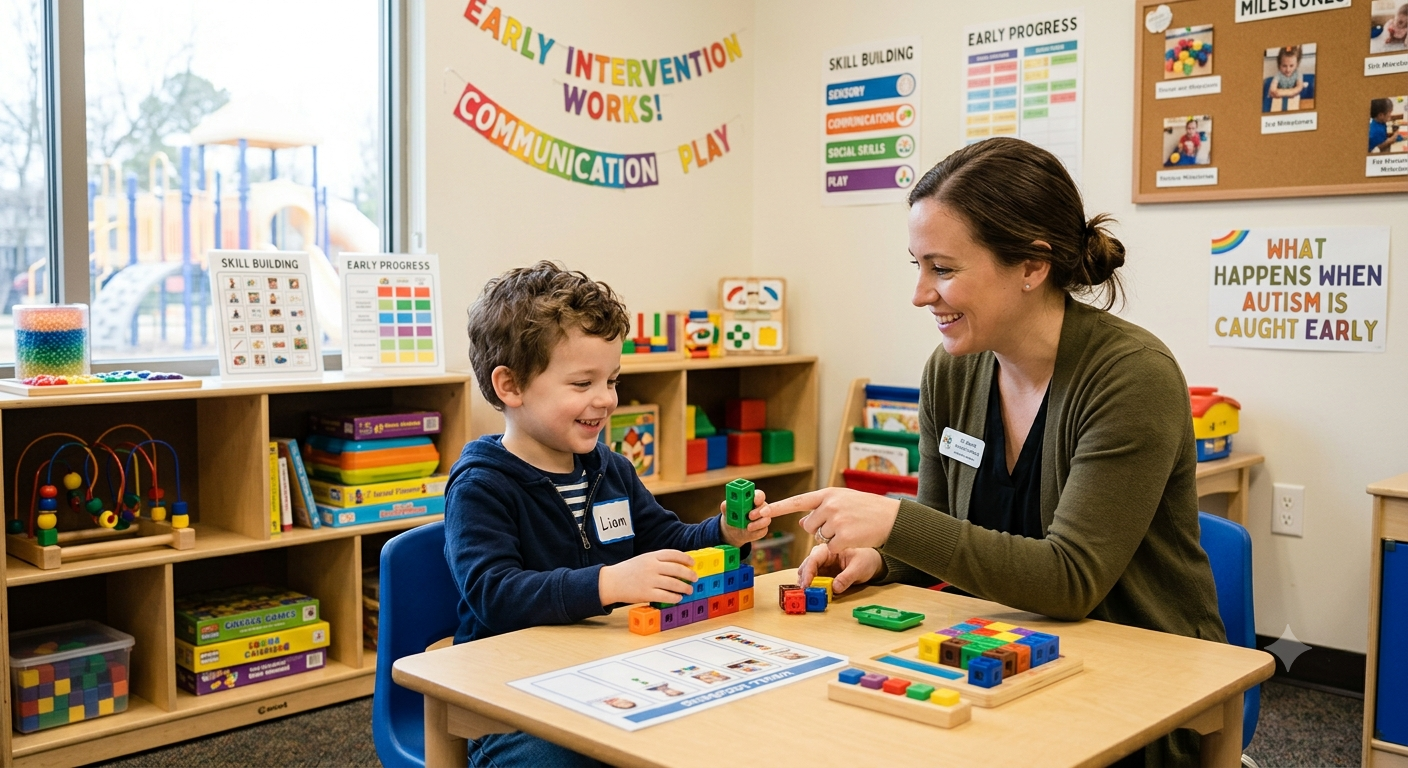
Early autism intervention works
What Happens When Autism Is Caught Early
When autism is caught early the outcomes for autistic children are measurably better across nearly every domain that matters for long-term quality of life.
Language and communication: When autism is caught early and communication support begins during the critical language development window, children develop stronger functional communication skills. This includes both verbal language and alternative communication methods for children who are nonverbal. Early speech and language therapy can make a profound difference to a child's ability to communicate their needs, preferences, and experiences.
Social development: When autism is caught early, support can be tailored to help autistic children develop social skills and build relationships during the period when the social brain is most actively developing. This does not mean making autistic children perform neurotypical social behavior. It means helping them develop authentic ways of connecting with others that work with their neurology.
Sensory regulation: When autism is caught early, occupational therapy and sensory integration support can help children develop more effective sensory regulation strategies during the period when those strategies are most readily learned. Children who develop better sensory regulation early are less likely to experience the kind of sensory overload that significantly affects functioning at school and in the community.
Academic readiness: When autism is caught early, children enter school with more of the foundational skills they need to benefit from education. Communication, self-regulation, attention, and the ability to manage transitions all contribute to school readiness and all can be meaningfully supported through early intervention.
Family functioning: When autism is caught early, families understand what they are dealing with earlier. The confusion, the self-blame, the wondering what is wrong, and the misinterpretation of autistic behavior as intentional or willful all reduce when there is a diagnosis and a framework for understanding the child. Families can access support, connect with community, and build their own knowledge and confidence much sooner.
Mental health: When autism is caught early, the years of struggling without understanding are shorter. Many autistic adults who were diagnosed late report significant mental health impacts from years of not understanding why they were different and why things that seemed easy for others felt so hard. Early autism detection reduces the duration of that confusion.
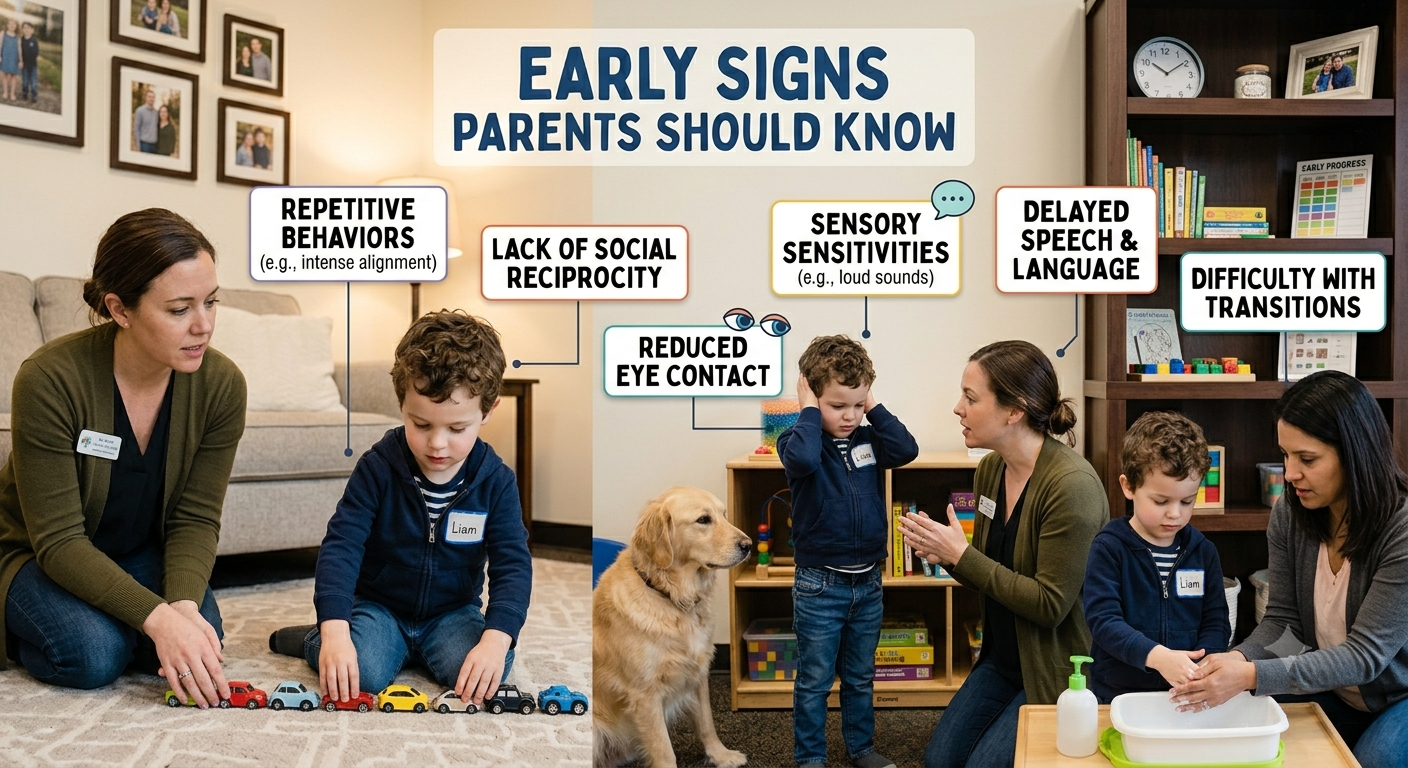
Autism Signs
Early Signs Parents Should Know
Knowing the early signs of autism is part of early autism detection and it is something every parent benefits from understanding whether or not they currently have concerns about their child.
Signs in the first year:
Limited eye contact during feeding and social interaction
Not responding to their name by 9 to 12 months
Not showing things to parents by pointing by 12 months
Limited babbling or loss of babbling that had been developing
Not reaching toward familiar people
Unusual responses to sensory input including sounds, touch, or lights
Signs between 12 and 24 months:
Not using single words by 16 months
Not using two-word phrases by 24 months
Loss of previously acquired language at any point
Not engaging in simple pretend play by 18 months
Limited interest in other children
Strong preference for specific routines with significant distress at changes
Repetitive movements including hand flapping, spinning, or rocking
Intense focus on specific objects or aspects of objects
Signs in the preschool years:
Significant difficulty with peer interaction
Unusual language patterns including echolalia, scripted speech, or very formal language
Extreme reactions to sensory input
Intense, narrow interests that dominate play
Difficulty with transitions and unexpected changes
Limited pretend play or play that is highly repetitive
The presence of any of these signs does not confirm autism. But it does mean that seeking evaluation is the right next step. For a complete guide to the testing process once concerns have been identified, the post on how to test for autism covers every stage in detail.
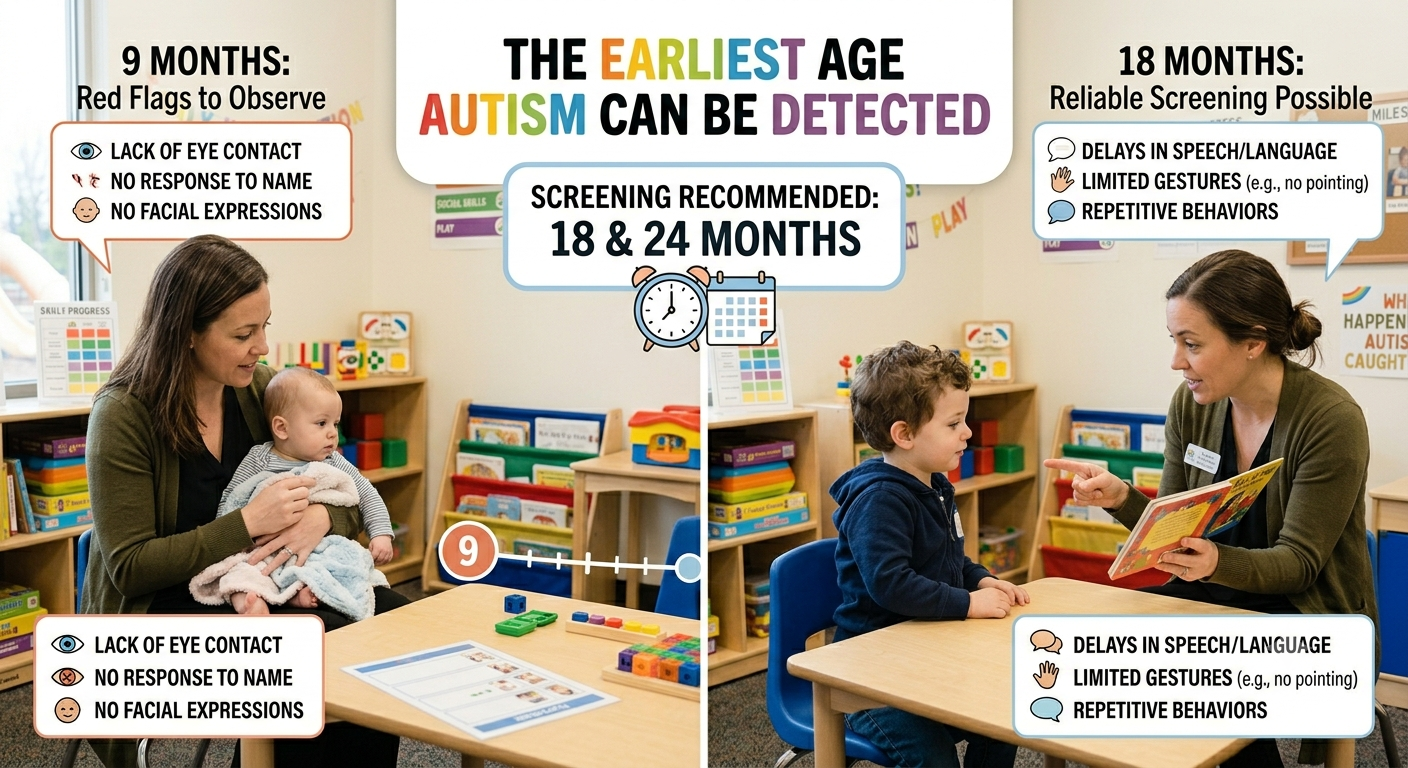
Ages autism can be detected
The Earliest Age Autism Can Be Detected
Early autism detection has its limits, and those limits are worth understanding honestly.
The American Academy of Pediatrics recommends autism-specific screening at 18 and 24 months. Research suggests that reliable autism identification is possible from around 18 months for children showing clear signs and from 24 months for more subtle presentations.
Some research has found that certain early markers in infant behavior, including patterns of eye contact, response to name, and social engagement, can be detectable as early as six months in infants who are later diagnosed with autism. These very early markers are currently the subject of active research but are not yet used in routine clinical screening.
For most families, the realistic window for early autism detection begins between 18 and 24 months when standard screening tools are reliable and diagnostic evaluations can be conducted with confidence.
It is worth noting that even an 18 to 24 month diagnosis, while considered early in clinical terms, still allows access to early intervention services during the most critical developmental window. Early is relative, and any diagnosis before school age opens doors that later diagnosis does not.
For parents who are carrying the emotional weight of a new diagnosis and trying to find their footing between the urgency of early intervention and the importance of acceptance, Sonia's coaching work is built for exactly that balance.
Book a coaching session with Sonia here and get the support that helps you hold both the urgency and the acceptance at the same time.
What Early Intervention Looks Like
Early autism detection is only valuable if it is followed by early intervention. Understanding what early intervention actually involves helps parents know what to pursue and what to expect.
Speech and language therapy: Communication support is almost universally recommended as part of early intervention for autistic children. This includes verbal language development for children who are developing speech and AAC implementation for children who are nonverbal or minimally verbal. Early speech therapy during the critical language development window is one of the most impactful interventions available.
Occupational therapy: Occupational therapy in early intervention addresses sensory processing, fine motor development, and the daily living skills that autistic children may need specific support to develop. Sensory integration approaches help young autistic children develop more effective regulation strategies during the period when those strategies are most readily learned.
Applied Behavior Analysis: ABA therapy is widely used in early autism intervention and has the most extensive evidence base of any autism intervention approach. It is also the most debated, with significant concerns raised by autistic advocates about historical ABA practices focused on compliance and suppression of autistic traits. Modern naturalistic ABA approaches that focus on skill development in the context of play and child-led interaction are generally considered more appropriate than older discrete trial formats.
Developmental relationship-based approaches: Approaches including DIR Floortime and the Early Start Denver Model use child-led play and relationship-based interaction to support communication, social engagement, and development. These approaches have growing evidence bases and are widely endorsed by autistic advocates as more affirming than purely behavioral approaches.
Early childhood special education: Many children with early autism detection qualify for early childhood special education services through their school district beginning at age three. These services provide structured educational support in settings designed for children with developmental needs.
Parent coaching: One of the most impactful components of early intervention is supporting parents to understand their child's communication and developmental needs and to respond in ways that promote development in everyday interactions. Parent coaching multiplies the impact of formal therapy by extending support into every interaction throughout the child's day.
Barriers to Early Autism Detection
Early autism detection is not equally available to all families and the barriers that prevent it are worth naming clearly.
Racial and ethnic disparities:Research consistently shows that Black, Hispanic, and Asian children are diagnosed with autism later on average than white children. These disparities reflect systemic inequities in access to healthcare, cultural factors that affect how autistic behavior is interpreted, and bias in the referral and diagnostic process.
Geographic barriers: Families in rural and remote areas often face significant barriers to autism evaluation including limited availability of specialist services and long travel distances to evaluation centers.
Economic barriers: Comprehensive private autism evaluations can cost several thousand dollars. Public pathways exist but have long waiting lists in many areas. Families without resources to access private evaluation may wait significantly longer for diagnosis.
Cultural barriers: In some communities, autism is stigmatized in ways that prevent families from seeking evaluation. Cultural beliefs about the cause of developmental differences, distrust of medical systems, and concerns about labeling can all delay early autism detection.
Professional barriers: Not all pediatricians are equally knowledgeable about autism. Concerns raised by parents are sometimes dismissed, minimized, or attributed to parenting anxiety. Families of girls are particularly likely to encounter this barrier.
Addressing these barriers is a systemic issue that goes beyond what individual families can solve. But knowing they exist helps parents advocate more effectively when they encounter them.
What Parents Can Do Right Now
If you are concerned about your child's development, here is what to do:
Request autism screening at your child's next pediatric appointment, or sooner if concerns are present
Document specific behaviors you have observed with dates and contexts
Request a referral for a full autism evaluation if screening raises concerns or if you have concerns regardless of screening results
Contact your local early intervention program directly if your child is under three, you do not need a referral in most states
Request a free educational evaluation through your school district if your child is three or older
Connect with other autism families who can share their experience navigating the evaluation and early intervention process
How Early Detection Connects to Acceptance
Early autism detection is most valuable when it is followed not just by early intervention but by early acceptance.
The goal of early identification is not to minimize autism or to engineer the most neurotypical version of the autistic child possible. It is to understand the child deeply enough, early enough, to build a life and an environment that genuinely supports them.
That requires acceptance alongside intervention. Acceptance of the autistic neurology as the genuine, permanent, valuable foundation of who your child is. Acceptance that the goal is flourishing as an autistic person, not passing as a neurotypical one.
The post on autism awareness vs autism acceptance covers why that distinction matters and what acceptance looks like in practice. It is worth reading early in the journey because the framework you bring to your child's diagnosis shapes every decision you make from here.
FAQs
What does it mean when autism is caught early
Early autism detection means identifying autism before age three when the brain is most responsive to intervention and support can be put in place during the critical developmental window.
What happens when autism is caught early?
When autism is caught early children show better outcomes in communication, social development, sensory regulation, school readiness, and mental health compared to children identified later.
Can autism be detected at birth?
Not reliably. Early markers may be present in the first months of life but reliable identification typically begins around 18 months using validated screening tools.
Does early detection mean early intervention always works? Early intervention significantly improves outcomes but results vary depending on the individual child, the type of intervention, and the quality of support provided.
What is the best early intervention for autism?
No single approach works for every child. Speech therapy, occupational therapy, developmental relationship-based approaches, and parent coaching all have strong evidence bases for early intervention.
Does early autism detection change the autism itself?
No. Autism is neurological and present from birth. Early detection changes the support environment, not the underlying neurology.
Does early autism detection prevent autism regression?
Early detection and appropriate support reduce the risk of autism regression by building stronger regulatory and communicative foundations before the demands that trigger regression become significant.
Final Thoughts
Early autism detection is not about fear. It is not about catching something terrible before it gets worse. It is about giving an autistic child the right conditions at the right time, during the window when those conditions make the most difference to how their brain develops and how their life unfolds.
When autism is caught early, families stop guessing and start understanding. Children stop struggling in silence and start receiving support that makes sense of their experience. The years of confusion are shorter. The foundation is stronger. The path forward is clearer.
If you have concerns about your child's development, act on them now. The evaluation process is navigable. The early intervention services are accessible. And the difference that early autism detection makes to a child's life is real, measurable, and worth every step of the process it takes to get there.
Your child's brain is working hard. Early autism detection is how you make sure the world works with it.
References:
Maksimović S, Marisavljević M, Stanojević N, Ćirović M, Punišić S, Adamović T, Đorđević J, Krgović I, Subotić M. Importance of Early Intervention in Reducing Autistic Symptoms and Speech–Language Deficits in Children with Autism Spectrum Disorder. Children (Basel). 2023 Jan 6;10(1):122. Available from: https://pmc.ncbi.nlm.nih.gov/articles/PMC9857540/
Estes A, Munson J, Rogers SJ, Greenson J, Winter J, Dawson G. Long-Term Outcomes of Early Intervention in 6-Year-Old Children With Autism Spectrum Disorder. J Am Acad Child Adolesc Psychiatry. 2015 Jul;54(7):580-7. Available from: https://pubmed.ncbi.nlm.nih.gov/26088663/
American Academy of Pediatrics. Autism Spectrum Disorder [Internet]. Last updated October 2025. Available from: https://www.aap.org/en/patient-care/autism/
Young GS, Merin N, Rogers SJ, Ozonoff S. Gaze Behavior and Affect at 6-Months: Predicting Clinical Outcomes and Language Development in Typically Developing Infants and Infants At-Risk for Autism. Dev Sci. 2009 Sep;12(5):798-814. Available from: https://pmc.ncbi.nlm.nih.gov/articles/PMC2732664/
International Council on Development and Learning (ICDL). What is DIR®? [Internet]. Available from: https://www.icdl.com/dir
Autism Speaks. What is Early Start Denver Model (ESDM)? [Internet]. Available from: https://www.autismspeaks.org/early-start-denver-model-esdm
Aylward BS, Gal-Szabo DE, Taraman S. Racial, Ethnic, and Sociodemographic Disparities in Diagnosis of Children with Autism Spectrum Disorder. J Dev Behav Pediatr. 2021 Oct-Nov;42(8):682-689. Available from: https://pmc.ncbi.nlm.nih.gov/articles/PMC8500365/
