
How to Test for Autism: A Complete Guide for Parents
If you are wondering how to test for autism, you are probably not reading this out of idle curiosity. You are reading it because something has shifted. A developmental checkup raised a concern. A teacher said something. A friend mentioned it. Or you have been watching your child and quietly noting things that do not quite add up, and you have finally decided to find out what is going on.
Knowing how to test for autism is the first practical step in a process that can feel overwhelming before you understand how it actually works. This post walks you through everything, from the earliest screening tools to the full diagnostic process, what to expect at each stage, how to advocate effectively, and what comes after a diagnosis.
How to test for autism is a question with a real, practical answer. And having that answer puts you in a far stronger position than most parents have when they start this process.
So, let’s get into it.
Table of Contents
How to Test for Autism: The Short Answer
The Difference Between Autism Screening and Autism Testing
Early Signs That Prompt Autism Testing
Step One: Developmental Screening at Your Pediatrician
Step Two: Formal Autism Evaluation
Who Can Diagnose Autism
What Happens During an Autism Evaluation
The Main Diagnostic Tools Used to Test for Autism
Online Autism Tests: Are They Reliable
What Happens After an Autism Diagnosis
How to Advocate for Testing When You Are Being Dismissed
Final Thoughts
How to Test for Autism: The Short Answer
How to test for autism involves a two-stage process. The first stage is screening, which identifies children who may be at risk for autism and need further evaluation. The second stage is a comprehensive diagnostic evaluation, which is a detailed, multi-professional assessment that either confirms or rules out an autism diagnosis.
There is no single test for autism. No blood test, no brain scan, no genetic test, and no quick checklist can diagnose autism on its own. Autism is diagnosed through a combination of developmental history, behavioral observation, standardized assessment tools, and clinical judgment from trained professionals.
This two-stage process is how to test for autism in the most accurate and reliable way currently available. Understanding both stages and what happens within them helps parents navigate the process with confidence rather than confusion.
The Difference Between Autism Screening and Autism Testing
Before going further, it helps to understand that screening and testing are different things and the distinction matters practically.
Autism screening: Screening is a quick, low-burden process designed to identify children who may need further evaluation. It does not diagnose autism. It flags a concern and prompts the next step. Screening tools are typically used by pediatricians at routine developmental checkups and take only a few minutes to complete.
Autism testing or evaluation: A full autism evaluation is a comprehensive, multi-session process conducted by trained specialists. It involves direct observation of the child, standardized assessment tools, detailed developmental history, and input from multiple sources including parents, teachers, and other professionals who know the child. It results in either a diagnosis or a ruling out of autism, along with a full picture of the child's strengths and support needs.
The screening identifies who needs testing. The testing provides the diagnosis.
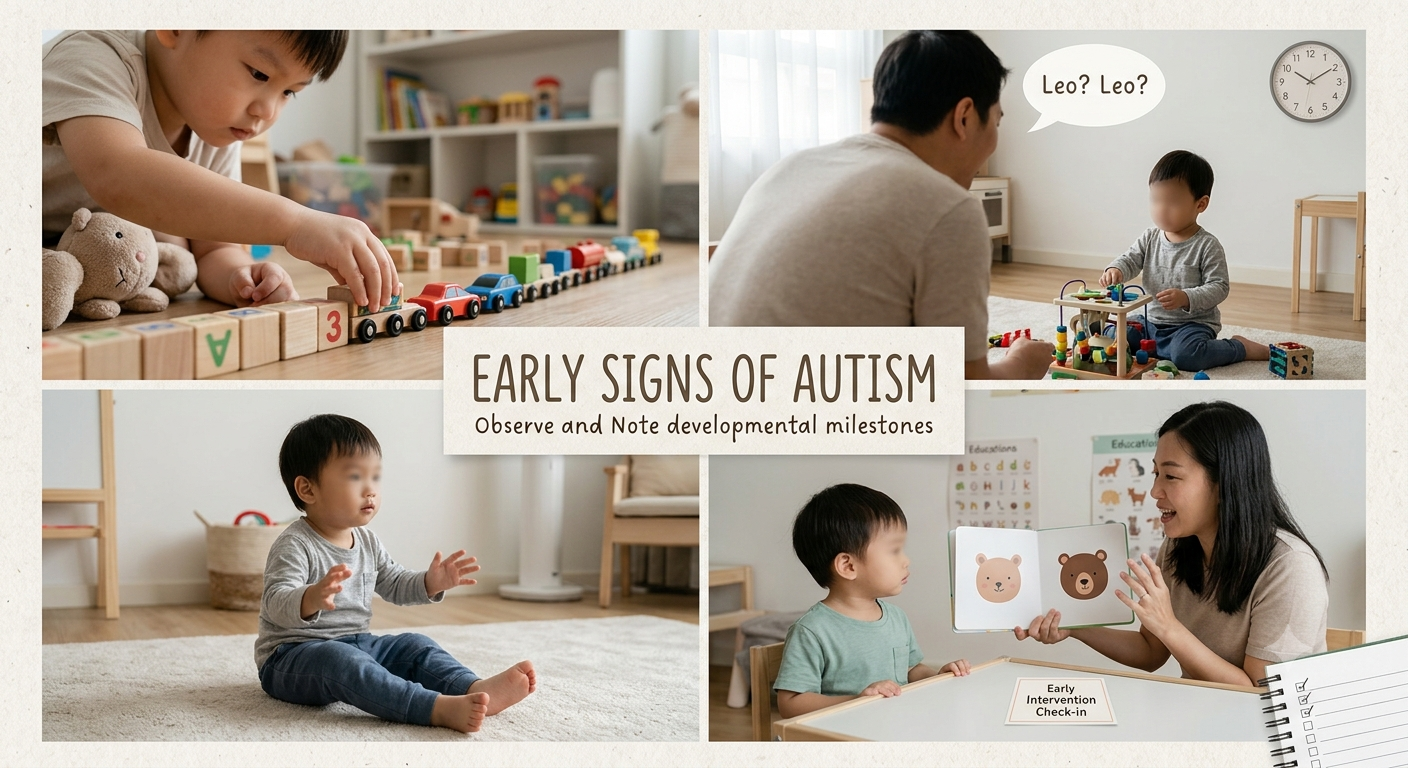
early signs of autism to know
Early Signs That Prompt Autism Testing
Most parents begin thinking about how to test for autism because they have noticed something specific about their child's development. Here are the signs that most commonly prompt parents and professionals to pursue autism testing:
In infants and toddlers:
Not responding to their name by 12 months
Not pointing or waving by 12 months
No babbling by 12 months
No two-word phrases by 24 months
Loss of previously acquired language or social skills at any age
Limited or absent eye contact
Not smiling in response to smiling faces
Appearing not to hear even though hearing tests are normal
In preschool age children:
Significant difficulty with social interaction with peers
Strong preference for routine with extreme distress at changes
Repetitive movements including hand flapping, rocking, or spinning
Intense, narrow interests that dominate play and conversation
Unusual sensory responses including strong reactions to sounds, textures, or lights
Delayed or unusual language development
Difficulty with pretend play
In school age children:
Social difficulties that are becoming more visible as peer expectations increase
Difficulty understanding unwritten social rules
Challenges with executive functioning including organization and task initiation
Sensory sensitivities that affect participation in school activities
Intense special interests that differ significantly from peers
Difficulty with transitions and unexpected changes
In teenagers:
Social isolation increasing as peer relationships become more complex
Anxiety and depression emerging alongside social difficulty
Academic performance inconsistent with cognitive ability
Fatigue and burnout from sustained social effort
Questioning their own identity and neurological difference
If you are seeing several of these signs in your child, pursuing autism testing is the right next step. Waiting to see if they grow out of it is rarely the best approach. Earlier identification means earlier support, and earlier support produces better outcomes.
Step One: Developmental Screening at Your Pediatrician
The first step in how to test for autism for most families is a conversation with their child's pediatrician.
The American Academy of Pediatrics recommends autism-specific screening for all children at their 18 and 24 month well-child visits, regardless of whether any concerns have been raised. Many pediatricians also screen at other routine visits if developmental concerns are present.
The most widely used screening tool at this stage is the M-CHAT-R, which stands for Modified Checklist for Autism in Toddlers, Revised. It is a 20-item parent-report questionnaire that takes about five minutes to complete and identifies toddlers who may need further evaluation.
What to do at this stage:
Be honest and specific when completing screening questionnaires. Describe what your child actually does, not what you hope or expect they will do
Come prepared with specific examples of the behaviors that concern you
Ask directly whether your child's screening results suggest further evaluation is needed
Request a referral for a full evaluation if the screening is positive or if you have concerns even when the screening is negative
It is worth knowing that a negative screening result does not rule out autism, particularly in children who have developed effective compensatory strategies or whose autism presents in ways that are less visible on standard screening tools. If you have concerns, advocate for further evaluation regardless of screening results.
Step Two: Formal Autism Evaluation
If screening raises concerns or if you have requested a full evaluation based on your own observations, the next step in how to test for autism is a comprehensive diagnostic evaluation.
This evaluation can be requested through several pathways:
Through your pediatrician: Ask for a referral to a developmental pediatrician, child psychologist, or autism specialist for a full evaluation.
Through your school district: Under the Individuals with Disabilities Education Act, you have the right to request a free educational evaluation through your child's school district. This evaluation is not the same as a clinical diagnosis but can identify educational support needs and sometimes contributes to the diagnostic process.
Through a specialist center: Many children's hospitals and university medical centers have dedicated autism evaluation programs. These programs typically offer the most comprehensive evaluations but often have longer waiting lists.
Privately: Private autism evaluations are available through clinical psychologists and developmental pediatricians in private practice. These can be faster than public pathways but involve out of pocket costs that vary significantly.

Professionals who can diagnose autism
Who Can Diagnose Autism
Knowing who can diagnose autism is part of understanding how to test for autism effectively.
In the United States, autism can be diagnosed by:
Developmental pediatricians: Medical doctors who specialize in child development and developmental disorders
Child psychiatrists: Medical doctors who specialize in mental health conditions in children including neurodevelopmental conditions
Clinical psychologists: Doctoral level psychologists with training in psychological assessment and neurodevelopmental conditions
Pediatric neurologists: Medical doctors specializing in neurological conditions in children, particularly relevant when epilepsy or other neurological conditions are also present
The most comprehensive autism evaluations are typically conducted by multidisciplinary teams that include several of these professionals working together. A team approach produces a more complete picture of the child's profile than a single professional assessment.
What Happens During an Autism Evaluation
Understanding what happens during an autism evaluation helps parents prepare effectively and know what to expect. Here is a typical sequence:
Developmental history interview: A detailed interview with parents covering the child's developmental history from birth, including milestones, early language development, social development, behavioral patterns, medical history, and family history. This usually takes one to two hours and is one of the most important parts of the evaluation.
Direct assessment of the child: The evaluator spends direct time with the child conducting standardized observations and assessments. The child may participate in structured play activities, respond to social prompts, complete cognitive tasks, and engage in conversation depending on their age and language level.
Cognitive and language assessment: Most comprehensive autism evaluations include assessment of cognitive ability and language development. This helps identify co-occurring conditions including intellectual disability and language disorders and provides a complete picture of the child's profile.
Behavior rating scales: Standardized questionnaires completed by parents and teachers that assess behavior across different settings. These provide information about how the child functions across environments rather than only in the assessment room.
Sensory processing assessment: Many evaluations include assessment of sensory processing, either through standardized tools or through clinical observation.
Feedback session: After the evaluation is complete, the evaluating team meets with parents to share findings, explain the diagnosis or ruling out of autism, and discuss recommendations for support.
If this section resonated with you, this is exactly what coaching sessions with Sonia are built around. Book here.
The Main Diagnostic Tools Used to Test for Autism
Several standardized tools are commonly used as part of how to test for autism in clinical practice. Knowing what these are helps parents understand the process:
ADOS-2 (Autism Diagnostic Observation Schedule, Second Edition): This is considered the gold standard observational assessment for autism. It is a structured, semi-structured interaction between the evaluator and the child that is scored according to specific criteria. It provides direct observational data on social communication and restricted or repetitive behaviors.
ADI-R (Autism Diagnostic Interview, Revised):A structured interview with parents covering developmental history and current behavior. It is often used alongside the ADOS-2 to provide a comprehensive picture combining observational and historical data.
M-CHAT-R:The screening tool used at pediatric well-child visits for toddlers aged 16 to 30 months.
CARS-2 (Childhood Autism Rating Scale, Second Edition): A rating scale used to assess autism severity across multiple behavioral domains.
Vineland Adaptive Behavior Scales:Assesses adaptive functioning including communication, daily living skills, and socialization across age groups.
Online Autism Tests: Are They Reliable
Parents searching for how to test for autism will inevitably come across online autism tests and screening tools. It is worth being clear about what these are and what they are not.
What online autism tests can do:
Provide an informal indication of whether an autism evaluation might be worthwhile
Help parents organize their observations and concerns before a professional consultation
Give autistic adults a framework for understanding their own experience before seeking formal diagnosis
What online autism tests cannot do:
Diagnose autism
Replace a comprehensive clinical evaluation
Provide a reliable ruling out of autism
The most widely used and most validated online screening tools include the Autism Spectrum Quotient, known as the AQ, developed by Simon Baron-Cohen and colleagues at Cambridge University, and the Ritvo Autism Asperger Diagnostic Scale, known as the RAADS-R. These are research-grade tools that can provide useful information but are not diagnostic instruments.
If an online screening raises concerns, the appropriate next step is a full clinical evaluation with a qualified professional. Online tools are a starting point, not an endpoint.
What Happens After an Autism Diagnosis
Understanding what comes after autism testing and diagnosis is part of knowing how to test for autism effectively because the diagnosis is only the beginning of the process.
After a diagnosis, the immediate priorities are:
Getting the right support in place: Use the diagnosis to access services including speech therapy, occupational therapy, behavioral support, and school accommodations. The diagnosis is the key that unlocks these services.
Educating yourself: Read widely from credible sources including autistic authors and advocates. The more you understand your child's specific profile, the better you can advocate for them and support them.
Connecting with community: Find other families who are navigating similar experiences. The autism parenting community is one of the most generous and knowledgeable communities you will ever encounter.
Processing the emotional response: A diagnosis brings up complex emotions for most parents. Giving yourself space to process those emotions, with support if needed, is important before diving entirely into action mode.
For a comprehensive guide to the practical steps that follow a diagnosis, the post on newly diagnosed autism parent guide covers everything in detail.
For the broader context of what acceptance looks like beyond diagnosis, the post on autism awareness vs autism acceptance is worth reading early in the journey because the framework you use to understand your child's diagnosis will shape every decision you make from here.
How to Advocate for Testing When You Are Being Dismissed
One of the most frustrating experiences parents describe in the autism testing process is being dismissed by professionals who minimize their concerns. Here is how to advocate effectively when that happens:
Document everything: Keep a written record of specific behaviors you have observed, with dates, contexts, and details. Specific documented observations are harder to dismiss than general concerns.
Request things in writing: If a professional declines to refer for evaluation, ask them to put that decision in writing with their clinical reasoning. This often prompts a more careful reconsideration.
Seek a second opinion: You are not obligated to accept a single professional's judgment. If your concerns are being dismissed, seek another opinion from a professional with specific autism expertise.
Use your school district rights: Under IDEA you have the right to request a free educational evaluation through your school district. You do not need your pediatrician's agreement to do this. Submit the request in writing and the school district has 60 days to respond.
Trust your observations: You know your child better than any professional who has spent one hour with them. Your observations are valid data. Do not let a dismissive response convince you otherwise.
Final Thoughts
Knowing how to test for autism puts you ahead of where most parents are when they start this process. The testing itself is not something to fear. It is the process of finally getting accurate information about your child that you can use to get them the support they deserve.
How to test for autism is a question with a clear practical answer. Two stages. Multiple professionals. Standardized tools combined with developmental history and direct observation. A process that takes time but produces a picture of your child that opens doors to genuine support.
If you have concerns about your child, pursue them. Document what you are seeing. Request the evaluation. Advocate when you need to. And trust that the clarity that comes from knowing is almost always better than the uncertainty of not knowing.
Your child is worth finding out.
References:
American Academy of Pediatrics. Autism Spectrum Disorder [Internet]. Last updated October 2025. Available from: https://www.aap.org/en/patient-care/autism/
Robins DL, Fein D, Barton M. M-CHAT-R/F: Modified Checklist for Autism in Toddlers, Revised with Follow-Up [Internet]. 2009. Available from: https://www.mchatscreen.com/
U.S. Department of Education. Individuals with Disabilities Education Act, Section 1414: Evaluations, Eligibility Determinations, Individualized Education Programs, and Educational Placements [Internet]. Available from: https://sites.ed.gov/idea/statute-chapter-33/subchapter-ii/1414/
Global Autism Interactive Network (GAIN), University of Kansas Life Span Institute. Autism Diagnostic Interview – Revised (ADI-R) [Internet]. Available from: https://gain.ku.edu/autism-diagnostic-interview-revised-adi-r
Massachusetts General Hospital, Lurie Center for Autism. Autism Diagnostic Observation Schedule, Second Edition (ADOS-2) [Internet]. Available from: https://www.massgeneral.org/children/autism/lurie-center/autism-diagnostic-observation-schedulesecond-edition-ados2
Ji SI, Park H, Yoon SA, Hong SB. A Validation Study of the CARS-2 Compared With the ADOS-2 in the Diagnosis of Autism Spectrum Disorder: A Suggestion for Cutoff Scores. J Korean Acad Child Adolesc Psychiatry. 2023 Jan;34(1):45-50. Available from: https://pmc.ncbi.nlm.nih.gov/articles/PMC9816003/
ScienceDirect Topics. Vineland Adaptive Behavior Scale [Internet]. Elsevier. Available from: https://www.sciencedirect.com/topics/medicine-and-dentistry/vineland-adaptive-behavior-scale
Baron-Cohen S, Wheelwright S, Skinner R, Martin J, Clubley E. The Autism-Spectrum Quotient (AQ): Evidence from Asperger Syndrome/High-Functioning Autism, Males and Females, Scientists and Mathematicians. J Autism Dev Disord. 2001;31(1):5-17. Available from: https://psychology-tools.com/test/autism-spectrum-quotient
Ritvo RA, et al. Ritvo Autism Asperger Diagnostic Scale – Revised (RAADS-R) [Internet]. NovoPsych. 2011. Available from: https://novopsych.com/assessments/diagnosis/ritvo-autism-asperger-diagnostic-scale-revised-raads-r/
