
Is Autism Coaching Right for Me?
Is autism coaching right for me is a question that sits quietly in the back of a lot of autistic adults' minds, sometimes for months before they ever say it out loud. They have read about coaching. They have maybe listened to conversations about it. They are curious but uncertain, and underneath the uncertainty is usually a combination of hope and caution that makes complete sense given how many times support has promised more than it delivered.
This post is written for that moment of uncertainty. It answers the question honestly, without the sales pressure that most coaching pages carry, because the right answer for you matters more than a conversion.
Autism coaching is genuinely transformative for the right person at the right time. It is also not the right fit for everyone, and part of what makes coaching with Sonia different is the commitment to helping you figure out which one is true for you before you commit to anything.
Table of Contents
What Autism Coaching Actually Is
Signs That Autism Coaching Might Be Right for You
Signs That Something Else Might Be a Better First Step
What Makes Sonia's Coaching Different
The Six Month Self-Esteem Coaching Program
Common Concerns About Starting Coaching
FAQs
Final Thoughts
What Autism Coaching Actually Is
Before you can answer is autism coaching right for me, you need a clear picture of what autism coaching actually is, because the word coaching gets used in so many different ways that it has become genuinely difficult to know what you are signing up for.
Autism coaching is not therapy. It does not diagnose, treat, or clinically address mental health conditions. It does not spend its primary energy in the past, excavating childhood experiences or processing trauma in the way that clinical therapy does.
Autism coaching is forward-focused. It works with where you are right now and where you want to go, building the specific skills, self-understanding, and inner confidence that allow you to function more effectively, more authentically, and with significantly less exhaustion in the areas of life that are currently hardest.
For autistic adults, this typically means building practical tools for social navigation, developing emotional regulation strategies that work with autistic neurology rather than against it, challenging the limiting beliefs that have accumulated from years of being misunderstood, and building the genuine self-worth that makes advocating for yourself feel possible rather than presumptuous.
It is practical. It is personalized. And when it is delivered by someone with the right combination of clinical depth, autistic understanding, and genuine lived experience, it is one of the most useful forms of support available to autistic adults outside of clinical treatment.
Signs That Autism Coaching Might Be Right for You
The honest answer to is autism coaching right for me involves looking at where you actually are right now and what is genuinely in the way of the life you want.
Coaching is likely a strong fit if you recognize yourself in several of the following:
You have a diagnosis but not much else
You received your autism diagnosis, whether recently or some years ago, and the diagnosis answered questions but did not come with a roadmap. You know what you are. You are still figuring out what to do with that knowledge.
You are functioning but exhausted
From the outside your life looks manageable. On the inside you are running on empty in ways you cannot fully explain to the people around you. The masking, the social effort, the constant navigation of a world not designed for your brain, it adds up and nobody around you quite sees the cost.
You want better relationships but do not know how to build them
The desire for genuine connection is real. The gap between wanting it and knowing how to create and sustain it is also real. You have watched friendships fade, professional relationships stall, or personal connections struggle under the weight of communication styles that do not quite match.
You struggle to advocate for yourself
You know what you need. You cannot consistently say it. Whether it is workplace accommodations, adjustments in relationships, or simply communicating your sensory needs without feeling like a burden, the gap between knowing and saying is significant.
Your self-image is shaped more by what went wrong than by who you actually are
Years of struggling without understanding have left a specific kind of mark. Not depression necessarily, but a quiet, pervasive sense that something about you is fundamentally more difficult than it should be. Coaching addresses exactly that.
You are a late-diagnosed adult still making sense of your history
If autism was identified later in your life, the work of understanding your past through a new lens, and building forward from that understanding, is specific and significant. Coaching created by someone who has navigated the same experience is a genuinely different form of support.
Dropped in a Maze by Sonia Chand is the book that speaks directly to many of these experiences, written from the inside of an autistic life and the process of understanding it more clearly.
Signs That Something Else Might Be a Better First Step
Honesty about when coaching is not the right fit matters as much as everything above.
Coaching may not be the right starting point if:
You are currently in acute mental health crisis
If you are experiencing suicidal ideation, severe depression, active trauma responses, or any mental health situation that requires clinical intervention, therapy with a licensed clinical professional is the appropriate first step, not coaching. Coaching works alongside stable mental health, not in place of clinical treatment when clinical treatment is genuinely needed.
You have not yet been assessed or diagnosed
If you are still in the process of understanding whether autism applies to you, getting an accurate assessment is the right first step. Coaching is most effective when built on an accurate understanding of the person's neurology. For a full guide to the assessment process, the post on how to test for autism covers every stage in detail.
You are looking for someone to do the work for you
Coaching requires genuine engagement. It requires showing up, reflecting honestly, and doing the between-session work that makes the sessions themselves meaningful. If you are not in a position to engage actively right now, waiting until you are will produce better results than starting before you are ready.
None of these are permanent disqualifications. They are honest assessments of timing, and timing matters in coaching as much as anything else.
What Makes Sonia's Coaching Different
When you are asking is autism coaching right for me, you are also implicitly asking is this particular coach right for me, and that question deserves a specific answer.
Sonia Chand is a licensed psychotherapist, which means she brings clinical depth to her coaching work that most coaches simply do not have. She has completed graduate-level clinical training, accumulated supervised clinical hours, and is held to the professional and ethical standards of a regulated clinical field. When you work with Sonia, you are not working with someone who completed a coaching certification and called themselves an autism specialist. You are working with a clinically trained professional who has specialized specifically in neurodivergent adult support.
She is also a late-diagnosed autistic adult herself. That personal experience is not incidental to her coaching. It is foundational to it. She knows what it feels like to spend years navigating a world without the right framework. She knows the specific texture of late diagnosis, the relief, the grief, the rebuilding. And she knows what genuine support in the aftermath of that diagnosis makes possible, because she has experienced it from both sides of the coaching relationship.
Her two core coaching services are built around this combination:
Socio-emotional coaching builds real-world skills for social navigation, friendship, professional relationships, everyday interactions, and emotional regulation, in ways that work with autistic communication styles rather than against them.
Self-esteem coaching works on the inner foundation, the limiting beliefs, the self-image, and the self-compassion that determine whether external skills actually translate into genuine confidence and genuine change.
Six Month Self-Esteem Coaching Program
The Six Month Self-Esteem Coaching Program
For autistic adults who are ready for the most structured and comprehensive coaching engagement, the six month self-esteem coaching program is the answer to is autism coaching right for me in its fullest form.
This is not a series of disconnected sessions. It is a structured, evidence-informed pathway that moves progressively through the work of rebuilding and strengthening self-esteem from the ground up.
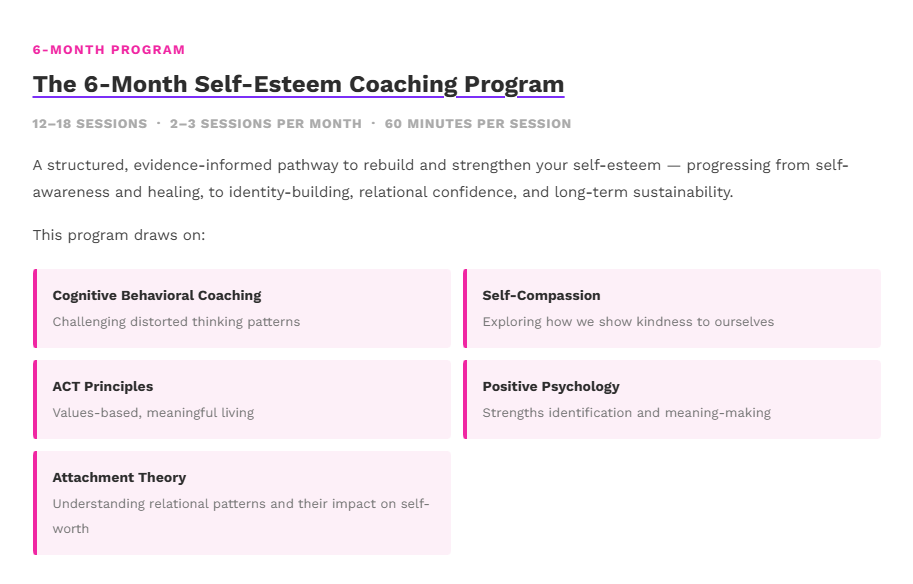
The program runs across twelve to eighteen sessions, two to three sessions per month, each sixty minutes long. It draws on cognitive behavioral coaching, self-compassion principles, ACT, positive psychology, and attachment theory, all adapted specifically for autistic neurology.
Here is what the six months actually look like:
Month one: Foundation and Self-Awareness
The program begins with a baseline assessment, an exploration of your self-story, and a clarification of your values. Before you can rebuild, you need to know what you are working with and what you are working toward. This month establishes both.
Month two: Challenging the Inner Critic
The accumulated self-critical narratives that form without accurate self-understanding get examined and challenged here through cognitive reframing and the development of genuine, evidence-based self-talk that actually holds up.
Month three: Self-Compassion and Resilience
Building the capacity to hold your history with kindness rather than judgment, to regulate your emotions without shutting down, and to move forward from setbacks rather than being defined by them.
Month four: Identity, Strengths and Ownership
A genuine strengths inventory, deeper work on authenticity, and the building of confidence in action rather than only in theory. This is where the autistic person's genuine assets become visible and owned.
Month five: Relationships, Boundaries and Social Confidence
The practical relational work. Boundary-setting, assertiveness, navigating social anxiety, and building the relational confidence that makes genuine connection possible rather than perpetually exhausting.
Month six: Integration and Sustainability
The final month reviews progress, builds a personal blueprint for continued growth, and creates a clear, grounded vision for the life ahead. The goal is not dependency on coaching but genuine independence built on a foundation that was not there before.
By the end of the program, clients will have:
Identified and challenged the limiting beliefs undermining their self-worth
Developed consistent self-compassion and emotional self-regulation
Learned to own and communicate their strengths confidently in relationships
Set and maintained healthy personal boundaries
Built the tools to sustain healthy self-esteem independently
This is not a program for people who want to feel slightly better. It is a program for people who are ready to genuinely change the relationship they have with themselves.
Book a discovery call with Sonia here
Common Concerns About Starting Coaching
If you are asking is autism coaching right for me and something is still holding you back, it is probably one of these:
I am not sure I am autistic enough for coaching to apply to me
Autism is a spectrum and support needs vary enormously. The experiences that coaching addresses, social exhaustion, self-esteem damage, communication difficulty, and identity uncertainty, are present across the full range of autistic experience. You do not need to be visibly struggling to deserve support.
I have tried therapy and it did not help
This is one of the most common starting points for coaching clients. Therapy that did not address the autistic neurology underlying the anxiety, depression, or relational difficulties was always going to have limited impact. Coaching that starts from the autism first is a genuinely different experience.
I am worried it will not work for me specifically
The discovery call exists for exactly this concern. It is a genuine conversation, not a sales call, where you can ask your questions, share your specific situation, and get an honest assessment of whether this is the right fit.
I cannot afford to invest in something that might not help
This is a real and valid concern. The discovery call is free, there is no pressure to commit during it, and it is designed specifically to help you make an informed decision rather than an impulse one.
For autistic adults who are also managing the daily life demands of executive functioning and routine alongside their coaching work, the post on why routine matters for autistic adults covers the practical daily structures that support everything else.
FAQs
Is autism coaching the same as therapy?
No. Coaching is forward-focused and practical. Sonia is both a licensed psychotherapist and a specialist coach, which means she brings clinical depth to coaching that most coaches cannot offer.
Do I need a formal autism diagnosis to work with Sonia?
A diagnosis is helpful context but not always a prerequisite. The discovery call is the right place to discuss your specific situation honestly.
How is the six month program different from individual coaching sessions?
The six month program provides a structured, progressive pathway through specific outcomes. Individual coaching sessions are more flexibly tailored to immediate goals and challenges.
What if I start and it does not feel right?
The discovery call is designed to reduce this risk significantly. And if something is not working during coaching, that conversation is always available and welcomed.
Is coaching available online?
Yes. All of Sonia's coaching is delivered online, making it accessible regardless of location and removing the sensory and logistical demands of in-person appointments.
What is the first step?
A discovery call. Free, no pressure, and genuinely useful whether you decide to proceed or not.
Final Thoughts
Is autism coaching right for me is not a question with a universal answer. It is a question that depends on where you are, what you need, and whether the specific coach in front of you has the right combination of training, understanding, and personal knowledge to meet you there.
What is clear is this: autistic adults who have access to genuinely qualified, personally grounded, autism-informed coaching consistently describe it as one of the most useful forms of support they have ever received. Not because it fixes anything. But because it finally gives them the tools to understand themselves accurately and build forward from that understanding in a way that is genuinely theirs. That work starts with a single conversation.
