
Why Routine Matters for Autistic Adults
Routine is not a quirk for autistic adults. It is not rigidity, stubbornness, or an unwillingness to be flexible. For many autistic adults, routine is the scaffolding that makes daily life genuinely possible, and understanding why routine is important for autistic adults changes how you think about the whole conversation around flexibility, spontaneity, and what it actually means to thrive with an autistic brain.
This post covers the neuroscience behind why routine matters so much, what happens when routines are disrupted, how to build routines that genuinely work, and what support looks like for autistic adults who are still trying to figure this out.
Table of Contents
The Neuroscience Behind Routine and Autism
What Routine Actually Does for an Autistic Nervous System
What Happens When Routine Breaks Down
Routine vs Rigidity: An Important Distinction
How to Build Routines That Actually Work
Routine and Mental Health in Autism
Routine at Work and in Relationships
FAQs
Final Thoughts
References
The Neuroscience Behind Routine and Autism
To understand why routine is important for autistic adults, you need to understand what the autistic brain is doing when it encounters the world moment to moment.
The neurotypical brain is constantly making predictions. It takes in sensory information, compares it to what it expects based on past experience, and flags only the things that do not match. This predictive processing system is one of the reasons neurotypical people can walk into a busy café and tune out most of the noise. The brain has predicted what the environment will be like and filters accordingly.
In many autistic brains, this predictive processing system works differently. Rather than filtering based on strong predictions, the autistic brain often processes more of the incoming sensory and contextual information in full, without the same degree of automatic filtering. The result is an environment that is experienced as more intense, more demanding of cognitive resources, and more exhausting to navigate.
Routine reduces this demand directly. When the environment and the sequence of events are predictable, the brain does not need to expend as much energy processing what is happening. It already knows. That saved energy is available for everything else.
Research has proposed the predictive coding framework for understanding autism, finding that differences in how autistic brains process prediction and uncertainty help explain both sensory sensitivities and the strong preference for routine and sameness.
This is not a preference for comfort. It is a neurological efficiency strategy.
What Routine Actually Does for an Autistic Nervous System
Understanding why routine is important for autistic adults becomes clearer when you look at what routine is actually doing for the nervous system on a practical level.
It reduces decision fatigue: Every decision costs cognitive resources. For autistic adults, who are often managing a higher baseline cognitive load than their neurotypical peers due to sensory processing demands and executive functioning differences, the decisions required by an unstructured day can be genuinely depleting before the day has properly started. Routine removes the need to make repeated decisions about what comes next, conserving those resources for the things that actually require them.
It creates a regulated baseline: The autistic nervous system regulates more easily in predictable environments. When the sequence of events is known, the threat detection system does not need to stay on high alert for unexpected changes. Routine creates the conditions for genuine calm rather than the effortful performance of calm that many autistic adults live with when their day is unpredictable.
It supports executive functioning: Many autistic adults experience executive functioning differences including difficulty with task initiation, planning, and sequencing. A well-built routine externalizes these functions. Rather than having to figure out what to do next and then generate the motivation to start it, the routine simply carries the person through the sequence. The decision has already been made.
If you are an autistic adult who is struggling to build sustainable routines and would benefit from personalised, autism-informed support to do it, Sonia's coaching is built for exactly this kind of practical, real-world work.
Book a discovery call with Sonia here and start building the daily structure that works with your actual neurology.

What Happens When Routine Breaks Down
The distress that autistic adults experience when routines are disrupted is one of the most consistently misunderstood aspects of autistic experience, and it deserves honest explanation rather than dismissal.
When a routine breaks down unexpectedly, the autistic nervous system loses the predictability that was keeping it regulated. The brain shifts from a state of efficient, low-alert processing to a state of heightened vigilance as it tries to recalibrate to a situation it did not anticipate. Depending on the individual and the degree of disruption, this can manifest as anxiety, irritability, shutdown, meltdown, or a pervasive sense of wrongness that is difficult to shake even after the disruption has passed.
This is not an overreaction. It is a nervous system doing exactly what it is designed to do when the expected environment changes unexpectedly. The problem is not the response. The problem is that the environment changed without warning.
Dropped in a Maze by Sonia Chand captures the experience of navigating daily life when the expected predictability collapses, with the kind of honest, grounded insight that makes autistic adults feel genuinely seen rather than simply described.
Get your copy of Dropped in a Maze here
Routine vs Rigidity: An Important Distinction
One of the most unhelpful framings in the conversation about why routine is important for autistic adults is the conflation of routine with rigidity.
Routine and rigidity are not the same thing. Routine is a structure that supports functioning. Rigidity is a response to anxiety that makes any deviation from the routine feel dangerous rather than simply inconvenient. The distinction matters because the response to each is different.
Supporting healthy routine means helping an autistic adult build the predictable structures that allow their nervous system to regulate efficiently. It means respecting those structures as genuine needs rather than treating them as preferences to be challenged or overcome.
Addressing rigidity, when it has developed to the point where any unexpected change causes significant distress, requires more than just maintaining routine. It requires addressing the underlying anxiety that has made flexibility feel impossible, which is a deeper piece of work.
Many autistic adults live with both. They have routines that genuinely serve them and they also carry anxiety around disruption that goes beyond what the situation warrants. Coaching can work with both dimensions simultaneously.
Book a discovery call with Sonia here and get the support that helps you build structure without becoming imprisoned by it.
How to Build Routines That Actually Work
Knowing why routine is important for autistic adults is one thing. Building routines that are genuinely sustainable in a real life is another, and it requires more thought than simply writing a schedule.
Start with anchor points rather than minute-by-minute schedules: Overly detailed schedules create more opportunities for disruption rather than fewer. Building a routine around a handful of consistent anchor points in the day, wake time, the start of work, a midday break, an end of day transition, and sleep, provides the predictable structure the nervous system needs without the fragility of a rigid timetable.
Build transition buffers deliberately: The cognitive cost of switching between activities is higher for many autistic adults than for neurotypical people. Building explicit transition time between activities rather than scheduling them back-to-back significantly reduces the dysregulation that accumulates when transitions are rushed.
Include genuine recovery time as a non-negotiable: Recovery is not a reward for getting through a productive day. It is a neurological necessity that needs to be built into the routine as a fixed, non-negotiable element. Many autistic adults who struggle with sustainable routines are building routines that have no genuine recovery time, which is like building a budget with no emergency fund.
Make the routine visible: External visual representations of the routine, whether a written schedule, a digital planner, or a visual timeline, support the executive functioning demands of following the routine and reduce the cognitive load of keeping track of what comes next.
Plan for disruptions before they happen: Building a simple protocol for what to do when the routine breaks down, a pre-planned response to unexpected changes, reduces the distress of disruption because the disruption itself now has a predictable structure around it.
For autistic adults who are navigating both routine-building and time management simultaneously, the post onautism and time management: practical strategies for adults covers the executive functioning dimension of daily structure in full detail.
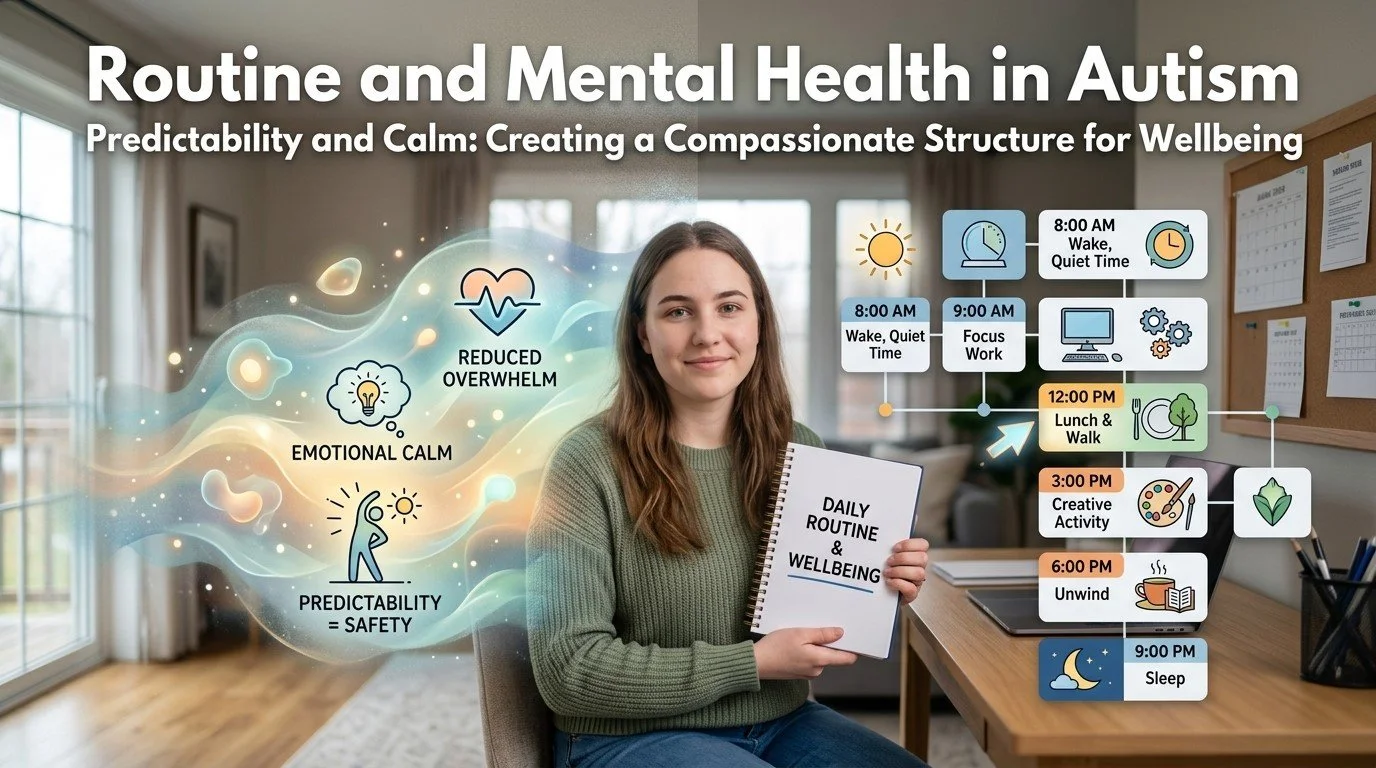
Routine and Mental Health in Autism
The relationship between routine and mental health in autistic adults is direct and well-documented, and it is one of the most compelling reasons why routine is important for autistic adults beyond simple daily functioning.
Anxiety is significantly more common in autistic adults than in the neurotypical population, and unpredictability is one of the most consistent anxiety triggers. A life with predictable, stable routines reduces the ambient anxiety load that autistic adults carry, which has downstream effects on mood, energy, social functioning, and cognitive performance.
Research published in Pubmed found that autistic adults who reported higher levels of daily routine consistency also reported significantly lower anxiety and better overall wellbeing than those with more variable daily structures.
The relationship also runs in the other direction. When mental health deteriorates, the capacity to maintain routine often deteriorates with it, which further worsens mental health in a cycle that can be difficult to interrupt without support.
Routine at Work and in Relationships
Two of the areas where the importance of routine for autistic adults is most practically significant are work and relationships, and both deserve specific attention.
At work: Unpredictable work environments, shifting schedules, last-minute changes to plans, and unclear expectations are among the most consistent contributors to autistic burnout in the workplace. Building workplace routines, including consistent start and end times, predictable task sequences, and clear communication about schedule changes in advance, significantly reduces the cognitive and anxiety load of the working day.
Advocating for workplace routines as part of a reasonable accommodation request is entirely appropriate. Written schedules, consistent meeting formats, and advance notice of changes are all low-cost accommodations that make a meaningful difference.
In relationships: Routine in personal relationships is often misunderstood by neurotypical partners and friends as a lack of spontaneity or interest. It is neither. Consistent rituals, predictable communication patterns, and reliable plans reduce the social anxiety and cognitive load of relationships in ways that allow autistic adults to be more genuinely present and more genuinely themselves within them.
Explaining this to the people in your life is itself a form of self-advocacy, and one that coaching directly supports.
For autistic adults who are navigating autistic burnout alongside routine disruption, the post on what does autistic burnout feel like in adults covers how routine breakdown and burnout interact and what recovery genuinely requires.
FAQs
Why is routine important for autistic adults?
Routine reduces the cognitive and sensory processing demands of daily life, supports nervous system regulation, and compensates for executive functioning differences that make unstructured time genuinely hard to manage.
Is needing routine a sign of rigidity?
No. Routine is a functional neurological strategy. Rigidity is an anxiety-driven response to disruption. The two are related but distinct, and they require different responses.
Can autistic adults learn to cope with disrupted routines?
Yes. Building flexible protocols for disruption, addressing the underlying anxiety, and developing self-regulation strategies all reduce the distress of unexpected changes over time.
How does routine affect mental health in autism?
Consistent daily structure is associated with significantly lower anxiety and better overall wellbeing in autistic adults. Routine is one of the most accessible mental health supports available.
What is the best way to build a sustainable routine?
Start with anchor points rather than detailed schedules, build in transition time and genuine recovery, make the routine visually accessible, and plan a simple protocol for when disruptions occur.
Final Thoughts
Routine is not a limitation of the autistic experience. It is one of the most intelligent responses an autistic nervous system can make to a world that asks a great deal of it every single day.
Understanding why routine is important for autistic adults is not about excusing inflexibility or avoiding challenge. It is about building a life that works with the brain you actually have rather than constantly fighting against it. And that life, built on genuine structure and genuine self-knowledge, is one where thriving is genuinely possible.
References:
Theo M. The role of routine in supporting people on the autism spectrum [Internet]. Autism Spectrum Australia (Aspect); 2024 Sep 10. Available from: https://www.aspect.org.au/blog/the-role-of-routine-in-supporting-people-on-the-autism-spectrum
Leicestershire Partnership NHS Trust. The benefits of familiarity and predictability for autistic people [Internet]. Last modified 2026 May 13. Available from: https://www.leicspart.nhs.uk/autism-space/health-and-lifestyle/the-benefits-of-familiarity-predictability-for-autistic-people/
National Autistic Society. Preference for order, predictability or routine [Internet]. Available from: https://www.autism.org.uk/advice-and-guidance/about-autism/preference-for-order-predictability-or-routine
Cannon J, O'Brien AM, Bungert L, Sinha P. Prediction in autism spectrum disorder: A systematic review of empirical evidence. Autism Res. 2021;14(4):604-630. Available from: https://pmc.ncbi.nlm.nih.gov/articles/PMC8043993/
Taylor EC, Livingston LA, Clutterbuck RA, Callan MJ, Shah P. Psychological strengths and well-being: Strengths use predicts quality of life, well-being and mental health in autism. Autism. 2023;27(6):1826-1839. Available from: https://pmc.ncbi.nlm.nih.gov/articles/PMC10375006
