
7 Questions to Ask Before Choosing an Autism Coach
Choosing an autism coach is one of the most important decisions an autistic adult or autism family can make. The right coach can change the trajectory of your life. The wrong one can waste your time, your money, and, more painfully, your trust at a moment when trust is already hard to extend.
The problem is that autism coaching is an unregulated space. Anyone can call themselves an autism coach. There are no universal standards, no required qualifications, and no guaranteed framework behind the title. Which means the questions you ask before committing matter enormously.
This post gives you the seven most important questions to ask any autism coach before you begin working with them, and answers each one from Sonia Chand's own practice, because transparency is the beginning of trust and trust is the beginning of everything that coaching can offer.
Table of Contents
Do You Have Personal Experience of Autism?
What Are Your Professional Qualifications?
What Coaching Approach Do You Use?
Who Do You Work With?
How Do You Measure Progress?
What Does a Typical Coaching Engagement Look Like?
Why Should I Choose You Over Someone Else?
Final Thoughts
Do You Have Personal Experience of Autism?
This is the question that separates coaches who understand autism intellectually from coaches who understand it in their bones.
Many autism coaches have studied autism extensively. They have read the research, completed the training, and built their practice around clinical knowledge of the condition. That is valuable. But it is different from knowing what it feels like to sit in a classroom for years without understanding why social interaction costs you so much more than it seems to cost everyone around you. It is different from spending decades building compensatory strategies without knowing what you were compensating for. It is different from receiving a diagnosis later in life and having to rebuild your understanding of your entire history in its light.
Sonia Chand is a late-diagnosed autistic adult. She received her own autism diagnosis as an adult, which means she knows firsthand the specific experience that many of her clients are navigating when they come to her. The confusion that precedes diagnosis. The relief and grief that follow it. The complex, layered work of understanding your past through a new lens while simultaneously trying to build a better future.
That personal experience does not replace clinical training. But it adds something clinical training cannot provide: the kind of understanding that only comes from having lived it.
When a client sits across from Sonia and tries to explain what it felt like to spend years feeling fundamentally out of step with the world around them, she does not have to translate that experience into something she can understand. She already knows. And that knowing changes the quality of the coaching relationship in ways that are difficult to quantify but impossible to miss.
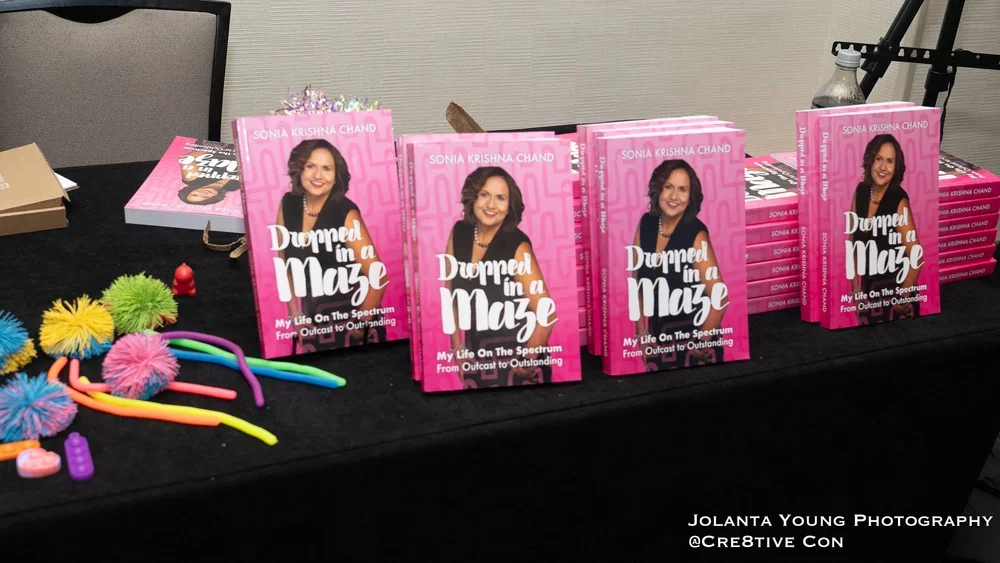
Dropped in a Maze by Sonia Chand is the book that captures this personal journey honestly and in full. It is the story of navigating an autistic life without a map, and it is the reading that gives her coaching work its deepest roots.
Get your copy of Dropped in a Maze here and read the story behind the coach before you ever book your first session.
What Are Your Professional Qualifications?
Personal experience of autism is important. Professional qualifications are not optional.
Coaching is an unregulated field, which means the question of qualifications is entirely on you to ask. And the answer matters, because the depth of support a coach can offer is shaped significantly by the depth of their training.
Sonia Chand is a licensed psychotherapist. That is not the same as being a coach who has done a weekend certification or a short online course. It means she has completed graduate-level clinical training, accumulated supervised clinical hours, passed professional licensing examinations, and is held to the ethical and professional standards of a regulated clinical field.
What this means in practice for her coaching clients is significant. Sonia can recognize when what a client is presenting goes beyond coaching into clinical territory that needs clinical support. She can work with the psychological dimensions of autistic experience, including trauma, identity disruption, and the mental health consequences of years of masking, with a depth and safety that a coach without clinical training cannot offer.
It also means that the frameworks she uses in her coaching work, cognitive behavioral coaching, self-compassion principles, ACT, positive psychology, and attachment theory, are not things she encountered in a coaching certification. They are the frameworks of her professional clinical training, adapted and applied to the specific neurology and lived experience of the autistic adults she works with.
When you choose Sonia as your autism coach, you are not choosing between a coach and a therapist. You are choosing someone who brings both.
Book a discovery call with Sonia here and experience the difference that genuinely qualified, clinically informed autism coaching makes from the very first conversation.
What Coaching Approach Do You Use?
The approach a coach uses tells you a great deal about how they understand autism and what they believe the goal of coaching is.
Some coaching approaches are deficit-focused, built around identifying what is not working and fixing it. Some are purely skill-based, focused on teaching specific social or behavioral strategies. Some are primarily motivational, focused on mindset and goal-setting in a generic way that does not account for the specific realities of autistic neurology.
Sonia's approach is different on all three counts.
Her coaching is strengths-based, which means it starts from the genuine strengths that autistic individuals bring rather than from a catalogue of deficits to be addressed. It is neurodiversity-affirming, which means the goal is never to make an autistic person appear more neurotypical but to help them thrive as their authentic autistic self. And it is personalized, which means the work is built around the specific individual sitting in front of her rather than applied generically from a standard curriculum.
The two core coaching services Sonia offers reflect this approach directly.
Socio-emotional coaching builds real-world skills for navigating friendships, professional relationships, everyday social situations, and emotional regulation in ways that work with autistic communication styles rather than against them.
Self-esteem coaching works on the inner foundation, the limiting beliefs, the self-image, the self-compassion, and the goal-setting capacity that determine whether external skills actually translate into genuine confidence and genuine change.
Neither service is about performing neurotypicality. Both are about building a life that genuinely fits.
Book a discovery call with Sonia here and find out which approach is the right starting point for where you are right now.
Who Do You Work With?
Understanding who a coach works with helps you assess whether they are the right fit for your specific situation.
Some autism coaches work primarily with children. Some work with parents. Some work only with autistic adults at a specific end of the spectrum. Knowing who a coach has the most experience with, and who they have designed their practice around, helps you assess whether your own situation falls within their genuine area of expertise.
Sonia works primarily with autistic adults and neurodivergent individuals who are navigating the social, emotional, and identity dimensions of their experience. Her practice is not built around childhood intervention or parent coaching. It is built around adults who are trying to understand themselves more accurately and build lives that genuinely work for their neurology.
Within that population, she has particular depth of experience and particular personal understanding in two specific areas.
The first is late-diagnosed autistic adults, people who received their diagnosis in adulthood and are working through the complex mixture of relief, grief, and rebuilding that follows. Because Sonia has navigated this herself, she understands it at a level that goes beyond professional knowledge.
The second is autistic adults who are navigating the social world with genuine desire for connection but significant difficulty, people who want relationships, friendships, and professional belonging but who have not had access to the tools and self-understanding that would make those things genuinely achievable.
If you fall into either of those groups, or both, Sonia's practice was built with you specifically in mind.
How Do You Measure Progress?
One of the most important questions to ask any coach is how they measure whether the work is actually working.
Vague measures of progress, feeling better, being more confident, having better conversations, are not enough on their own. Genuine coaching needs to be able to point to specific, meaningful changes in how a person is functioning, thinking, or engaging with their life.
Sonia's six month self-esteem coaching program provides the clearest answer to this question, because it is structured around specific, progressive outcomes across each of its six phases.
By the end of the program, clients will have identified and challenged the limiting beliefs that have been undermining their self-worth, developed consistent self-compassion and emotional self-regulation practices, learned to own and communicate their strengths confidently in relationships, established and maintained healthy personal boundaries, and built the tools to sustain healthy self-esteem independently through personalized rituals and tools.
Those are not vague aspirations. They are specific, observable changes that both the client and the coach can assess honestly as the program progresses.
The program runs across twelve to eighteen sessions, two to three sessions per month, each sixty minutes long. Progress is reviewed explicitly at each phase, and the program is designed to build systematically from self-awareness through to long-term sustainability rather than jumping between topics without a coherent arc.
The On the Spectrum podcast with Sonia Chand gives you a genuine sense of how Sonia thinks about progress, growth, and the autistic experience before you ever commit to working with her.
Listen here and let the conversations speak for themselves.
What Does a Typical Coaching Engagement Look Like?
In addition, understanding the practical structure of coaching before you begin helps you assess whether it is a realistic fit for your life and whether the investment of time and energy is one you can genuinely make.
For Sonia's socio-emotional coaching, the structure is tailored to the individual. Sessions are typically sixty minutes and the frequency is agreed collaboratively based on the client's needs, goals, and capacity. The work is focused on specific, real-world challenges the client is navigating and builds practical skills through a combination of conversation, reflection, and between-session practice.
For the six month self-esteem program, the structure is clear and progressive as described above. Twelve to eighteen sessions across six months, each building on the last, moving from foundation through to integration and long-term sustainability.
Both services are delivered online, which means they are accessible regardless of where you are located and can be scheduled around the demands of your actual life rather than requiring you to reorganize your life around them.
The accessibility of online coaching matters particularly for autistic adults, many of whom find the removal of travel, waiting rooms, and unfamiliar physical environments genuinely significant in terms of the cognitive and sensory load of the engagement itself. You come to the session from your own space, on your own terms, which means more of your energy goes into the actual work.
Why Should I Choose You Over Someone Else?
This is the most direct question and the one most coaches are least prepared for. It deserves a direct answer.
Sonia Chand offers something that is genuinely rare in the autism coaching space: the combination of clinical professional training at a licensed psychotherapist level, specialization in neurodivergent adult coaching, and her own lived experience of late autism diagnosis.
Most coaches have one or two of those things. Very few have all three.
Her clinical training means she can work with the full depth of what autistic adults bring to coaching, including the trauma, the identity disruption, and the mental health consequences of years of masking, in a way that a coach without clinical training cannot do safely or effectively.
Her specialization means she has built her entire practice around the specific needs of autistic and neurodivergent adults rather than applying a generic coaching framework and hoping it transfers.
Her personal experience means she understands what she is hearing not just as a professional but as someone who has been in the same place. That understanding creates a coaching relationship built on genuine connection rather than clinical distance.
And her book, Dropped in a Maze, is the proof of all of the above in its most honest and most human form. It is the story of her own journey, written for everyone who has ever felt lost in a system that was not built for them and wondered if a way through actually exists.
Final Thoughts
Choosing an autism coach is an act of trust. And trust, for many autistic adults who have spent years being misunderstood by the very systems and people that were supposed to help them, does not come easily or cheaply.
The questions in this post are not bureaucratic checklists. They are the questions that help you find someone who genuinely deserves that trust. Someone who has the training to work safely and effectively with the full complexity of your experience. Someone who has the personal understanding to meet you where you actually are rather than where a textbook says you should be.
Someone who has been where you are and found their way through.
That is what Sonia offers. And it starts with a single conversation.
