

How Personalized Autism Coaching Can Help You Reach Your Goals
Most autistic adults have goals. Real ones. Not vague aspirations about being happier or less stressed, but specific, concrete things they want to be different. A career that does not drain them. Friendships that actually last. The ability to walk into a difficult conversation and say what they need without shutting down. A relationship with themselves that is not built entirely on what went wrong.
The problem is rarely the goal. The problem is the gap between knowing what you want and having the right tools and support to actually get there, built around how your brain specifically works rather than how the world assumes it should work.
That is exactly what personalized autism coaching is designed to close.
Table of Contents
Why Generic Support Does Not Work for Autistic Adults
What Personalized Autism Coaching Actually Looks Like
Socio-Emotional Coaching: Building the Life You Actually Want
Self-Esteem Coaching: Building the Foundation Everything Else Stands On
The Six Month Self-Esteem Coaching Program
Goals That Coaching Helps Autistic Adults Actually Reach
What Makes Sonia's Coaching Different
FAQs
Final Thoughts
Why Generic Support Does Not Work for Autistic Adults
There is a specific kind of frustration that comes from trying support that was designed for someone else.
You read the productivity book. You follow the advice. You try the communication framework. And it works, briefly, before it stops working, because it was built on assumptions about how brains process information, manage energy, navigate social situations, and build motivation that do not match how your brain actually does any of those things.
Generic support fails autistic adults not because the autistic adult is not trying hard enough. It fails because the support itself was built around neurotypical neurology and then offered, with minimal adjustment, to people whose neurology works fundamentally differently.
Personalized autism coaching starts from the opposite direction. It begins with an accurate, detailed understanding of how your specific brain works, what drains it, what regulates it, what motivates it, and what gets in the way, and builds everything from there. The strategy fits the person. Not the other way around.
This is the difference between support that produces temporary improvement and support that produces genuine, lasting change.
What Personalized Autism Coaching Actually Looks Like
Personalized autism coaching is not a set curriculum delivered the same way to every client. It is a responsive, collaborative process that is built around the specific individual sitting in front of the coach.
In practice, this means:
Starting with genuine understanding
Before any strategy is built, the coaching begins with a real picture of who you are, what your specific challenges look like in daily life, what you have already tried, what your genuine strengths are, and what you actually want to be different. This is not a standard intake questionnaire. It is the foundation of everything that follows.
Building strategies that fit your neurology
The approaches used in coaching are adapted to how your brain specifically processes information, manages social demands, regulates emotionally, and initiates action. What works for one autistic adult may not work for another, and genuinely personalized coaching accounts for that.
Adjusting as you grow
You are not the same person at session twelve that you were at session one. Personalized coaching evolves with you rather than rigidly following a preset plan regardless of what is actually happening.
Holding the whole picture
Social goals, self-esteem, workplace challenges, relationship patterns, daily life management, and long-term vision are not separate silos. They are interconnected dimensions of the same life, and coaching that holds all of them at once produces more meaningful results than coaching that addresses only one in isolation.
Sonia Chand's coaching is built on all of these principles, informed by her clinical training as a licensed psychotherapist and deepened by her own lived experience of navigating adulthood as a late-diagnosed autistic woman.
Book a discovery call with Sonia here and experience what genuinely personalized autism coaching feels like from the very first conversation.
Socio-Emotional Coaching: Building the Life You Actually Want
The social and emotional dimension of autistic adult life is where the gap between wanting something and knowing how to get it is often widest. Sonia's socio-emotional coaching is built to close that gap with practical, personalized, real-world tools.
This coaching is for autistic adults who want genuine connection, professional belonging, and the ability to navigate everyday social situations without the level of exhaustion that currently makes the whole thing feel barely worth the effort.
What socio-emotional coaching covers:
Friendships that actually last
Learning how to identify people worth investing in, how to start and sustain conversations, how to navigate the awkward middle ground of building a friendship from acquaintance to something real, and how to do all of this in ways that are authentic rather than performed.
Social situations that do not wipe you out
Getting practical strategies for the everyday social encounters that neurotypical people navigate automatically but that many autistic adults find genuinely effortful, from grocery store interactions to work event small talk to family gatherings where the rules feel constantly shifting.
Workplace relationships that work
Building the professional relationship skills that affect employment outcomes significantly, including how to manage up, how to navigate team dynamics, how to handle conflict directly without it feeling catastrophic, and how to build professional credibility in environments that were not designed for autistic communication styles.
Emotional regulation that is actually useful
Understanding and expressing your emotions effectively across different contexts, so that your emotional experience becomes information you can work with rather than something that takes you by surprise or comes out sideways.
Social cues that make more sense
Developing a practical working understanding of the unwritten social language that neurotypical people use, not to perform it perfectly but to read it well enough that social situations become significantly more navigable.
The On the Spectrum podcast with Sonia Chand covers the real-world experience of navigating all of these challenges as an autistic adult, with honest conversations that make you feel seen rather than studied.
Listen here and find the community that understands exactly what you are working with.
Self-Esteem Coaching: Building the Foundation Everything Else Stands On
Here is something that most autistic adults discover once the skills work starts: external skills only get you so far if the internal foundation is not there.
You can learn what to say in a difficult conversation. But if you do not genuinely believe your needs are worth saying, the skill never quite lands the way it should.
You can understand what a healthy boundary looks like. But if your self-image is built primarily on years of being too much, not enough, or simply more work than you are worth, setting that boundary feels like a fight you do not quite believe you will win.
This is where self-esteem coaching does its most important work.
Sonia's self-esteem coaching is not positive thinking. It is not motivational. It is structured, evidence-informed work that helps autistic adults identify and systematically challenge the limiting beliefs that formed in the absence of accurate self-understanding, and replace them with something more honest, more compassionate, and more genuinely grounded.
What self-esteem coaching addresses:
Limiting beliefs that have been running the show for years
The specific narratives that undermine daily functioning, I am asking for too much, other people manage without this, something about me is fundamentally more difficult than it should be, are identified, examined, and challenged with the same rigor that clinical cognitive behavioral work applies to distorted thinking.
A self-image built on real evidence
Rather than replacing negative beliefs with generic positive ones, the work builds an accurate picture of who you actually are, including the genuine strengths that autistic neurology brings and that years of deficit-focused framing have often obscured.
Self-compassion that actually holds
Learning to treat yourself with the same kindness you would extend to someone you care about, particularly in moments of failure, setback, or the inevitable imperfection of building new skills in a world that was not designed for your brain.
Goals that move from intention to reality
Gaining the clarity and genuine confidence to take meaningful steps toward personal and professional goals rather than staying permanently in the planning stage because uncertainty feels too risky.
Dropped in a Maze by Sonia Chand is the book that captures the experience this coaching is built to address, the journey of understanding yourself accurately for the first time and discovering that the person underneath the years of masking and misunderstanding is someone worth building around.
The Six Month Self-Esteem Coaching Program
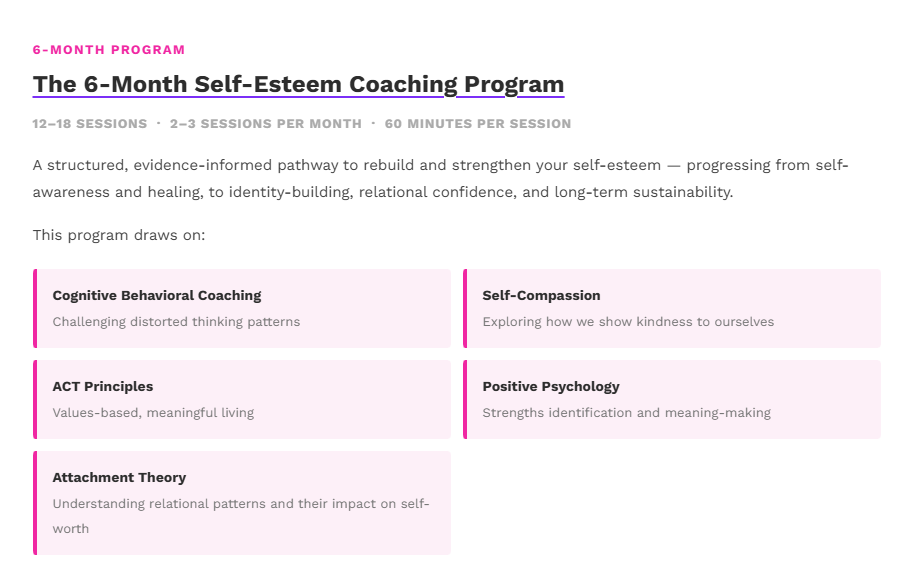
For autistic adults who are ready for the most structured and comprehensive investment in themselves, the six month self-esteem coaching program is where that commitment takes its fullest form.
This is not a series of disconnected sessions. It is a carefully designed, evidence-informed pathway that moves progressively through the full arc of self-esteem rebuilding, from the ground up, with each phase building on the last.
The structure: Twelve to eighteen sessions across six months. Two to three sessions per month. Sixty minutes per session.
The framework: The program draws on cognitive behavioral coaching, self-compassion principles, ACT, positive psychology, and attachment theory, all adapted specifically for autistic neurology rather than applied from a neurotypical template.
The six phases:
Month one: Foundation and Self-Awareness
The program begins where all meaningful change begins, with an honest, detailed baseline. A self-assessment, an exploration of your self-story, and a clarification of the values that will guide everything that follows. Before you can rebuild, you need to know what you are working with and what you are actually building toward.
Month two: Challenging the Inner Critic
The accumulated self-critical narratives that formed without accurate information get examined and challenged here. Cognitive reframing, inner critic work, and the development of genuine positive self-talk that is evidence-based rather than aspirational.
Month three: Self-Compassion and Resilience
Building the capacity to hold your history with kindness rather than judgment. Emotional regulation practice. The healing work that makes moving forward possible rather than perpetually effortful.
Month four: Identity, Strengths and Ownership
A genuine strengths inventory. Deeper work on authenticity. Confidence built in action rather than only in theory. This is where the autistic person's genuine assets become visible, owned, and communicable.
Month five: Relationships, Boundaries and Social Confidence
Practical boundary-setting. Assertiveness. Navigating social anxiety in personal and professional contexts. The relational confidence that makes genuine connection possible rather than perpetually exhausting.
Month six: Integration and Sustainability
Progress review. A personal blueprint for continued growth. A clear, grounded vision for the life ahead. The goal of the final month is not continued dependency on coaching but genuine independence built on a foundation that was not there before.
What you will have by the end:
Identified and challenged the limiting beliefs that have been undermining your self-worth
Developed consistent self-compassion and emotional self-regulation practices
Learned to own and communicate your strengths confidently in relationships
Set and maintained healthy personal boundaries
Built the tools to sustain genuine self-esteem independently through personalized rituals and tools
This program is for autistic adults who are done with managing and ready to genuinely thrive.
Book a discovery call with Sonia here to find out whether the six month program is the right fit for where you are and what you are ready to build.
Goals That Coaching Helps Autistic Adults Actually Reach
To make this concrete, here are the kinds of goals that autistic adults bring to coaching and that personalized coaching actually helps them reach:
Career goals:
Finding or creating work that is sustainable for autistic neurology. Advocating for accommodations. Managing workplace relationships. Building the professional presence and communication skills that open doors without requiring constant exhausting performance.
Relationship goals:
Building genuine friendships. Navigating romantic relationships with more clarity and less anxiety. Repairing or renegotiating family dynamics in light of new self-understanding. Building the relational confidence to be authentically present rather than performing.
Self-understanding goals:
Making sense of a late diagnosis. Understanding the history of your life through an accurate lens. Developing a stable, positive autistic identity that is built on who you actually are rather than who you were expected to be.
Daily life goals:
Building sustainable routines. Managing time and executive functioning more effectively. Reducing the daily exhaustion of masking by developing environments and strategies that require less compensation.
Inner life goals:
Challenging the self-critical narratives. Building genuine self-worth. Developing the self-compassion and emotional regulation that make everything else more possible.
For autistic adults who are also working on the daily structure dimension of these goals, the post on why routine matters for autistic adults covers the practical scaffolding that supports everything coaching builds.
What Makes Sonia's Coaching Different
There are more autism coaches available now than there have ever been. Why Sonia specifically is a question worth answering directly.
Clinical training at a licensed level
Sonia is a licensed psychotherapist, not a coach who completed a certification weekend. Her clinical training gives her coaching work a depth and safety that most coaches cannot offer, and it means she can recognize when a client's needs go beyond coaching into clinical territory.
Lived experience of late diagnosis
Sonia is a late-diagnosed autistic adult herself. She knows the experience of receiving a diagnosis as an adult, of looking back at a lifetime with new understanding, and of doing the identity and rebuilding work that follows. That personal knowledge shapes every coaching relationship in ways that clinical training alone cannot replicate.
A practice built specifically for this population
This is not a general life coaching practice with an autism module added on. Sonia's entire practice is built around neurodivergent adults, which means the approaches, the language, the pace, and the goals are all adapted specifically for autistic neurology rather than borrowed from frameworks designed for a different population.
FAQs
What goals can autism coaching help me reach?
Career sustainability, genuine relationships, self-advocacy, daily life management, identity clarity, and genuine self-worth are among the most common and most transformative goals that personalized autism coaching helps autistic adults reach.
How is personalized coaching different from a standard coaching program?
Personalized coaching is built around the specific individual rather than delivered from a preset curriculum. It adapts to your specific neurology, circumstances, and goals rather than applying a generic framework.
Do I need a diagnosis to work with Sonia?
Not necessarily. The discovery call is the right place to discuss your specific situation and whether coaching is a good fit.
How long does it take to reach my goals through coaching?
It depends on the goals and the individual. Meaningful shifts often begin within the first few sessions. The six month program provides the most structured and comprehensive pathway for deeper, more lasting change.
Final Thoughts
You already have goals. What you need is support that is built around how your brain actually works and a coach who understands that from the inside as well as from the clinical training.
That combination is rare. And when you find it, it changes what is possible.
Personalized autism coaching does not give you a template to follow. It gives you a genuine understanding of yourself, the specific skills your specific life requires, and the inner foundation that makes external goals actually achievable rather than perpetually out of reach. That work starts with a conversation.

How Autism Coaching Differs From Other Types of Support
When you are autistic and looking for help, the options can feel both overwhelming and frustratingly inadequate at the same time. There is therapy. There is psychiatry. There are support groups, self-help books, online communities, and a growing number of people calling themselves autism coaches. Knowing which one you actually need, and when, is genuinely difficult without a clear picture of what each one does and does not do.
This post breaks down how autism coaching differs from other types of support available to autistic adults, where each one is most useful, and why the combination that works best is rarely a single option chosen at the exclusion of everything else.
Sonia Chand is a licensed psychotherapist and late-diagnosed autistic adult who has built her coaching practice specifically around the gap between what clinical services offer and what autistic adults actually need to thrive in daily life. Understanding where that gap is helps you understand why coaching exists and whether it is the missing piece for you.
Table of Contents
Autism Coaching vs Therapy
Autism Coaching vs Psychiatry
Autism Coaching vs Occupational Therapy
Autism Coaching vs Support Groups
Autism Coaching vs Self-Help and Books
When Autism Coaching Is the Right Addition
How Sonia's Coaching Fills the Gap
FAQs
Final Thoughts
Autism Coaching vs Therapy
This is the distinction that comes up most often and the one that most needs a clear, honest answer.
Therapy and coaching are not interchangeable. They are different in their focus, their methods, their regulatory framework, and what they are designed to achieve. Understanding the difference helps you know which one you need and when.
What therapy does: Therapy is a clinical process delivered by a licensed professional. It is designed to diagnose and treat mental health conditions. It works with the full depth of a person's psychological history, including trauma, attachment patterns, and the roots of recurring emotional difficulties. Therapy is regulated, which means the clinician is accountable to a licensing body and is required to meet specific professional and ethical standards.
Therapy is the right choice when you are dealing with clinical mental health conditions including depression, anxiety disorder, PTSD, OCD, or any other condition that requires clinical diagnosis and treatment. It is also the right choice when the past is actively shaping the present in ways that require skilled clinical intervention to work through.
What coaching does: Coaching is forward-focused. It does not diagnose or clinically treat mental health conditions. It works with where you are now and where you want to go, building specific skills, strategies, and inner resources that allow you to function more effectively and more authentically in the areas of life that are currently hardest.
Autism coaching specifically addresses the practical daily life challenges that autistic adults face, including social navigation, self-esteem, emotional regulation, self-advocacy, and the identity work that follows a late diagnosis, in a way that is personalized to autistic neurology rather than applied generically.
Where Sonia sits: Sonia is genuinely both. She is a licensed psychotherapist with full clinical training, and she is a specialist autism coach. This means she brings clinical depth to her coaching work that most coaches cannot offer, and she can recognize when a client's needs go beyond coaching into clinical territory that requires clinical support. That clinical awareness makes her coaching safer and more effective than coaching delivered without clinical grounding.
The On the Spectrum podcast with Sonia Chand explores these distinctions in real conversations about what different forms of support actually offer and where the gaps in the current system are.

Autism Coaching vs Psychiatry
Psychiatry is a medical specialty focused on the diagnosis and medication management of mental health and neurodevelopmental conditions. A psychiatrist can diagnose autism, assess for co-occurring conditions, and prescribe medication for conditions including anxiety, ADHD, depression, and epilepsy that frequently co-occur with autism.
Psychiatry does not provide talking therapy in most modern clinical settings, and it does not provide coaching. A psychiatry appointment is typically focused on symptoms, medication, and medical management rather than on building daily life skills or working through identity and self-esteem challenges.
Coaching and psychiatry address completely different dimensions of autistic experience and for many autistic adults, both are part of a comprehensive support picture. Medication that reduces the baseline anxiety load makes the skill-building work of coaching more accessible. Coaching that builds genuine self-regulation strategies reduces the overall medication burden needed over time. The two are complementary rather than competitive.
If you are currently working with a psychiatrist or considering doing so, coaching sits alongside that work rather than replacing it. The question is never psychiatry or coaching. It is how each one contributes to the overall support structure.
Autism Coaching vs Occupational Therapy
Occupational therapy is one of the most useful forms of support for autistic individuals and one that is often underutilized by autistic adults who think of it primarily as a childhood intervention.
Occupational therapy for autistic adults addresses sensory processing, daily living skills, fine and gross motor coordination, and the practical adaptations that make daily functioning more manageable. An occupational therapist might help an autistic adult develop a sensory profile, build strategies for managing sensory overload at work, or find adaptive tools that reduce the cognitive load of daily tasks.
Where OT works with the body and the sensory environment, coaching works with the mind, the identity, the beliefs, and the social and emotional skills that shape how an autistic person experiences and navigates their world.
Both are valuable. Both address real dimensions of autistic experience. And for many autistic adults, having both an occupational therapist and a coach addressing different domains of their experience produces significantly better outcomes than either one alone.
Autism Coaching vs Support Groups
Support groups, whether in-person or online, offer something that no professional support can fully replicate: the specific comfort and recognition that comes from being in a room, physical or virtual, with people who genuinely understand your experience from the inside.
Autistic community, in whatever form it takes, is genuinely valuable. The sense of belonging, the shared language, the reduction in social effort that comes from being with people who communicate similarly and understand implicitly, these are real and significant benefits that contribute meaningfully to autistic adult wellbeing.
What support groups do not offer is personalized guidance. A support group can validate your experience. It cannot build a tailored strategy for your specific situation. It can make you feel less alone. It cannot challenge the specific limiting beliefs that are holding you back or build the specific skills that your particular challenges require.
Support groups and coaching work best together. Community provides the belonging. Coaching provides the personalized development. Neither replaces the other.

Autism Coaching vs Self-Help and Books
Self-help books and resources are the most accessible form of autism support, and for many autistic adults they are the starting point that leads to everything else.
A good book can provide a framework for understanding your own neurology that changes how you see your entire history. It can give you language for experiences that previously had none. It can make you feel genuinely seen in a way that is hard to find elsewhere.
Dropped in a Maze by Sonia Chand is exactly that kind of book. It is the honest account of navigating an autistic life and finding your way to genuine self-understanding, written from the inside of that experience rather than from a clinical distance. It is the reading that gives the coaching work its fullest human context and that many clients describe as the thing that helped them finally understand why they needed coaching in the first place.
Get your copy of Dropped in a Maze here and let it be the beginning of a much larger shift in how you understand yourself.
What books cannot do is respond to you specifically. They offer frameworks and insights that apply broadly, but they cannot assess your particular situation, challenge your specific limiting beliefs, or build the personalized strategy that your specific challenges require. That is what coaching does. Books and coaching work in sequence and in parallel. One opens the door. The other walks through it with you.
When Autism Coaching Is the Right Addition
Having mapped how autism coaching differs from other types of support, the question becomes practical: when is coaching specifically the right addition to your support picture?
Coaching is the right addition when:
The diagnosis has arrived but the roadmap has not. You have a diagnosis, recent or otherwise, and you understand what you are. You are still figuring out what to do with that understanding and how to build forward from it.
You are functioning but not thriving. The baseline is manageable. The life you actually want feels significantly out of reach. The gap between managing and thriving is where coaching lives.
Clinical support has addressed the symptoms but not the daily life. Therapy has helped with the anxiety or the depression. But the social navigation is still hard. The self-esteem is still shaky. The workplace is still exhausting. Coaching addresses the daily life dimension that clinical support often does not reach.
You want personalized guidance, not generic advice. You have read the books. You have tried the strategies. You need someone who can look at your specific situation and build something that genuinely fits your specific neurology, circumstances, and goals.
Book a discovery call with Sonia here and find out why coaching is important for you.
How Sonia's Coaching Fills the Gap
Sonia's coaching practice is built specifically around the gap that most autistic adults fall into: the space between clinical diagnosis and genuinely thriving daily life.
Her two core coaching services address the two dimensions of that gap most directly.
Socio-emotional coaching builds the real-world skills for navigating social situations, professional relationships, friendships, and everyday interactions in ways that work with autistic communication styles. It addresses emotional regulation, social cue recognition, and the practical everyday scenarios that neurotypical people navigate automatically but that many autistic adults find genuinely effortful without specific support.
Self-esteem coaching works on the inner foundation. The limiting beliefs, the self-image, the self-compassion, and the genuine confidence that make everything else possible. For many autistic adults, particularly late-diagnosed ones who have spent years without accurate self-understanding, this inner work is the most transformative and the most necessary.
The six month self-esteem coaching program provides the most structured and comprehensive pathway through this inner work. Running across twelve to eighteen sessions over six months, it moves progressively from foundation and self-awareness through challenging the inner critic, building self-compassion, developing identity and strength ownership, building relational confidence, and finally integrating everything into a personal blueprint for long-term sustainability.
By the end, clients have challenged the limiting beliefs that have been undermining their self-worth, developed consistent emotional self-regulation, learned to own and communicate their strengths confidently, established healthy personal boundaries, and built the tools to sustain genuine self-esteem independently.
Sonia's own late autism diagnosis is the foundation beneath all of this. She is not offering coaching built on theoretical knowledge of what autistic adults experience. She is offering coaching built on having lived it, on having received her own diagnosis as an adult, on having done the identity work and the rebuilding that follows, and on having the clinical training to support others through the same process at a depth and with a safety that lived experience alone cannot provide.
FAQs
Is autism coaching a replacement for therapy?
No. Coaching and therapy address different dimensions of experience and work best as complements rather than alternatives. Sonia is both a licensed psychotherapist and a specialist coach, which means she brings clinical awareness to her coaching work without coaching replacing therapy when therapy is genuinely needed.
Can I do coaching and therapy at the same time?
Yes, and for many autistic adults this is the most effective combination. Therapy addresses clinical mental health needs. Coaching builds the daily life skills and inner confidence that therapy does not always reach.
How is coaching different from occupational therapy?
OT works with the body, the sensory environment, and practical daily living adaptations. Coaching works with identity, self-esteem, social skills, and the inner and outer dimensions of autistic daily life.
Do I need a diagnosis to access autism coaching?
Not necessarily. A diagnosis provides useful context but is not always a prerequisite. The discovery call is the right place to discuss your specific situation.
What makes Sonia's coaching different from other autism coaches?
The combination of licensed psychotherapist training, specialization in neurodivergent adult coaching, and her own lived experience of late autism diagnosis makes her practice genuinely distinctive in a field where those three things rarely exist together.
What is the first step?
A discovery call. Free, no pressure, and genuinely useful whether you decide to proceed or not.
Final Thoughts
The question is rarely which type of support is best in the abstract. It is which combination of support addresses the specific dimensions of your specific experience most effectively.
Autism coaching is not a replacement for anything. It is an addition. It fills the gap between clinical diagnosis and genuinely thriving daily life, and it does so in a way that is personalized, forward-focused, and built specifically around autistic neurology rather than applied generically from a neurotypical template.
When it is delivered by someone with the right clinical training, the right specialist knowledge, and the right personal understanding, it is one of the most useful forms of support an autistic adult can access.
That conversation starts with a single call.
References:
Sander E. Examining the Impact of Autism-Informed Integrative Counselling and Coaching on the Workplace Experiences of Autistic Individuals: An Interpretative Phenomenological Analysis. Couns Psychother Res. 2026. Available from: https://doi.org/10.1002/capr.70093
Drury J. The Difference Between Autism Counselling & Coaching Is Overstated [Internet]. LinkedIn Pulse. Available from: https://www.linkedin.com/pulse/difference-between-autism-counselling-coaching-overstated-drury-lnsbe

Is Autism Coaching Right for Me?
Is autism coaching right for me is a question that sits quietly in the back of a lot of autistic adults' minds, sometimes for months before they ever say it out loud. They have read about coaching. They have maybe listened to conversations about it. They are curious but uncertain, and underneath the uncertainty is usually a combination of hope and caution that makes complete sense given how many times support has promised more than it delivered.
This post is written for that moment of uncertainty. It answers the question honestly, without the sales pressure that most coaching pages carry, because the right answer for you matters more than a conversion.
Autism coaching is genuinely transformative for the right person at the right time. It is also not the right fit for everyone, and part of what makes coaching with Sonia different is the commitment to helping you figure out which one is true for you before you commit to anything.
Table of Contents
What Autism Coaching Actually Is
Signs That Autism Coaching Might Be Right for You
Signs That Something Else Might Be a Better First Step
What Makes Sonia's Coaching Different
The Six Month Self-Esteem Coaching Program
Common Concerns About Starting Coaching
FAQs
Final Thoughts
What Autism Coaching Actually Is
Before you can answer is autism coaching right for me, you need a clear picture of what autism coaching actually is, because the word coaching gets used in so many different ways that it has become genuinely difficult to know what you are signing up for.
Autism coaching is not therapy. It does not diagnose, treat, or clinically address mental health conditions. It does not spend its primary energy in the past, excavating childhood experiences or processing trauma in the way that clinical therapy does.
Autism coaching is forward-focused. It works with where you are right now and where you want to go, building the specific skills, self-understanding, and inner confidence that allow you to function more effectively, more authentically, and with significantly less exhaustion in the areas of life that are currently hardest.
For autistic adults, this typically means building practical tools for social navigation, developing emotional regulation strategies that work with autistic neurology rather than against it, challenging the limiting beliefs that have accumulated from years of being misunderstood, and building the genuine self-worth that makes advocating for yourself feel possible rather than presumptuous.
It is practical. It is personalized. And when it is delivered by someone with the right combination of clinical depth, autistic understanding, and genuine lived experience, it is one of the most useful forms of support available to autistic adults outside of clinical treatment.
Signs That Autism Coaching Might Be Right for You
The honest answer to is autism coaching right for me involves looking at where you actually are right now and what is genuinely in the way of the life you want.
Coaching is likely a strong fit if you recognize yourself in several of the following:
You have a diagnosis but not much else
You received your autism diagnosis, whether recently or some years ago, and the diagnosis answered questions but did not come with a roadmap. You know what you are. You are still figuring out what to do with that knowledge.
You are functioning but exhausted
From the outside your life looks manageable. On the inside you are running on empty in ways you cannot fully explain to the people around you. The masking, the social effort, the constant navigation of a world not designed for your brain, it adds up and nobody around you quite sees the cost.
You want better relationships but do not know how to build them
The desire for genuine connection is real. The gap between wanting it and knowing how to create and sustain it is also real. You have watched friendships fade, professional relationships stall, or personal connections struggle under the weight of communication styles that do not quite match.
You struggle to advocate for yourself
You know what you need. You cannot consistently say it. Whether it is workplace accommodations, adjustments in relationships, or simply communicating your sensory needs without feeling like a burden, the gap between knowing and saying is significant.
Your self-image is shaped more by what went wrong than by who you actually are
Years of struggling without understanding have left a specific kind of mark. Not depression necessarily, but a quiet, pervasive sense that something about you is fundamentally more difficult than it should be. Coaching addresses exactly that.
You are a late-diagnosed adult still making sense of your history
If autism was identified later in your life, the work of understanding your past through a new lens, and building forward from that understanding, is specific and significant. Coaching created by someone who has navigated the same experience is a genuinely different form of support.
Dropped in a Maze by Sonia Chand is the book that speaks directly to many of these experiences, written from the inside of an autistic life and the process of understanding it more clearly.
Signs That Something Else Might Be a Better First Step
Honesty about when coaching is not the right fit matters as much as everything above.
Coaching may not be the right starting point if:
You are currently in acute mental health crisis
If you are experiencing suicidal ideation, severe depression, active trauma responses, or any mental health situation that requires clinical intervention, therapy with a licensed clinical professional is the appropriate first step, not coaching. Coaching works alongside stable mental health, not in place of clinical treatment when clinical treatment is genuinely needed.
You have not yet been assessed or diagnosed
If you are still in the process of understanding whether autism applies to you, getting an accurate assessment is the right first step. Coaching is most effective when built on an accurate understanding of the person's neurology. For a full guide to the assessment process, the post on how to test for autism covers every stage in detail.
You are looking for someone to do the work for you
Coaching requires genuine engagement. It requires showing up, reflecting honestly, and doing the between-session work that makes the sessions themselves meaningful. If you are not in a position to engage actively right now, waiting until you are will produce better results than starting before you are ready.
None of these are permanent disqualifications. They are honest assessments of timing, and timing matters in coaching as much as anything else.
What Makes Sonia's Coaching Different
When you are asking is autism coaching right for me, you are also implicitly asking is this particular coach right for me, and that question deserves a specific answer.
Sonia Chand is a licensed psychotherapist, which means she brings clinical depth to her coaching work that most coaches simply do not have. She has completed graduate-level clinical training, accumulated supervised clinical hours, and is held to the professional and ethical standards of a regulated clinical field. When you work with Sonia, you are not working with someone who completed a coaching certification and called themselves an autism specialist. You are working with a clinically trained professional who has specialized specifically in neurodivergent adult support.
She is also a late-diagnosed autistic adult herself. That personal experience is not incidental to her coaching. It is foundational to it. She knows what it feels like to spend years navigating a world without the right framework. She knows the specific texture of late diagnosis, the relief, the grief, the rebuilding. And she knows what genuine support in the aftermath of that diagnosis makes possible, because she has experienced it from both sides of the coaching relationship.
Her two core coaching services are built around this combination:
Socio-emotional coaching builds real-world skills for social navigation, friendship, professional relationships, everyday interactions, and emotional regulation, in ways that work with autistic communication styles rather than against them.
Self-esteem coaching works on the inner foundation, the limiting beliefs, the self-image, and the self-compassion that determine whether external skills actually translate into genuine confidence and genuine change.
Six Month Self-Esteem Coaching Program
The Six Month Self-Esteem Coaching Program
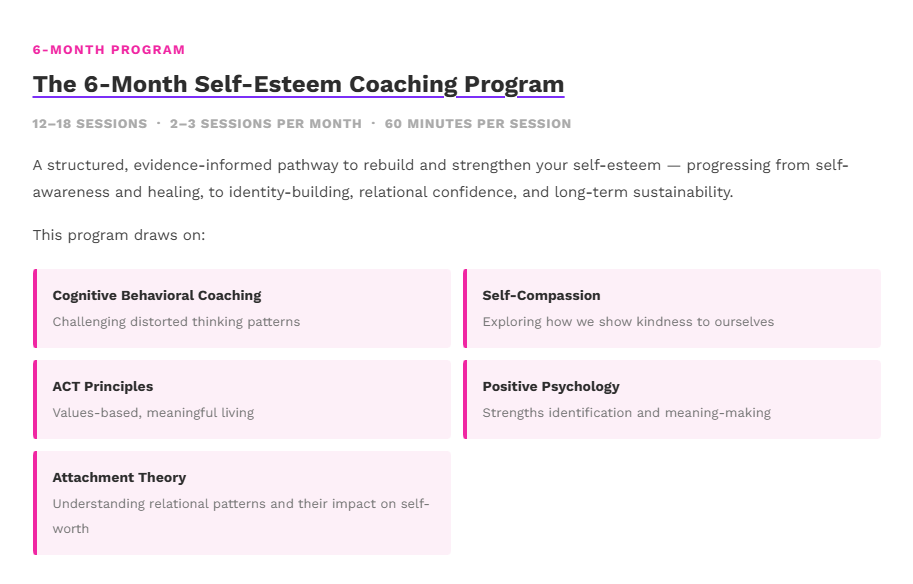
For autistic adults who are ready for the most structured and comprehensive coaching engagement, the six month self-esteem coaching program is the answer to is autism coaching right for me in its fullest form.
This is not a series of disconnected sessions. It is a structured, evidence-informed pathway that moves progressively through the work of rebuilding and strengthening self-esteem from the ground up.
The program runs across twelve to eighteen sessions, two to three sessions per month, each sixty minutes long. It draws on cognitive behavioral coaching, self-compassion principles, ACT, positive psychology, and attachment theory, all adapted specifically for autistic neurology.
Here is what the six months actually look like:
Month one: Foundation and Self-Awareness
The program begins with a baseline assessment, an exploration of your self-story, and a clarification of your values. Before you can rebuild, you need to know what you are working with and what you are working toward. This month establishes both.
Month two: Challenging the Inner Critic
The accumulated self-critical narratives that form without accurate self-understanding get examined and challenged here through cognitive reframing and the development of genuine, evidence-based self-talk that actually holds up.
Month three: Self-Compassion and Resilience
Building the capacity to hold your history with kindness rather than judgment, to regulate your emotions without shutting down, and to move forward from setbacks rather than being defined by them.
Month four: Identity, Strengths and Ownership
A genuine strengths inventory, deeper work on authenticity, and the building of confidence in action rather than only in theory. This is where the autistic person's genuine assets become visible and owned.
Month five: Relationships, Boundaries and Social Confidence
The practical relational work. Boundary-setting, assertiveness, navigating social anxiety, and building the relational confidence that makes genuine connection possible rather than perpetually exhausting.
Month six: Integration and Sustainability
The final month reviews progress, builds a personal blueprint for continued growth, and creates a clear, grounded vision for the life ahead. The goal is not dependency on coaching but genuine independence built on a foundation that was not there before.
By the end of the program, clients will have:
Identified and challenged the limiting beliefs undermining their self-worth
Developed consistent self-compassion and emotional self-regulation
Learned to own and communicate their strengths confidently in relationships
Set and maintained healthy personal boundaries
Built the tools to sustain healthy self-esteem independently
This is not a program for people who want to feel slightly better. It is a program for people who are ready to genuinely change the relationship they have with themselves.
Book a discovery call with Sonia here
Common Concerns About Starting Coaching
If you are asking is autism coaching right for me and something is still holding you back, it is probably one of these:
I am not sure I am autistic enough for coaching to apply to me
Autism is a spectrum and support needs vary enormously. The experiences that coaching addresses, social exhaustion, self-esteem damage, communication difficulty, and identity uncertainty, are present across the full range of autistic experience. You do not need to be visibly struggling to deserve support.
I have tried therapy and it did not help
This is one of the most common starting points for coaching clients. Therapy that did not address the autistic neurology underlying the anxiety, depression, or relational difficulties was always going to have limited impact. Coaching that starts from the autism first is a genuinely different experience.
I am worried it will not work for me specifically
The discovery call exists for exactly this concern. It is a genuine conversation, not a sales call, where you can ask your questions, share your specific situation, and get an honest assessment of whether this is the right fit.
I cannot afford to invest in something that might not help
This is a real and valid concern. The discovery call is free, there is no pressure to commit during it, and it is designed specifically to help you make an informed decision rather than an impulse one.
For autistic adults who are also managing the daily life demands of executive functioning and routine alongside their coaching work, the post on why routine matters for autistic adults covers the practical daily structures that support everything else.
FAQs
Is autism coaching the same as therapy?
No. Coaching is forward-focused and practical. Sonia is both a licensed psychotherapist and a specialist coach, which means she brings clinical depth to coaching that most coaches cannot offer.
Do I need a formal autism diagnosis to work with Sonia?
A diagnosis is helpful context but not always a prerequisite. The discovery call is the right place to discuss your specific situation honestly.
How is the six month program different from individual coaching sessions?
The six month program provides a structured, progressive pathway through specific outcomes. Individual coaching sessions are more flexibly tailored to immediate goals and challenges.
What if I start and it does not feel right?
The discovery call is designed to reduce this risk significantly. And if something is not working during coaching, that conversation is always available and welcomed.
Is coaching available online?
Yes. All of Sonia's coaching is delivered online, making it accessible regardless of location and removing the sensory and logistical demands of in-person appointments.
What is the first step?
A discovery call. Free, no pressure, and genuinely useful whether you decide to proceed or not.
Final Thoughts
Is autism coaching right for me is not a question with a universal answer. It is a question that depends on where you are, what you need, and whether the specific coach in front of you has the right combination of training, understanding, and personal knowledge to meet you there.
What is clear is this: autistic adults who have access to genuinely qualified, personally grounded, autism-informed coaching consistently describe it as one of the most useful forms of support they have ever received. Not because it fixes anything. But because it finally gives them the tools to understand themselves accurately and build forward from that understanding in a way that is genuinely theirs. That work starts with a single conversation.

7 Questions to Ask Before Choosing an Autism Coach
Choosing an autism coach is one of the most important decisions an autistic adult or autism family can make. The right coach can change the trajectory of your life. The wrong one can waste your time, your money, and, more painfully, your trust at a moment when trust is already hard to extend.
The problem is that autism coaching is an unregulated space. Anyone can call themselves an autism coach. There are no universal standards, no required qualifications, and no guaranteed framework behind the title. Which means the questions you ask before committing matter enormously.
This post gives you the seven most important questions to ask any autism coach before you begin working with them, and answers each one from Sonia Chand's own practice, because transparency is the beginning of trust and trust is the beginning of everything that coaching can offer.
Table of Contents
Do You Have Personal Experience of Autism?
What Are Your Professional Qualifications?
What Coaching Approach Do You Use?
Who Do You Work With?
How Do You Measure Progress?
What Does a Typical Coaching Engagement Look Like?
Why Should I Choose You Over Someone Else?
Final Thoughts
Do You Have Personal Experience of Autism?
This is the question that separates coaches who understand autism intellectually from coaches who understand it in their bones.
Many autism coaches have studied autism extensively. They have read the research, completed the training, and built their practice around clinical knowledge of the condition. That is valuable. But it is different from knowing what it feels like to sit in a classroom for years without understanding why social interaction costs you so much more than it seems to cost everyone around you. It is different from spending decades building compensatory strategies without knowing what you were compensating for. It is different from receiving a diagnosis later in life and having to rebuild your understanding of your entire history in its light.
Sonia Chand is a late-diagnosed autistic adult. She received her own autism diagnosis as an adult, which means she knows firsthand the specific experience that many of her clients are navigating when they come to her. The confusion that precedes diagnosis. The relief and grief that follow it. The complex, layered work of understanding your past through a new lens while simultaneously trying to build a better future.
That personal experience does not replace clinical training. But it adds something clinical training cannot provide: the kind of understanding that only comes from having lived it.
When a client sits across from Sonia and tries to explain what it felt like to spend years feeling fundamentally out of step with the world around them, she does not have to translate that experience into something she can understand. She already knows. And that knowing changes the quality of the coaching relationship in ways that are difficult to quantify but impossible to miss.
Dropped in a Maze by Sonia Chand is the book that captures this personal journey honestly and in full. It is the story of navigating an autistic life without a map, and it is the reading that gives her coaching work its deepest roots.
Get your copy of Dropped in a Maze here and read the story behind the coach before you ever book your first session.
What Are Your Professional Qualifications?
Personal experience of autism is important. Professional qualifications are not optional.
Coaching is an unregulated field, which means the question of qualifications is entirely on you to ask. And the answer matters, because the depth of support a coach can offer is shaped significantly by the depth of their training.
Sonia Chand is a licensed psychotherapist. That is not the same as being a coach who has done a weekend certification or a short online course. It means she has completed graduate-level clinical training, accumulated supervised clinical hours, passed professional licensing examinations, and is held to the ethical and professional standards of a regulated clinical field.
What this means in practice for her coaching clients is significant. Sonia can recognize when what a client is presenting goes beyond coaching into clinical territory that needs clinical support. She can work with the psychological dimensions of autistic experience, including trauma, identity disruption, and the mental health consequences of years of masking, with a depth and safety that a coach without clinical training cannot offer.
It also means that the frameworks she uses in her coaching work, cognitive behavioral coaching, self-compassion principles, ACT, positive psychology, and attachment theory, are not things she encountered in a coaching certification. They are the frameworks of her professional clinical training, adapted and applied to the specific neurology and lived experience of the autistic adults she works with.
When you choose Sonia as your autism coach, you are not choosing between a coach and a therapist. You are choosing someone who brings both.
Book a discovery call with Sonia here and experience the difference that genuinely qualified, clinically informed autism coaching makes from the very first conversation.
What Coaching Approach Do You Use?
The approach a coach uses tells you a great deal about how they understand autism and what they believe the goal of coaching is.
Some coaching approaches are deficit-focused, built around identifying what is not working and fixing it. Some are purely skill-based, focused on teaching specific social or behavioral strategies. Some are primarily motivational, focused on mindset and goal-setting in a generic way that does not account for the specific realities of autistic neurology.
Sonia's approach is different on all three counts.
Her coaching is strengths-based, which means it starts from the genuine strengths that autistic individuals bring rather than from a catalogue of deficits to be addressed. It is neurodiversity-affirming, which means the goal is never to make an autistic person appear more neurotypical but to help them thrive as their authentic autistic self. And it is personalized, which means the work is built around the specific individual sitting in front of her rather than applied generically from a standard curriculum.
The two core coaching services Sonia offers reflect this approach directly.
Socio-emotional coaching builds real-world skills for navigating friendships, professional relationships, everyday social situations, and emotional regulation in ways that work with autistic communication styles rather than against them.
Self-esteem coaching works on the inner foundation, the limiting beliefs, the self-image, the self-compassion, and the goal-setting capacity that determine whether external skills actually translate into genuine confidence and genuine change.
Neither service is about performing neurotypicality. Both are about building a life that genuinely fits.
Book a discovery call with Sonia here and find out which approach is the right starting point for where you are right now.
Who Do You Work With?
Understanding who a coach works with helps you assess whether they are the right fit for your specific situation.
Some autism coaches work primarily with children. Some work with parents. Some work only with autistic adults at a specific end of the spectrum. Knowing who a coach has the most experience with, and who they have designed their practice around, helps you assess whether your own situation falls within their genuine area of expertise.
Sonia works primarily with autistic adults and neurodivergent individuals who are navigating the social, emotional, and identity dimensions of their experience. Her practice is not built around childhood intervention or parent coaching. It is built around adults who are trying to understand themselves more accurately and build lives that genuinely work for their neurology.
Within that population, she has particular depth of experience and particular personal understanding in two specific areas.
The first is late-diagnosed autistic adults, people who received their diagnosis in adulthood and are working through the complex mixture of relief, grief, and rebuilding that follows. Because Sonia has navigated this herself, she understands it at a level that goes beyond professional knowledge.
The second is autistic adults who are navigating the social world with genuine desire for connection but significant difficulty, people who want relationships, friendships, and professional belonging but who have not had access to the tools and self-understanding that would make those things genuinely achievable.
If you fall into either of those groups, or both, Sonia's practice was built with you specifically in mind.
How Do You Measure Progress?
One of the most important questions to ask any coach is how they measure whether the work is actually working.
Vague measures of progress, feeling better, being more confident, having better conversations, are not enough on their own. Genuine coaching needs to be able to point to specific, meaningful changes in how a person is functioning, thinking, or engaging with their life.
Sonia's six month self-esteem coaching program provides the clearest answer to this question, because it is structured around specific, progressive outcomes across each of its six phases.
By the end of the program, clients will have identified and challenged the limiting beliefs that have been undermining their self-worth, developed consistent self-compassion and emotional self-regulation practices, learned to own and communicate their strengths confidently in relationships, established and maintained healthy personal boundaries, and built the tools to sustain healthy self-esteem independently through personalized rituals and tools.
Those are not vague aspirations. They are specific, observable changes that both the client and the coach can assess honestly as the program progresses.
The program runs across twelve to eighteen sessions, two to three sessions per month, each sixty minutes long. Progress is reviewed explicitly at each phase, and the program is designed to build systematically from self-awareness through to long-term sustainability rather than jumping between topics without a coherent arc.
The On the Spectrum podcast with Sonia Chand gives you a genuine sense of how Sonia thinks about progress, growth, and the autistic experience before you ever commit to working with her.
Listen here and let the conversations speak for themselves.
What Does a Typical Coaching Engagement Look Like?
In addition, understanding the practical structure of coaching before you begin helps you assess whether it is a realistic fit for your life and whether the investment of time and energy is one you can genuinely make.
For Sonia's socio-emotional coaching, the structure is tailored to the individual. Sessions are typically sixty minutes and the frequency is agreed collaboratively based on the client's needs, goals, and capacity. The work is focused on specific, real-world challenges the client is navigating and builds practical skills through a combination of conversation, reflection, and between-session practice.
For the six month self-esteem program, the structure is clear and progressive as described above. Twelve to eighteen sessions across six months, each building on the last, moving from foundation through to integration and long-term sustainability.
Both services are delivered online, which means they are accessible regardless of where you are located and can be scheduled around the demands of your actual life rather than requiring you to reorganize your life around them.
The accessibility of online coaching matters particularly for autistic adults, many of whom find the removal of travel, waiting rooms, and unfamiliar physical environments genuinely significant in terms of the cognitive and sensory load of the engagement itself. You come to the session from your own space, on your own terms, which means more of your energy goes into the actual work.

Why Should I Choose You Over Someone Else?
This is the most direct question and the one most coaches are least prepared for. It deserves a direct answer.
Sonia Chand offers something that is genuinely rare in the autism coaching space: the combination of clinical professional training at a licensed psychotherapist level, specialization in neurodivergent adult coaching, and her own lived experience of late autism diagnosis.
Most coaches have one or two of those things. Very few have all three.
Her clinical training means she can work with the full depth of what autistic adults bring to coaching, including the trauma, the identity disruption, and the mental health consequences of years of masking, in a way that a coach without clinical training cannot do safely or effectively.
Her specialization means she has built her entire practice around the specific needs of autistic and neurodivergent adults rather than applying a generic coaching framework and hoping it transfers.
Her personal experience means she understands what she is hearing not just as a professional but as someone who has been in the same place. That understanding creates a coaching relationship built on genuine connection rather than clinical distance.
And her book, Dropped in a Maze, is the proof of all of the above in its most honest and most human form. It is the story of her own journey, written for everyone who has ever felt lost in a system that was not built for them and wondered if a way through actually exists.
Final Thoughts
Choosing an autism coach is an act of trust. And trust, for many autistic adults who have spent years being misunderstood by the very systems and people that were supposed to help them, does not come easily or cheaply.
The questions in this post are not bureaucratic checklists. They are the questions that help you find someone who genuinely deserves that trust. Someone who has the training to work safely and effectively with the full complexity of your experience. Someone who has the personal understanding to meet you where you actually are rather than where a textbook says you should be.
Someone who has been where you are and found their way through.
That is what Sonia offers. And it starts with a single conversation.

How Autism Coaching Can Support Life After a Late Diagnosis
Receiving an autism diagnosis in adulthood changes everything and nothing at the same time. The world does not look different the morning after. Your history does not rewrite itself. But something fundamental shifts, because suddenly there is a name for a lifetime of experiences that never quite had one.
For many adults, a late diagnosis brings a complicated mixture of relief, grief, anger, and the particular exhaustion that comes from realizing you spent decades working harder than everyone around you without understanding why. You were not difficult. You were not broken. You were autistic, navigating a world that was not built for your brain, without the tools, the language, or the community that would have made that navigation genuinely possible.
Sonia Chand knows this from the inside. As a licensed psychotherapist, autism specialist, and late-diagnosed autistic adult herself, she brings something to her coaching work that most practitioners cannot: the lived experience of what it actually feels like to receive a diagnosis later in life, to look back at your history through a new lens, and to build forward from there.
That combination of clinical expertise and personal understanding is what makes her coaching genuinely different for adults navigating life after a late diagnosis.
Table of Contents
What a Late Autism Diagnosis Actually Feels Like
Why Late Diagnosis Leaves So Much Unresolved
What Coaching After Late Diagnosis Actually Involves
Rebuilding Identity After a Late Diagnosis
Processing the Grief That Comes With Late Diagnosis
Building Practical Life Skills With a New Framework
Relationships After a Late Autism Diagnosis
The Six Month Program and What It Offers
FAQs
Final Thoughts
Reference
What a Late Autism Diagnosis Actually Feels Like
There is a specific quality to the experience of receiving an autism diagnosis as an adult that is different from receiving almost any other kind of news.
It is not purely good news, even though understanding yourself more accurately is always valuable. It is not purely bad news, even though there is real loss embedded in the recognition of what went unrecognized for so long. It is something more layered than either of those, and it tends to arrive in waves rather than all at once.
The first wave is usually relief. Finally. A framework. A reason. The exhaustion, the social difficulty, the sensory overload, the burnout cycles, the friendships that never quite held, the jobs that fell apart, the relationships that struggled under the weight of things that never had names, all of it suddenly makes a different kind of sense.
The second wave is often grief. For the years spent without understanding. For the support that could have existed and did not. For the version of your life that might have unfolded differently if someone had seen what was actually happening earlier.
The third wave, when it comes, is something closer to possibility. Because a late diagnosis, as disorienting as it is, is also a beginning. It is the moment when the right support finally becomes possible, because you finally have the accurate picture of yourself that support needs to start from.
Sonia has navigated all three of those waves herself. She knows the terrain. And that personal knowledge shapes everything about how she works with adults who are standing at the same crossroads.
The On the Spectrum podcast with Sonia Chand covers this experience honestly and in depth, with conversations that make late-diagnosed autistic adults feel genuinely seen rather than simply categorized.
Listen here and find the community that understands exactly where you are right now.
Why Late Diagnosis Leaves So Much Unresolved
A diagnosis answers the question of what. It does not automatically answer any of the questions that follow.
Why did my relationships keep struggling in the same ways? Why did I burn out every time things seemed to be going well? Why did I always feel like I was performing rather than living? Why did the things other people seemed to find easy feel so impossible to me?
These questions do not resolve themselves just because a name has been applied. The accumulated patterns, the coping strategies, the beliefs about yourself that were built on an inaccurate foundation, those do not disappear with a diagnosis. They need to be actively worked through.
And then there is the practical dimension. A late-diagnosed autistic adult is often still living in environments, working in jobs, and maintaining relationships that were built without any understanding of what they actually need. The diagnosis gives them the information. It does not automatically give them the tools to use it or the confidence to advocate for the changes that would genuinely help.
This is precisely the gap that coaching fills.
If you have recently been diagnosed and are trying to figure out what comes next, the best first step is a real conversation with someone who has been there and who has the professional tools to help you move forward.
Book a discovery call with Sonia here and to help make life after late diagnosis easier for you.
What Coaching After Late Diagnosis Actually Involves
Coaching after a late autism diagnosis is not about learning autism from scratch. It is about looking at your existing life with new eyes and building from what you now know.
Sonia's coaching is structured around two core services, socio-emotional coaching and self-esteem coaching, and both are deeply relevant for late-diagnosed adults.
Socio-emotional coaching addresses the practical social and communicative challenges that a late diagnosis finally explains. It builds real-world skills for navigating friendships, professional relationships, everyday social situations, and the emotional regulation demands of a social world that was never designed for autistic communication styles.
For late-diagnosed adults, this work often involves unlearning the exhausting compensatory strategies they developed without knowing why, and replacing them with approaches that are more sustainable because they are genuinely aligned with how their brain works rather than designed to disguise it.
Self-esteem coaching addresses the inner dimension, the beliefs about yourself that were formed in the absence of accurate self-understanding. For many late-diagnosed autistic adults, decades of struggling without explanation have left a residue of self-doubt, shame, and a sense of fundamental inadequacy that a diagnosis alone does not dissolve.
The self-esteem coaching work challenges those beliefs systematically and builds a more accurate, more compassionate, and more genuinely grounded sense of self in their place.
Rebuilding Identity After a Late Diagnosis
One of the most significant and least discussed aspects of life after a late autism diagnosis is the identity work it requires.
Many late-diagnosed autistic adults spent years constructing an identity without access to the most important piece of information about themselves. They built a self-story, a sense of who they are and why, based on incomplete and often inaccurate data. When the diagnosis arrives, that self-story needs to be revisited, not dismantled entirely, but examined honestly and rebuilt on a more accurate foundation.
That process involves:
Looking back at the history of your life and understanding it differently, not with blame but with genuine compassion for the person who was navigating something very difficult without the right tools
Identifying the strengths that were always there but may have been obscured by the deficit-focused narratives that surrounded them
Letting go of the explanations for your struggles that were rooted in self-criticism, such as I am lazy, I do not try hard enough, something is wrong with me, and replacing them with more accurate ones
Building a sense of autistic identity that is not defined primarily by difficulty but by a genuine, full-spectrum understanding of who you are
This identity work is at the heart of Sonia's self-esteem coaching, and it is one of the areas where her own experience of late diagnosis is most directly relevant. She has done this work herself. She knows what it requires and what it makes possible.
Dropped in a Maze by Sonia Chand is the book that gives this identity work its fullest expression, the honest account of navigating an autistic life and finding your way to genuine self-understanding, written for everyone who has ever felt lost in a system that was not built for them.
Get your copy of Dropped in a Maze here and find the words for a journey that may have felt impossible to describe until now.
Processing the Grief That Comes With Late Diagnosis
Grief is a word that surprises some late-diagnosed adults when it comes up in the context of their diagnosis. But it is the right word, and it deserves honest acknowledgment.
The grief of a late autism diagnosis is specific. It is grief for the years spent without understanding. For the support that should have existed and did not. For the relationships, jobs, and opportunities that struggled or failed not because you were not trying but because you were trying without the right tools and without the right understanding of yourself.
It is also, for some adults, grief for the loss of a previous self-concept. The identity that was built without autism as part of the picture did not include autism as a strength, as a community, or as a framework for understanding what had always been true. Letting go of that identity, even to replace it with a more accurate one, involves a real and valid sense of loss.
Coaching creates a space to acknowledge and move through that grief without getting stuck in it. The goal is not to bypass the grief but to hold it with self-compassion while building forward from the accurate understanding that the diagnosis finally makes possible.
Building Practical Life Skills With a New Framework
Once the emotional and identity dimensions of late diagnosis begin to settle, the practical dimension becomes the focus. And for many late-diagnosed autistic adults, this is where coaching makes the most immediately tangible difference.
With an accurate understanding of their neurology, late-diagnosed adults can finally build the daily structures, communication strategies, and self-care approaches that were always missing because they were built on an inaccurate picture of what they needed.
This includes:
Routine and structure: Building daily routines that account for genuine sensory and cognitive needs rather than trying to match neurotypical productivity expectations. For a deeper look at why routine is so important for autistic adults and how to build it sustainably, the post onwhy routine matters for autistic adults covers this in full.
Workplace advocacy: Learning to identify and request the specific accommodations that would make employment sustainable, often for the first time, because previously there was no framework for understanding why certain environments and structures were necessary rather than merely preferred.
Communication strategies: Developing communication approaches that work with autistic processing styles rather than against them, including direct communication, explicit expectation setting, and written rather than verbal information processing where appropriate.
Sensory management: Building environmental accommodations and sensory regulation strategies that reduce the baseline load on the nervous system and create the conditions for genuine daily functioning rather than constant compensation.
Relationships After a Late Autism Diagnosis
Relationships are one of the areas where late diagnosis has the most complex and most significant implications, and one of the areas where coaching is most valuable.
For many late-diagnosed autistic adults, relationships have been a consistent source of confusion, pain, and the particular loneliness that comes from feeling perpetually misunderstood by people who genuinely care about you. The diagnosis explains a great deal. But it also raises new questions.
How do you talk to your partner, your family, or your friends about what you have learned about yourself? How do you renegotiate the dynamics of long-standing relationships in the light of new understanding? How do you build new relationships going forward in a way that is genuinely authentic rather than a performance of what you thought you were supposed to be?
These are the conversations that socio-emotional coaching is built for. Not as a set of scripts to memorize but as a genuine, supported process of developing the relational skills and confidence that make authentic connection possible.
For more on how autistic burnout intersects with the relational challenges of late diagnosis, particularly the burnout that often precedes or follows the diagnosis itself, the post on what does autistic burnout feel like in adults is worth reading alongside this one.
The Six Month Program and What It Offers
For late-diagnosed autistic adults who want the most structured and comprehensive coaching support, Sonia's six month self-esteem coaching program provides a clear, progressive pathway through the identity, emotional, and practical work that life after a late diagnosis requires.
The program runs across twelve to eighteen sessions, two to three sessions per month, each sixty minutes long.
Month one establishes the foundation through self-assessment, exploring your self-story with the new understanding that the diagnosis brings, and clarifying the values that will guide the work ahead.
Month two challenges the inner critic, the accumulated self-critical narratives that formed without accurate information, through cognitive reframing and the development of genuine, evidence-based self-talk.
Month three builds self-compassion and emotional resilience, the capacity to hold your history with kindness rather than judgment, and to move forward from it rather than being defined by it.
Month four focuses on identity, strengths, and ownership, building the authentic self-understanding that late diagnosis makes possible for the first time.
Month five addresses relationships, boundaries, and social confidence, the practical relational work that late diagnosis both requires and finally makes genuinely possible.
Month six integrates everything into a personal blueprint and a sustainable vision for the life ahead, on your terms, with your actual neurology at the center rather than as an afterthought.
The program draws on cognitive behavioral coaching, self-compassion principles, ACT, positive psychology, and attachment theory, all adapted for autistic neurology and informed by Sonia's own late-diagnosed experience.
FAQs
Is it too late to benefit from coaching after a late autism diagnosis?
Absolutely not. Research consistently shows that appropriate post-diagnostic support significantly improves quality of life outcomes for late-diagnosed autistic adults regardless of when the diagnosis arrives.
How is Sonia's coaching different from other autism coaching?
Sonia is both a licensed psychotherapist and a late-diagnosed autistic adult herself, which means she brings clinical expertise and genuine personal understanding of the late diagnosis experience to every coaching relationship.
What is the first step after a late autism diagnosis?
Understanding yourself accurately is the foundation, and a discovery call with Sonia is the best way to start understanding what support would genuinely help you move forward.
How long does coaching after late diagnosis typically last?
It depends on the individual and their goals. The six month self-esteem program provides the most structured pathway. Socio-emotional coaching is tailored to individual needs and timelines.
Can coaching help with the grief that follows a late diagnosis?
Yes. Coaching creates a supported space to acknowledge and move through grief while simultaneously building forward from the accurate self-understanding the diagnosis provides.
Final Thoughts
A late autism diagnosis is not the end of a story. It is the point in the story where the most important piece of information finally arrives.
Everything that came before makes more sense now. And everything that comes after can be built on a foundation that is finally accurate, finally honest, and finally genuinely yours.
That building work is not something you have to do alone. Sonia has walked this road herself. She knows what it costs and what it makes possible. And her coaching is built to help late-diagnosed autistic adults do exactly what the diagnosis opens the door to: understand themselves clearly, build lives that genuinely fit, and stop spending their energy pretending to be someone they were never meant to be.
Book your discovery call with Sonia here.
References:
Crane L, Davidson I, Cage E, Happé F, et al. Post-diagnostic support for adults diagnosed with autism in adulthood in the UK: A systematic review with narrative synthesis. Autism. 2024;29(2):284-309. Available from:https://pmc.ncbi.nlm.nih.gov/articles/PMC11816465/
Chand SK. Dropped in the Maze [Book]. Motivation Champs Publishing; 2025. Available from:https://www.amazon.com/Dropped-Maze-Sonia-Krishna-Chand/dp/1956353690
What Does an Autism Coach Do?
What does an autism coach do is a question that more autistic individuals and their families are asking as coaching becomes increasingly recognized as one of the most genuinely useful forms of support available outside of clinical therapy. And it is a question worth answering clearly, because the answer is often very different from what people expect.
What does an autism coach do is not the same as what a therapist does, not the same as what a behavioral interventionist does, and not the same as what a life coach does in the general sense. It is something more specific, more practical, and for many autistic adults, more immediately transformative than any of those alternatives.
This post answers what does an autism coach do in full, explains how coaching differs from therapy, covers what Sonia Chand's specific coaching programs involve, and helps you understand whether coaching is the right next step for where you are right now.
Table of Contents
What Does an Autism Coach Do?
How Autism Coaching Differs From Therapy
Socio-Emotional Coaching: What It Covers and Who It Helps
Self-Esteem Coaching: What It Covers and Who It Helps
The Six Month Self-Esteem Coaching Program
How Long Does Autism Coaching Last
Who Benefits Most From Autism Coaching
FAQs
Final Thoughts
What Does an Autism Coach Do?
What does an autism coach do in the most direct terms is help autistic individuals build the practical skills, self-understanding, and inner confidence they need to navigate the specific challenges their neurology creates in social, emotional, and professional life.
An autism coach does not diagnose. They do not provide clinical treatment for mental health conditions. They do not focus primarily on the past in the way that therapy often does. What an autism coach does instead is work in the present and toward the future, helping the autistic individual understand how their brain works, what strategies genuinely help, and how to build a life that fits their actual neurology rather than the neurotypical template they have been expected to follow.
What does an autism coach do in Sonia Chand's practice specifically? Sonia is a licensed psychotherapist who brings both clinical training and deep personal understanding of the autistic experience to her coaching work. Her coaching services are designed to empower neurodivergent individuals to navigate social interactions, build meaningful connections, and foster genuine self-confidence, not by making them more neurotypical, but by helping them understand and work with who they actually are.
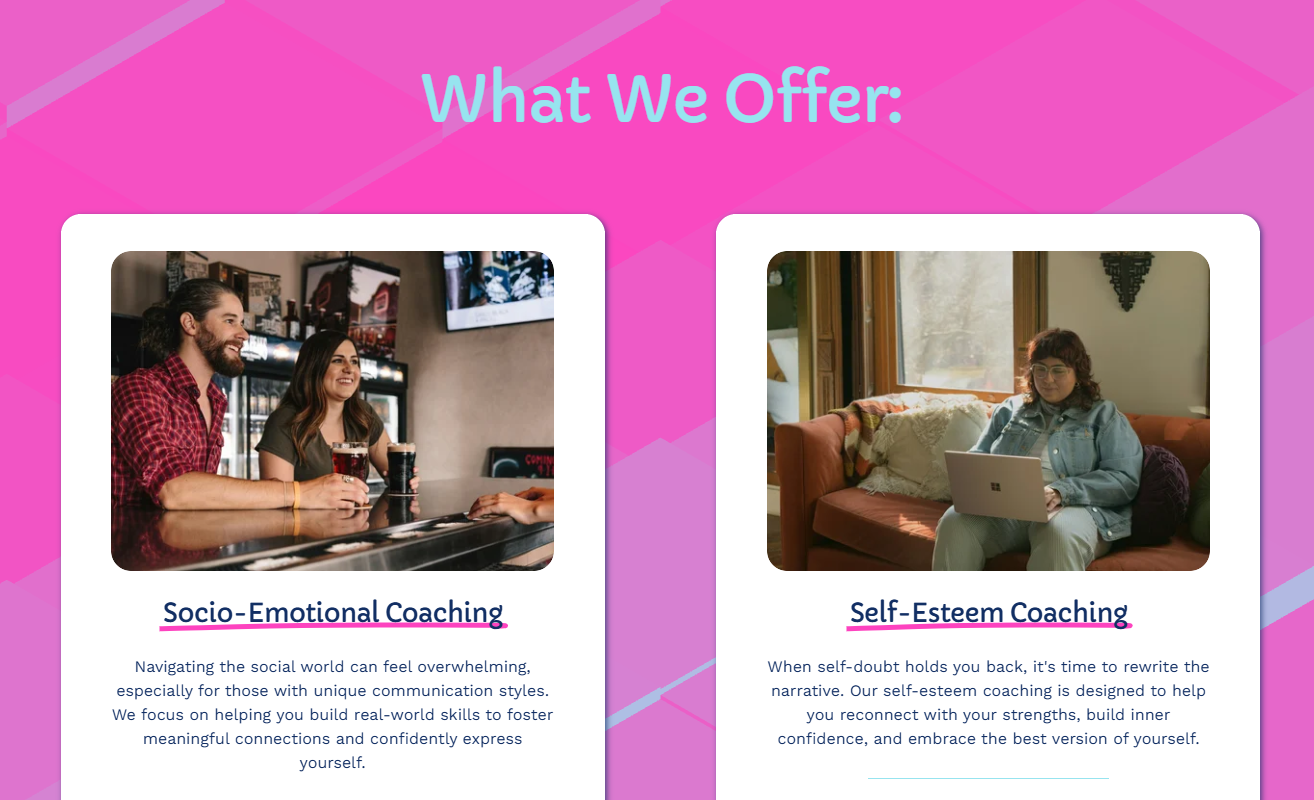
How Autism Coaching Differs From Therapy
Understanding what does an autism coach do requires understanding how coaching differs from therapy, because the distinction is practically important for knowing which one you need.
Therapy, particularly in its clinical forms, is primarily focused on diagnosing and treating mental health conditions. It often works with the past, exploring how early experiences, trauma, and psychological patterns have shaped current functioning. Therapy is delivered by licensed clinicians and is subject to specific regulatory frameworks.
Coaching is forward-focused. It works with where you are now and where you want to go, rather than primarily with where you have been. It focuses on building skills, developing strategies, and creating practical change in specific areas of life rather than on clinical treatment of mental health conditions.
For autistic adults, coaching fills a gap that therapy frequently does not. Many autistic adults have spent years in therapy that addressed their anxiety or depression without ever addressing the autistic neurology driving those experiences. Coaching that is built specifically around autistic neurology addresses the root experience, the social navigation, the self-esteem, the emotional regulation, and the daily life challenges, in a way that generic clinical therapy often cannot.
What does an autism coach do that therapy does not? It meets you where your daily life actually is and builds practical tools for the specific situations that are genuinely hard.
Because Sonia is both a licensed psychotherapist and a specialist coach, her work uniquely bridges both worlds. She brings clinical depth to coaching in a way that most coaches cannot, and she brings practical, forward-focused skill building to her work in a way that most therapy does not.
Book a discovery call with Sonia here and experience the difference that genuinely autism-informed support makes from the very first conversation.
Socio-Emotional Coaching: What It Covers and Who It Helps
What does an autism coach do in the socio-emotional coaching space? For many autistic adults, the social world is simultaneously one of the most desired and most exhausting aspects of life. The desire for connection is real. The difficulty of navigating the unwritten rules, the implicit communication, the workplace dynamics, and the everyday social exchanges is equally real.
Sonia's socio-emotional coaching addresses this directly and practically. It is not about teaching autistic adults to perform neurotypicality. It is about building a genuine, personal toolkit for the social world they are actually living in.
What socio-emotional coaching covers includes:
Friendships: Learning how to identify shared interests, start conversations, and nurture relationships over time in ways that work with autistic social styles rather than against them.
Social cues: Developing a practical understanding of body language, tone, and context that makes social interactions more navigable without requiring the kind of exhausting real-time decoding that burns most autistic adults out.
Everyday social situations: Getting specific, practical strategies for the kinds of everyday social exchanges, grocery store trips, restaurant orders, workplace interactions, casual conversations, that neurotypical people navigate automatically but that many autistic adults find genuinely effortful.
Workplace relationships: Building the professional relationship skills including small talk, networking, and navigating workplace social dynamics that affect employment outcomes significantly.
Emotional regulation: Understanding and expressing emotions effectively across different social contexts, which is one of the most consistent challenges for autistic adults regardless of their overall social competence.
Dropped in a Maze by Sonia Chand captures the experience of navigating the social and emotional complexity of the autism journey with the honesty and wisdom that only comes from having lived it deeply. It is the reading that gives the socio-emotional coaching work its fuller context.
Self-Esteem Coaching: What It Covers and Who It Helps
What does an autism coach do when self-doubt is the primary obstacle? For many autistic adults, years of being misunderstood, corrected, excluded, and expected to be something they are not have left a residue of self-doubt that is deeper and more stubborn than any social skill deficit.
Sonia's self-esteem coaching works on this deeper layer. It is not motivational coaching. It is not positive thinking. It is structured, evidence-informed work that helps autistic adults identify and challenge the limiting beliefs that have accumulated over years of navigating a world that did not fully accommodate them.
What self-esteem coaching covers includes:
Limiting beliefs: Identifying and challenging the specific mental narratives that undermine self-worth. Not generic negative thinking but the specific beliefs that autistic adults carry, that they are too much, not enough, fundamentally different in a way that makes them less.
Self-image: Discovering and genuinely owning the strengths that autism brings alongside its challenges, because those strengths are real, they are significant, and most autistic adults have been given very little help in seeing them clearly.
Self-compassion: Learning practical techniques for bouncing back from setbacks and practicing genuine kindness toward themselves, particularly important for autistic adults who hold themselves to exhausting standards of performance.
Goal setting: Gaining the clarity and confidence to take meaningful steps toward personal and professional goals rather than staying in the planning stage indefinitely because uncertainty feels too risky.
For autistic adults who are also navigating burnout alongside low self-esteem, the post on what does autistic burnout feel like in adults covers the specific relationship between burnout and the identity damage it creates, and is worth reading alongside any self-esteem coaching work.
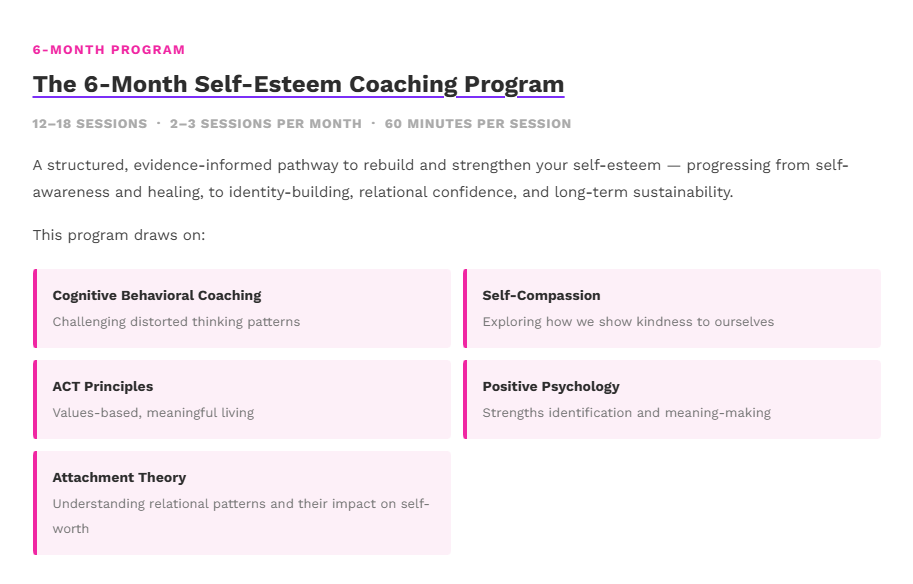
The Six Month Self-Esteem Coaching Program
What does an autism coach do across an extended engagement? Sonia's six month self-esteem coaching program is the most structured and most comprehensive answer to that question.
The program runs across twelve to eighteen sessions, delivered at two to three sessions per month, each sixty minutes long. It is structured as a progressive journey through six distinct phases, each building on the last.
Month one: Foundation and self-awareness Baseline assessment, exploring your self-story, and clarifying your values as the foundation everything else builds on.
Month two: Challenging the inner critic Cognitive reframing, working directly with the inner critic, and building positive self-talk that is genuine rather than performative.
Month three: Self-compassion and resilience Developing a consistent self-compassion practice, building emotional regulation capacity, and beginning the healing process from accumulated identity damage.
Month four: Identity, strengths, and ownership A strengths inventory, deepening authenticity, and building confidence in action rather than just in theory.
Month five: Relationships, boundaries, and social confidence Practical boundary-setting, developing assertiveness, and addressing the social anxiety that affects so many autistic adults in personal and professional relationships.
Month six: Integration and sustainability Reviewing progress, building a personal blueprint for continued growth, and creating a clear vision for the life ahead.
The program draws on cognitive behavioral coaching, self-compassion principles, ACT, positive psychology, and attachment theory, integrated into a framework that is specifically adapted for autistic neurology rather than applied generically.
By the end of the program, clients have identified and challenged the limiting beliefs undermining their self-worth, developed consistent self-compassion and emotional regulation practices, learned to own and communicate their strengths confidently, established and maintained healthy personal boundaries, and built the tools to sustain healthy self-esteem independently.
How Long Does Autism Coaching Last
How long autism coaching lasts depends on the specific coaching service and the individual's goals and starting point.
For socio-emotional coaching, session frequency and duration are tailored to the individual. Some clients work with Sonia for a focused period of three to four months on specific skill areas. Others choose ongoing coaching that evolves as their needs change.
For the six month self-esteem coaching program, the structure is clear. Twelve to eighteen sessions across six months, progressing systematically through the phases described above.
What does an autism coach do across these different time frames? The work deepens. Early sessions build the foundation of self-understanding and trust. Middle sessions apply that understanding to the specific challenges the individual is facing. Later sessions build the sustainability and independence that make the growth last beyond the coaching relationship itself.
The On the Spectrum podcast with Sonia Chand is a rich companion resource to the coaching work, offering honest conversations about the autistic experience that give context, community, and insight to everything that happens in the coaching sessions themselves.
Who Benefits Most From Autism Coaching
What does an autism coach do is most relevant for autistic adults who are:
Navigating social and professional life with significant effort and exhaustion but without a clear framework for why things are hard or what would genuinely help
Recovering from autistic burnout and needing support to rebuild functioning and identity alongside practical daily life skills
Recently diagnosed and trying to make sense of how autism has shaped their life and what changes would genuinely help going forward
Struggling with self-doubt, limiting beliefs, and a self-image shaped by years of being misunderstood rather than by an accurate understanding of their own strengths
Working toward specific goals in relationships, employment, or daily independence and needing personalised, autism-informed support to get there
For autistic adults who are also navigating the management of their autism more broadly, the post on what are the management of autism covers the full range of evidence-based approaches and helps clarify where coaching fits within a comprehensive support picture.
FAQs
What does an autism coach do differently from a therapist?
An autism coach focuses on practical skill building, present and future focused strategies, and specific life areas rather than on clinical treatment of mental health conditions.
How long does autism coaching last?
It varies. Socio-emotional coaching is tailored to individual needs and goals. The six month self-esteem program runs twelve to eighteen sessions over six months.
Is Sonia Chand a therapist or a coach?
Sonia is both. She is a licensed psychotherapist who also offers specialized coaching services, bringing clinical depth to coaching in a way that most coaches cannot.
Who is autism coaching for?
Autistic adults who want practical, personalised support for social navigation, self-esteem, emotional regulation, and building a life that genuinely works for their neurology.
What is the difference between socio-emotional coaching and self-esteem coaching?
Socio-emotional coaching focuses on building practical social and communication skills. Self-esteem coaching focuses on identifying and challenging limiting beliefs and building genuine inner confidence.
How do I know if coaching is right for me?
The best way to find out is a discovery call with Sonia, where you can ask your questions and get a genuine sense of whether the coaching approach is the right fit for where you are right now.
Final Thoughts
What does an autism coach do? At its best, it does something that very few other forms of support manage: it meets you exactly where you are, understands your neurology accurately, and helps you build forward from there in a way that is genuinely yours.
Not a neurotypical template applied to an autistic life. Not a clinical treatment that addresses symptoms without touching the experience underneath them. Something more personal, more practical, and more genuinely transformative than either.
That is what Sonia's coaching is built to do. And it starts with a single conversation.