
What Does an Autism Coach Do?
What does an autism coach do is a question that more autistic individuals and their families are asking as coaching becomes increasingly recognized as one of the most genuinely useful forms of support available outside of clinical therapy. And it is a question worth answering clearly, because the answer is often very different from what people expect.
What does an autism coach do is not the same as what a therapist does, not the same as what a behavioral interventionist does, and not the same as what a life coach does in the general sense. It is something more specific, more practical, and for many autistic adults, more immediately transformative than any of those alternatives.
This post answers what does an autism coach do in full, explains how coaching differs from therapy, covers what Sonia Chand's specific coaching programs involve, and helps you understand whether coaching is the right next step for where you are right now.
Table of Contents
What Does an Autism Coach Do?
How Autism Coaching Differs From Therapy
Socio-Emotional Coaching: What It Covers and Who It Helps
Self-Esteem Coaching: What It Covers and Who It Helps
The Six Month Self-Esteem Coaching Program
How Long Does Autism Coaching Last
Who Benefits Most From Autism Coaching
FAQs
Final Thoughts
What Does an Autism Coach Do?
What does an autism coach do in the most direct terms is help autistic individuals build the practical skills, self-understanding, and inner confidence they need to navigate the specific challenges their neurology creates in social, emotional, and professional life.
An autism coach does not diagnose. They do not provide clinical treatment for mental health conditions. They do not focus primarily on the past in the way that therapy often does. What an autism coach does instead is work in the present and toward the future, helping the autistic individual understand how their brain works, what strategies genuinely help, and how to build a life that fits their actual neurology rather than the neurotypical template they have been expected to follow.
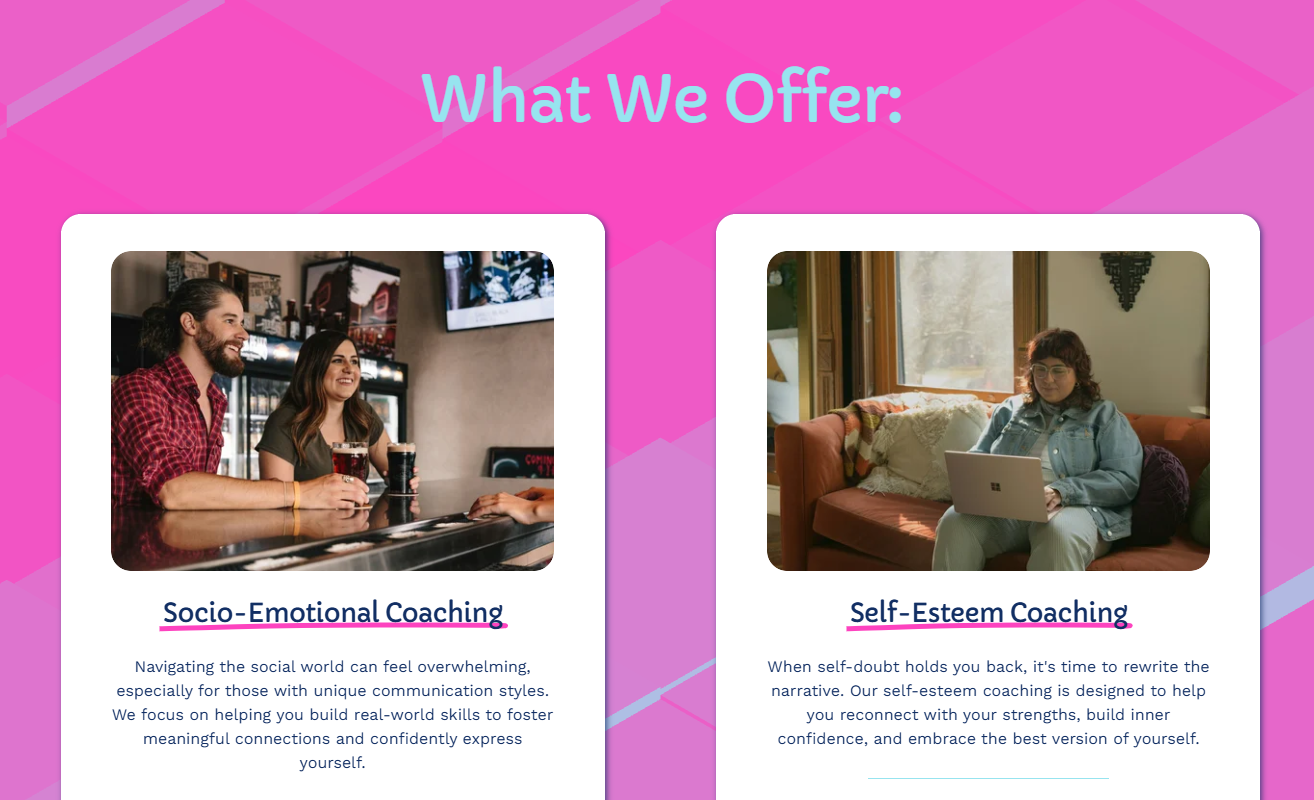
What does an autism coach do in Sonia Chand's practice specifically? Sonia is a licensed psychotherapist who brings both clinical training and deep personal understanding of the autistic experience to her coaching work. Her coaching services are designed to empower neurodivergent individuals to navigate social interactions, build meaningful connections, and foster genuine self-confidence, not by making them more neurotypical, but by helping them understand and work with who they actually are.
How Autism Coaching Differs From Therapy
Understanding what does an autism coach do requires understanding how coaching differs from therapy, because the distinction is practically important for knowing which one you need.
Therapy, particularly in its clinical forms, is primarily focused on diagnosing and treating mental health conditions. It often works with the past, exploring how early experiences, trauma, and psychological patterns have shaped current functioning. Therapy is delivered by licensed clinicians and is subject to specific regulatory frameworks.
Coaching is forward-focused. It works with where you are now and where you want to go, rather than primarily with where you have been. It focuses on building skills, developing strategies, and creating practical change in specific areas of life rather than on clinical treatment of mental health conditions.
For autistic adults, coaching fills a gap that therapy frequently does not. Many autistic adults have spent years in therapy that addressed their anxiety or depression without ever addressing the autistic neurology driving those experiences. Coaching that is built specifically around autistic neurology addresses the root experience, the social navigation, the self-esteem, the emotional regulation, and the daily life challenges, in a way that generic clinical therapy often cannot.
What does an autism coach do that therapy does not? It meets you where your daily life actually is and builds practical tools for the specific situations that are genuinely hard.
Because Sonia is both a licensed psychotherapist and a specialist coach, her work uniquely bridges both worlds. She brings clinical depth to coaching in a way that most coaches cannot, and she brings practical, forward-focused skill building to her work in a way that most therapy does not.
Book a discovery call with Sonia here and experience the difference that genuinely autism-informed support makes from the very first conversation.
Socio-Emotional Coaching: What It Covers and Who It Helps
What does an autism coach do in the socio-emotional coaching space? For many autistic adults, the social world is simultaneously one of the most desired and most exhausting aspects of life. The desire for connection is real. The difficulty of navigating the unwritten rules, the implicit communication, the workplace dynamics, and the everyday social exchanges is equally real.
Sonia's socio-emotional coaching addresses this directly and practically. It is not about teaching autistic adults to perform neurotypicality. It is about building a genuine, personal toolkit for the social world they are actually living in.
What socio-emotional coaching covers includes:
Friendships: Learning how to identify shared interests, start conversations, and nurture relationships over time in ways that work with autistic social styles rather than against them.
Social cues: Developing a practical understanding of body language, tone, and context that makes social interactions more navigable without requiring the kind of exhausting real-time decoding that burns most autistic adults out.
Everyday social situations: Getting specific, practical strategies for the kinds of everyday social exchanges, grocery store trips, restaurant orders, workplace interactions, casual conversations, that neurotypical people navigate automatically but that many autistic adults find genuinely effortful.
Workplace relationships: Building the professional relationship skills including small talk, networking, and navigating workplace social dynamics that affect employment outcomes significantly.
Emotional regulation: Understanding and expressing emotions effectively across different social contexts, which is one of the most consistent challenges for autistic adults regardless of their overall social competence.
Dropped in a Maze by Sonia Chand captures the experience of navigating the social and emotional complexity of the autism journey with the honesty and wisdom that only comes from having lived it deeply. It is the reading that gives the socio-emotional coaching work its fuller context.
Self-Esteem Coaching: What It Covers and Who It Helps
What does an autism coach do when self-doubt is the primary obstacle? For many autistic adults, years of being misunderstood, corrected, excluded, and expected to be something they are not have left a residue of self-doubt that is deeper and more stubborn than any social skill deficit.
Sonia's self-esteem coaching works on this deeper layer. It is not motivational coaching. It is not positive thinking. It is structured, evidence-informed work that helps autistic adults identify and challenge the limiting beliefs that have accumulated over years of navigating a world that did not fully accommodate them.
What self-esteem coaching covers includes:
Limiting beliefs: Identifying and challenging the specific mental narratives that undermine self-worth. Not generic negative thinking but the specific beliefs that autistic adults carry, that they are too much, not enough, fundamentally different in a way that makes them less.
Self-image: Discovering and genuinely owning the strengths that autism brings alongside its challenges, because those strengths are real, they are significant, and most autistic adults have been given very little help in seeing them clearly.
Self-compassion: Learning practical techniques for bouncing back from setbacks and practicing genuine kindness toward themselves, particularly important for autistic adults who hold themselves to exhausting standards of performance.
Goal setting: Gaining the clarity and confidence to take meaningful steps toward personal and professional goals rather than staying in the planning stage indefinitely because uncertainty feels too risky.
For autistic adults who are also navigating burnout alongside low self-esteem, the post on what does autistic burnout feel like in adults covers the specific relationship between burnout and the identity damage it creates, and is worth reading alongside any self-esteem coaching work.
The Six Month Self-Esteem Coaching Program
What does an autism coach do across an extended engagement? Sonia's six month self-esteem coaching program is the most structured and most comprehensive answer to that question.
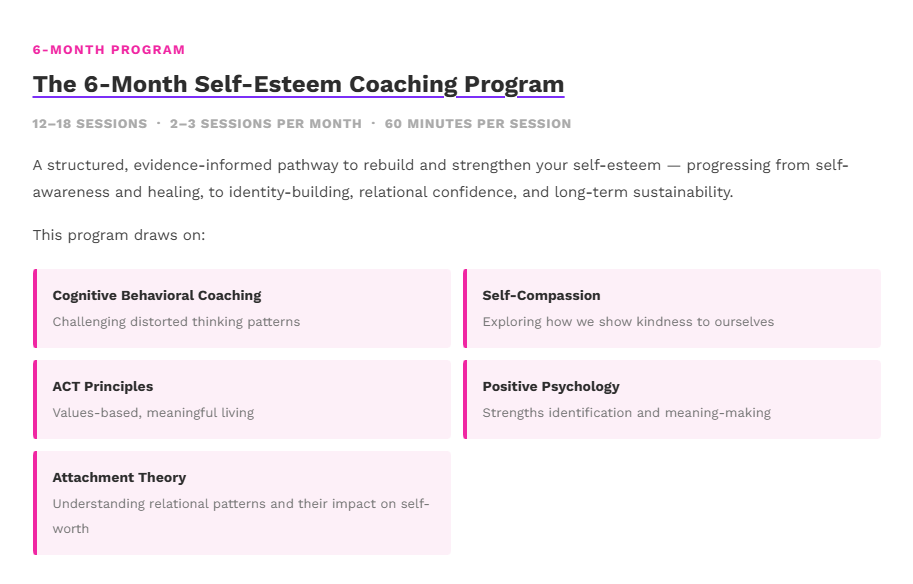
The program runs across twelve to eighteen sessions, delivered at two to three sessions per month, each sixty minutes long. It is structured as a progressive journey through six distinct phases, each building on the last.
Month one: Foundation and self-awareness Baseline assessment, exploring your self-story, and clarifying your values as the foundation everything else builds on.
Month two: Challenging the inner critic Cognitive reframing, working directly with the inner critic, and building positive self-talk that is genuine rather than performative.
Month three: Self-compassion and resilience Developing a consistent self-compassion practice, building emotional regulation capacity, and beginning the healing process from accumulated identity damage.
Month four: Identity, strengths, and ownership A strengths inventory, deepening authenticity, and building confidence in action rather than just in theory.
Month five: Relationships, boundaries, and social confidence Practical boundary-setting, developing assertiveness, and addressing the social anxiety that affects so many autistic adults in personal and professional relationships.
Month six: Integration and sustainability Reviewing progress, building a personal blueprint for continued growth, and creating a clear vision for the life ahead.
The program draws on cognitive behavioral coaching, self-compassion principles, ACT, positive psychology, and attachment theory, integrated into a framework that is specifically adapted for autistic neurology rather than applied generically.
By the end of the program, clients have identified and challenged the limiting beliefs undermining their self-worth, developed consistent self-compassion and emotional regulation practices, learned to own and communicate their strengths confidently, established and maintained healthy personal boundaries, and built the tools to sustain healthy self-esteem independently.
How Long Does Autism Coaching Last
How long autism coaching lasts depends on the specific coaching service and the individual's goals and starting point.
For socio-emotional coaching, session frequency and duration are tailored to the individual. Some clients work with Sonia for a focused period of three to four months on specific skill areas. Others choose ongoing coaching that evolves as their needs change.
For the six month self-esteem coaching program, the structure is clear. Twelve to eighteen sessions across six months, progressing systematically through the phases described above.
What does an autism coach do across these different time frames? The work deepens. Early sessions build the foundation of self-understanding and trust. Middle sessions apply that understanding to the specific challenges the individual is facing. Later sessions build the sustainability and independence that make the growth last beyond the coaching relationship itself.
The On the Spectrum podcast with Sonia Chand is a rich companion resource to the coaching work, offering honest conversations about the autistic experience that give context, community, and insight to everything that happens in the coaching sessions themselves.
Who Benefits Most From Autism Coaching
What does an autism coach do is most relevant for autistic adults who are:
Navigating social and professional life with significant effort and exhaustion but without a clear framework for why things are hard or what would genuinely help
Recovering from autistic burnout and needing support to rebuild functioning and identity alongside practical daily life skills
Recently diagnosed and trying to make sense of how autism has shaped their life and what changes would genuinely help going forward
Struggling with self-doubt, limiting beliefs, and a self-image shaped by years of being misunderstood rather than by an accurate understanding of their own strengths
Working toward specific goals in relationships, employment, or daily independence and needing personalised, autism-informed support to get there
For autistic adults who are also navigating the management of their autism more broadly, the post on what are the management of autism covers the full range of evidence-based approaches and helps clarify where coaching fits within a comprehensive support picture.
FAQs
What does an autism coach do differently from a therapist?
An autism coach focuses on practical skill building, present and future focused strategies, and specific life areas rather than on clinical treatment of mental health conditions.
How long does autism coaching last?
It varies. Socio-emotional coaching is tailored to individual needs and goals. The six month self-esteem program runs twelve to eighteen sessions over six months.
Is Sonia Chand a therapist or a coach?
Sonia is both. She is a licensed psychotherapist who also offers specialized coaching services, bringing clinical depth to coaching in a way that most coaches cannot.
Who is autism coaching for?
Autistic adults who want practical, personalised support for social navigation, self-esteem, emotional regulation, and building a life that genuinely works for their neurology.
What is the difference between socio-emotional coaching and self-esteem coaching?
Socio-emotional coaching focuses on building practical social and communication skills. Self-esteem coaching focuses on identifying and challenging limiting beliefs and building genuine inner confidence.
How do I know if coaching is right for me?
The best way to find out is a discovery call with Sonia, where you can ask your questions and get a genuine sense of whether the coaching approach is the right fit for where you are right now.
Final Thoughts
What does an autism coach do? At its best, it does something that very few other forms of support manage: it meets you exactly where you are, understands your neurology accurately, and helps you build forward from there in a way that is genuinely yours.
Not a neurotypical template applied to an autistic life. Not a clinical treatment that addresses symptoms without touching the experience underneath them. Something more personal, more practical, and more genuinely transformative than either.
That is what Sonia's coaching is built to do. And it starts with a single conversation.
