
What Is Level 1 Autism? A Complete Guide for Adults
What is level 1 autism is a question a lot of adults end up searching late at night, often after a conversation that did not quite land the way it should have, or after watching a video about autism and feeling an uncomfortable jolt of recognition. If you are here because you suspect level 1 autism might explain something about your own life, you are not overreacting. You are paying attention.
What is level 1 autism in the simplest possible terms is the official diagnostic category for autistic individuals who need some support but who function independently in many areas of daily life. It is the part of the spectrum that is hardest to spot from the outside and hardest to live with quietly on the inside, because the struggle is real even when it is invisible to everyone around you.
This post answers what is level 1 autism in full, what it actually feels like to live with from the inside, how it differs from other autism levels, and what comes next if you recognize yourself in what you read.
Table of Contents
What Is Level 1 Autism?
Where Level 1 Autism Fits on the Spectrum
Signs of Level 1 Autism in Adults
What Level 1 Autism Feels Like From the Inside
Why Level 1 Autism Is So Often Missed in Adults
Level 1 Autism and Masking
Level 1 Autism and Mental Health
Getting Assessed for Level 1 Autism as an Adult
What Support Actually Looks Like for Level 1 Autism
Life After Recognizing Level 1 Autism in Yourself
FAQs
Final Thoughts
What Is Level 1 Autism?
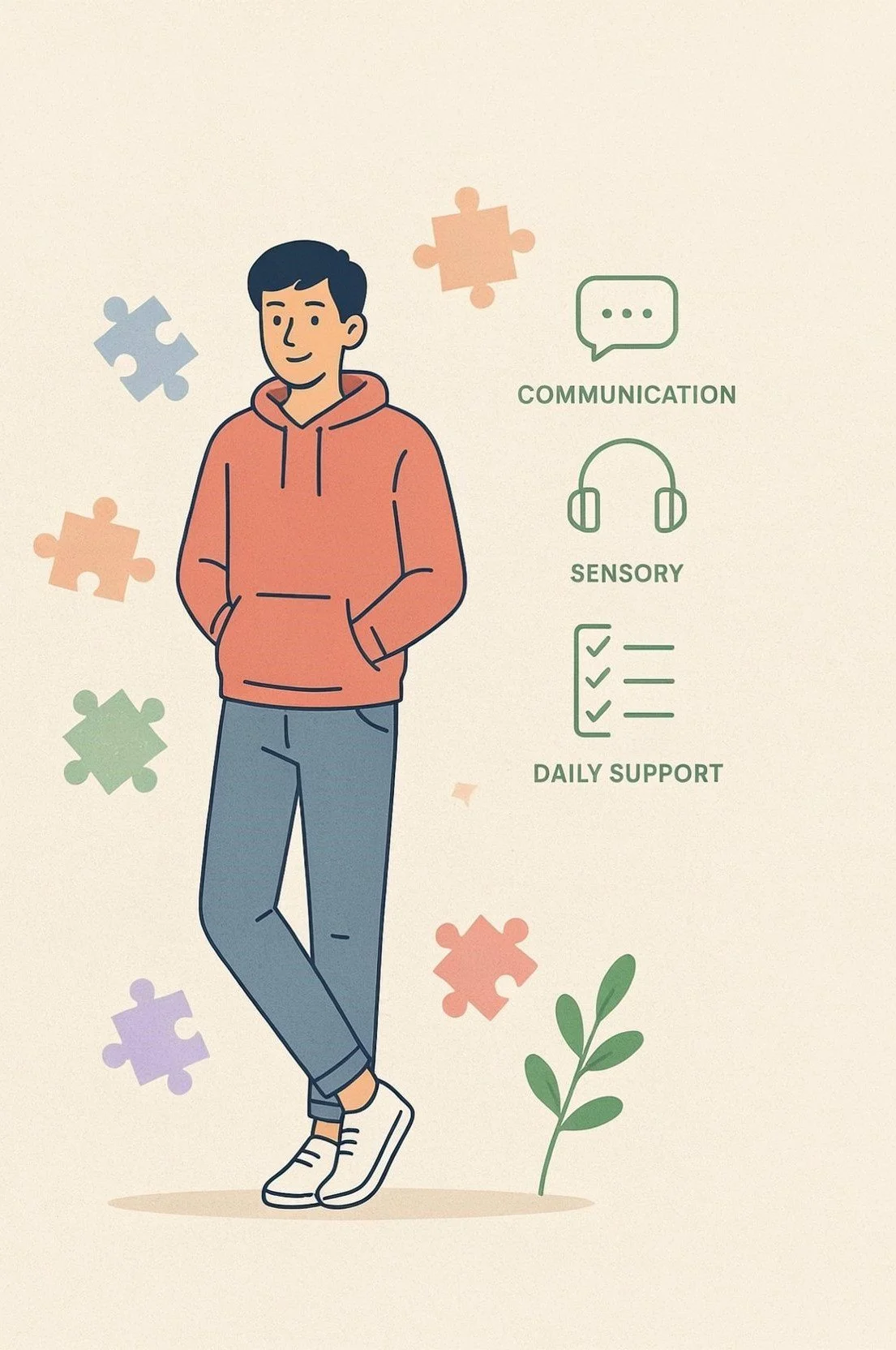
What is level 1 autism according to the DSM-5? It is the diagnostic label given to autistic individuals who, in the language of the manual, require support. This is the lowest support level on the official three-tier system, sitting below Level 2, which requires substantial support, and Level 3, which requires very substantial support.
What is level 1 autism in practical terms is autism that allows a person to live, work, and function across most everyday settings without needing constant external support, while still experiencing real and sometimes significant challenges in social communication and in managing restricted or repetitive patterns of behavior.
What is level 1 autism not is autism that is mild, easy, or somehow less real than the rest of the spectrum. The word level here describes visible support needs as assessed in a specific evaluation, not the internal effort, exhaustion, or struggle a person experiences day to day. Many people with what is clinically labeled level 1 autism describe their daily life as anything but easy.
For a complete breakdown of all three autism levels and how they compare to one another, the post on what are the levels of autism: a guide for parents covers Level 1, Level 2, and Level 3 side by side in detail.
Where Level 1 Autism Fits on the Spectrum
Understanding what is level 1 autism requires understanding where it sits relative to the other two levels.
Level 1 autism involves noticeable difficulties with social communication that are not severe enough to prevent functioning without support in most settings, alongside restricted or repetitive behaviors that cause some interference with functioning in one or more contexts but that the person can often manage with effort.
Level 2 autism involves more substantial social communication challenges that are apparent even with support in place, and restricted or repetitive behaviors that interfere with functioning across multiple contexts and are harder to redirect.
Level 3 autism involves severe deficits in social communication that cause significant impairment even with support, alongside restricted or repetitive behaviors that markedly interfere with functioning across all areas of life.
What is level 1 autism, placed against this scale, is the presentation that looks the most capable from the outside and is therefore the one most likely to have its real struggles dismissed, minimized, or simply not believed.
How Autism Affects
Signs of Level 1 Autism in Adults
What is level 1 autism in adults looks different from the textbook descriptions that were largely built around observing children. Here is what it commonly looks like when it shows up in grown adults navigating careers, relationships, and independent life.
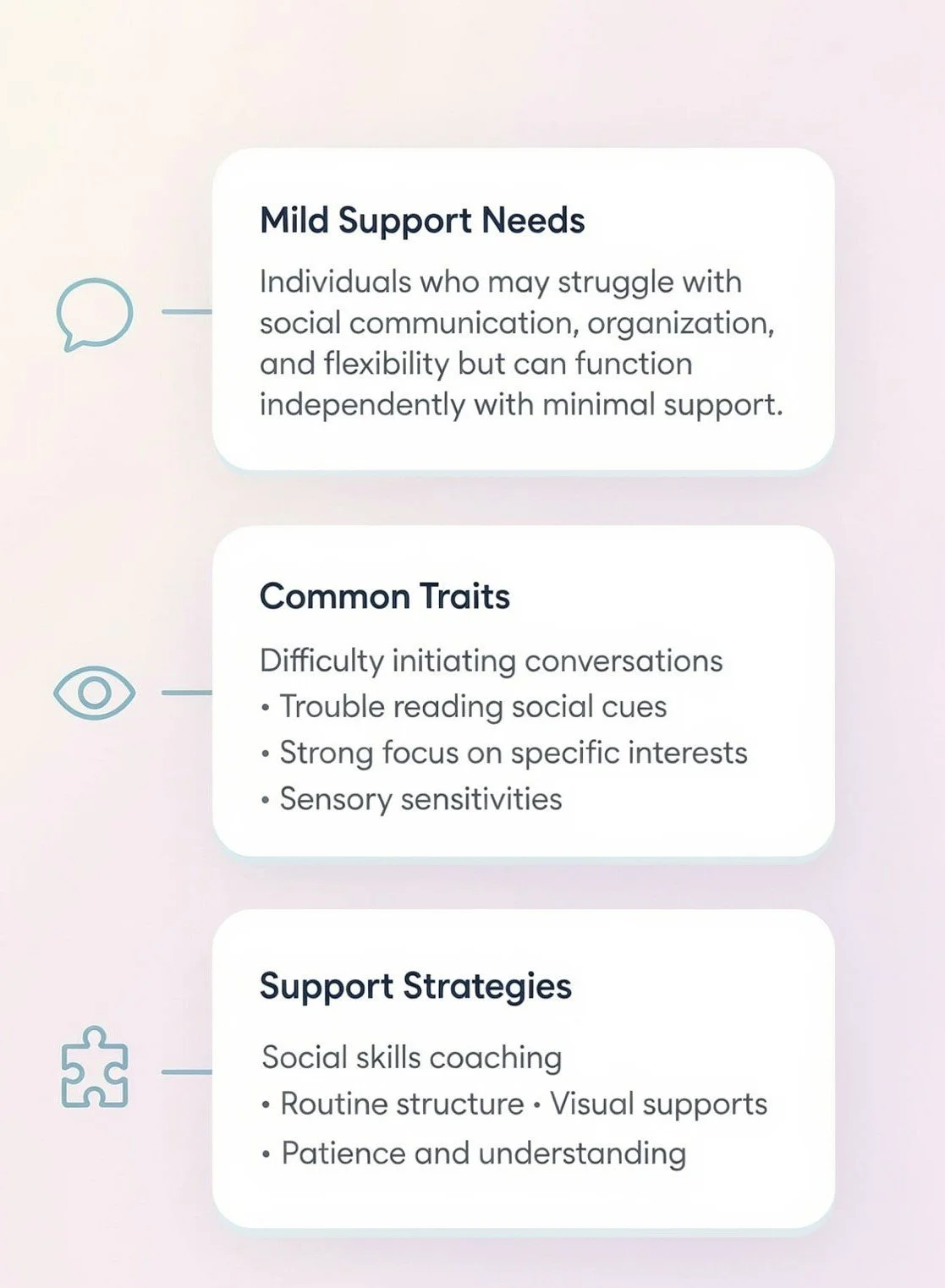
Social communication signs:
Difficulty with the unwritten rules of conversation including knowing when to speak, when to stop, and how to read when someone has lost interest
A tendency toward very literal interpretation of language, missing sarcasm, idioms, or implied meaning until it is explained directly
Genuine desire for connection paired with exhaustion after socializing, even socializing that went well
Difficulty maintaining friendships over time, not from lack of caring but from struggling with the ongoing maintenance that relationships require
Being told you come across as blunt, intense, or too direct when you did not intend to
Restricted and repetitive pattern signs:
One or more deep, narrow interests that you could talk about for hours given the chance
Strong need for routine and predictability, with real distress when plans change unexpectedly
Repetitive movements or habits, sometimes subtle, such as foot tapping, hair twirling, or specific verbal phrases you repeat under stress
Discomfort with open-ended or ambiguous situations that lack clear structure
Sensory signs:
Strong reactions to specific sounds, lights, textures, or smells that other people do not seem to notice at all
Needing to retreat and decompress after busy or loud environments
Preference for specific clothing textures or an inability to tolerate certain fabrics, tags, or seams
If several of these genuinely resonate, Sonia's coaching can help you build practical strategies for social and emotional challenges that fit you.
What Level 1 Autism Feels Like From the Inside
What is level 1 autism on paper and what level 1 autism feels like in a person's actual daily life are two very different things, and the gap between them is exactly why so many adults go undiagnosed for decades.
From the inside, level 1 autism often feels like running a constant background process that other people do not seem to be running. Every social interaction involves a layer of conscious calculation: what is the right facial expression here, how long should eye contact last, is this the moment to speak or stay quiet, did that comment mean what it sounded like or something else entirely.
It often feels like exhaustion that does not match the apparent size of the event that caused it. A birthday party, a work meeting, a casual coffee with a friend, things that look ordinary from the outside, can leave a person with level 1 autism needing hours or even days to recover.
It often feels like being told you are too sensitive, too rigid, too intense, or too much, by people who have no idea that what they are describing has a name and a reason behind it. To better understand this, Dropped by Maze explains this from a lived experience of Sonia Chand.
What is level 1 autism, lived rather than studied, is the experience of working significantly harder than most people around you just to arrive at outcomes that look, from the outside, ordinary and unremarkable.
What to know about Level 1 Autism
Why Level 1 Autism Is So Often Missed in Adults
What is level 1 autism, more than anything else, is the presentation most likely to be missed entirely, and there are specific reasons why.
Compensation and intelligence: Many adults with level 1 autism are highly intelligent and have spent years building sophisticated, often exhausting, workarounds for the things that do not come naturally. The compensation can be so effective that nobody, including the person themselves, realizes anything different is going on underneath it.
The wrong comparison point: Most people's mental image of autism comes from more visible presentations, often from childhood. An adult who holds a job, lives independently, and maintains some relationships does not match that image, so what is level 1 autism gets overlooked by professionals and loved ones alike.
Misdiagnosis along the way: Many adults with level 1 autism spent years collecting other diagnoses first, anxiety disorder, depression, social anxiety disorder, or even personality disorders, because those were the labels available to professionals who were not looking specifically for autism.
Gender bias in research and diagnosis: Women and people socialized as women are especially likely to have level 1 autism missed because diagnostic criteria were largely developed by observing boys, and because girls and women tend to mask more effectively from a young age.
Level 1 Autism and Masking
Masking is one of the central features of what is level 1 autism in adulthood, and it deserves its own real attention here.
Masking is the conscious or semi-conscious suppression of natural autistic traits in order to appear more neurotypical. For adults with level 1 autism, masking often becomes so automatic and so deeply practiced that it stops feeling like a performance and starts feeling like simply who they are, until exhaustion, burnout, or a major life change forces the mask to slip and the underlying reality becomes visible again.
Common masking behaviors in level 1 autism include forcing eye contact that feels physically uncomfortable, rehearsing conversations in advance, mimicking the tone and body language of people around you, and suppressing stimming behaviors in public only to release them once alone.
The cost of sustained masking is significant. It is strongly associated with anxiety, depression, and a specific kind of exhaustion known as autistic burnout, which can present as a sudden and frightening collapse in someone who appeared, to everyone around them, to be managing just fine.
Level 1 Autism and Mental Health
What is level 1 autism cannot be fully understood without understanding its close relationship with mental health, because the two are deeply intertwined for most adults living with this profile.
Research consistently shows elevated rates of anxiety and depression among autistic adults, and level 1 autism specifically carries a particular mental health burden because the demand to mask and to function at a neurotypical standard is highest precisely in this group. The very thing that makes level 1 autism less visible, the apparent capability, is also what denies many adults the recognition and support that would meaningfully reduce their mental health risk.
Many adults discovering what is level 1 autism for the first time describe genuine relief at finally understanding the root cause of years of anxiety or low mood that talk therapy alone never fully resolved, because the therapy was treating symptoms without addressing the underlying autistic experience driving them.
Getting Assessed for Level 1 Autism as an Adult
If what is level 1 autism has started to feel like it might be describing you specifically, formal assessment is available and increasingly accessible.
Adult autism assessment typically involves a detailed developmental history interview, standardized tools adapted for adults including the ADOS-2 Module 4, self-report questionnaires such as the Autism Spectrum Quotient, and a comprehensive clinical interview that explores both childhood history and current functioning.
Finding an assessor with specific experience in adult autism, and ideally specific experience with level 1 presentations and with women and people who mask effectively, makes a significant difference in the quality and accuracy of the assessment. For a full walkthrough of the entire testing process from screening through to diagnosis, the post on how to test for autism covers every stage in detail, including what to expect at each step.
Socio-emotional coaching helps with the very practical next step: learning how to navigate relationships, work, and daily life in ways that genuinely work with your level 1 autism rather than constantly fighting against it.
Book a socio-emotional coaching session with Sonia here and start building strategies that actually fit how your brain works.
What Support Actually Looks Like for Level 1 Autism
Support for what is level 1 autism in adulthood looks very different from support designed for children, and it is worth knowing what is genuinely available and helpful.
Useful forms of support include therapy or coaching with a practitioner who understands autism specifically rather than treating only the secondary anxiety or depression, workplace accommodations such as written instructions, flexibility around sensory environment, and clear expectations, structured routines that reduce daily decision fatigue, and connection with other late-identified autistic adults who understand the experience without needing it explained.
What tends not to help, and can actively cause harm, is any approach focused on making someone appear more neurotypical rather than helping them understand and work with their own neurology. The goal of good support for level 1 autism is never to eliminate the autism. It is to reduce the exhausting compensation and replace it with genuine understanding and accommodation.
Life After Recognizing Level 1 Autism in Yourself
Recognizing what is level 1 autism in your own life, whether through formal diagnosis or simply through deep self-recognition, often marks a genuine turning point, and it is worth being honest that the period right after this recognition can be emotionally complex.
There is frequently grief, for the years spent not understanding yourself, for the relationships that struggled under the weight of unexplained differences, for the energy spent compensating for something that had a name all along. There is also, very often, real relief, the kind that comes from finally having language for a lifetime of experiences that never quite made sense before.
This is exactly the territory where Sonia's coaching work becomes most valuable. Self-esteem coaching helps adults who are newly understanding their own level 1 autism rebuild a sense of identity that is not built on years of masking and self-criticism, but on an accurate and compassionate understanding of who they actually are.
Book a self-esteem coaching session with Sonia here and start building a sense of self that does not depend on the mask anymore.
FAQs
Is level 1 autism the same as high functioning autism?
The terms overlap significantly. High functioning autism is an informal term while Level 1 is the official diagnostic designation.
Can adults be diagnosed with level 1 autism?
Yes. Adult autism assessment is increasingly available and many adults are diagnosed with level 1 autism for the first time later in life.
Is level 1 autism the same as Asperger Syndrome?
They describe largely the same population. Asperger Syndrome was discontinued as a separate diagnosis in 2013 and folded into Level 1 autism under the DSM-5.
Why is level 1 autism so often missed in adults?
Effective masking, high intelligence, compensation strategies, and gender bias in diagnostic criteria all contribute to level 1 autism being frequently overlooked.
Does level 1 autism require support?
Yes. The word level 1 specifically means requiring support, just less visible or intensive support than Level 2 or Level 3.
What is the difference between level 1 and level 2 autism?
Level 2 involves more substantial social communication challenges and more pronounced repetitive behaviors that interfere with functioning across more settings than Level 1.
Final Thoughts
What is level 1 autism is ultimately a question with a fairly simple clinical answer and a far more complicated lived answer. Clinically, it describes autistic individuals who need support but who manage independently across many areas of daily life. In real life, it describes years of quiet exhaustion, of masking that nobody saw, of working twice as hard for outcomes that looked effortless from the outside.
If what is level 1 autism has started to sound like your own story, that recognition is worth taking seriously. Whether you pursue formal assessment, seek coaching support, or simply start reading and learning more, the clarity that comes from understanding your own neurology accurately is almost always better than continuing to carry an unexplained weight alone.
References:
Cleveland Clinic. Autism [Internet]. Available from: https://my.clevelandclinic.org/health/articles/autism
NovoPsych. Autism Spectrum Quotient (AQ) [Internet]. https://novopsych.com/assessments/diagnosis/autism-spectrum-quotient/
Evans JA, Krumrei-Mancuso EJ, Rouse SV. What You Are Hiding Could Be Hurting You: Autistic Masking in Relation to Mental Health, Interpersonal Trauma, Authenticity, and Self-Esteem. Autism Adulthood. 2024;6(2):229-240. https://pmc.ncbi.nlm.nih.gov/articles/PMC11317797/
Al Raish SM, Shokr MM, Eladawy RM, Azar YO. Depression in Autism Spectrum Disorder: Neurobiological Convergence and Emerging Therapeutic Strategies. Biology. 2026;15(10):745. https://doi.org/10.3390/biology15100745
Hus V, Lord C. The Autism Diagnostic Observation Schedule, Module 4: Revised Algorithm and Standardized Severity Scores. J Autism Dev Disord. 2014;44(8):1996-2012. https://pmc.ncbi.nlm.nih.gov/articles/PMC4104252/
