
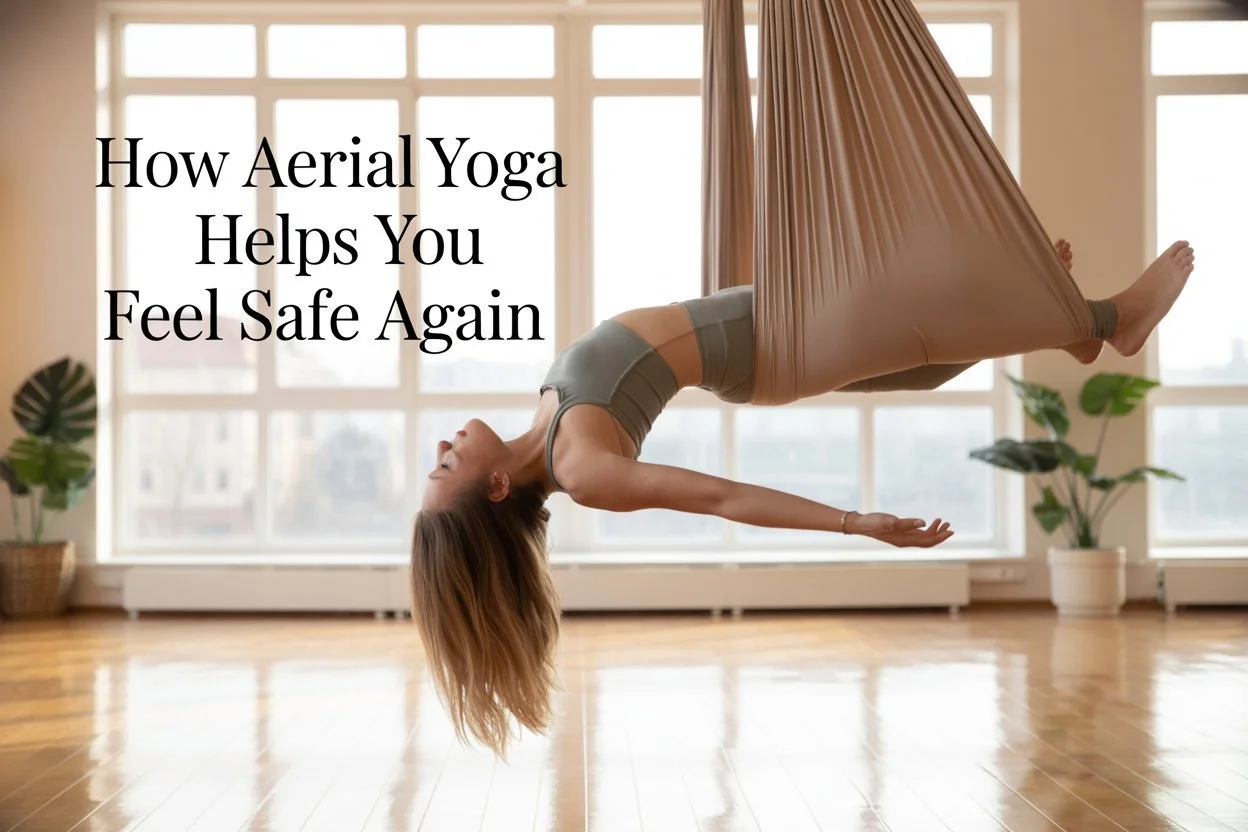
How Aerial Yoga Helps You Feel Safe Again
Most people picture aerial yoga and think of acrobatics. Performers suspended high above the ground, bodies twisted into impossible shapes, strength and flexibility on display for an audience.
What actually happens inside the hammock is often the complete opposite of that.
It is quieter. Slower. More inward. And for many people, particularly those who have spent years feeling unsafe, overwhelmed, or simply out of place in their own bodies, it can be genuinely transformative.
Jo Stewart is a Melbourne-based aerial yoga teacher and the author of Eight Limbs of Aerial Yoga: Neurodiversity. She joined Sonia on the On the Spectrum podcast for a conversation that went far beyond the physical practice and into something much more important: what it actually feels like to finally feel at home in your body, and how the right movement environment can get you there.
This post pulls together the key insights from that conversation. Whether you are neurodivergent, trauma-affected, or simply someone who has never quite found a wellness space that felt built for you, this one is worth reading slowly.
Listen to the full episode with Jo Stewart on the On the Spectrum podcast here.
Table of Contents
What Aerial Yoga Actually Is and Is Not
Why the Hammock Works for Nervous System Regulation
The Sensory Tools That Make the Difference
Vestibular Stimulation and Why Motion Calms Some Brains
What a Trauma-Informed Aerial Yoga Class Looks Like
The Three Level Pose Principle
When Yoga Language Misses the Moment
Consent, Choice and Why Rest Is Always Allowed
Access, Mental Health and the Wellness Space Problem
Yoga's South Asian Roots and Why Acknowledgment Matters
About Jo's Book and Where to Find Her
Final Thoughts
What Aerial Yoga Actually Is and Is Not
Before anything else, it helps to clear up what aerial yoga actually involves because the gap between the Instagram version and the real thing is significant.
What most people picture:
Advanced acrobatic poses at height
Strength and flexibility requirements that feel out of reach
Performance-oriented practice in large studios
Something designed for a specific body type or ability level
What Jo's aerial yoga actually is:
A hammock suspended at hip height used as a prop for support and sensation
Accessible to people of most body types, mobility levels, and experience backgrounds
Primarily a floor-based and low-level practice with optional inversions
A sensory and nervous system tool as much as a movement practice
A space built around individual need rather than group performance
The hammock, Jo explained, is not there to take you up. It is there to hold you. That distinction matters enormously for anyone who has felt excluded from movement spaces because of their body, their sensory needs, or the way traditional wellness environments are structured.
Listen to the full episode with Jo Stewart on the On the Spectrum podcast here.
Why the Hammock Works for Nervous System Regulation
This is the heart of everything Jo shared in the conversation and the reason aerial yoga is particularly relevant for neurodivergent individuals and trauma survivors.
The human nervous system responds to specific types of input in predictable ways. Deep pressure, gentle rocking, cocooning, and supported compression are all inputs that signal safety to the nervous system. They are the same kinds of input that weighted blankets, rocking chairs, and swaddling provide. They communicate, at a level below conscious thought: you are held, you are safe, you can relax.
The hammock delivers all of these naturally.
What happens in the hammock at a nervous system level:
Being wrapped in fabric from multiple sides creates a cocooning effect that many people describe as immediately calming
The gentle sway of the hammock provides rhythmic vestibular input that helps regulate the nervous system
The even pressure of the fabric against the body mimics the calming effect of deep pressure therapy
The supported nature of many poses removes the need to brace and hold, allowing the body to genuinely release tension it may have been carrying for years
For people who live in a chronic state of hypervigilance, whether because of trauma, sensory processing differences, anxiety, or the accumulated stress of navigating a world that was not designed for their nervous system, this kind of input can be genuinely regulatory in ways that talk-based support alone cannot provide.
The body keeps its own records. And sometimes the body needs its own language of healing.
This is also why the emotional and physical are so deeply connected in the coaching work Sonia does with neurodivergent individuals. Building a sense of safety in your body is often the foundation for the deeper identity and confidence work. If you are looking for that kind of support alongside a body-based practice, book a socio-emotional coaching session with Sonia here and start building that foundation.
The Sensory Tools That Make the Difference
Jo broke down the specific sensory inputs that aerial yoga offers and why each one matters for different people:
Cocooning Being wrapped fully in the hammock creates a contained, enclosed sensation. For many autistic individuals and trauma survivors, this sense of containment is deeply regulating. It reduces the sense of exposure that open spaces can create and signals the nervous system that it is safe to settle.
Deep Pressure The even compression of the fabric across the body activates the parasympathetic nervous system, the rest and digest state, rather than the sympathetic fight or flight response. This is the same mechanism behind weighted blankets and therapeutic massage.
Gentle Rocking Rhythmic motion is one of the oldest and most universal calming tools humans have. It is why we rock babies. It is why people stim with rocking movements. The gentle sway of the hammock provides this input continuously and naturally throughout a session.
Optional Inversions Going upside down, even slightly, changes blood flow, shifts perspective, and can create a profound sense of release. For people who are ready for it, inversions offer a unique kind of regulation. For those who are not, they remain completely optional. No progression is implied and no pressure is applied.
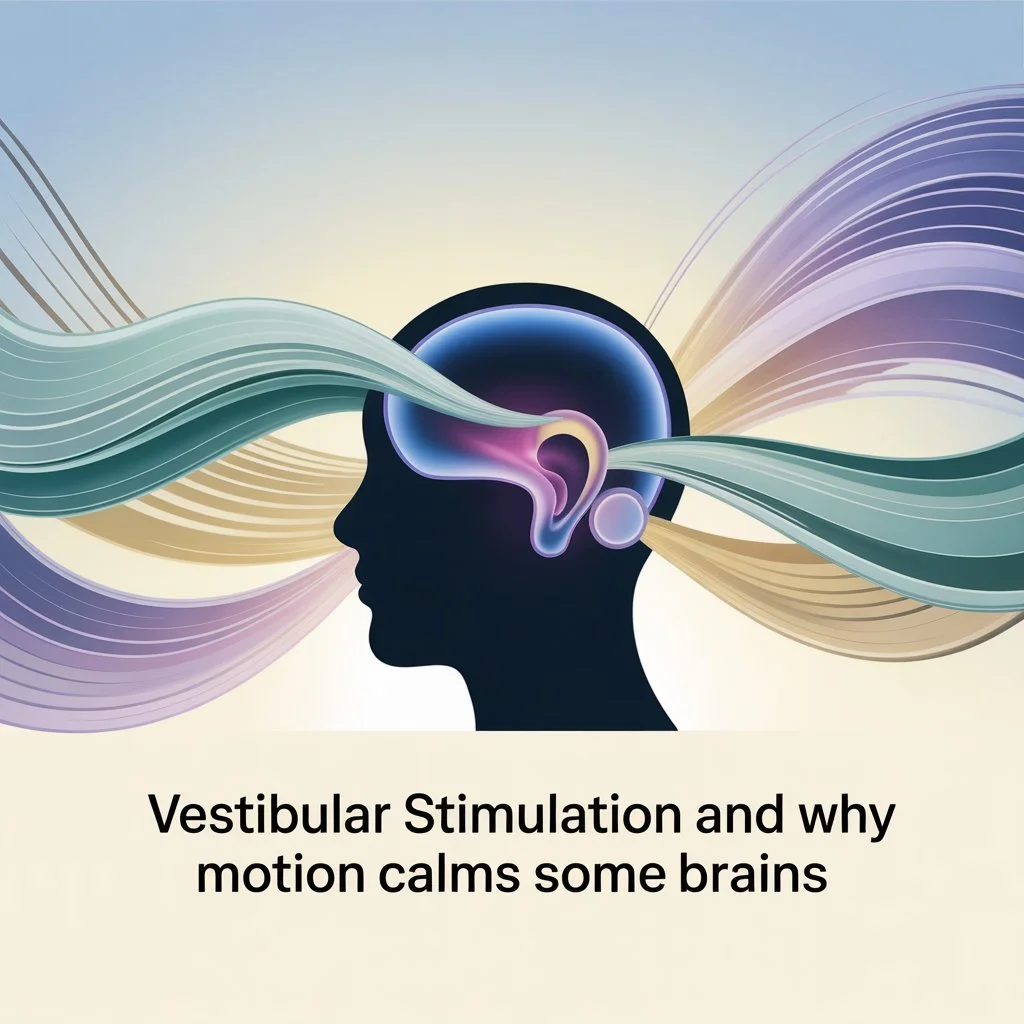
Vestibular Stimulation and Why Motion Calms Some Brains
One of the most practically useful parts of the conversation was Jo's explanation of vestibular stimulation and why it works so differently for different people.
The vestibular system lives in the inner ear and is responsible for our sense of movement, balance, and spatial orientation. For many people with ADHD and autism, the vestibular system is either under-responsive or seeking input in ways that the typical environment does not provide.
For people who are vestibular-seeking:
Spinning, swinging, and rocking feel regulating and calming
Motion helps them become more present and focused rather than more distracted
The aerial hammock's natural movement provides exactly the input their nervous system is looking for
For people who are vestibular-sensitive:
The same motion can feel overwhelming, disorienting, or nauseating
Stillness and predictability are more regulating than movement
The hammock can be used in a completely stable way with no swinging at all
Jo was clear that neither response is wrong. They are simply different nervous systems with different needs. The skill of a good trauma-informed aerial yoga teacher is reading those needs and offering options that meet each person where they are rather than assuming one experience works for everyone.
This is exactly the kind of nuanced, individual-first thinking that distinguishes genuinely inclusive wellness spaces from spaces that claim inclusivity without delivering it.
Listen to the full episode with Jo Stewart on the On the Spectrum podcast here.
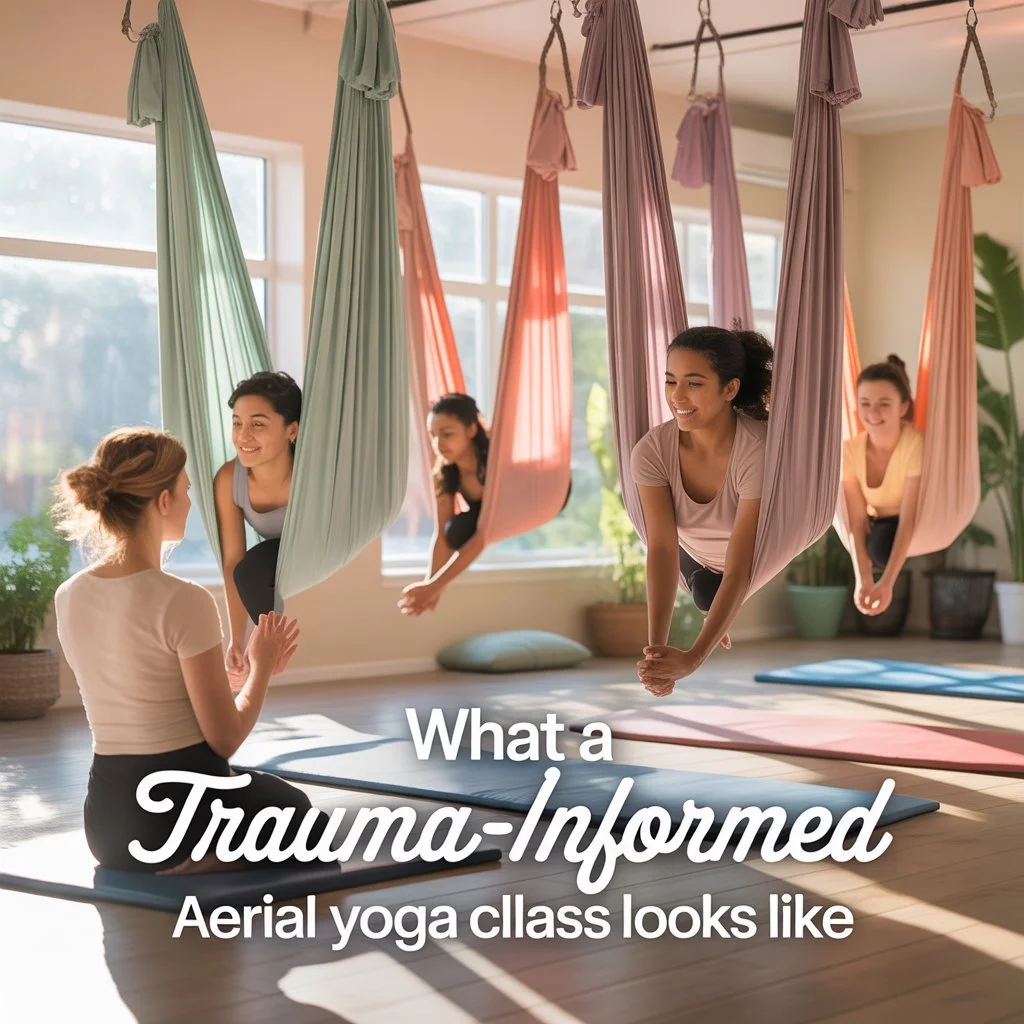
What a Trauma-Informed Aerial Yoga Class Looks Like
Jo described in practical detail what it looks like to build a class around genuine trauma-informed principles. The difference between a class that says it is trauma-informed and one that actually is shows up in the details.
Small group sizes Jo keeps her classes deliberately small. This is not just a practical decision. It is a values decision. Smaller groups mean more individual attention, lower sensory overwhelm, less social anxiety, and a greater ability for the teacher to notice and respond to what each person needs.
Check-ins
Classes begin with a check-in. Not a performative one but a genuine one. How are you arriving today? What does your body need? What do you want to leave at the door? This sets the tone that the session is organized around the participants rather than around a preset curriculum.
Multiple versions of every pose
Every single pose in Jo's classes comes with multiple versions. Not a modified version that signals you are doing the lesser option, but genuinely different expressions of the same movement that meet different bodies and nervous systems at different points.
No framing as progression Nothing is presented as the goal you are working toward. There is no hierarchy of poses where the full version is the real version and everything else is a step along the way. Each version is complete in itself. This removes the performance dynamic entirely.
Rest is always an option At any point in the class, rest is not just allowed but explicitly offered as a valid choice. This matters profoundly for people whose previous wellness experiences have communicated, implicitly or explicitly, that stopping is failure.
The Three Level Pose Principle
Jo gave a specific example in the episode that is worth pulling out because it illustrates her approach so clearly.
She described teaching an aerial down dog, a pose that in a typical yoga class requires being fully on the ground on hands and knees. In her class, this single pose has three completely distinct expressions:
Level one: Fully grounded. Hands and feet on the floor with the hammock providing gentle support across the hips. No height, no inversion, complete contact with the ground.
Level two: Partially elevated. The hammock supports more of the body weight, creating a gentle traction through the spine and a partial shift in orientation. Still accessible, still grounded in feel.
Level three: A supported inversion. The body tilts further, the head moves below the heart, the hammock holds the full weight. A genuine inversion experience with complete support.
All three happen in the same class, at the same time, with the same instruction. Nobody is singled out for being at level one. Nobody is praised for being at level three. All three are presented as full and complete expressions of the same pose.
That is inclusion done properly. Not as a policy statement but as a lived practice in the room.
Listen to the full episode with Jo Stewart on the On the Spectrum podcast here.
When Yoga Language Misses the Moment
Jo shared a story in the episode that stopped the conversation in its tracks. It is the kind of story that changes how you think about language in wellness spaces permanently.
She was going through a cancer crisis. In the middle of that, she attended a yoga class. The class was themed around bliss.
Bliss.
The entire session was built around cultivating a feeling that was completely inaccessible to her at that moment. Every instruction, every invitation, every carefully chosen word pointed toward a emotional state she could not reach and did not want to be pushed toward.
Rather than feeling held by the practice, she felt more alone in it.
That experience changed how Jo teaches. It made her deeply attentive to the gap between the language teachers use and the reality participants are living. Because people bring their whole lives into a yoga class. The grief, the fear, the diagnosis, the fight they had that morning, the relationship that is falling apart, the body that does not feel like theirs.
What she changed as a result:
Language that invites rather than instructs
Themes that are open enough for many emotional states to coexist within them
Releasing the assumption that every participant is arriving from a place of wellness seeking more wellness
Making space for the full range of human experience rather than curating only the pleasant parts
This kind of attentiveness to language and emotional reality is something Sonia brings to her coaching work too. The words used around neurodivergent individuals, around their struggles, their strengths, and their experiences, shape how they see themselves in profound ways.
Book a self-esteem coaching session with Sonia here and experience what it feels like to be met exactly where you are.
Consent, Choice and Why Rest Is Always Allowed
The through-line of Jo's entire teaching philosophy is consent.
In a world where many neurodivergent people have spent years being told what their bodies should do, how they should move, what sensory experiences are appropriate and which are not, a practice built entirely on choice is genuinely countercultural.
In Jo's classes:
Nothing is framed as something you should be working toward
Every sensation is offered as an option not an expectation
Participants are encouraged to notice their own responses and honor them
Leaving a pose early is not dropping out, it is listening
Resting is not giving up, it is participating
This matters beyond yoga. It is a model for how neurodivergent individuals deserve to be treated in every space they inhabit. With their own agency intact. With their own nervous system responses treated as valid information rather than inconvenient behavior to be managed.
Access, Mental Health and the Wellness Space Problem
Jo did not sidestep the access question and it is worth addressing directly because it sits behind a lot of conversations about wellness.
Many of the people who would benefit most from practices like trauma-informed aerial yoga are the least likely to be able to access them. Cost, location, physical accessibility, sensory environment, and the cultural makeup of most wellness spaces all create barriers that disproportionately affect the people these practices could help most.
Jo's response to this is not a simple one because there are no simple answers. But her commitment is visible in the choices she makes:
Small group sizes that allow genuine individual attention
A teaching approach that does not require participants to have prior yoga experience
Language and framing that does not assume a particular body type, background, or level of physical ability
A genuine engagement with who is and is not in the room and why
Mental health is health. Movement is healthcare. And the wellness industry has a long way to go before it is genuinely accessible to everyone who needs it.
Yoga's South Asian Roots and Why Acknowledgment Matters
Jo raised the topic of cultural appropriation and yoga's origins in a way that was thoughtful and direct.
Yoga comes from South Asia. It has a history, a philosophy, an ethical framework, and a spiritual context that extends thousands of years before it became a fitness class in Western studios. Acknowledging that history is not performative. It is accurate. And it matters because the communities whose practice this originally was deserve recognition rather than erasure.
Jo was clear that aerial yoga is an adaptation and evolution of yoga tradition rather than a direct continuation of it. She holds that honestly. And she connects her teaching to the broader philosophical framework of yoga, including the eight limbs of yoga practice referenced in her book title, as a way of honoring rather than erasing those roots.
For anyone practicing or teaching yoga in a Western context, this is a conversation worth having openly rather than avoiding.
About Jo's Book and Where to Find Her
Jo's book, Eight Limbs of Aerial Yoga: Neurodiversity, is available through her website and on Amazon:
The book connects aerial yoga practice to the traditional eight limbs of yoga philosophy through the specific lens of neurodiversity. It is both a practical guide and a philosophical framework for teachers and practitioners who want to bring genuine inclusivity into their movement spaces.
Final Thoughts
Feeling safe in your body is not a small thing. For many neurodivergent people and trauma survivors, it is something that has never quite been available. The world is loud, the sensory demands are relentless, and most wellness spaces were not designed with their nervous systems in mind.
What Jo Stewart has built in her aerial yoga practice is a different kind of invitation. One that says: come as you are. Your nervous system is not a problem to manage. Rest is always allowed. And there is a version of this practice that meets you exactly where you are today.
That is not just good yoga teaching. It is a model for what inclusive, person-first support looks like in practice.
If this conversation opened something up for you, listen to the full episode with Jo Stewart on the On the Spectrum podcast here. It is one of those conversations that stays with you long after it ends.