
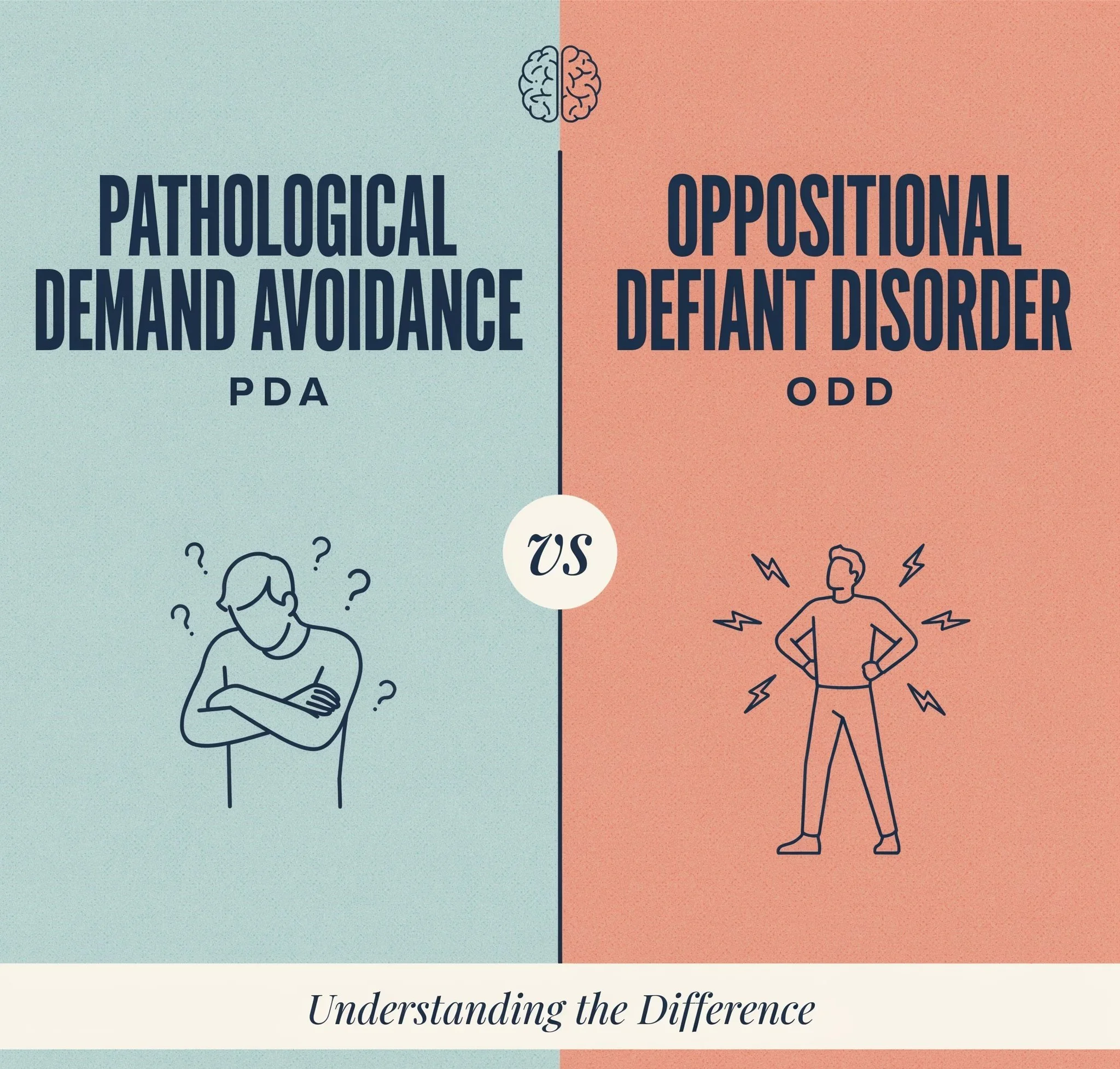
Pathological Demand Avoidance vs Oppositional Defiant Disorder: What Is the Difference
Pathological demand avoidance vs oppositional defiant disorder is one of the most important distinctions a parent or adult can learn to make, because the two profiles can look almost identical on the surface while requiring completely different responses underneath. Getting this distinction wrong does not just fail to help. It can actively make things significantly worse.
Pathological demand avoidance vs oppositional defiant disorder comes up constantly in parenting forums, in school meetings, and in clinical offices, because both profiles involve a child or adult who refuses, resists, and pushes back against everyday demands and expectations. From the outside, the behavior can look the same. From the inside, the two are driven by completely different mechanisms, and that difference changes everything about what genuinely helps.
This post breaks down pathological demand avoidance vs oppositional defiant disorder clearly, explains what distinguishes them, and gives parents and adults a practical framework for understanding which one they might actually be dealing with.
Table of Contents
Pathological Demand Avoidance vs Oppositional Defiant Disorder: The Core Difference
What Is Pathological Demand Avoidance
What Is Oppositional Defiant Disorder
Pathological Demand Avoidance vs Oppositional Defiant Disorder: Side by Side
Why the Two Get Confused So Often
The Anxiety Question
How Each Profile Responds to Discipline
Can Someone Have Both
Getting an Accurate Assessment
What Actually Helps Each Profile
Final Thoughts
Pathological Demand Avoidance vs Oppositional Defiant Disorder
Pathological demand avoidance vs oppositional defiant disorder ultimately comes down to one core question: what is driving the resistance.
Oppositional defiant disorder is a behaviorally defined condition characterized by a persistent pattern of angry, defiant, and vindictive behavior directed at authority figures. The defiance is the central feature, and it typically responds, at least to some degree, to consistent behavioral management approaches.
Pathological demand avoidance, often discussed as a profile within autism, is driven by extreme anxiety related to a perceived loss of autonomy and control. The avoidance is not defiance for its own sake. It is a survival response triggered by demands themselves, regardless of how reasonable or appealing the demand actually is.
Pathological demand avoidance vs oppositional defiant disorder is therefore not really a question of which behaviors are present. Both can involve refusal, anger, and resistance. It is a question of what is underneath those behaviors, and that underlying mechanism determines which approaches will help and which will make things significantly worse.
What Is Pathological Demand Avoidance
Understanding pathological demand avoidance vs oppositional defiant disorder starts with a clear picture of what pathological demand avoidance actually is.
Pathological demand avoidance, often shortened to PDA, was first described by British psychologist Elizabeth Newson in the 1980s as a profile within the autism spectrum. It is characterized by an extreme and pervasive drive to avoid everyday demands and expectations, driven by anxiety about loss of autonomy rather than a simple desire to be defiant.
People with pathological demand avoidance experience ordinary requests, getting dressed, answering a question, sitting down to eat, as genuine threats to their sense of control. Their nervous system activates a fight, flight, or freeze response in reaction to demands, and from that activated state, compliance becomes neurologically very difficult rather than simply undesirable.
Pathological demand avoidance is not currently a formal diagnosis in the DSM-5, though awareness of the profile is growing steadily among clinicians who work with autistic individuals.
What Is Oppositional Defiant Disorder
The other half of pathological demand avoidance vs oppositional defiant disorder is ODD, a formally recognized diagnosis in the DSM-5.
Oppositional defiant disorder is defined by a pattern lasting at least six months of angry or irritable mood, argumentative or defiant behavior, and vindictiveness directed primarily at authority figures such as parents and teachers. To meet the diagnostic threshold, the behavior must occur with at least one person who is not a sibling and must be more frequent and intense than is typical for the person's developmental stage.
Common features of oppositional defiant disorder include frequent loss of temper, deliberately annoying others, blaming others for one's own mistakes, being easily annoyed by others, and a pattern of being spiteful or vindictive at least twice within a six month period.
ODD is generally understood as a behaviorally and emotionally driven condition, and it typically responds, with appropriate intervention, to structured behavioral approaches including consistent consequences, clear expectations, and positive reinforcement systems.
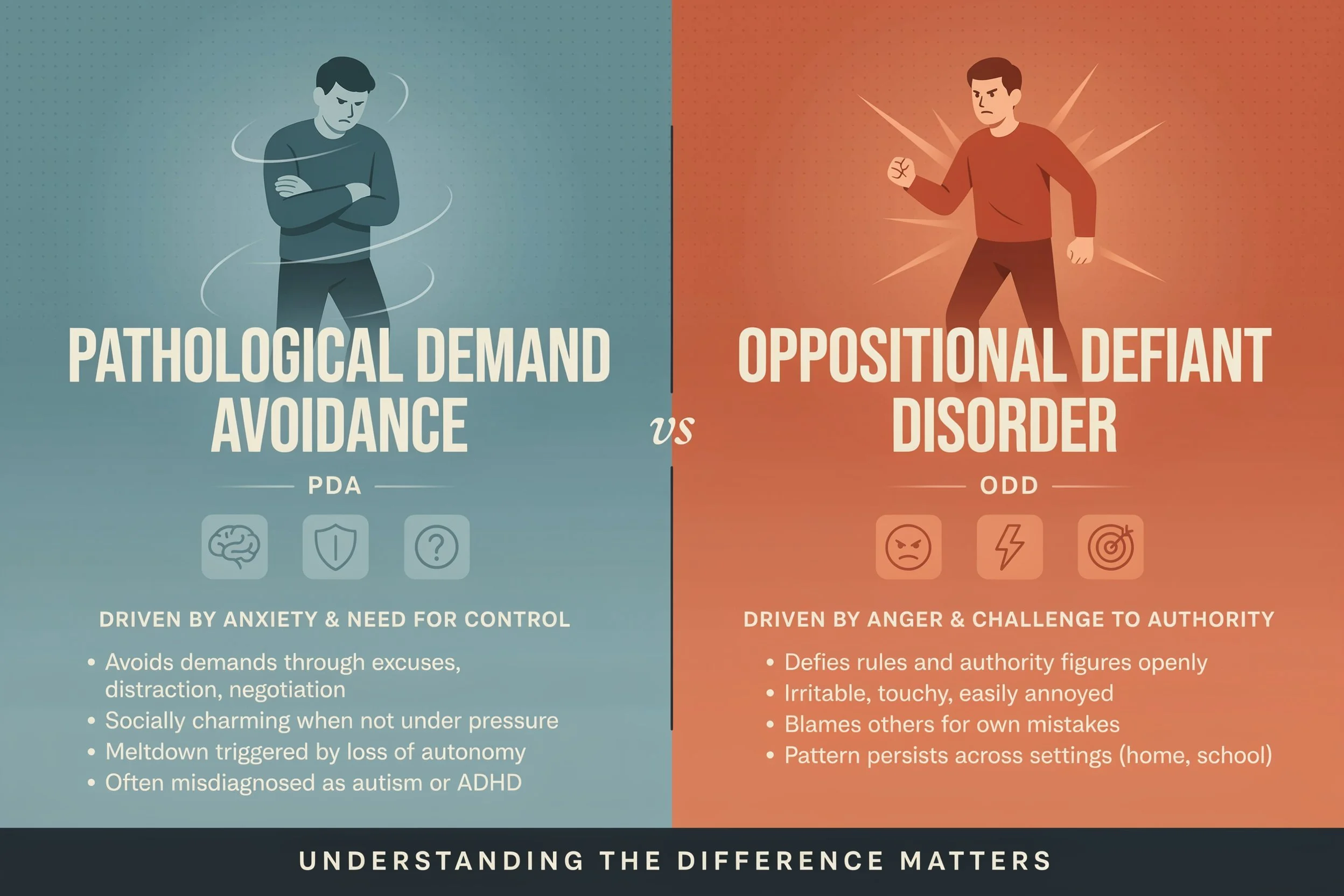
Comparing Pathological demand avoidance and oppositional defiant disorder
Pathological Demand Avoidance vs Oppositional Defiant Disorder: Side by Side
Putting pathological demand avoidance vs oppositional defiant disorder directly next to each other makes the distinction clearer:
Underlying driver: Pathological demand avoidance is driven by anxiety about loss of autonomy and control. Oppositional defiant disorder is driven by a pattern of angry, defiant, and vindictive behavior toward authority.
Target of the behavior: Pathological demand avoidance is triggered by demands themselves, regardless of who is making them or what the demand actually is. Oppositional defiant disorder is typically directed specifically at authority figures and tends to be more relationship-specific.
Response to a desirable demand: A person with pathological demand avoidance may avoid a demand even when the underlying activity is something they genuinely want to do, because the demand itself, not the activity, is the trigger. A person with oppositional defiant disorder is more likely to comply with demands around activities they want to do and resist demands around activities they do not want to do.
Response to choice and autonomy: Pathological demand avoidance significantly improves when autonomy and choice are genuinely increased. Oppositional defiant disorder does not respond to increased autonomy in the same predictable way and often requires consistent structure and boundaries instead.
Social presentation: Pathological demand avoidance frequently involves surface social skills that can appear sophisticated, including the use of social strategies to avoid demands. Oppositional defiant disorder typically does not involve this kind of social camouflaging.
Underlying condition: Pathological demand avoidance is understood as a profile within autism. Oppositional defiant disorder can occur independently or alongside other conditions including ADHD, anxiety disorders, and sometimes autism itself.
Why the Two Get Confused So Often
Pathological demand avoidance vs oppositional defiant disorder gets confused constantly, and there are specific reasons why.
Both profiles involve a child or adult refusing requests, becoming angry when pushed, and pushing back against authority. From a purely behavioral observation standpoint, without understanding what is driving the behavior, the two can look extremely similar in a single moment or even across several incidents.
Many clinicians, teachers, and parents were trained or grew up understanding defiance primarily through a behavioral lens, where resistance to authority is interpreted as a willful choice rather than as a potential symptom of underlying anxiety. This makes oppositional defiant disorder the more familiar, more readily reached-for explanation, even when pathological demand avoidance is actually the more accurate one.
Additionally, pathological demand avoidance is not in the DSM-5, which means clinicians working within strict diagnostic frameworks may default to oppositional defiant disorder simply because it is the available, billable diagnosis, even in cases where the underlying presentation more closely matches pathological demand avoidance.
The Anxiety Question
One of the most useful diagnostic questions in pathological demand avoidance vs oppositional defiant disorder is simply: where is the anxiety, and what is it about?
In pathological demand avoidance, anxiety is central and specific. It is anxiety about loss of control and autonomy, triggered consistently by demands of almost any kind. This anxiety is often visible even during refusal, manifesting as genuine distress rather than calculated defiance.
In oppositional defiant disorder, anxiety may or may not be present as a co-occurring condition, but it is not the defining driver of the oppositional behavior itself. The defiance in ODD is more closely tied to anger, frustration, and a pattern of conflict with authority rather than to an anxiety response specifically about demands and autonomy.
Asking what is actually happening internally in the moments before refusal, panic and overwhelm versus anger and a desire to assert control, often provides one of the clearest signals in distinguishing pathological demand avoidance vs oppositional defiant disorder.
How Each Profile Responds to Discipline
This is one of the most practically important parts of pathological demand avoidance vs oppositional defiant disorder, because the standard advice for ODD can significantly worsen pathological demand avoidance.
Oppositional defiant disorder generally responds, over time and with consistency, to structured behavioral approaches including clear consequences, reward systems, firm and predictable boundaries, and parent training programs designed specifically for ODD.
Pathological demand avoidance typically gets worse, not better, with these same approaches. Increased structure, increased consequences, and increased pressure all raise the demand load, which increases the anxiety driving the avoidance, which increases the avoidance itself. What helps with pathological demand avoidance instead is reducing the experience of external demand, increasing genuine autonomy and choice, and using indirect language rather than direct instruction.
This is exactly why getting pathological demand avoidance vs oppositional defiant disorder right matters so much in practice. Using the wrong framework does not just fail to help. It can create a worsening cycle that becomes increasingly difficult to interrupt.
If this feels personal, Sonia's coaching can help you build practical strategies for social and emotional challenges that fit you.
Can Someone Have Both
Pathological demand avoidance vs oppositional defiant disorder is not always a strict either-or question, and it is worth being honest about that.
It is possible for oppositional defiant disorder to be diagnosed alongside autism, including in individuals who also show pathological demand avoidance features. It is also possible for a child or adult who is actually experiencing pathological demand avoidance to be misdiagnosed with oppositional defiant disorder simply because that was the diagnostic framework available to the clinician at the time.
This is why getting a thorough, autism-informed assessment matters so much when pathological demand avoidance vs oppositional defiant disorder is genuinely unclear. A surface-level behavioral assessment alone is often not enough to distinguish the two accurately.
Getting an Accurate Assessment
Because pathological demand avoidance is not currently in the DSM-5, getting it properly recognized as part of the pathological demand avoidance vs oppositional defiant disorder distinction requires working with a clinician who has specific experience with the profile.
Useful steps include seeking assessment from a clinician with specific autism and PDA experience rather than a general behavioral evaluation alone, using the Extreme Demand Avoidance Questionnaire, a validated tool developed specifically to assess the PDA profile, documenting specific examples of avoidance across multiple settings including home, school, and community, and paying close attention to whether autonomy and choice genuinely reduce the avoidance, which is a strong indicator pointing toward PDA rather than ODD.
For a complete picture of what pathological demand avoidance involves and what genuinely helps, the full post on pathological demand avoidance in autism covers the profile in depth.
What Actually Helps Each Profile
Given everything above, pathological demand avoidance vs oppositional defiant disorder requires genuinely different support strategies.
For oppositional defiant disorder, what generally helps includes parent management training, consistent and predictable consequences, positive reinforcement for cooperative behavior, and family therapy approaches that address communication and conflict patterns within the family system.
For pathological demand avoidance, what generally helps includes reducing the overall demand load wherever possible, framing requests as genuine choices rather than instructions, using indirect and collaborative language, building trust and relationship as the foundation rather than compliance, and creating low-demand recovery periods when anxiety is high.
Getting pathological demand avoidance vs oppositional defiant disorder right is not just an academic exercise. It is the difference between a support plan that genuinely helps and one that actively makes things worse.
Final Thoughts
Pathological demand avoidance vs oppositional defiant disorder is a distinction that genuinely matters, not as an academic exercise but as a practical question that shapes whether the support a child or adult receives actually helps or actively makes things worse.
If the standard approaches to defiance are not working, or are making things significantly worse, pathological demand avoidance is worth seriously considering as the more accurate explanation. Getting the right framework, and the right support that follows from it, can change everything.
References:
Burns R. Is PDA in the DSM? What 'PDA-Style' Demand Avoidance Means [Internet]. ScienceWorks Behavioral Healthcare; 2025 Dec 17. Available from: https://www.scienceworkshealth.com/post/pda-not-in-dsm-what-clinicians-mean-by-pda-style-demand-avoidance
Burns R. PDA vs ODD: How Demand Avoidance Differs from Defiance [Internet]. ScienceWorks Behavioral Healthcare; 2025 Nov 18. Available from: https://www.scienceworkshealth.com/post/pda-anxiety-or-oppositional-making-sense-of-demand-avoidance
Baker S. Extreme Demand Avoidance Questionnaire – Adult (EDA-QA) [Internet]. NovoPsych; 2025 Dec 4. Available from: https://novopsych.com/assessments/autism/extreme-demand-avoidance-questionnaire-adult-eda-qa/
O'Nions E, Gould J, Christie P, Gillberg C, Viding E, Happé F. Identifying features of 'pathological demand avoidance' using the Diagnostic Interview for Social and Communication Disorders (DISCO). Eur Child Adolesc Psychiatry. 2015;25:407-419. Available from: https://doi.org/10.1007/s00787-015-0740-2