
Pathological demand avoidance in autism is one of the most misunderstood and underdiagnosed presentations on the autism spectrum. If you are a parent watching your child melt down over the simplest request, or an autistic adult who has spent years wondering why ordinary expectations feel physically impossible to meet, pathological demand avoidance in autism may be the framework that finally makes sense of what you have been experiencing.
This post covers everything you need to know about pathological demand avoidance in autism, from what it actually is, to how it presents, how it is identified, and what actually helps.
Table of Contents
What Is Pathological Demand Avoidance in Autism
Where the Term Comes From
How Pathological Demand Avoidance in Autism Differs From Typical Autism Presentations
Signs of Pathological Demand Avoidance in Autism in Children
Signs of Pathological Demand Avoidance in Autism in Adults
What Drives Pathological Demand Avoidance in Autism
How Pathological Demand Avoidance in Autism Is Identified
What Does Not Work and Why
What Actually Helps With Pathological Demand Avoidance in Autism
Pathological Demand Avoidance in Autism at School
How This Connects to Profound Autism and Autism Levels
The Role of Coaching and Support
FAQs
Final Thoughts
What Is Pathological Demand Avoidance in Autism
Pathological demand avoidance in autism is a profile of autism characterized by an extreme and pervasive drive to avoid everyday demands and expectations. The avoidance is not willful defiance. It is not laziness. It is not a parenting problem. It is an anxiety-driven neurological response to perceived loss of control and autonomy.
People with pathological demand avoidance in autism experience ordinary demands, getting dressed, eating breakfast, answering a question, going to school, as genuine threats to their sense of safety and autonomy. Their nervous system responds to these demands the way most people's nervous systems respond to actual danger. The fight, flight, or freeze response activates. And from that activated state, compliance feels neurologically impossible rather than simply undesirable.
Understanding pathological demand avoidance in autism starts with understanding that the word pathological here does not mean the person is broken or disordered in a moral sense. It means the demand avoidance is pervasive enough to significantly affect daily functioning across all environments. It is descriptive, not judgmental.
Where the Term Comes From
The term pathological demand avoidance in autism was first introduced by British psychologist Elizabeth Newson in the 1980s following her clinical observations of a group of children who did not fit neatly into existing autism diagnostic categories but shared a distinctive profile of extreme demand avoidance, surface sociability masking significant social difficulties, and a strong need to control their environment and the people in it.
Newson proposed pathological demand avoidance as a separate profile within the autism spectrum rather than a separate condition entirely. Her work has been built upon by researchers and clinicians in the UK, where pathological demand avoidance in autism is more widely recognized than in the United States.
It is worth noting that pathological demand avoidance in autism is not currently in the DSM-5, the diagnostic manual used in the US. This means it is not a formal diagnosis American clinicians can give. However, awareness of pathological demand avoidance in autism is growing in the US clinical community, and many clinicians are becoming more familiar with the profile even if they cannot formally diagnose it under that name.
How Pathological Demand Avoidance in Autism Differs From Typical Autism Presentations
Pathological demand avoidance in autism shares core features with other autism presentations but differs in several important ways that affect how support needs to be delivered.
Similarities with other autism presentations:
Social communication differences
Sensory sensitivities
Need for predictability and routine
Anxiety as a significant co-occurring feature
Difficulty with transitions
What makes pathological demand avoidance in autism distinct:
The demand avoidance is the central and most impairing feature, more so than social communication differences
People with pathological demand avoidance in autism often have better surface social skills than many autistic people, making the profile harder to spot
The avoidance strategies are highly varied, creative, and often socially manipulative in appearance, including distraction, negotiation, physical incapacity, and fantasy
Standard autism interventions, particularly those based on structure, compliance, and reward systems, often make pathological demand avoidance in autism worse rather than better
The anxiety driving pathological demand avoidance in autism is specifically triggered by demands and perceived loss of autonomy, not just by sensory or social overload
This distinction matters enormously for support. An autistic child without the pathological demand avoidance in autism profile may respond well to structured routines and clear expectations. A child with pathological demand avoidance in autism may become significantly more dysregulated by the same approach.
Signs of Pathological Demand Avoidance in Autism in Children
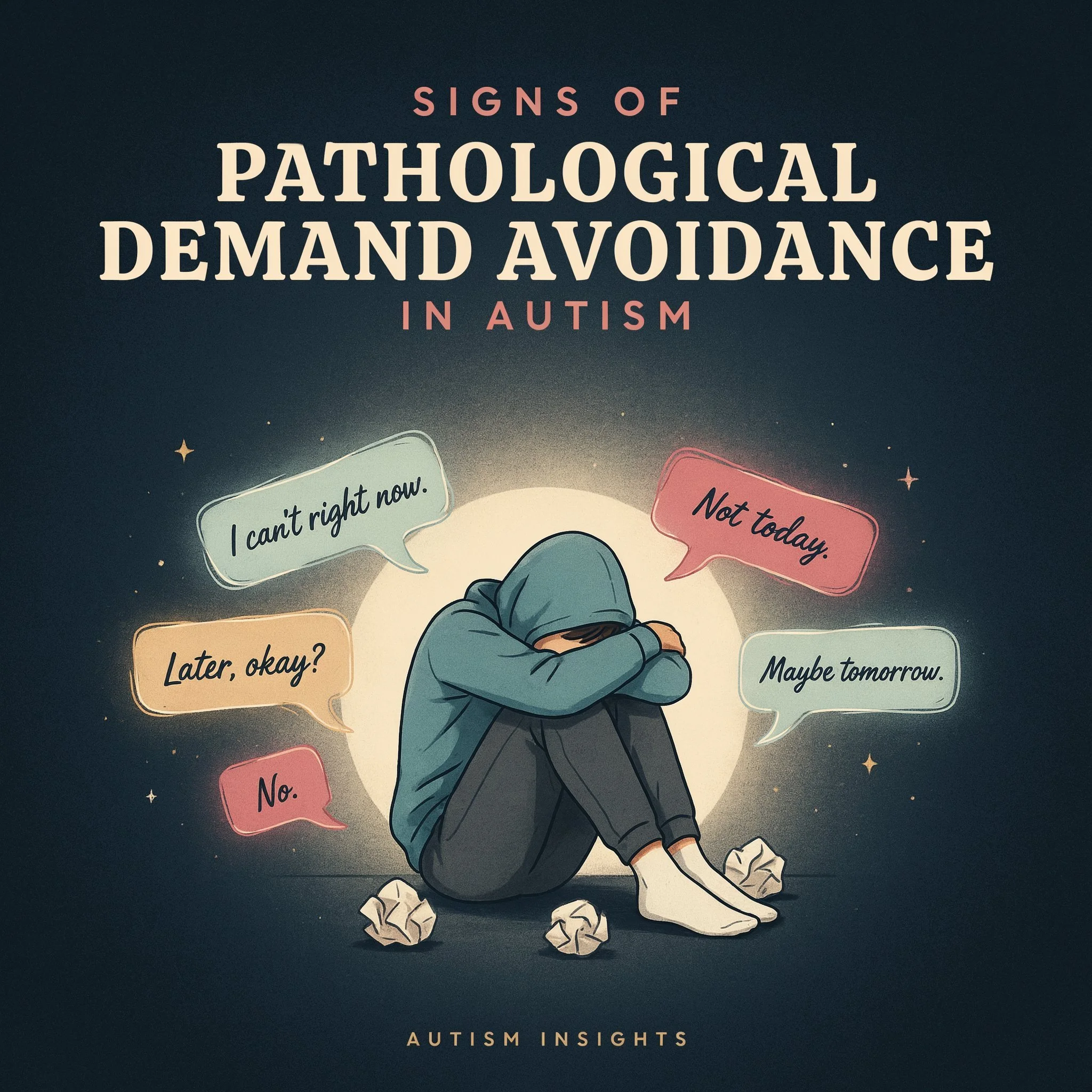
Recognizing pathological demand avoidance in autism in children is the first step toward getting them the right support. Here is what it commonly looks like:
Demand avoidance patterns:
Refusing or avoiding everyday tasks even ones the child enjoys or has done willingly before
Using creative strategies to avoid demands including distraction, negotiation, delay, and fantasy
Appearing not to hear instructions or suddenly becoming physically incapable
Intense resistance that escalates rapidly when pressure is applied
Control and autonomy:
Extreme need to be in control of their environment, activities, and interactions
Difficulty tolerating other people making decisions that affect them
May attempt to control others including parents, teachers, and peers
Strong reaction to perceived unfairness or being told what to do
Social presentation:
Often more socially aware and socially skilled on the surface than many autistic children
Can appear charming and engaging in low demand situations
Social difficulties become more visible under pressure or when demands are made
May use social skills strategically to avoid demands
Emotional regulation:
Extreme and rapid mood changes particularly in response to demands
Meltdowns that seem disproportionate to the triggering situation
High levels of anxiety that may not always be visible until a threshold is crossed
Difficulty recovering from dysregulation
Identity and fantasy:
Strong engagement with fantasy and role play sometimes used as a demand avoidance strategy
May inhabit characters or personas as a way of managing anxiety
Sense of identity can be fluid and variable
Signs of Pathological Demand Avoidance in Autism in Adults
Pathological demand avoidance in autism in adults often looks different from the childhood presentation because adults have developed more sophisticated strategies for managing their demand avoidance, often at significant personal cost.
Common presentations in adults:
Chronic difficulty maintaining employment because workplace demands trigger overwhelming anxiety
History of burnout from sustained effort to comply with demands over time
Difficulty with relationships because the implicit demands of intimacy and partnership feel overwhelming
Procrastination that goes far beyond typical avoidance and significantly affects daily functioning
Physical symptoms that emerge when demand load becomes too high, including fatigue, pain, and illness
Intense relief when demands are removed and intense dread when they return
A history of being told they are capable of more than they produce, creating significant shame
Many autistic adults who eventually learn about pathological demand avoidance in autism describe it as the first framework that explains a lifetime of experiences that nothing else adequately captured.
What Drives Pathological Demand Avoidance in Autism
Understanding what is actually happening neurologically in pathological demand avoidance in autism helps both parents and autistic individuals approach it with more compassion and more effective strategies.
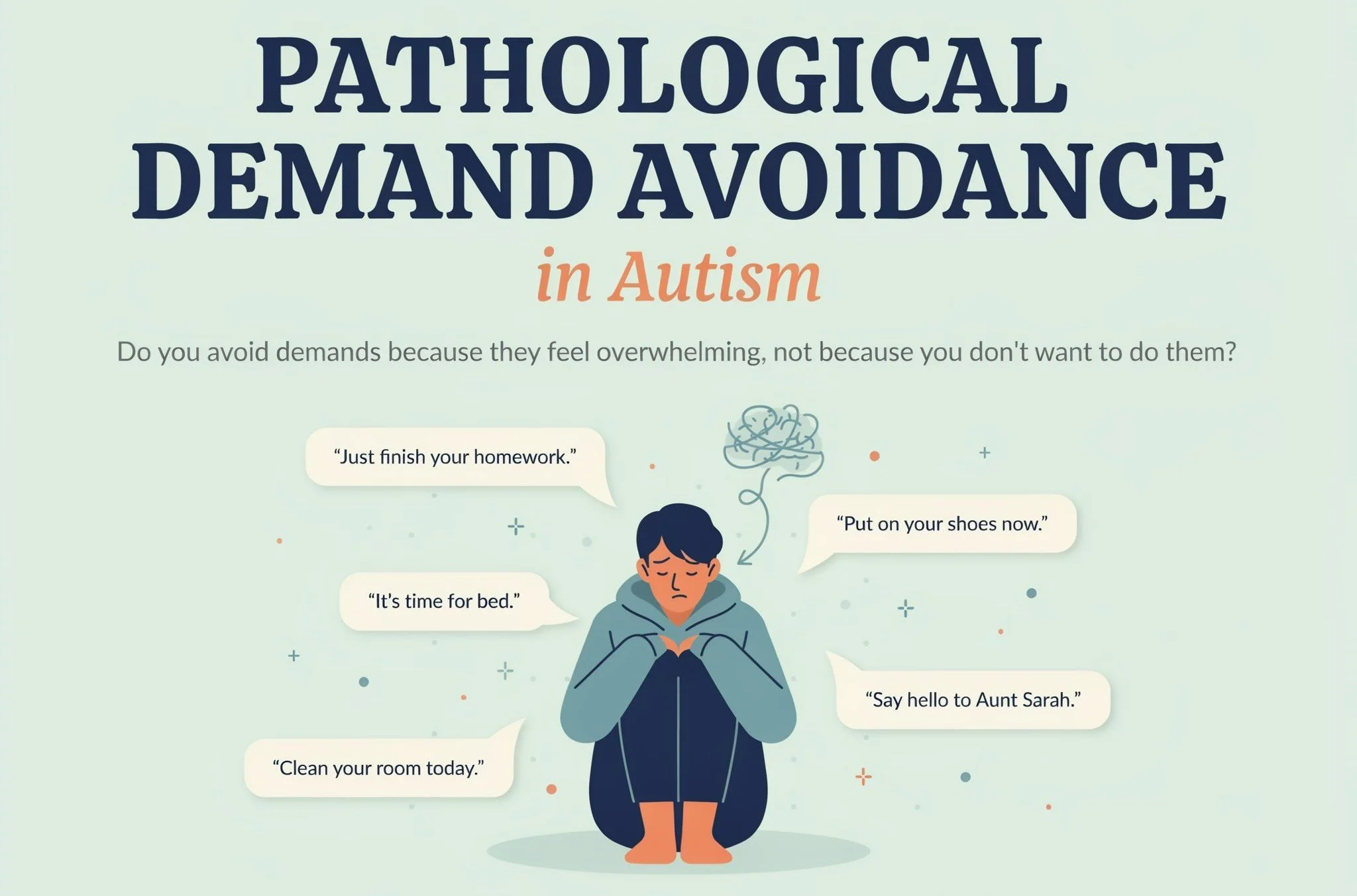
The core driver of pathological demand avoidance in autism is anxiety, specifically anxiety about loss of autonomy and control. When a demand is made, the nervous system of a person with pathological demand avoidance in autism interprets it as a threat. Not a mild inconvenience or a minor frustration but a genuine threat that triggers the survival response.
From inside that threat response, compliance is not a choice that is being refused. It is a response that is neurologically unavailable. The brain is in survival mode. Survival mode and compliance are incompatible states.
This is why punishment, pressure, and reward-based systems so often fail with pathological demand avoidance in autism. They increase the demand load and therefore increase the anxiety, which makes the avoidance more extreme rather than less. The person is not being manipulative or oppositional. They are dysregulated.
What reduces the demand avoidance is reducing the anxiety. And what reduces the anxiety is increasing the sense of autonomy, safety, and control.
PDA in Autism
How Pathological Demand Avoidance in Autism Is Identified
Because pathological demand avoidance in autism is not in the DSM-5, getting it formally recognized in the US requires working with a clinician who is familiar with the profile.
Steps toward identification:
Seek assessment from a clinician who has specific experience with autism and who is familiar with pathological demand avoidance in autism as a profile
Request a comprehensive assessment that goes beyond the standard autism diagnostic tools to include detailed developmental history and behavioral observation
Use the Extreme Demand Avoidance Questionnaire, known as the EDA-Q, which is a validated tool developed specifically to assess the pathological demand avoidance in autism profile
Document specific examples of demand avoidance across different settings, home, school, community, to show the pervasive nature of the profile
Connect with clinicians and researchers in the UK where pathological demand avoidance in autism is more widely recognized and more clinical guidance is available
The Role of Coaching and Support
Living with pathological demand avoidance in autism, whether as the person who has it or as their parent or caregiver, is genuinely demanding in ways that most people around you will not fully understand.
For autistic adults with pathological demand avoidance in autism, the shame and confusion that comes from a lifetime of being told you are capable of more than you produce is one of the most significant things to work through. Understanding that the avoidance is neurologically driven rather than a character flaw is often the beginning of a profound shift in self-perception.
For parents, the grief and exhaustion of navigating a profile that most systems are not designed for, and that most professionals do not understand, is real and accumulating.
Both of these experiences deserve skilled, informed support.
Sonia's socio-emotional coaching works specifically with neurodivergent individuals on navigating the social and emotional landscape that pathological demand avoidance in autism creates, including how to communicate needs, build relationships that accommodate the profile, and develop strategies that work with the nervous system rather than against it.
What Does Not Work and Why
This section is important because many families with a child showing pathological demand avoidance in autism spend years trying approaches that make things worse before finding ones that help.
Approaches that typically worsen pathological demand avoidance in autism:
Strict behavioral programs based on compliance, reward, and consequence
Increasing structure and routine in response to avoidance
Applying more pressure when demands are refused
Using token economies or sticker charts that make demands more explicit
Issuing ultimatums or consequences for non-compliance
Trying to out-wait or outlast the avoidance
All of these approaches increase the sense of external control and therefore increase the anxiety driving the pathological demand avoidance in autism. They may produce short-term compliance in some children but they almost always increase the overall demand avoidance over time and significantly increase the risk of autistic burnout.
Also, reading books on Autism especially a lived experience is a way to navigation easier.
What Actually Helps With Pathological Demand Avoidance in Autism
The approaches that genuinely help with pathological demand avoidance in autism share a common thread: they reduce the perception of external demand and increase the sense of autonomy and collaboration.
At home:
Frame requests as choices rather than demands wherever possible
Reduce the number of direct demands in a day to the minimum necessary
Use indirect language, wondering out loud rather than instructing
Offer genuine choices about how and when tasks get done rather than whether they get done
Build relationship and trust as the foundation rather than compliance
Allow the child to lead activities regularly so they experience genuine control
Use humor, play, and indirection to reduce the felt demand of necessary tasks
Reduce the overall anxiety load by creating a low demand environment during recovery periods
What this looks like in practice:
Instead of: get your shoes on, we are leaving in five minutes. Try: I wonder if anyone around here has shoes that need to go on before we head out.
Instead of: you need to eat your dinner. Try: dinner is on the table whenever you are ready. What would you like to start with?
The goal is not to remove all demands from life. It is to reduce the experience of external imposition enough that the nervous system can stay regulated enough to participate.
Pathological Demand Avoidance in Autism at School
School is often the environment where pathological demand avoidance in autism is most visible and most challenging because school is fundamentally a high demand environment.
What schools need to understand about pathological demand avoidance in autism:
Standard behavior management approaches are likely to make things significantly worse
Reducing demands and increasing autonomy is not rewarding bad behavior, it is meeting a genuine neurological need
The child is not being defiant. They are dysregulated
Flexibility, relationship-based approaches, and genuine collaboration produce better outcomes than structure and compliance
What to advocate for in an IEP for a child with pathological demand avoidance in autism:
A low demand curriculum delivery approach
Flexibility around when and how tasks are completed
Genuine choice and agency built into the school day
A trusted key adult who can support regulation
Reduced whole-class participation requirements
A quiet withdrawal space available on demand
Staff trained specifically in pathological demand avoidance in autism approaches
FAQs
Is pathological demand avoidance in autism an official diagnosis in the US?
No. It is not in the DSM-5 but awareness among US clinicians is growing.
Is pathological demand avoidance in autism the same as oppositional defiant disorder?
No. ODD is behaviorally driven while pathological demand avoidance in autism is anxiety-driven and neurological in origin.
Can girls have pathological demand avoidance in autism?
Yes. Pathological demand avoidance in autism appears to affect girls at higher rates than other autism profiles and is frequently missed or misdiagnosed.
Does pathological demand avoidance in autism get better with age? With the right support and environment it can become more manageable but the underlying neurological profile does not disappear.
Should I tell my child's school about pathological demand avoidance in autism? Yes. Understanding the profile helps schools implement the right approaches and avoid the ones that make things worse.
Final Thoughts
Pathological demand avoidance in autism is not a behavior problem. It is not a discipline failure. It is not something that more consistency or firmer boundaries will fix.
It is a neurological profile in which the experience of demands triggers a genuine threat response that makes compliance neurologically unavailable rather than simply undesirable. Understanding pathological demand avoidance in autism at that level changes everything about how you respond to it, whether you are the person living with it or the parent, teacher, or clinician trying to support someone who is.
The right support for pathological demand avoidance in autism looks different from standard autism support. It prioritizes autonomy over compliance, relationship over structure, and nervous system regulation over behavioral management. When those conditions are in place, people with pathological demand avoidance in autism can and do thrive.
They just need the world to stop treating their neurology as a problem to be overcome and start treating it as a difference to be understood.
Listen to the On the Spectrum podcast with Sonia here for more honest, informed conversations about neurodivergent profiles, mental health, and what genuine support looks like.
References:
Wikipedia. Elizabeth Newson [Internet]. Last edited 2024. https://en.wikipedia.org/wiki/Elizabeth_Newson
Cleveland Clinic. DSM-5: What It Is & What It Diagnoses [Internet]. Last updated October 14, 2022. https://my.clevelandclinic.org/health/articles/24291-diagnostic-and-statistical-manual-dsm-5
