
How to Find an Autism Specialist in Your Area: A Guide
Finding the right autism specialist feels straightforward until you actually try to do it. Then comes the waiting lists, the confusing job titles, the referrals that go nowhere, and the growing sense that the system was not designed with your family in mind.
The truth is, finding the right support for your autistic child takes time, patience, and knowing what to look for before you start. Most parents figure this out by trial and error. This post exists so you do not have to.
Whether your child was recently diagnosed or you are revisiting their support plan because something is not working, this guide walks through exactly how to find the right autism specialist, what each type of professional actually does, and what to do when the usual routes are not enough.
Table of Contents
Start With a Clear Picture of What Your Child Needs
Understanding the Different Types of Autism Specialists
How to Find Autism Specialists in the UK
How to Find Autism Specialists in the US
What to Look for When Choosing a Specialist
Questions to Ask Before You Commit
When Traditional Routes Are Not Enough: Coaching as a Support Option
Socio-Emotional and Self-Esteem Coaching With Sonia Chand
Final Thoughts
Start With a Clear Picture of What Your Child Needs
Before searching for a specialist, it helps to get specific about what you are actually looking for. Autism support is not one size fits all and the right specialist for one child may not be the right fit for another.
Start by asking yourself these questions:
What is my child struggling with most right now?
Is the main challenge communication, sensory processing, behaviour, emotional regulation, or social connection?
Has my child already been diagnosed or are we still in the assessment stage?
What has already been tried and what has not worked?
Am I looking for clinical therapy, practical coaching, school support, or a combination?
Writing down the answers before you start making calls or filling in referral forms will save you a significant amount of time. It will also help you communicate your child's needs clearly to professionals who are seeing them for the first time.
The more specific you can be about what support you need, the faster you will find the right person to provide it.
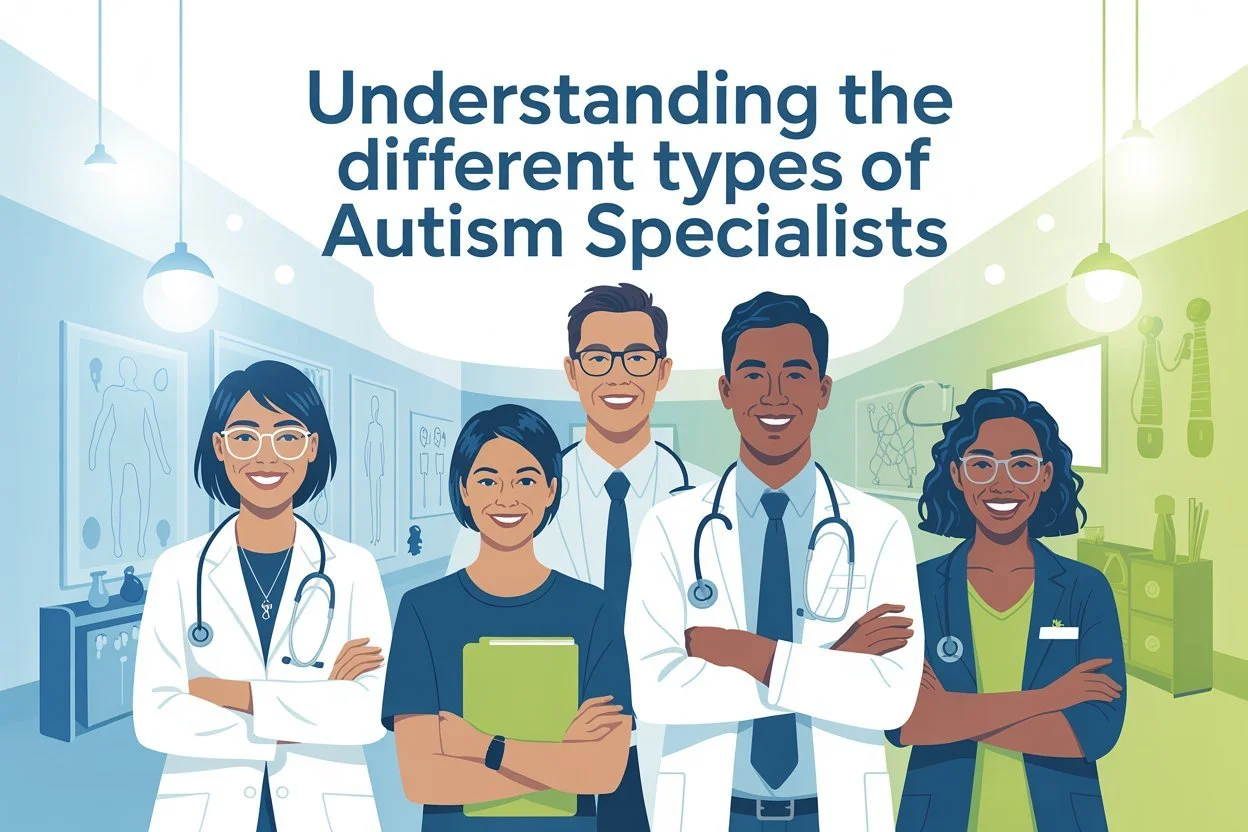
Understanding the Different Types of Autism Specialists
One of the most confusing parts of navigating autism support is the sheer number of professional titles. Here is a plain language breakdown of who does what:
Developmental Paediatrician
A medical doctor who specialises in child development. Often involved in the initial diagnosis and ongoing medical monitoring. Your first point of contact if you are still in the assessment stage.
Child Psychologist or Clinical Psychologist
Assesses and supports emotional, behavioural, and cognitive development. Can provide therapy for anxiety, emotional regulation, and mental health challenges that often accompany autism.
Speech and Language Therapist
Works on communication, both verbal and nonverbal, as well as the social use of language. Particularly important for children who are nonverbal, have limited speech, or struggle with conversation and social communication.
Occupational Therapist
Supports sensory processing, fine motor skills, and daily living tasks. Helps children manage sensory sensitivities and develop the practical skills needed for school and home life.
Behaviour Analyst or ABA Therapist
Specialises in Applied Behaviour Analysis, a structured approach to building skills and reducing challenging behaviours. This type of therapy is widely used but also debated within the autism community, so it is worth researching thoroughly before committing.
Educational Psychologist
Focuses specifically on learning and how to support a child in an educational setting. Often involved in the process of getting an Education, Health and Care Plan in the UK or an IEP in the US.
Autism Coach or Specialist Coach
Works outside the clinical framework to support individuals and families with practical strategies, emotional regulation, social skills, and confidence building. Particularly valuable when clinical waiting lists are long or when a child needs ongoing personalised support beyond what therapy sessions provide.
How to Find Autism Specialists in the US
In the US, the route to finding autism support depends on your child's age, your insurance, and your state. Here is where to start:
Talk to your paediatrician
Ask for a referral to a developmental paediatrician or a child neurologist who can conduct or coordinate a full autism evaluation.
Contact your state's early intervention programme
For children under three, early intervention services are available in every state and are free regardless of income. These services can include speech therapy, occupational therapy, and developmental support.
Request an evaluation through your school district
Under the Individuals with Disabilities Education Act, known as IDEA, every child has the right to a free and appropriate public education. Schools are required to evaluate children suspected of having a disability at no cost to parents.
Use the Autism Speaks Resource Guide
At autismspeaks.org to search for specialists, therapy providers, and support organisations by zip code. It is one of the most comprehensive directories available to US families.
Check your insurance coverage
Most states now require insurance plans to cover autism-related therapies including ABA, speech therapy, and occupational therapy. Contact your insurance provider directly to understand what is covered and how to access it.
What to Look for When Choosing a Specialist
Once you have a list of potential specialists, the next step is knowing how to evaluate them. Qualifications matter, but they are not the only thing that matters.
Look for someone who:
Has specific experience working with autistic children, not just general child development experience
Takes a neurodiversity affirming approach, meaning they support your child's differences rather than trying to eliminate them
Communicates clearly with parents and keeps you involved in the process
Listens to your child and adapts their approach based on what works
Has a clear framework for measuring progress that goes beyond surface level behaviour
Be cautious of anyone who:
Promises rapid results or guaranteed outcomes
Focuses exclusively on making your child appear more neurotypical
Dismisses your concerns or talks over your knowledge of your own child
Uses punishment-based approaches or relies on distress as a motivator
Trust your instincts. You know your child better than any specialist does. The right professional will make you feel like a partner in the process, not a bystander.
For a broader understanding of what genuinely supportive autism care looks like, the post on autism awareness vs autism acceptance explains why the approach a specialist takes matters just as much as their credentials.

Questions to ask
Questions to Ask Before You Commit
Before starting with any new specialist, ask these questions directly:
What is your specific experience with autistic children at my child's age and support level?
What approach do you use and why?
How do you involve parents in the process?
How do you measure progress and how often will we review it?
What does a typical session look like for a child like mine?
What happens if the approach is not working?
Are you familiar with the current thinking around neurodiversity and autistic identity?
The answers will tell you a great deal about whether this is someone who will genuinely support your child or simply go through the clinical motions.
When Traditional Routes Are Not Enough: Coaching as a Support Option
Clinical therapy is essential for many autistic children. But it does not cover everything. Therapy sessions are typically short, infrequent, and focused on specific clinical goals. What many autistic children and their families also need is ongoing, personalised support that addresses the everyday challenges that do not fit neatly into a therapy framework.
This is where coaching comes in.
Coaching sits alongside clinical support rather than replacing it. It is particularly valuable for:
Autistic children and young people who struggle with social interactions and do not know how to navigate friendships, group settings, or school dynamics
Children who have the language and cognitive ability to engage in conversation but lack the emotional tools to manage relationships and regulate their responses
Young people whose confidence has been eroded by years of feeling different, misunderstood, or left out
Families who need practical, personalised guidance to implement strategies at home that actually work for their specific child
The right coach does not work from a generic template. They meet the child where they are, build on their strengths, and give them tools they can use in real situations, not just in a therapy room.
Socio-Emotional and Self-Esteem Coaching With Sonia Chand
Sonia Chand is a licensed psychotherapist offering specialised coaching services designed specifically for neurodivergent individuals and the families who support them.
There are two core coaching services available:
Socio-Emotional Coaching
Many autistic children understand the world in deep and meaningful ways but struggle to navigate the social landscape around them. They find friendships confusing, group dynamics overwhelming, and social rules that seem obvious to others completely invisible to them.
Socio-emotional coaching addresses exactly this. Working directly with the individual, Sonia provides practical, personalized guidance on navigating social interactions, building meaningful connections, and developing the emotional literacy that helps autistic people understand and express what they are feeling. The goal is not to make an autistic person behave like a neurotypical one. The goal is to give them a genuine toolkit for the world they are actually living in.
Self-Esteem Coaching
Years of feeling different, being corrected, struggling in environments not designed for them, and watching peers move through the world with what looks like ease can take a serious toll on an autistic child's sense of self. By the time many autistic young people reach adolescence, their confidence has taken significant hits that no amount of academic achievement or therapy alone can fully address.
Self-esteem coaching works on the inside. It helps autistic individuals reconnect with their strengths, challenge the narratives they have built about themselves, and develop a stable, grounded sense of who they are regardless of how the world around them responds.
Both services are available for neurodivergent individuals and are delivered with the practical, empathetic approach that comes from being both a licensed psychotherapist and someone who has navigated the autism journey personally.
Book a socio-emotional or self-esteem coaching session with Sonia here and give your child the tools to truly thrive.
Final Thoughts
Finding the right autism specialist is rarely quick and rarely straightforward. The system in both the UK and the US was not built for ease of navigation, and the waiting times alone can feel demoralizing when your child needs support now.
But the right support exists. The right people are out there. And knowing what to look for, what questions to ask, and where to search puts you in a far stronger position than most parents have when they start this process.
Go in informed. Go in with a clear picture of your child's specific needs. And do not be afraid to keep looking until you find the professional who genuinely gets your child and works with you as a partner.
Your child deserves that. And so do you.