
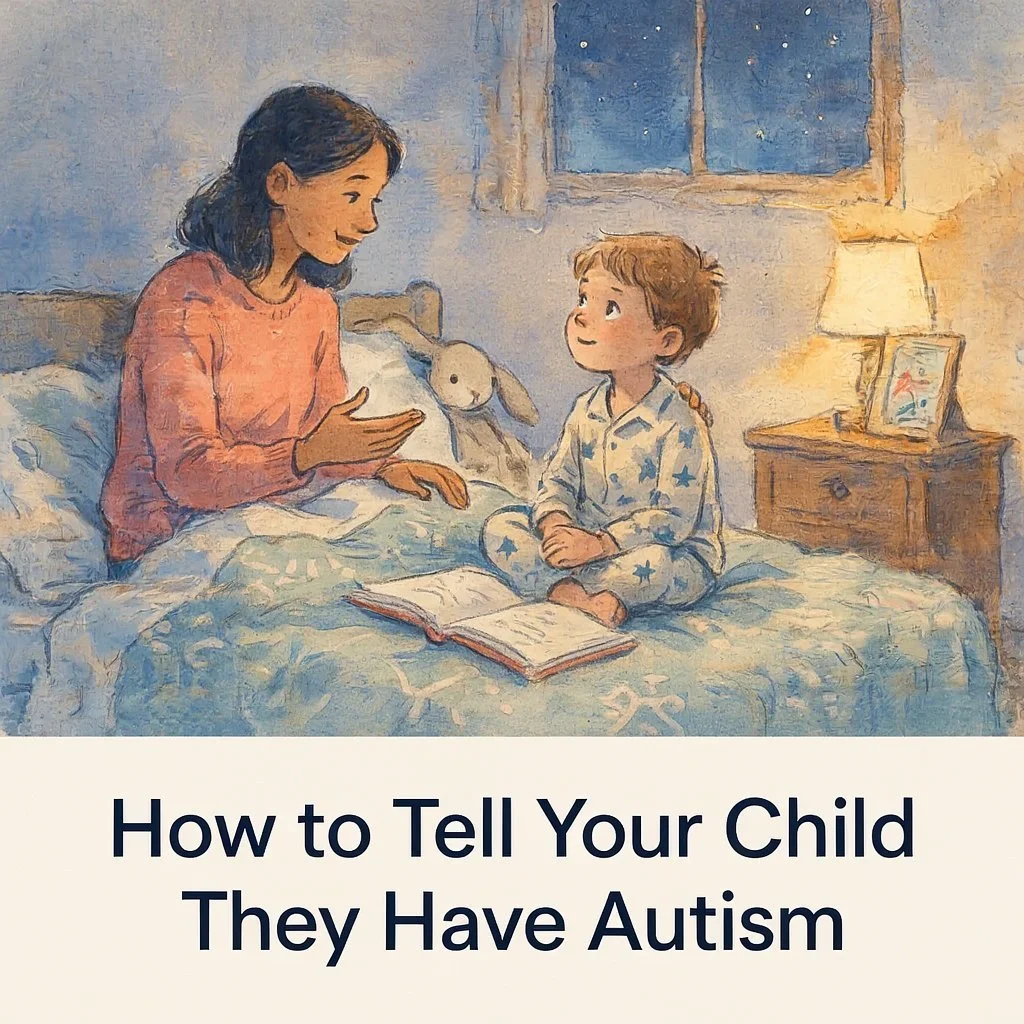
How to Tell Your Child They Have Autism
How to tell your child they have autism is one of the most emotionally loaded questions a parent faces after a diagnosis. You have processed your own feelings, or you are still in the middle of processing them, and now you are trying to figure out how to hand this information to your child in a way that helps rather than harms.
How to tell your child they have autism is not a conversation that has one right script. But it does have principles that consistently produce better outcomes than the alternatives, and understanding those principles before you sit down with your child makes an enormous practical difference to how the conversation goes and what your child takes from it.
This post covers when to tell your child, how to frame the conversation at different ages, what language to use, what to avoid, and how to keep the conversation going long after the first disclosure.
Table of Contents
Should You Tell Your Child They Have Autism?
When Is the Right Time to Tell Your Child They Have Autism?
How to Tell Your Child They Have Autism: The Core Principles
How to Tell Your Child They Have Autism at Different Ages
What Language to Use and What to Avoid
How to Frame Autism as a Difference Not a Deficit
What to Do When Your Child Reacts With Distress
Keeping the Conversation Going After the First Disclosure
Final Thoughts
References
Should You Tell Your Child They Have Autism?
Before addressing how to tell your child they have autism, it is worth addressing the question that sits behind it for many parents: should you tell them at all?
The answer from both research and from the autistic community is consistently and clearly yes. Autistic children who are told about their diagnosis early and in a supportive, affirming way consistently fare better than those who are not told or who find out accidentally or later in life.
The reasons are practical and emotional. An autistic child who does not know they are autistic still experiences the world as harder to navigate than it appears to be for everyone else. They still feel the social friction, the sensory overload, the confusion about why things that seem easy for peers feel so difficult for them. Without the autism framework, the story they tell themselves about why this is happening is almost always some version of: something is wrong with me. I am broken. I am not trying hard enough.
Telling your child they have autism replaces that damaging internal narrative with an accurate one. It gives them language for their experience. It explains why certain strategies help them and others do not. And it opens the door to a community of people who understand their experience from the inside.
The question is never really whether to tell. It is how to tell your child they have autism in a way that serves them well.
When Is the Right Time to Tell Your Child They Have Autism?
Most autism experts and advocates agree that earlier is better, and that there is no minimum age at which the conversation becomes appropriate. The way you have the conversation changes significantly with age, but the principle of honest, age-appropriate disclosure applies from the earliest years.
Many developmental psychologists and autism specialists recommend that parents begin using autism-related language naturally from the point of diagnosis, so that the word autism is never a shocking revelation but simply a familiar part of the family's vocabulary around how the child experiences the world.
Research has it that autistic individuals who were told about their diagnosis earlier in childhood reported better psychological adjustment and more positive autism identity as adults than those who found out later. The earlier the disclosure, within an affirming and supportive family context, the better the long-term outcomes.
The worst time to tell your child they have autism is when they find out accidentally, through overhearing a conversation, reading a document, or being told by someone other than their parents. Accidental disclosure removes the parent's ability to frame the information supportively and is associated with significantly more negative emotional responses.
How to Tell Your Child They Have Autism: The Core Principles
However old your child is when you have this conversation, these core principles apply consistently.
Lead with the positive: The first thing your child should hear is not that something is wrong with them. It is that their brain works differently, and that that difference explains a lot of things they have already noticed about themselves. Start from strength, not deficit.
Be honest and simple: Use clear, direct language that matches your child's developmental level. Do not hedge or use so many qualifications that the core message gets lost. Autism is a word that describes how your brain is wired. That is the message.
Make it a conversation, not a lecture: How to tell your child they have autism is not a presentation you deliver. It is a conversation you start. Ask what they already know. Ask what they have noticed about themselves. Let their questions guide where the conversation goes.
Normalize it: Make clear that autism is not something to be ashamed of, not something that defines their worth, and not something that limits what they can do or become. Many people are autistic. Famous scientists, artists, athletes, and thinkers are autistic. Their brain is a good brain that works differently.
Keep the door open: The first conversation about how to tell your child they have autism is not the last one. It is the beginning of an ongoing dialogue that will evolve as your child grows and their understanding deepens.
How to Tell Your Child They Have Autism at Different Ages
Toddlers and preschoolers (ages 2 to 5): At this age, abstract explanations are less effective than concrete, sensory-based language. You might say something like: your brain notices sounds really loudly, and that is just how your brain works. Or: some things are harder for your brain and some things your brain is really brilliant at. Use picture books about brain differences and neurodiversity. The word autism can be introduced simply and without drama, as one word among many that describe who they are.
Early school age (ages 6 to 10): Children at this age are beginning to notice more clearly that they are different from peers, and often the autism conversation comes in response to their own questions about why. How to tell your child they have autism at this age involves being more explicit about what autism means, why certain things are harder, and why certain supports are in place. Use analogies: every brain has its own operating system. Yours runs on a different one than most people's, and that means some things work differently.
Tweens (ages 10 to 12): At this age, identity is becoming more salient and the stakes of the autism conversation increase. Your child is more likely to have complex emotional responses including relief, anger, grief, or resistance. How to tell your child they have autism at this age needs to make space for all of those responses without rushing toward a tidy resolution. Acknowledge that it is a lot to take in. Answer questions honestly. Connect them with autistic role models and community.
Teenagers: Adolescence is the most complicated time for autism disclosure because identity, peer relationships, and self-concept are all in flux simultaneously. If your teenager does not already know, they have almost certainly already sensed their difference and may have built up significant shame or confusion around it. How to tell your child they have autism as a teenager requires particular sensitivity to the narrative they have already constructed about themselves and a willingness to sit with their emotional response without trying to fix it immediately.
What Language to Use and What to Avoid
Language that helps:
Your brain is wired differently, and that is why some things feel harder and some things you are exceptionally good at
Autism is the name for how your brain works
Lots of brilliant, creative, interesting people are autistic
This explains why certain environments feel overwhelming and why certain strategies help you
Being autistic is part of who you are, not something wrong with you
Language to avoid:
You have a disorder
There is something wrong with your brain
You are different in a bad way
This is why you struggle
You need to try harder to be like other children
The language you use when figuring out how to tell your child they have autism shapes the internal narrative they build about themselves. Choose words that build identity rather than erode it.
How to Frame Autism as a Difference Not a Deficit
One of the most important aspects of how to tell your child they have autism is the frame you use to present what autism means.
The deficit frame says: you have autism, which means you have difficulties with social communication, sensory processing, and flexible thinking. These are challenges you will need to work on.
The difference frame says: you have autism, which means your brain processes the world differently. That means some things are harder in environments designed for neurotypical brains. It also means some things come more naturally to you than to most people, including depth of focus, attention to detail, and the ability to pursue things you care about with extraordinary commitment.
Both frames are accurate. But the difference frame produces better self-concept, better mental health, and better long-term outcomes. It is also more honest, because autism genuinely does involve both challenges and strengths, and presenting only the challenges is an incomplete picture.
For a deeper understanding of why the language and frame around autism matter so profoundly, the post onautism awareness vs autism acceptance explores this in full and is worth reading alongside this one as you prepare for the conversation with your child.
Preparing for this conversation while also navigating your own emotional response to the diagnosis is genuinely complex, and having skilled, informed support alongside that process makes a real difference.
Book a coaching session with Sonia here and get the support that helps you have this conversation from a place of clarity, confidence, and genuine acceptance.
What to Do When Your Child Reacts With Distress
Not every child responds to the autism disclosure with immediate acceptance or relief. Some children respond with grief, anger, denial, or intense distress. All of these responses are valid and none of them mean you did anything wrong.
When your child responds with distress:
Stay present and calm without rushing to fix the feeling
Validate the emotion without reinforcing a negative framing of autism
Avoid minimizing: it is not that bad is not helpful, but neither is catastrophizing alongside them
Give them time and space to process before continuing the conversation
Connect them with other autistic children or adults whose lived experience reflects what is possible
The distress is almost never really about the word autism. It is about the fear of what the word means for their future, their relationships, and how other people will see them. Addressing those fears directly and honestly, with genuine reassurance grounded in reality rather than false promises, is the most effective response.
Keeping the Conversation Going After the First Disclosure
How to tell your child they have autism is really a question about how to begin a lifelong conversation rather than how to have a single defining moment. The first disclosure is important, but what happens after it matters just as much.
Keep autism a normal part of family conversation. Reference it when it is relevant, not as a label that explains every difficulty but as a context that explains specific experiences. Allow your child to bring it up themselves. Answer their questions honestly as they evolve. Connect them with autistic community, books, media, and role models as they grow.
According to research. autistic individuals who grew up in families where autism was discussed openly and positively had significantly better autistic identity and mental health outcomes in adulthood than those for whom it was a topic that was avoided or discussed primarily in terms of challenges.
The conversation you start when you figure out how to tell your child they have autism is the first chapter of a much longer story. Make it a good one.
Dropped in a Maze by Sonia Chand is one of the most honest and practically grounded accounts of navigating the autism journey as a family, and it is exactly the kind of reading that helps parents find the words for conversations that feel impossibly hard before you start them.
Final Thoughts
How to tell your child they have autism is one of the most important conversations you will have as a parent. Not because it is the hardest, though it can feel that way, but because it is the beginning of your child's relationship with their own identity. The frame you use, the language you choose, and the ongoing conversation you commit to after the first disclosure all shape who your child believes themselves to be and what they believe is possible for them.
Get it right and you give your child the most powerful gift available: an accurate understanding of their own mind, offered with love, so they can spend their life building on who they actually are rather than apologizing for it.
References
Cooper K, Russell AJ, Lei J, Smith LGE. The impact of a positive autism identity and autistic community solidarity on social anxiety and mental health in autistic young people. Autism. 2023;27(3):848-857. Available from: https://pmc.ncbi.nlm.nih.gov/articles/PMC10074754/
Wheeler M. Getting Started: Introducing Your Child to His or Her Diagnosis of Autism [Internet]. Indiana Resource Center for Autism; 2020 May. Available from: https://iidc.indiana.edu/irca/resources/learn-about-autism/getting-started-introducing-your-child-to-his-or-her-diagnosis-of-autism.html
