
Many parents of autistic children describe the same pattern. Their child is happiest when a parent is right beside them, narrating, joining in, and keeping things going. The moment the adult steps away, play stops, the child follows, or distress begins. Parents often feel guilty about this, or worry that something is missing, while also needing a few minutes to cook dinner, answer an email, or simply sit down.
Independent play is a skill, and like most skills it can be built gradually. It matters for several reasons. It gives a child time to explore their own interests at their own pace. It supports self-regulation, since many autistic children use play to settle their nervous system. It builds the confidence that comes from doing something without help. And it gives the whole family a more sustainable day.
It also helps to start with a clear picture of what independent play can look like. For many autistic children it will not resemble the pretend tea parties found in parenting books. It may involve lining up cars, sorting blocks by color, watching a ball roll, or repeating a favorite sequence. Those are valid forms of play, and a good place to start from.
This post covers how to set up the space, how to build independent play in small steps, and how to support your child without pushing.
Table of Contents
Why Independent Play Can Be Hard for Autistic Children
Start With What Your Child Already Enjoys
Set Up the Space
Make Play Predictable With Visual Supports
Build Independence in Small Steps
Ideas for Different Play Styles
What to Do When Your Child Resists
Adapting for Older Children
When to Ask for Extra Support
FAQs
Final Thoughts
Why Independent Play Can Be Hard for Autistic Children
Independent play asks a child to do several things at once. They need to choose an activity, start it, keep it going, and decide when it is finished, all without an adult providing the next step. Those are executive functioning skills, and they develop differently in many autistic children.
Open-ended time can also feel unpredictable. A pile of toys and no instructions leaves a lot of room for uncertainty, and uncertainty is often hard for autistic children to tolerate. Sensory factors matter too. A room that is too loud, too bright, or too cluttered can make settling into play difficult.
Many autistic children also find adult interaction more engaging, or more regulating, than solitary activity, particularly if an adult has always been the one to start and sustain play. Understanding all of this removes the blame. Difficulty with independent play is not defiance or lack of imagination. It is a skill that benefits from clear structure and patient practice.
If you are an autistic or neurodivergent parent, or you want support understanding your own regulation and sensory needs while you support your child, Sonia's coaching offers personalized, practical guidance for neurodivergent adults.
Start With What Your Child Already Enjoys
The most reliable way to build independent play is to start with activities your child already chooses. Motivation is easier when the activity is genuinely interesting, and a special interest can be a strength to build on, not something to redirect.
Watch for:
Which toys or objects they return to most often
What they do with them, such as lining up, sorting, spinning, stacking, or taking apart
The sensory feedback they seek, such as sounds, textures, movement, or visual patterns
How long they stay with an activity when left alone
Use what you notice to choose activities that fit. A child who loves sorting might enjoy color-matching trays. A child who loves water might enjoy a tub with cups and funnels. A child fascinated by trains might build track layouts. The aim is not to change what your child enjoys but to help them enjoy it without needing you.
Set Up the Space
A well-prepared space does a lot of the work for you.
Choose a consistent spot: A familiar corner, table, or rug signals that this is where play happens.
Reduce visual clutter: A few options are easier to choose from than a whole toy box.
Keep sensory input manageable: Think about lighting, background noise, and anything the child finds unpleasant.
Offer a limited, rotating selection: Keep a few activities out and swap them occasionally to keep things fresh.
Make materials easy to reach: Open shelves or labeled bins let your child get things without asking.
Ensure safety: If you are going to step back, the space should be safe enough that you can do so with confidence.
Include a calming option: A cushion, a blanket, or a quiet corner gives your child somewhere to settle if play becomes overwhelming.
Make Play Predictable With Visual Supports
Predictability helps many autistic children feel secure enough to play alone. Visual supports show what is happening and what comes next, so they do not have to rely on an adult for each step.
Useful tools include:
A visual timer: Showing time as a shrinking segment makes "how long" concrete.
A first-then board: "First play with blocks, then snack" gives a clear endpoint.
A simple activity sequence: Pictures of two or three activities in order can guide a play session.
A basket or tray system: Each tray holds one activity, so the child sees how much there is to do and when it is finished.
A tray or basket approach is a practical version of the work systems used in structured teaching approaches such as TEACCH. The idea is to make four things visible: what to do, how much, how the child will know it is finished, and what happens next.
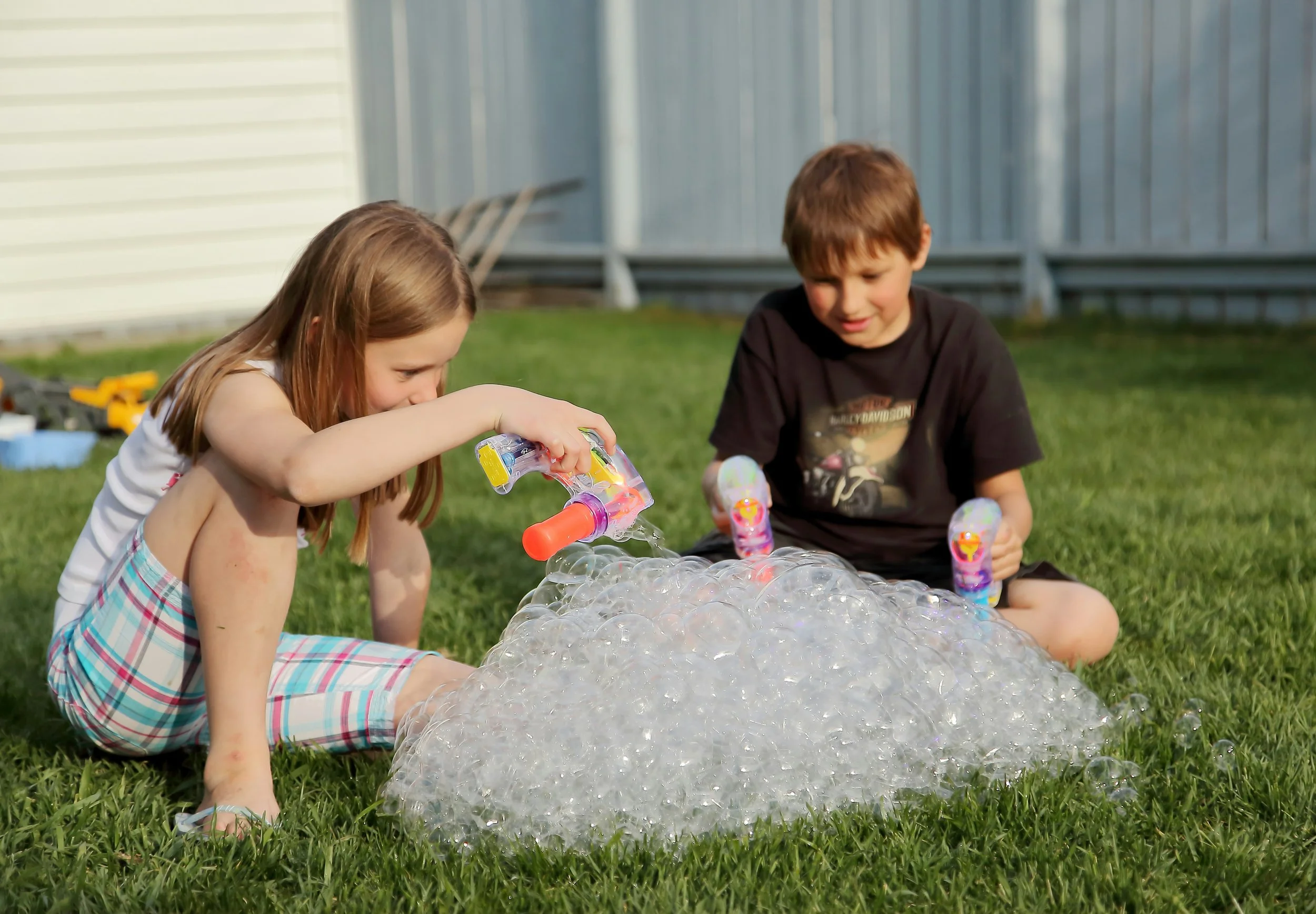
Photo by Anna Khromova on Unsplash
Build Independence in Small Steps
Start small and increase gradually. Expecting a long stretch of solo play from the beginning is a common reason attempts fail.
Play together first: Begin by joining your child in the activity so they feel safe and know how it works.
Step back slightly: Stay in the room but move a little further away, still close enough to respond.
Reduce your input: Offer fewer prompts and let your child lead.
Leave for a short time: Start with a minute or two in a nearby space, and tell your child you are going and that you will be back.
Return before they become distressed: Coming back while things are still calm builds trust that you will return.
Lengthen the time gradually: Add a minute or two as your child shows they are comfortable.
Notice and acknowledge success: A brief, calm "you played by yourself, nice work" helps, as long as the praise does not interrupt the play.
If your child becomes distressed at any step, go back to the previous one and stay there longer. Moving slowly is not failing. It is how the skill becomes secure.
For ongoing conversations about autism and daily life, listen to the On the Spectrum podcast here.
Ideas for Different Play Styles
Independent play looks different depending on what your child enjoys. These are common starting points:
Sensory play
Water, sand, or dry rice with scoops and containers
Playdough, kinetic sand, or textured objects
Light-up toys, bubbles, or sensory bottles
Construction and building
Blocks, magnetic tiles, and interlocking bricks
Train tracks, marble runs, and ramps
Sorting and matching
Sorting by color, shape, or size
Puzzles and shape sorters
Matching cards or lacing activities
Creative activities
Drawing, coloring, stickers, and collage
Music, simple instruments, or listening to favorite songs
Movement
A small trampoline, swing, or balance activity, where it is safe and suitable
Dancing or obstacle courses set up in advance
Interest-based play
Books or pictures about a favorite topic
Small figures related to a special interest
Sorting or arranging collections
Choose one or two to start. Familiarity is helpful, and many children are happiest repeating the same activity many times.
For visual resources and practical ideas, follow Sonia on Pinterest here.
What to Do When Your Child Resists
Resistance is useful information, not a sign to stop.
Check the basics: Hunger, tiredness, and sensory discomfort can all get in the way of play.
Look at the difficulty level: The activity may be too hard or too open-ended. Simplify it.
Look at the timing: After a demanding day, a child may need decompression time before they can play. Quiet downtime after school or a busy outing is often a better time than the middle of a hectic evening.
Use a gentle transition: Moving between activities can be a flashpoint, and the post on how to help an autistic child with transitions between activities covers warnings, visual supports, and handling a difficult moment.
Stay calm and keep the plan: Frustration from an adult can make solo play feel unsafe. Step back to an earlier stage and try again another day.
Avoid forcing: Pressure tends to increase distress and can make your child less willing to try.
Adapting for Older Children
Independent play looks different as children grow, and the same principles apply.
Follow their interests: Older children may prefer building, drawing, gaming, reading, collecting, or learning about a favorite subject.
Involve them in the plan: Ask what they would like to do during quiet time and let them help set it up.
Offer choices: A short menu of options gives control while keeping structure.
Use written schedules: Visual supports can become written lists or phone reminders.
Respect the need for alone time: For many autistic older children and teens, time alone is a valid way to recharge, not a problem to fix.
When to Ask for Extra Support
Some children need more help than home strategies can provide. It may be worth speaking to a professional if:
Your child seems unable to engage with any activity, even briefly
Play is very limited and not expanding over time
Distress around being left alone is intense or prolonged
You are concerned about safety when your child is playing without you
You would like help with specific sensory or communication needs
An occupational therapist, speech and language therapist, or autism specialist can tailor suggestions to your child's profile. Asking for help does not mean you are doing anything wrong.
FAQs
Is it normal for an autistic child to prefer playing alone?
Yes. Many autistic children enjoy solitary play, and it can be a healthy way to regulate and recharge.
Is repetitive play a problem?
Not by itself. Repetitive play is common in autistic children and often serves a calming or comforting purpose.
How long should independent play last?
It depends on the child. Start with a minute or two and increase gradually as your child becomes comfortable.
Should I praise my child during independent play?
Brief, calm acknowledgment afterward is usually better than interrupting the play with praise.
What if my child will not play without me?
Return to playing together and move away in very small steps over time.
Can screens count as independent play?
Screens can be enjoyable and are part of many families' routines, but many parents also aim for a mix of activities, including hands-on play.
Final Thoughts
Encouraging independent play in autistic children is less about teaching a child to play the way other children do and more about giving them the structure, the space, and the confidence to enjoy their own way of playing without constant support. Start with their interests, keep the setup predictable, step back slowly, and let progress happen at your child's pace.
Small steps add up. A few calm minutes of solo play today can become a more settled afternoon in a few months, and a more confident child along the way.
If you are looking for an honest, personal story about navigating autism without a map, Get your copy of Dropped in a Maze here.
References:
HANDS Center for Autism. 5 Ways To Encourage Independent Play in Children With Autism [Internet]. 2025 May 2. Available from: https://www.handscenter.com/5-ways-to-encourage-independent-play-in-children-with-autism
Ginzy A. Creating a Home Environment That Encourages Play and Leisure for Autistic Children [Internet]. Autism Spectrum News; 2026 Apr 3. Available from: https://autismspectrumnews.org/creating-a-home-environment-that-encourages-play-and-leisure-for-autistic-children/
Forta Health. Independent play for children with autism [Internet]. 2022 Jul 15. Available from: https://www.fortahealth.com/resources/independent-play-for-children-with-autism
