
How Special Interests Protect and Strengthen Autistic Mental Health
For decades, the professional world treated special interests as symptoms to be managed. The research now tells a completely different story. Special interests are not quirks. They are not obsessions in the clinical sense.
They are not signs that something has gone wrong in an autistic brain. They are sophisticated, powerful mental health tools that many autistic people are using, often without knowing it, to regulate their nervous systems, manage anxiety, build identity, and connect with the world around them.
This post is about what the science says, what the lived experience says, and why the way we think about special interests in the autism community needs to change completely.
Table of Contents
What Special Interests Actually Are
Why the Brain Lights Up Around Special Interests
Special Interests as Anxiety Regulation
Special Interests and Identity
Special Interests as Social Bridges
What Happens When Special Interests Are Suppressed
How Parents Can Support Rather Than Limit
Special Interests in Adults: The Workplace and Beyond
When Special Interests Become Careers
What This Means for Therapy and Coaching
Final Thoughts
What Special Interests Actually Are
Special interests, sometimes called circumscribed interests or hyperfixations, are areas of intense, focused engagement that are characteristic of many autistic people. They are different from hobbies in both degree and kind.
A hobby is something you enjoy. A special interest is something you inhabit.
What makes a special interest distinct:
The depth of engagement goes far beyond what is typical for that topic or age group
The interest generates a level of joy, energy, and focus that is qualitatively different from general enjoyment
Knowledge accumulates rapidly and becomes remarkably detailed
The interest provides a reliable source of comfort and regulation
Time spent in the interest feels restorative rather than draining
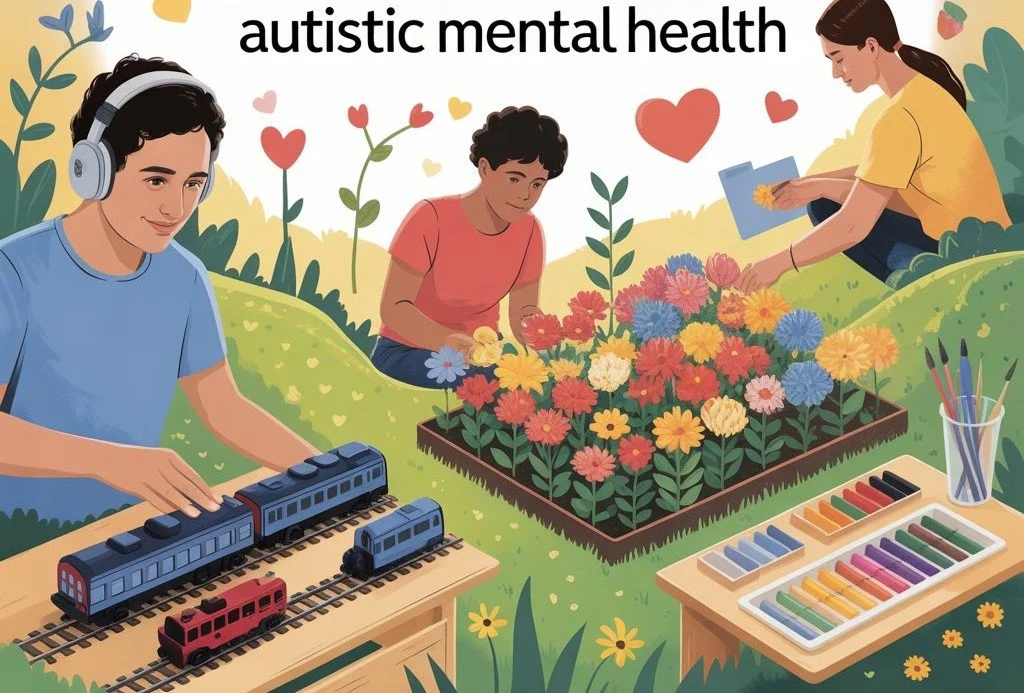
Special interests can be narrow or broad. They can last a lifetime or shift over time. They can look like an encyclopedic knowledge of train schedules, a total immersion in the history of a specific country, an ability to identify every species of insect in a region, or a deep engagement with a fictional universe that most people around the autistic person barely know exists.
What they share is intensity. And that intensity, it turns out, is not a problem. It is information.
Why the Brain Lights Up Around Special Interests
The neuroscience behind special interests is genuinely fascinating and it explains a great deal about why they are so important to autistic wellbeing.
When an autistic person engages with their special interest, the brain's reward system activates in a significant way. Dopamine, the neurotransmitter associated with motivation, pleasure, and reward, is released in ways that feel qualitatively different from general activities.
This matters because research consistently shows that many autistic individuals have differences in how their dopamine systems function. The reward circuitry can be less responsive to the kinds of social and environmental rewards that neurotypical people find motivating. But around special interests, that system comes alive.
What this means practically:
Special interests are not just fun. They are neurologically regulatory
The pleasure autistic people experience in their special interest is not excessive. It is the brain accessing a reliable reward pathway
Restricting special interests does not just reduce enjoyment. It removes a primary neurological regulation tool
Special Interests as Anxiety Regulation
This is one of the most important and least understood functions of special interests, and it is the one that has the most direct implications for mental health.
Anxiety affects the majority of autistic people. Estimates suggest that between 40 and 60 percent of autistic individuals meet diagnostic criteria for an anxiety disorder, and that is before accounting for the chronic background anxiety that many autistic people live with as a result of navigating a world that was not designed for their nervous system.
Special interests serve as one of the most effective anxiety regulation tools many autistic people have access to, often without ever having been taught that this is what they are doing.
How special interests regulate anxiety:
Engaging with a known, predictable, deeply familiar subject reduces cognitive load and uncertainty
The focused attention required by a special interest interrupts anxious rumination
The dopamine release associated with the interest actively counteracts the stress response
The sense of mastery and expertise that comes from deep knowledge builds a stable internal anchor
The physical experience of being absorbed in something pleasant regulates the nervous system directly
Many autistic people describe returning to their special interest after a difficult day the way other people describe exercise or meditation. It is not escapism. It is recovery.
When this tool is removed, restricted, or repeatedly interrupted, the autistic person loses one of their primary coping mechanisms. The anxiety does not disappear. It simply has nowhere to go.
If you are an autistic adult working to understand your own regulation patterns, or a parent trying to support your child's emotional wellbeing, this is the conversation that Sonia's socio-emotional coaching is built around.
Book a session here and start understanding your own nervous system with the depth it deserves.
Special Interests and Identity
Beyond regulation, special interests play a critical role in autistic identity formation, and this is a dimension of their importance that is almost never discussed in clinical literature.
For many autistic people, particularly those who spent years masking, suppressing their natural responses, and performing neurotypicality for the benefit of the people around them, special interests are one of the few places where they are fully and unambiguously themselves.
The interest does not ask them to be different. It does not require social performance. It does not have unwritten rules that they have to decode. It is simply there, consistent and welcoming, responding to their engagement in predictable and satisfying ways.
What special interests provide for autistic identity:
A domain where competence and mastery are real and felt, not performed
A consistent sense of self that persists across different social environments
A source of genuine pride that does not depend on external validation
A private inner world that belongs entirely to the autistic person
This is particularly significant for autistic people who have been told, implicitly or explicitly, that the way they naturally engage with the world is wrong. The special interest is often the clearest evidence they have that there is nothing wrong with them. Their brain works. It works exceptionally well in this domain. That knowledge matters.
The connection between special interests and self-esteem is direct. When autistic people are supported in their interests, their sense of self stabilizes. When their interests are repeatedly dismissed or redirected, their self-concept takes a hit that accumulates over time into something much harder to address.
This is exactly the territory that Sonia's self-esteem coaching works in. The intersection of identity, autistic experience, and the narratives people carry about themselves.
Special Interests as Social Bridges
One of the most persistent myths about autism is that autistic people do not want social connection. The research and the lived experience of autistic people consistently contradict this.
Most autistic people want connection deeply. What they often struggle with is the neurotypical social format, the small talk, the implicit rules, the performance of interest in topics they find genuinely unstimulating, the requirement to meet in the middle of a conversational landscape that was designed by and for a different kind of brain.
Special interests change this equation entirely.
When autistic people connect around shared interests, the social anxiety that characterizes so many of their neurotypical interactions drops significantly. The rules of engagement are clearer. The subject matter is genuinely engaging. The depth of conversation that the interest allows is exactly the depth that autistic people prefer.
What shared special interests provide socially:
A natural entry point into conversation that does not require small talk
A context in which autistic social strengths, depth, knowledge, enthusiasm, directness, become assets rather than liabilities
Communities of people who share the same level of engagement and do not find it excessive
Friendships built on genuine mutual interest rather than social obligation
Online communities have been particularly significant here. The internet has allowed autistic people with highly specific interests to find each other across geographic boundaries and build real, meaningful relationships around shared passions that no one in their immediate environment might share.
This is not a lesser form of social connection. For many autistic people, it is the most genuine social connection they have ever experienced.
For more on what genuine connection and social navigation looks like for autistic individuals, the post on online therapy for autism and whether it is as effective as in person covers how autistic adults can access support in formats that actually work for their social and sensory needs.
What Happens When Special Interests Are Suppressed
This section matters and it is worth being direct about what the evidence shows.
When special interests are consistently restricted, redirected, or dismissed, the consequences for autistic mental health are real and significant.
What the research and lived experience show:
Anxiety increases when a primary regulation tool is removed
Self-esteem erodes when something central to identity is treated as a problem
Masking intensifies as autistic people learn to hide their genuine engagement
Autistic burnout becomes more likely when regulatory resources are chronically depleted
Depression rates increase in autistic individuals who feel unable to express their authentic interests
The autistic adults who report the most significant mental health struggles are often those who spent the most years having their special interests treated as symptoms. The connection is not coincidental.
There is also a subtler cost that is harder to measure but deeply real. When an autistic person learns that their most genuine, most engaged, most alive self is unwelcome, they do not just suppress the interest. They suppress the version of themselves that exists within it. That is a profound and lasting loss.
Listen to the On the Spectrum podcast with Sonia here for more conversations about what it really means to thrive as an autistic or neurodivergent person
How Parents Can Support Rather Than Limit
For parents reading this, the practical question is: what does support actually look like?
Things that genuinely help:
Engaging with the interest yourself, even at a surface level. Asking questions, listening to what your child shares, showing genuine curiosity
Using the interest as a teaching bridge. Math through train schedules, reading through books about dinosaurs, social skills through role-playing favorite characters
Connecting your child with communities of people who share their interest, online and in person
Allowing the interest to take up real time in the day rather than treating it as a reward to be earned
Celebrating the expertise your child is building rather than managing the intensity
Things to move away from:
Treating the interest as a behavior to be limited to specific time slots
Using access to the interest as a behavior management tool to be taken away as punishment
Redirecting conversations about the interest repeatedly
Expressing impatience or disinterest when the topic comes up
Assuming the intensity means something is wrong
The special interest is not competing with your child's development. In most cases, it is actively supporting it.
For a deeper understanding of what acceptance looks like in everyday parenting, the post on autism awareness vs autism acceptance covers why the framework we use to see our children shapes every interaction we have with them.

Special Interests in Adults: The Workplace and Beyond
The conversation about special interests does not end at childhood. For autistic adults, special interests continue to serve the same regulatory and identity functions, and the workplace presents its own set of challenges and opportunities around them.
Challenges autistic adults face around special interests at work:
Masking the interest to appear professional or appropriately engaged in general conversation
Being in roles that have no connection to their area of deep interest, which can contribute to burnout
Navigating colleagues who find their depth of knowledge or enthusiasm excessive
Feeling unable to disclose their autism or their interests in ways that would help their colleagues understand them better
Opportunities that special interests create at work:
Deep expertise that can become a professional differentiator
The ability to sustain focus and motivation on complex problems within the interest domain
Pattern recognition and knowledge synthesis that exceeds what most generalists can offer
A clear signal about what kind of work environments and roles will be most sustainable
The autistic adults who thrive in the workplace are often those whose role has some meaningful connection to their special interest. That is not a coincidence. It is the nervous system doing what it does best when given the right conditions.
When Special Interests Become Careers
This is worth naming directly because it happens more often than most people expect.
The history of human innovation is full of people who went unreasonably deep into something that fascinated them and changed the world as a result. Many of those people, diagnosed or not, show the hallmarks of autistic cognition. The depth. The pattern recognition. The ability to sustain focus far beyond what is comfortable for most people. The refusal to stay at the surface of a topic when there is so much more to understand.
Special interests become careers when:
The interest aligns with a genuine market need
The depth of knowledge creates real expertise that others value
The autistic person finds an environment that accommodates their working style
They have support in translating their expertise into a professional context
None of this is guaranteed. But the starting point is recognizing that the interest is an asset, not a liability, and that building a professional life around something that naturally generates focus and passion is not indulgence. It is strategy.
For more on what autistic individuals can read to understand their strengths and build on them, browse the best selling autism books recommended on this site. Several are written by autistic authors about exactly this kind of strength-based navigation.
What This Means for Therapy and Coaching
The implications of everything above for therapeutic and coaching practice are significant.
Good autism-informed support does not treat special interests as behaviors to manage. It treats them as windows into how the autistic person is wired, what regulates them, what gives them joy, where their strengths live, and how they are most likely to thrive.
In practice this means:
Using the special interest as a starting point for understanding the person
Building therapeutic goals that work with the interest rather than around it
Recognizing the interest as a legitimate coping resource to be supported
Helping autistic individuals articulate the value of their interests to themselves and others
Supporting the development of identity that includes rather than minimizes the interest
This is the approach Sonia brings to both her socio-emotional coaching and self-esteem coaching work. The goal is never to make an autistic person more neurotypical. The goal is to help them understand their own wiring deeply enough to build a life that genuinely works for them.
Final Thoughts
Special interests are not the part of autism that needs to be managed. They are often the part that is doing the most important work.
They are regulating anxious nervous systems. They are building stable identities in people who have been told in a hundred subtle ways that their authentic self is too much. They are creating pathways to connection for people who struggle with the neurotypical social format. They are generating expertise that, in the right context, changes lives and careers and sometimes the world.
The question has never been how do we limit this. The question has always been how do we make room for it.
This April and every month beyond it, one of the most meaningful things the autism community can do is stop treating special interests as symptoms and start treating them as the sophisticated, essential, deeply human capacities that they actually are.
Because the autistic person who is deep in their special interest is not escaping from their life. They are living it most fully.
Listen to the On the Spectrum podcast with Sonia here for more conversations about what it really means to thrive as an autistic or neurodivergent person.
