
6 Ways Your Therapist May Be Harming You (Even If They Specialize in Autism)
Finding a therapist who specializes in autism feels like winning the lottery, especially after years of working with practitioners who don't understand your neurological differences. But specialization in autism doesn't automatically equal good therapy.
Sometimes the most harmful therapeutic relationships come from practitioners who understand autism intellectually but apply that knowledge in ways that reinforce shame, perfectionism, and self-hatred rather than building genuine self-worth.
This is about recognizing when autism-informed therapy crosses the line from helpful to harmful, and what to do when your therapist's advice is damaging your mental health instead of supporting it.
Table of Contents
Harmful Pattern #1: Obsessive Focus on Your Appearance and Weight
Harmful Pattern #2: Contradictory Messages That Keep You Confused
Harmful Pattern #3: Reinforcing That You Need to Be "Perfect"
Harmful Pattern #4: Judging People With Mental Health Struggles
Harmful Pattern #5: Discouraging Career Paths Based on Your Autism
Harmful Pattern #6: Telling You to Care What Everyone Thinks
What Healthy Autism-Informed Therapy Actually Looks Like
How to Protect Yourself From Harmful Therapy
Harmful Pattern #1: Obsessive Focus on Your Appearance and Weight
When Body Image Becomes Central to Treatment
One of Dr. Grey's frequent topics was my weight and appearance. Sessions would begin with questions like "So, you were never known as the heavy child?" followed by critiques of my eating habits, exercise routine, and overall appearance.
His advice included:
"Maybe you need to start eating more lean meat and protein-based foods"
"Hire a nutritionist to help you"
"Something isn't working if you have been going to the gym as often as you say"
When I mentioned girls complimenting my appearance: "They are just trying to be nice to you"
The Damaging Message
The culmination was this statement: "The reason I am telling you all this is that with your autism and mood disorder, everything has to be perfect. Thin girls get away with more."
This message communicated that:
Your neurological differences mean you're starting from a deficit
You must compensate for autism by achieving physical perfection
Other people's superficial judgments should dictate your self-worth
Being thin is a prerequisite for social acceptance
Why This Is Harmful
According to the National Eating Disorders Association, autistic people already have higher rates of eating disorders and body image issues. A therapist reinforcing that thinness equals worthiness can:
Trigger or exacerbate disordered eating
Create shame about natural body diversity
Tie self-worth to appearance rather than character
Add perfectionism on top of existing mental health struggles
What I Needed Instead
Therapeutic support should have addressed:
Using food emotionally as a coping mechanism
Building self-worth independent of appearance
Challenging societal beauty standards, not reinforcing them
Developing healthy relationship with body and food
For more on recognizing when therapeutic relationships have crossed into harmful territory, read our article on 5 Signs You've Found the Right Therapist (And 3 Red Flags You're With the Wrong One).
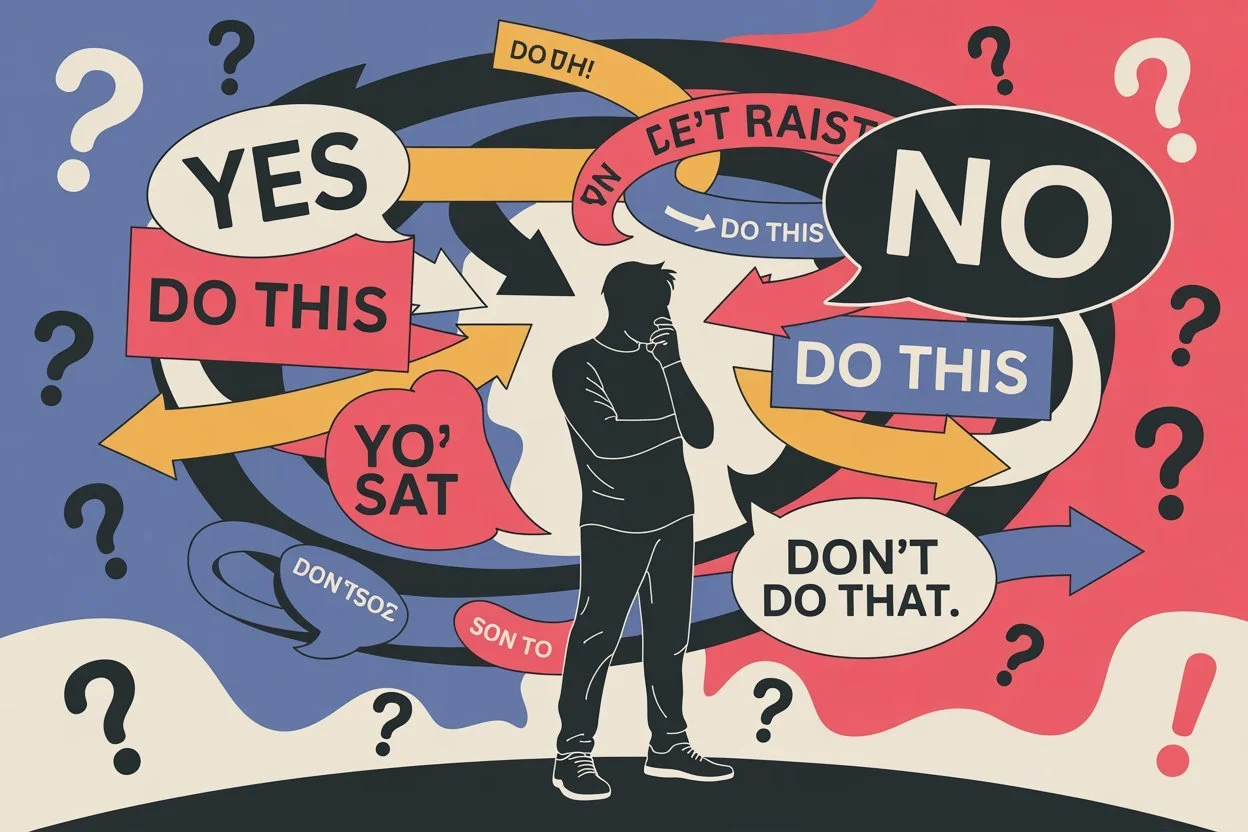
Contradictory Messages
Harmful Pattern #2: Contradictory Messages That Keep You Confused
The Ice Cream Paradox
Dr. Grey's messages often contradicted each other:
One session: "Because of your autism and mood disorder, everything has to be perfect. This means you need to be thin. People these days are obsessed with airbrushing, and I have clients who won't date a girl who is even five lbs overweight."
Another session: "On days you feel bad, you need to learn to go do something for yourself, such as go get an ice cream."
Why Contradictory Advice Harms
When therapeutic messages contradict each other:
You can never get it right. Whatever you do violates one piece of advice or another.
You lose trust in your judgment. If the expert keeps changing the rules, you stop trusting your own decisions.
You stay dependent on the therapist. Confusion keeps you coming back for clarity that never arrives.
You internalize the contradiction. The conflicting messages become your inner dialogue—"be perfect" versus "treat yourself" creates paralysis.
The Pattern Across Multiple Areas
The contradictions extended beyond food:
Be yourself / Change everything about yourself
Don't care what people think / Care deeply about what everyone thinks
Build self-worth / Your worth depends on others' judgments
Love yourself / You're not attractive enough as you are
What Consistent Therapeutic Messaging Looks Like
Effective therapy provides:
Clear, consistent principles you can rely on
Messages that align across different situations
Support for developing your own judgment
Acknowledgment when approaches need to shift, with explanation
For the complete story of my autistic journey through law school my book provides all the details, order your copy today.
Harmful Pattern #3: Reinforcing That You Need to Be "Perfect"
The Impossible Standard
Dr. Grey's recurring message: "Because of your autism and mood disorder, everything has to be perfect."
This extended to:
Physical appearance: Thin, fashionable, makeup done correctly
Social skills: Every interaction executed flawlessly
Body language: Walk correctly, posture perfect, no "weird" movements
Dating: Compensate for autism by achieving perfection in all areas
Why Perfectionism Is Toxic for Autistic People
Autistic people already tend toward:
All-or-nothing thinking
High standards for themselves
Difficulty with self-compassion
Shame about not meeting neurotypical expectations
A therapist reinforcing that you must be perfect to be acceptable amplifies these existing vulnerabilities.
The Impossible Equation
The message was clear: Autism + Mood Disorder = Need for Perfection to Compensate
This creates an impossible situation where:
Your neurological differences are framed as deficits
You must work harder than neurotypical people to be "acceptable"
Any imperfection confirms you're not trying hard enough
There's no room for being human, making mistakes, or having bad days
What I Started Teaching Myself Instead
During my deepest depression, I began practicing: "I am a sexy diva," repeatedly in front of the mirror. At first it felt weird, but it became a routine I loved.
When Dr. Grey dismissed this with "Guys don't see you like that," I responded: "I don't care what guys see me as. It's the opinion of myself that should count first, Dr. Grey."

Harmful Pattern #4: Judging People With Mental Health Struggles
The Stigmatizing Statement
During one session, Dr. Grey said: "The unfortunate truth is when people have any kind of psychiatric diagnosis, others don't like to be around that person. People step back."
He continued: "People want to be around someone who has sunshine in their hearts. People don't like to be around people who have all sorts of issues."
The Professional Betrayal
This statement from a psychotherapist—someone whose job is to support people with mental health struggles—was profoundly damaging.
It communicated:
Your mental health diagnosis makes you inherently undesirable
You should hide or minimize your struggles to be acceptable
People are right to avoid those with psychiatric diagnoses
Your worth is contingent on appearing "issue-free"
Why This Is Unethical
A mental health professional stigmatizing psychiatric diagnoses:
Violates the fundamental premise of therapeutic support
Reinforces societal stigma clients come to therapy to escape
Creates shame about seeking help or having diagnoses
Makes clients feel judged in what should be a safe space
The Question This Raises
As I noted at the time: "It made me wonder why someone like him was even a psychologist, but like in any profession, people can enter it for the wrong reasons."
When your therapist judges the very population they're supposed to serve, it reveals they're in the field for reasons other than genuine care and support.
If you're questioning whether your autism diagnosis was missed or misunderstood in your youth, read our article on The Journey to Autism Diagnosis: 7 Signs You Might Have Missed in Young Adults for more context.
Harmful Pattern #5: Discouraging Career Paths Based on Your Autism
The Limiting Beliefs
Despite my expressed desire to become a therapist and help others on the autism spectrum, Dr. Grey actively discouraged this path.
His reasoning:
Autism meant people wouldn't connect with me
I shouldn't be in mental health or trial law
I was better suited for financial advising where expertise mattered more than connection
The Deeper Issue
This advice revealed:
Limited vision of what autistic people can do: Assuming autism automatically disqualifies you from relationship-based work
Projection of his own biases: Perhaps his difficulty connecting with clients reflected his limitations, not autism's
Ignoring my strengths and passions: My heart was suited to helping others heal and feel understood
Reinforcing family pressure: Aligned with parents who wanted me to stay in law school rather than pursuing what called to me
What I Actually Knew
My desire to work in mental health came from authentic experience: "I wanted to be that person for someone else in ways I wish I had that someone for myself."
This is often the deepest calling—helping others through struggles you've survived yourself.
The Career That Actually Fits
Today, I work as an empowerment coach and host the On the Spectrum Empowerment Stories podcast—exactly the kind of relationship-based, healing-focused work Dr. Grey said autism made impossible.
His limiting beliefs about what autistic people can do were wrong. They reflected his biases, not reality.
For the complete, unfiltered story of my therapeutic journey, my book provides all the details.
Harmful Pattern #6: Telling You to Care What Everyone Thinks
The Detective Work
Dr. Grey started one session: "I wonder if perhaps there is a sign you are wearing that is pushing people away."
His solution: "This is where we need to do some detective work and get some feedback from others that could help us."
Later, when I shared feedback: "Well, let's listen to what these people are saying. You should care about what people say about you because this is what carried you throughout your whole life."
The Problem With This Approach
It reinforces external validation: Your worth becomes dependent on others' opinions rather than internal self-knowledge.
It ignores toxic sources: Feedback from people who called me "weird" and avoided me wasn't constructive—it was cruel.
It creates hypervigilance: Constantly monitoring others' reactions keeps you anxious and self-conscious.
It prevents authenticity: You can't be yourself while obsessing over everyone's judgments.
The Contradiction
Dr. Grey simultaneously wanted me to:
Care deeply about what everyone thinks
Develop confidence and self-worth
Be authentic while constantly performing for approval
These goals are incompatible.
What I Eventually Learned
The opinion of myself should count first. Not guys who rejected me. Not classmates who called me weird. Not even my therapist.
Building genuine self-worth requires:
Valuing your own assessment over others' judgments
Distinguishing between constructive feedback and cruel criticism
Developing internal standards rather than chasing external approval
Being selective about whose opinions you allow to matter
Ready to learn the complete story of navigating harmful therapy while struggling through law school? My book details every session, every harmful message, and what I eventually learned about genuine self-worth.
What Healthy Autism-Informed Therapy Actually Looks Like
The Positive Moments Were Real
Despite the harmful patterns, Dr. Grey did provide some valuable support:
CBT techniques: Teaching me to challenge all-or-nothing thinking and reframe negative thoughts like "Just because I never had a boyfriend doesn't mean I am nothing."
Validation of challenges: Acknowledging I had additional challenges other people didn't face because of autism and comorbid mood disorder.
Standing up for me: When family members suggested I was "cured" of autism or should stop therapy, he supported my continued treatment.
Advocacy against family misconceptions: Explaining that graduate school doesn't cure autism and therapy was keeping me afloat.
What Made Me Blind to the Problems
"This was where I blinded myself into thinking everything was okay with these therapy sessions: the fact that somebody understood autism."
When you've spent years with therapists who don't understand autism, finding someone who does feels like salvation. This can make you overlook significant problems with how they're applying that knowledge.
What Truly Helpful Autism Therapy Includes
Understanding autism without pathologizing it: Recognizing differences without framing them as deficits requiring compensation.
Building genuine self-worth: Internal validation that doesn't depend on appearance, dating success, or others' approval.
Consistent, non-contradictory messaging: Clear principles you can rely on to guide decisions.
Supporting authentic career paths: Helping you discover and pursue what genuinely calls to you, not limiting your options based on assumptions about autism.
Non-judgmental stance toward mental health: Creating safety rather than stigma around psychiatric diagnoses.
Balanced feedback processing: Teaching discernment about which opinions to consider versus which to dismiss.

How to Protect Yourself From Harmful Therapy
How to Protect Yourself From Harmful Therapy
Recognize the Warning Signs
Your therapy may be harmful if your therapist:
Makes you feel worse about yourself after sessions
Focuses obsessively on changing your appearance
Gives contradictory advice that keeps you confused
Reinforces that you must be "perfect" to compensate for autism
Stigmatizes mental health diagnoses
Limits your career aspirations based on assumptions about autism
Tells you to care what everyone thinks while claiming to build confidence
Trust Your Inner Voice
The moment I told Dr. Grey "I don't care what guys see me as. It's the opinion of myself that should count first" was pivotal.
Even in harmful therapeutic relationships, your inner wisdom knows truth. Listen to it.
You're Allowed to Push Back
Therapy isn't a one-way street where the expert dictates and you comply. You're allowed to:
Disagree with your therapist's assessments
Question advice that doesn't feel right
Express when something they said hurt you
Stop following guidance that makes you feel worse
Consider Whether the Relationship Is Worth Continuing
Ask yourself:
Is the helpful content worth the harmful messaging?
Am I staying because they understand autism, even though they're hurting me?
Would I tolerate this treatment from a friend or partner?
Is there someone else who could provide autism expertise without the harm?
Seek Second Opinions
If you're unsure whether your therapy is helpful or harmful:
Consult with another autism-informed therapist
Share specific examples with trusted people who know good therapy
Listen to your own emotional responses after sessions
Track whether you're getting better or worse over time
Listen to the On the Spectrum Empowerment Stories podcast for more insights on navigating therapeutic relationships, building genuine self-worth, and recognizing when support systems are helping versus harming.
Moving Forward From Harmful Therapy
The therapeutic relationship with Dr. Grey was complicated—moments of genuine support mixed with deeply harmful messaging that reinforced shame, perfectionism, and external validation.
The most important lesson: Specialization in autism doesn't guarantee good therapy.
What matters is:
How they apply their knowledge
Whether they build you up or tear you down
If they reinforce internal worth or external validation
Whether you feel better or worse after working with them
Today, I use my experience navigating harmful therapeutic relationships to help others recognize red flags earlier than I did. The years I spent absorbing harmful messages about needing to be perfect, thin, and acceptable took additional years to unlearn.
You don't have to repeat my mistakes. You can recognize harmful patterns early and find practitioners who truly support your authentic development.
For the complete, unfiltered story of my therapeutic journey through law school—including every harmful session, what kept me stuck, and how I eventually found genuine self-worth—my book provides all the details these takeaways only begin to address.
