
Signs Your Child Needs Emotion Coaching (and What to Do About It)
Does your child explode over small frustrations, shut down when upset, or struggle to say how they feel? You're not alone — and more importantly, there's a name for what they might need.
Research from the American Psychological Association shows that children who develop strong emotional regulation skills early in life experience better academic outcomes, healthier relationships, and improved mental health throughout adolescence and adulthood. The inverse is equally true: children who lack these skills often struggle in ways that compound over time.
That's where signs that a child needs emotion coaching become so important to recognise. Emotion coaching is a research-backed approach — developed by psychologist Dr. John Gottman — that teaches children to understand, name, and manage their feelings. When you know what to look for, you can step in early and make a real difference.
This guide will walk you through exactly what emotion coaching is, the clearest signs your child may need it, why it matters, and the practical steps you can start using today.
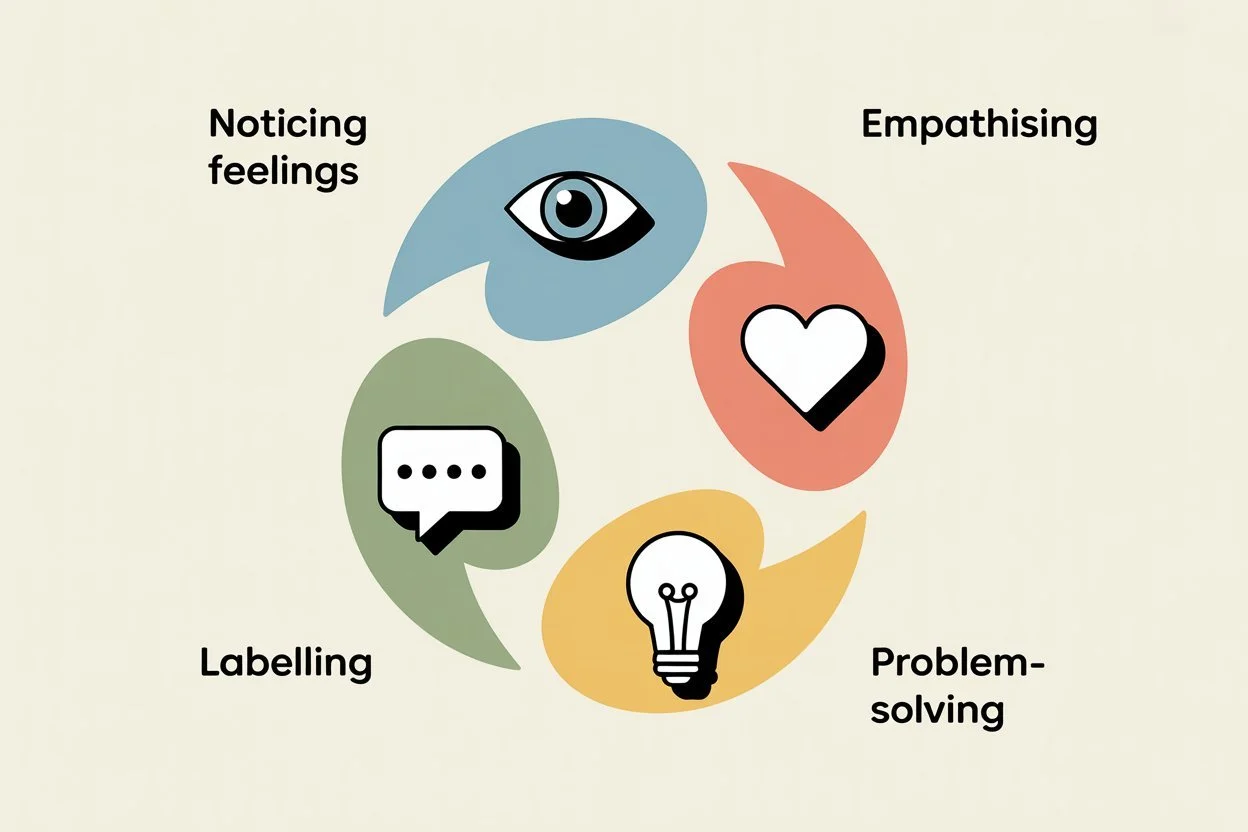
Infographic: The Emotion Coaching Cycle (Noticing feelings → Empathising → Labelling → Problem-solving)
What Is Emotion Coaching?
Emotion coaching is an approach to parenting that treats a child's difficult emotions not as problems to be silenced, but as opportunities to teach and connect. Rather than dismissing or punishing emotional outbursts, emotion-coached parents guide children through their feelings with empathy and language.
The concept was pioneered by Dr. John Gottman following decades of research into family dynamics. His studies found that children of emotion-coaching parents had fewer behavioural problems, performed better academically, and had stronger friendships — even when controlling for other variables.
At its core, emotion coaching involves four key steps: noticing the emotion, using it as an opportunity to connect, helping your child name the feeling, and then working together on limits and solutions.
"Emotion coaching is not just about managing a child's feelings. It's about helping them understand that feelings have value — and that you as the parent are their safe landing place. — Dr. John Gottman, The Heart of Parenting"
It's worth noting that emotion coaching isn't about being permissive. It's not about letting children do whatever they feel like. It's about validating the emotion while still setting firm limits on behaviour. That distinction is what makes it both compassionate and effective.
Want to understand the concept more deeply? Read our full guide on what emotion coaching is before diving into the signs.
How Emotion Coaching Works
Understanding the mechanics of emotion coaching helps you apply it consistently — especially in high-pressure moments when your child is mid-meltdown. It works through two interconnected processes: attunement and scaffolding.
Attunement: Tuning In Before You React
Attunement means noticing and acknowledging your child's emotional state before trying to fix anything. Most parenting instincts push us to immediately soothe, distract, or correct — but emotion coaching asks you to pause and reflect the feeling back first.
When a child feels genuinely seen and understood, their nervous system begins to settle. This is not a soft, feel-good concept — it is grounded in neuroscience. A child in emotional overwhelm cannot access rational thinking. Attunement helps them return to a regulated state where learning and problem-solving become possible.
In practice, this might sound like: "You're really angry that we had to leave the park. That makes sense — you were having such a good time." No fixing. No lecturing. Just being present with the feeling.
Scaffolding: Building Emotional Vocabulary and Skills
Scaffolding is the second phase — helping your child develop the tools to understand and navigate emotions over time. This includes building a feelings vocabulary, modelling calm emotional expression, and working through problems together once the emotional storm has passed.
Children are not born knowing the difference between feeling frustrated and feeling embarrassed. Emotion coaching builds this literacy brick by brick, over hundreds of small interactions. The more emotionally literate a child becomes, the better they can self-regulate — and the less explosive or withdrawn their reactions will be.
According to CASEL (Collaborative for Academic, Social, and Emotional Learning), social-emotional learning programmes that include emotional literacy components show an 11-percentile-point improvement in academic achievement, as well as significant reductions in behavioral problems.
Ready to take the next step?
Book an emotion coaching session with Sonia
Listen to Sonia's podcast for parents
Signs Your Child Needs Emotion Coaching — and How to Respond
If you've noticed your child struggling emotionally, this section is your practical roadmap. Below are the most common signs, paired with what you can actually do about each one.
What It Means & How to Respond
Frequent or intense meltdowns
Explosive reactions to small frustrations signal that a child's emotional toolkit is overwhelmed. Respond by staying calm yourself, naming the emotion, and resisting the urge to punish the feeling. "You're so frustrated right now. Let's figure this out together."
Difficulty naming feelings
If your child says "I don't know" when asked how they feel, they may lack emotional vocabulary. Build a feelings chart at home, read books with emotionally complex characters, and model labelling your own feelings aloud throughout the day.
Shutting down or withdrawing
Some children internalise their emotions rather than exploding. Watch for sulking, refusing to talk, or unexplained stomach aches. These children need a low-pressure invitation to share — try connection before conversation.
Social struggles with peers
Difficulty managing frustration in group settings, frequent conflict, or trouble sharing often signals a need for emotion coaching. Help your child practise perspective-taking through role play and debrief conflicts calmly after they happen.
Telling you feelings are stupid
Children who dismiss their own emotions have often been inadvertently taught that feelings are embarrassing or inconvenient. Normalise all emotions — including difficult ones like jealousy or fear — as part of being human.
Extreme sensitivity to criticism
Falling apart when corrected, or refusing to try things for fear of failure, often reflects poor emotional resilience. Use the language of "not yet" and separate a child's worth from their performance.
Difficulty transitioning between activities
Transitions require self-regulation. Children who struggle with them often need more advance warning, acknowledgement of their feelings about the change, and a predictable routine that creates emotional safety.
What unites all of these signs is that the child is struggling to process, express, or regulate their inner emotional world. They're not doing it to be difficult, they genuinely lack the tools.
The good news: emotion coaching builds those tools. And you don't need to be a perfect parent to do it, you just need to be a present one. For deeper guidance, explore Sonia's work on what emotion coaching is and how it translates into everyday moments.
Common Mistakes: What to Avoid When Your Child is Struggling
Even well-meaning parents can unknowingly make emotional regulation harder for their children. Here are the most common pitfalls and why they backfire:
Dismissing the emotion
Telling a child "You're fine" or "There's nothing to cry about" teaches them that their inner world doesn't matter. This drives feelings underground rather than resolving them, which increases anxiety and emotional outbursts over time.
Jumping straight to problem-solving
Children who feel unheard can't engage with solutions. Rushing to fix the situation before acknowledging the feeling leaves them feeling alone — even when your intentions are good.
Punishing the emotion
Sending a child to their room for crying or getting angry at them for being afraid creates shame around normal emotional experiences. Children learn to hide feelings rather than process them healthily.
Matching their intensity
When a parent escalates alongside an upset child, it pours petrol on the fire. Children co-regulate with adults — they need you to be calm in their storm, not another storm.
Over-reassuring without validating
Saying "Everything is fine, don't worry" bypasses the child's experience. Validation first: "I can see you're really worried." Then gentle reassurance, once they feel heard.
Emotion coaching only during crises
Emotion coaching is most effective when it's woven into everyday life — reading books together, debriefing small conflicts, noticing and naming feelings in calm moments. Crisis-only coaching doesn't build lasting skill.
Why Recognising the Signs of Emotion Coaching Need Matters
The stakes of unaddressed emotional struggles are high — but so is the potential when parents intervene early. Here's why identifying the signs your child needs emotion coaching is one of the most important things you can do as a parent.

Short-term vs Long-term outcomes of emotion coaching vs dismissing emotions
Emotional regulation is a foundational life skill
Just as children need to learn to read, they need to learn to manage their emotions. Research from Harvard's Centre on the Developing Child shows that the executive functioning skills tied to emotional regulation are predictive of success in school, relationships, and adult mental health. These skills don't develop automatically — they're built through interaction.
Early intervention prevents escalation
Emotional struggles that go unaddressed in early childhood tend to intensify. A child who can't name their feelings at age five becomes an adolescent who acts out without knowing why. Identifying the signs early and responding with emotion coaching breaks this cycle before it takes hold.
It strengthens your parent-child relationship
Emotion coaching is fundamentally about connection. When children feel safe to bring their messy, difficult feelings to you and know you won't dismiss or punish them for it — trust deepens. That trust becomes the foundation everything else is built on.
It protects mental health long-term
Children who are emotion-coached show lower rates of anxiety, depression, and behavioural disorders. The ability to identify, express, and regulate emotions is one of the most protective factors in mental health. You are literally building resilience with every coaching conversation.
It improves social outcomes
Emotionally literate children are better friends, more cooperative classmates, and more empathetic human beings. They can read social cues, manage conflict, and recover from setbacks — all of which are rooted in the emotional skills that emotion coaching develops.
It gives you tools, not just awareness
Many parents sense that something isn't right but don't know what to do. Emotion coaching gives you a framework — not a perfect script, but a way of responding that is grounded in your child's developmental needs. That shift from helplessness to action is itself transformative.
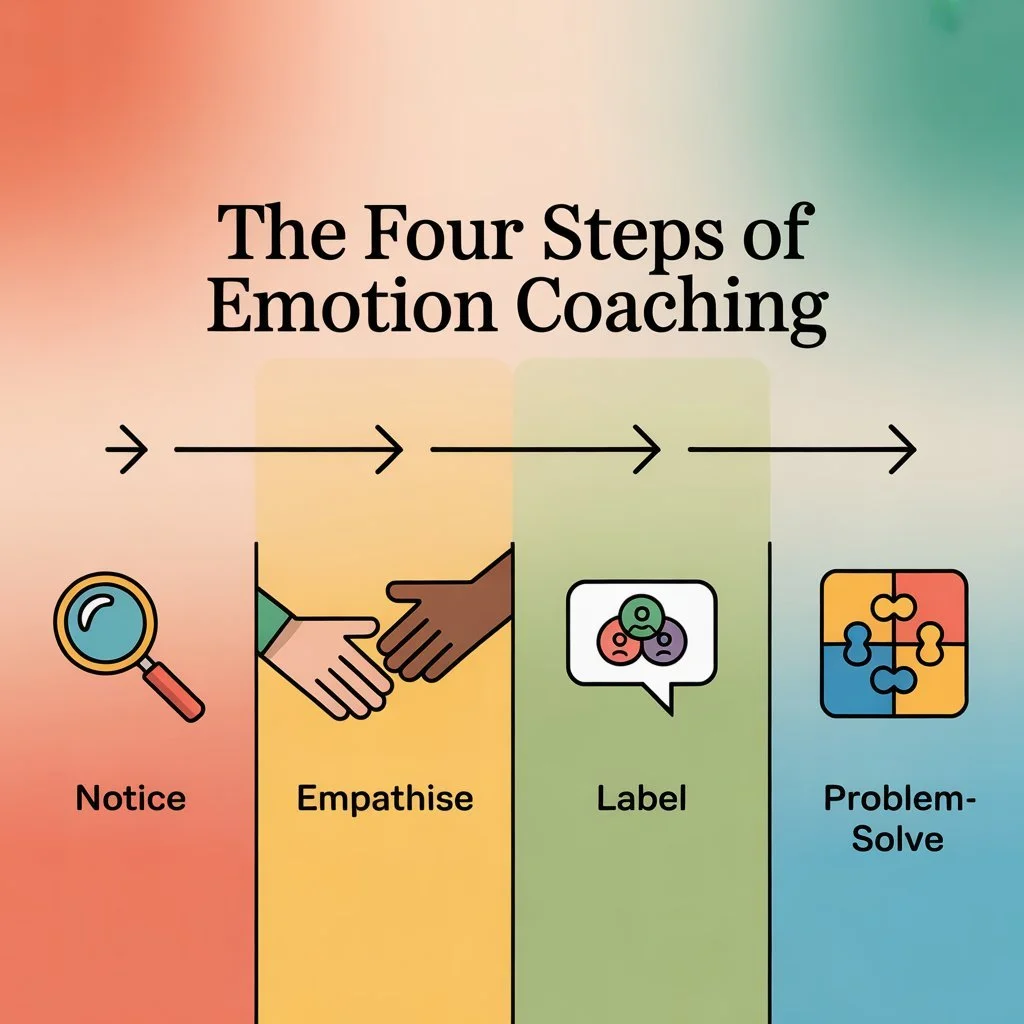
The four steps of emotion coaching (Notice → Empathise → Label → Problem-solve)
Think of emotion coaching the way you'd think of any other form of training. Athletes don't become resilient through talent alone — they're coached through difficulty, failure, and recovery. Your child's emotional life is no different. The moments of frustration, fear, and sadness are the training ground, and you are the coach.
The Growing Importance of Emotion Coaching — Trends and Future Outlook
As emotion coaching continues to evolve from a niche parenting concept into mainstream child development practice, the evidence base is growing rapidly. Schools, healthcare providers, and family therapists are increasingly incorporating emotion coaching principles into their work — a recognition that emotional literacy is as foundational as any academic skill.
The mental health landscape for children has shifted dramatically in recent years. Post-pandemic data from the World Health Organization indicates that anxiety and depression among children and adolescents have risen significantly, with emotional dysregulation identified as a key contributing factor. Parents who invest in emotion coaching now are not just responding to a trend — they're equipping their children for a world that increasingly demands emotional intelligence.
Practitioners who invest in this approach now — whether as parents, educators, or coaches — will be ahead of a curve that is rapidly becoming the new baseline expectation for child development support. The tools, research, and professional infrastructure around emotion coaching are maturing, making it more accessible than ever.
We also see growing integration of emotion coaching principles into school curricula through social-emotional learning frameworks, which further reinforces the skills that parents build at home. When home and school align on emotional literacy, children benefit exponentially. If you'd like to learn more about the foundational concepts underpinning this work, our guide on what emotion coaching is is the ideal starting point.
Frequently Asked Questions
1. What are the most obvious signs a child needs emotion coaching?
The most visible signs include frequent emotional meltdowns that seem disproportionate to the trigger, difficulty naming or describing how they feel, persistent social struggles with peers, emotional withdrawal or shutting down, and extreme sensitivity to correction or perceived failure. If your child regularly seems overwhelmed by their emotions or struggles to recover after an upset, emotion coaching is likely to help. These signs can appear as early as age three and become more complex as children grow.
2. At what age should emotion coaching start?
Emotion coaching can begin as soon as a child is forming emotional responses — which means from toddlerhood, around age 2–3. The language and approach will adapt to the child's developmental stage, but the core principle of acknowledging and naming feelings is appropriate from very early on. It's never too late to start either. Many parents begin emotion coaching with school-age children or even adolescents and see significant positive change.
3. What is the difference between emotion coaching and just being permissive?
Emotion coaching is not permissive parenting. It validates feelings while still holding firm on behaviour. You might say: "I can see you're furious that it's bedtime. That makes sense — you were in the middle of your game. AND bedtime is still at 7:30." The child's emotion is acknowledged; the limit is maintained. This is what makes emotion coaching effective — it's both empathetic and boundaried.
4. How long does it take to see results from emotion coaching?
Many parents notice a shift within a few weeks of consistent practice — particularly around the frequency and intensity of emotional outbursts. Deeper changes in emotional vocabulary, self-regulation, and social skills typically develop over several months. The key is consistency: emotion coaching works cumulatively, through many small interactions over time, not through a single breakthrough conversation.
5. Can I do emotion coaching without professional help?
Yes — and many parents do. Books, podcasts, and self-guided resources can give you a strong foundation. However, working with a specialist like Sonia Rossington offers personalised support that addresses your specific child's patterns and your specific parenting challenges. Many parents find that a few coaching sessions dramatically accelerate their progress compared to going it alone, particularly if their child's emotional struggles are intense or long-standing.
6. How is emotion coaching different from therapy?
Emotion coaching, as practiced by parents, is a preventive and developmental approach — it builds skills before or instead of clinical levels of struggle. Therapy, by contrast, addresses specific mental health concerns or trauma in a clinical context. They are complementary, not competing. If your child is experiencing significant anxiety, depression, or trauma symptoms, professional therapy is appropriate and important — and emotion coaching at home can support and reinforce that therapeutic work.
Next Steps — Work With Sonia Chand
If this guide has helped you see your child's emotional struggles in a new light — and given you a clearer sense of what they need — the next step is to take action. Recognizing the signs is the beginning; emotion coaching is the practice that creates lasting change.
Book a 1:1 Emotion Coaching Session with Sonia
Listen to Sonia's podcast for practical parenting guidance →