
How Personalized Autism Coaching Can Help You Reach Your Goals
Most autistic adults have goals. Real ones. Not vague aspirations about being happier or less stressed, but specific, concrete things they want to be different. A career that does not drain them. Friendships that actually last. The ability to walk into a difficult conversation and say what they need without shutting down. A relationship with themselves that is not built entirely on what went wrong.
The problem is rarely the goal. The problem is the gap between knowing what you want and having the right tools and support to actually get there, built around how your brain specifically works rather than how the world assumes it should work.
That is exactly what personalized autism coaching is designed to close.
Table of Contents
Why Generic Support Does Not Work for Autistic Adults
What Personalized Autism Coaching Actually Looks Like
Socio-Emotional Coaching: Building the Life You Actually Want
Self-Esteem Coaching: Building the Foundation Everything Else Stands On
The Six Month Self-Esteem Coaching Program
Goals That Coaching Helps Autistic Adults Actually Reach
What Makes Sonia's Coaching Different
FAQs
Final Thoughts
Why Generic Support Does Not Work for Autistic Adults
There is a specific kind of frustration that comes from trying support that was designed for someone else.
You read the productivity book. You follow the advice. You try the communication framework. And it works, briefly, before it stops working, because it was built on assumptions about how brains process information, manage energy, navigate social situations, and build motivation that do not match how your brain actually does any of those things.
Generic support fails autistic adults not because the autistic adult is not trying hard enough. It fails because the support itself was built around neurotypical neurology and then offered, with minimal adjustment, to people whose neurology works fundamentally differently.
Personalized autism coaching starts from the opposite direction. It begins with an accurate, detailed understanding of how your specific brain works, what drains it, what regulates it, what motivates it, and what gets in the way, and builds everything from there. The strategy fits the person. Not the other way around.
This is the difference between support that produces temporary improvement and support that produces genuine, lasting change.
What Personalized Autism Coaching Actually Looks Like
Personalized autism coaching is not a set curriculum delivered the same way to every client. It is a responsive, collaborative process that is built around the specific individual sitting in front of the coach.
In practice, this means:
Starting with genuine understanding
Before any strategy is built, the coaching begins with a real picture of who you are, what your specific challenges look like in daily life, what you have already tried, what your genuine strengths are, and what you actually want to be different. This is not a standard intake questionnaire. It is the foundation of everything that follows.
Building strategies that fit your neurology
The approaches used in coaching are adapted to how your brain specifically processes information, manages social demands, regulates emotionally, and initiates action. What works for one autistic adult may not work for another, and genuinely personalized coaching accounts for that.
Adjusting as you grow
You are not the same person at session twelve that you were at session one. Personalized coaching evolves with you rather than rigidly following a preset plan regardless of what is actually happening.
Holding the whole picture
Social goals, self-esteem, workplace challenges, relationship patterns, daily life management, and long-term vision are not separate silos. They are interconnected dimensions of the same life, and coaching that holds all of them at once produces more meaningful results than coaching that addresses only one in isolation.
Sonia Chand's coaching is built on all of these principles, informed by her clinical training as a licensed psychotherapist and deepened by her own lived experience of navigating adulthood as a late-diagnosed autistic woman.
Book a discovery call with Sonia here and experience what genuinely personalized autism coaching feels like from the very first conversation.
Socio-Emotional Coaching: Building the Life You Actually Want
The social and emotional dimension of autistic adult life is where the gap between wanting something and knowing how to get it is often widest. Sonia's socio-emotional coaching is built to close that gap with practical, personalized, real-world tools.
This coaching is for autistic adults who want genuine connection, professional belonging, and the ability to navigate everyday social situations without the level of exhaustion that currently makes the whole thing feel barely worth the effort.
What socio-emotional coaching covers:
Friendships that actually last
Learning how to identify people worth investing in, how to start and sustain conversations, how to navigate the awkward middle ground of building a friendship from acquaintance to something real, and how to do all of this in ways that are authentic rather than performed.
Social situations that do not wipe you out
Getting practical strategies for the everyday social encounters that neurotypical people navigate automatically but that many autistic adults find genuinely effortful, from grocery store interactions to work event small talk to family gatherings where the rules feel constantly shifting.
Workplace relationships that work
Building the professional relationship skills that affect employment outcomes significantly, including how to manage up, how to navigate team dynamics, how to handle conflict directly without it feeling catastrophic, and how to build professional credibility in environments that were not designed for autistic communication styles.
Emotional regulation that is actually useful
Understanding and expressing your emotions effectively across different contexts, so that your emotional experience becomes information you can work with rather than something that takes you by surprise or comes out sideways.
Social cues that make more sense
Developing a practical working understanding of the unwritten social language that neurotypical people use, not to perform it perfectly but to read it well enough that social situations become significantly more navigable.
The On the Spectrum podcast with Sonia Chand covers the real-world experience of navigating all of these challenges as an autistic adult, with honest conversations that make you feel seen rather than studied.
Listen here and find the community that understands exactly what you are working with.
Self-Esteem Coaching: Building the Foundation Everything Else Stands On
Here is something that most autistic adults discover once the skills work starts: external skills only get you so far if the internal foundation is not there.
You can learn what to say in a difficult conversation. But if you do not genuinely believe your needs are worth saying, the skill never quite lands the way it should.
You can understand what a healthy boundary looks like. But if your self-image is built primarily on years of being too much, not enough, or simply more work than you are worth, setting that boundary feels like a fight you do not quite believe you will win.
This is where self-esteem coaching does its most important work.
Sonia's self-esteem coaching is not positive thinking. It is not motivational. It is structured, evidence-informed work that helps autistic adults identify and systematically challenge the limiting beliefs that formed in the absence of accurate self-understanding, and replace them with something more honest, more compassionate, and more genuinely grounded.
What self-esteem coaching addresses:
Limiting beliefs that have been running the show for years
The specific narratives that undermine daily functioning, I am asking for too much, other people manage without this, something about me is fundamentally more difficult than it should be, are identified, examined, and challenged with the same rigor that clinical cognitive behavioral work applies to distorted thinking.
A self-image built on real evidence
Rather than replacing negative beliefs with generic positive ones, the work builds an accurate picture of who you actually are, including the genuine strengths that autistic neurology brings and that years of deficit-focused framing have often obscured.
Self-compassion that actually holds
Learning to treat yourself with the same kindness you would extend to someone you care about, particularly in moments of failure, setback, or the inevitable imperfection of building new skills in a world that was not designed for your brain.
Goals that move from intention to reality
Gaining the clarity and genuine confidence to take meaningful steps toward personal and professional goals rather than staying permanently in the planning stage because uncertainty feels too risky.
Dropped in a Maze by Sonia Chand is the book that captures the experience this coaching is built to address, the journey of understanding yourself accurately for the first time and discovering that the person underneath the years of masking and misunderstanding is someone worth building around.
The Six Month Self-Esteem Coaching Program
For autistic adults who are ready for the most structured and comprehensive investment in themselves, the six month self-esteem coaching program is where that commitment takes its fullest form.
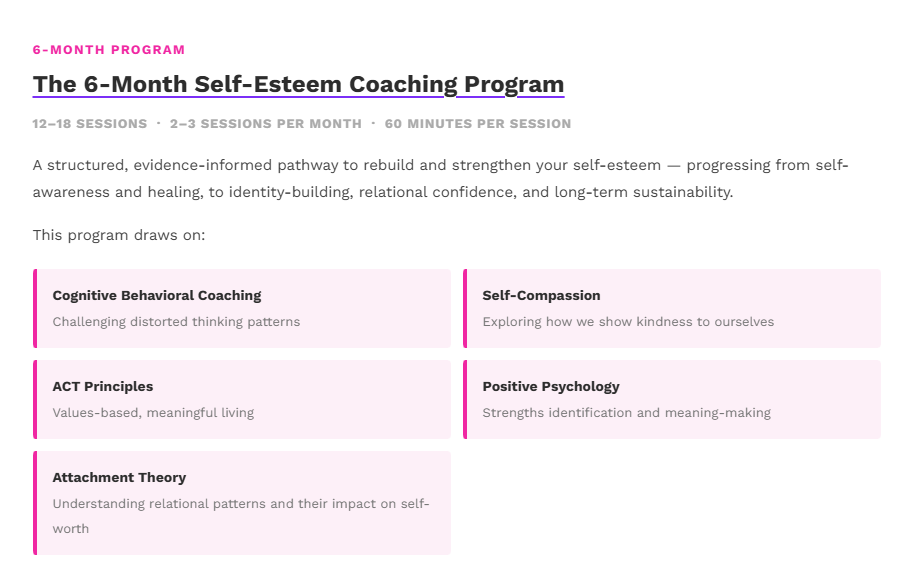
This is not a series of disconnected sessions. It is a carefully designed, evidence-informed pathway that moves progressively through the full arc of self-esteem rebuilding, from the ground up, with each phase building on the last.
The structure: Twelve to eighteen sessions across six months. Two to three sessions per month. Sixty minutes per session.
The framework: The program draws on cognitive behavioral coaching, self-compassion principles, ACT, positive psychology, and attachment theory, all adapted specifically for autistic neurology rather than applied from a neurotypical template.
The six phases:
Month one: Foundation and Self-Awareness
The program begins where all meaningful change begins, with an honest, detailed baseline. A self-assessment, an exploration of your self-story, and a clarification of the values that will guide everything that follows. Before you can rebuild, you need to know what you are working with and what you are actually building toward.
Month two: Challenging the Inner Critic
The accumulated self-critical narratives that formed without accurate information get examined and challenged here. Cognitive reframing, inner critic work, and the development of genuine positive self-talk that is evidence-based rather than aspirational.
Month three: Self-Compassion and Resilience
Building the capacity to hold your history with kindness rather than judgment. Emotional regulation practice. The healing work that makes moving forward possible rather than perpetually effortful.
Month four: Identity, Strengths and Ownership
A genuine strengths inventory. Deeper work on authenticity. Confidence built in action rather than only in theory. This is where the autistic person's genuine assets become visible, owned, and communicable.
Month five: Relationships, Boundaries and Social Confidence
Practical boundary-setting. Assertiveness. Navigating social anxiety in personal and professional contexts. The relational confidence that makes genuine connection possible rather than perpetually exhausting.
Month six: Integration and Sustainability
Progress review. A personal blueprint for continued growth. A clear, grounded vision for the life ahead. The goal of the final month is not continued dependency on coaching but genuine independence built on a foundation that was not there before.
What you will have by the end:
Identified and challenged the limiting beliefs that have been undermining your self-worth
Developed consistent self-compassion and emotional self-regulation practices
Learned to own and communicate your strengths confidently in relationships
Set and maintained healthy personal boundaries
Built the tools to sustain genuine self-esteem independently through personalized rituals and tools
This program is for autistic adults who are done with managing and ready to genuinely thrive.
Book a discovery call with Sonia here to find out whether the six month program is the right fit for where you are and what you are ready to build.
Goals That Coaching Helps Autistic Adults Actually Reach
To make this concrete, here are the kinds of goals that autistic adults bring to coaching and that personalized coaching actually helps them reach:
Career goals:
Finding or creating work that is sustainable for autistic neurology. Advocating for accommodations. Managing workplace relationships. Building the professional presence and communication skills that open doors without requiring constant exhausting performance.
Relationship goals:
Building genuine friendships. Navigating romantic relationships with more clarity and less anxiety. Repairing or renegotiating family dynamics in light of new self-understanding. Building the relational confidence to be authentically present rather than performing.
Self-understanding goals:
Making sense of a late diagnosis. Understanding the history of your life through an accurate lens. Developing a stable, positive autistic identity that is built on who you actually are rather than who you were expected to be.
Daily life goals:
Building sustainable routines. Managing time and executive functioning more effectively. Reducing the daily exhaustion of masking by developing environments and strategies that require less compensation.
Inner life goals:
Challenging the self-critical narratives. Building genuine self-worth. Developing the self-compassion and emotional regulation that make everything else more possible.
For autistic adults who are also working on the daily structure dimension of these goals, the post on why routine matters for autistic adults covers the practical scaffolding that supports everything coaching builds.
What Makes Sonia's Coaching Different
There are more autism coaches available now than there have ever been. Why Sonia specifically is a question worth answering directly.
Clinical training at a licensed level
Sonia is a licensed psychotherapist, not a coach who completed a certification weekend. Her clinical training gives her coaching work a depth and safety that most coaches cannot offer, and it means she can recognize when a client's needs go beyond coaching into clinical territory.
Lived experience of late diagnosis
Sonia is a late-diagnosed autistic adult herself. She knows the experience of receiving a diagnosis as an adult, of looking back at a lifetime with new understanding, and of doing the identity and rebuilding work that follows. That personal knowledge shapes every coaching relationship in ways that clinical training alone cannot replicate.
A practice built specifically for this population
This is not a general life coaching practice with an autism module added on. Sonia's entire practice is built around neurodivergent adults, which means the approaches, the language, the pace, and the goals are all adapted specifically for autistic neurology rather than borrowed from frameworks designed for a different population.
FAQs
What goals can autism coaching help me reach?
Career sustainability, genuine relationships, self-advocacy, daily life management, identity clarity, and genuine self-worth are among the most common and most transformative goals that personalized autism coaching helps autistic adults reach.
How is personalized coaching different from a standard coaching program?
Personalized coaching is built around the specific individual rather than delivered from a preset curriculum. It adapts to your specific neurology, circumstances, and goals rather than applying a generic framework.
Do I need a diagnosis to work with Sonia?
Not necessarily. The discovery call is the right place to discuss your specific situation and whether coaching is a good fit.
How long does it take to reach my goals through coaching?
It depends on the goals and the individual. Meaningful shifts often begin within the first few sessions. The six month program provides the most structured and comprehensive pathway for deeper, more lasting change.
Final Thoughts
You already have goals. What you need is support that is built around how your brain actually works and a coach who understands that from the inside as well as from the clinical training.
That combination is rare. And when you find it, it changes what is possible.
Personalized autism coaching does not give you a template to follow. It gives you a genuine understanding of yourself, the specific skills your specific life requires, and the inner foundation that makes external goals actually achievable rather than perpetually out of reach. That work starts with a conversation.