
How Autism Coaching Builds Real Self-Advocacy Skills
Most autistic adults were never taught to advocate for themselves. They were taught to comply, to mask, to manage, and to make themselves easier for the world to deal with. Self-advocacy, the ability to know what you need and say it clearly without apologizing for it, was rarely part of the picture.
That is exactly the gap autism coaching is built to close.
This post covers what genuine self-advocacy looks like for autistic adults, why it is so hard to develop without the right support, and how working with Sonia Chand builds the practical skills and inner confidence that make it possible.
Table of Contents
What Self-Advocacy Means for Autistic Adults
Why It Is So Hard to Speak Up for Yourself
How Autism Coaching Changes the Dynamic
Socio-Emotional Coaching: Building the Outer Skills
Self-Esteem Coaching: Building the Inner Foundation
The Six Month Program: A Structured Path Forward
Self-Advocacy at Work
FAQs
Final Thoughts
References
What Self-Advocacy Means for Autistic Adults
Self-advocacy is not about being confrontational or demanding. For autistic adults, it is about something much simpler and much harder: being able to say what you actually need without shrinking from it.
It shows up in moments that look small from the outside but feel enormous from the inside.
Asking your manager for written instructions instead of verbal ones. Telling a friend you need advance notice before plans change. Sitting in a medical appointment and describing your sensory experience accurately instead of downplaying it to seem more manageable. Requesting workplace accommodations without spending three days convincing yourself you do not really need them.
Self-advocacy is the ability to know yourself clearly enough to name what helps, and to trust that knowledge enough to say it out loud.
For most autistic adults, both of those things are harder than they should be. Not because the words are difficult to say, but because the belief that your needs are legitimate enough to be worth saying has been slowly eroded by years of being misunderstood, dismissed, or simply expected to manage.

Why It Is So Hard to Speak Up for Yourself
Before looking at what helps, it is worth being honest about why self-advocacy is genuinely difficult for so many autistic adults.
Masking trains you to hide your needs: When you spend years suppressing your natural responses to appear more acceptable to the people around you, the habit of concealment becomes deeply automatic. Many autistic adults no longer have easy access to what their actual needs are, let alone the confidence to communicate them.
A history of being dismissed: When previous attempts at self-advocacy have been met with skepticism, minimization, or being told you are overreacting, the rational conclusion is that trying is not worth it. That accumulated history does not disappear just because the situation has changed.
Difficulty in the moment: Even autistic adults who know exactly what they need may struggle to communicate it clearly in real time, particularly when the stakes are high or emotions are running. The processing time needed to formulate an accurate self-advocacy statement is often longer than the social situation allows.
No language for it: Without a clear framework for understanding their own neurology, many autistic adults cannot put words to their needs in ways that other people can understand. They know something is wrong. They cannot always explain what would help.
These are not personal failings. They are the predictable outcomes of navigating a world without the right support. And they are exactly what autism coaching addresses.
If you are ready to start building real self-advocacy skills with someone who genuinely understands autistic neurology, the place to begin is a conversation.
Book a discovery call with Sonia here and take the first step toward advocating for yourself with clarity and confidence.
How Autism Coaching Changes the Dynamic
Autism coaching does not hand you a script. It builds the foundations that genuine self-advocacy grows from.
Those foundations are:
Accurate self-knowledge: You cannot advocate for needs you have not identified. Coaching helps autistic adults develop a clear, detailed picture of what drains them, what regulates them, what environments support their functioning, and what communication styles work best for how their brain actually works.
Language that fits: Coaching develops the specific language to describe autistic experience in ways that are clear and comprehensible without requiring the autistic person to justify their experience before it is taken seriously.
The belief that your needs are legitimate: This is the deepest piece of the work. Coaching builds genuine belief from the inside out, addressing the limiting beliefs and accumulated shame that make self-assertion feel presumptuous rather than appropriate.
Practiced fluency: Coaching provides a safe space to rehearse difficult conversations and try out different ways of communicating needs before those conversations need to happen in the real world.
Dropped in a Maze by Sonia Chand speaks directly to the experience of learning to navigate the world as an autistic person without a map, and it gives the coaching work a richer, more personal context that many clients find genuinely grounding.
Socio-Emotional Coaching: Building the Outer Skills
One of the two coaching services Sonia offers is socio-emotional coaching, and it is where the practical, real-world work of self-advocacy gets built.
Sonia's socio-emotional coaching is designed for autistic individuals who find social navigation overwhelming, not because they do not want connection but because the tools for navigating social interaction were never built for the way their brain works.
In the context of self-advocacy, this coaching covers:
Reading social situations accurately: Knowing when and how to raise a need, which moments are right for a self-advocacy conversation and which are not, requires a practical understanding of social context that coaching builds over time.
Communicating clearly in relationships: Learning to express needs in friendships and personal relationships in ways that are direct, relational, and genuinely heard rather than either suppressed entirely or communicated as demands that create conflict.
Real-world scenarios: Coaching works through the specific everyday situations where self-advocacy is needed, from healthcare appointments to workplace conversations to social situations, building confidence and fluency in those specific contexts.
Staying regulated during hard conversations: The emotional regulation capacity to stay grounded and clear when a self-advocacy conversation becomes difficult, or when the initial response is dismissal, is one of the most practically valuable things coaching builds.
Book a discovery call with Sonia here and start building the social and communication skills that make self-advocacy feel possible rather than overwhelming.
Self-Esteem Coaching: Building the Inner Foundation
The second coaching service Sonia offers works at a deeper level, and it is where the inner foundation of self-advocacy is genuinely built.
Most autistic adults struggle with self-advocacy not because they lack skills but because they do not fully believe their needs are worth advocating for. Years of being too much or not enough have left a residue of self-doubt that makes self-assertion feel arrogant or presumptuous rather than simply appropriate.
Self-esteem coaching addresses this directly.
Challenging limiting beliefs: The specific narratives that undermine self-advocacy, I am asking for too much, other people manage without this, I should just try harder, are identified and systematically challenged using cognitive behavioral coaching approaches.
Building genuine self-worth: Rather than positive thinking, this coaching builds an accurate and evidence-based understanding of the autistic person's genuine strengths, which becomes the foundation for self-advocacy that comes from a place of self-knowledge rather than desperation.
Developing self-compassion: Genuine kindness toward yourself makes self-advocacy less fraught because it reduces the internal punishment that follows an imperfect attempt. Self-compassion makes it possible to try again after being dismissed, which is one of the most essential capacities for sustained self-advocacy.
Setting and maintaining boundaries: Healthy boundaries are self-advocacy made concrete. Coaching builds the clarity, confidence, and practical skills to set and maintain them in personal and professional relationships.
The On the Spectrum podcast with Sonia Chand covers the autistic experience with the kind of honest, practical insight that gives this inner work its fuller context. Listen here
The Six Month Program
The Six Month Program: A Structured Path Forward
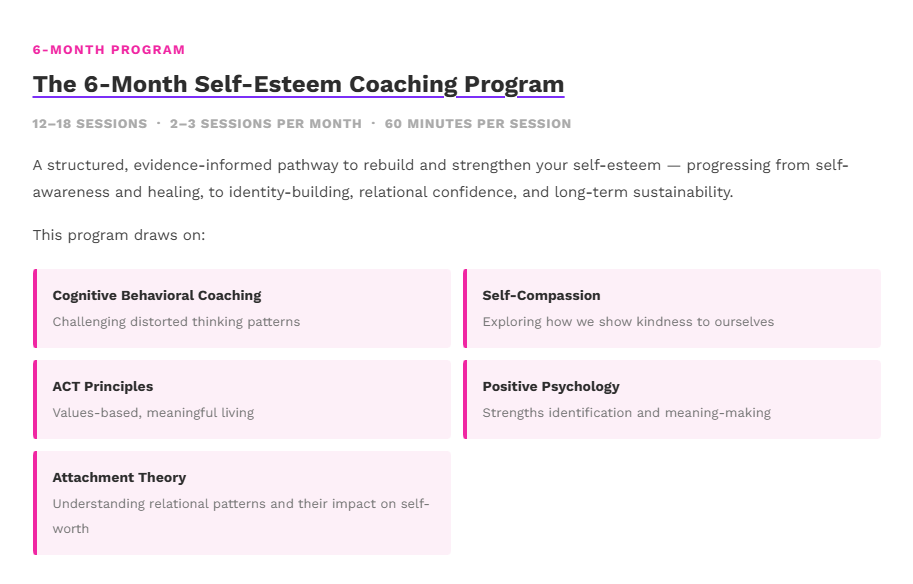
For autistic adults who want the most comprehensive and structured support, Sonia's six month self-esteem coaching program offers a progressive pathway through both the inner and outer work that genuine self-advocacy requires.
The program runs across twelve to eighteen sessions, two to three sessions per month, each sixty minutes long. It moves through six distinct phases:
Month one builds the foundation through self-assessment, exploring your self-story, and clarifying the values that genuine self-advocacy is rooted in.
Month two challenges the inner critic through cognitive reframing and building authentic self-talk that makes self-advocacy feel legitimate rather than presumptuous.
Month three develops the self-compassion and emotional resilience that sustains self-advocacy over time, particularly after setbacks.
Month four focuses on identity, strengths, and ownership, building the self-knowledge that makes self-advocacy specific, accurate, and genuinely yours.
Month five addresses relationships, boundaries, and social confidence directly, which is self-advocacy in its most practical and relational form.
Month six integrates everything into a personal blueprint and a sustainable vision for a life where self-advocacy is not a constant battle but a natural expression of knowing and valuing yourself.
The program draws on cognitive behavioral coaching, self-compassion principles, ACT, positive psychology, and attachment theory, all adapted specifically for autistic neurology.
By the end clients have identified and challenged the limiting beliefs undermining their self-worth, developed consistent self-compassion and emotional regulation, learned to own and communicate their strengths confidently, and built the tools to sustain healthy self-esteem independently.
Self-Advocacy at Work
The workplace is often where the consequences of inadequate self-advocacy are most immediate and most costly for autistic adults.
Without the ability to effectively communicate what they need, autistic adults are more likely to burn out, more likely to underperform relative to their actual ability, and more likely to leave jobs that could have worked with the right adjustments in place.
Coaching builds the specific capacities that workplace self-advocacy requires:
Knowing what accommodations are genuinely needed and being able to describe them specifically and clearly
Understanding when and how to disclose autism in a workplace context
Navigating formal accommodation request processes with confidence rather than anxiety
Managing the interpersonal dynamics of advocacy conversations with managers and colleagues
Recovering from advocacy attempts that did not go well and being willing to try again
For autistic adults who are navigating the self-advocacy challenges that come alongside autistic burnout, the post onwhat does autistic burnout feel like in adults covers the specific intersection of burnout, identity, and the rebuilding of capacity that makes ongoing self-advocacy possible.
FAQs
What is self-advocacy for autistic adults?
The ability to understand your own needs accurately and communicate them clearly to the people and systems around you without apologizing for having them.
How does coaching build self-advocacy?
Through developing self-knowledge, communication skills, challenging limiting beliefs, and practicing the specific conversations that self-advocacy requires in real life contexts.
Is coaching the same as therapy?
No. Coaching is forward-focused and practical. Sonia is both a licensed psychotherapist and a specialist coach, which means she brings clinical depth to coaching that most coaches cannot offer.
How long does the coaching take?
Socio-emotional coaching is tailored to individual needs. The six month self-esteem program runs twelve to eighteen sessions across six months.
What is the first step?
A discovery call with Sonia, where you can ask your questions and get a real sense of whether the approach is the right fit for you right now.
Final Thoughts
Self-advocacy is not about becoming someone who fights for everything. It is about becoming someone who knows what they need and believes those needs are worth communicating.
That belief, built from the inside out through skilled and genuinely autism-informed coaching, changes everything about how you move through the world. In workplaces, in relationships, in medical appointments, in the quiet internal moment when you decide whether to say what you actually need or swallow it one more time.
References:
Shore SM. Self-Advocacy & Autism [Internet]. Autism Research Institute; 2020 Apr 15.:https://autism.org/self-advocacy/
Autism Association of Australia. Self advocacy and autism [Internet]. https://www.autismaustralia.org.au/navigating-autism/self-advocacy-and-autism
Leadbitter K, Buckle KL, Ellis C, Dekker M. Autistic Self-Advocacy and the Neurodiversity Movement: Implications for Autism Early Intervention Research and Practice. Front Psychol. 2021;12:635690. https://doi.org/10.3389/fpsyg.2021.635690