
Autism or ADHD? Understanding the Differences and What Matters
Table of Contents
Intro
What Autism Is
What ADHD Is
Why Autism and ADHD Are Often Confused
Key Differences Between Autism and ADHD
Can Someone Have Both Autism and ADHD?
How Diagnosis and Support Differ
Why Understanding the Difference Matters
Supporting Neurodivergent Individuals With Confidence
Conclusion
Autism or ADHD?
Many parents, adults, and educators find themselves asking the same question at some point. Is this autism or ADHD? Sometimes the question comes after a teacher raises concerns. Other times it comes from personal reflection, especially when someone recognizes patterns in themselves they have carried since childhood.
The confusion is understandable. Autism and ADHD can look similar on the surface. Both affect how people focus, communicate, regulate emotions, and move through the world. But they are not the same thing. Understanding the difference can bring relief, clarity, and a better path forward.
This article is not about labeling people or creating boxes. It is about understanding how neurodevelopmental differences show up, why they are often confused, and how the right information can help people feel supported rather than judged. When we understand these differences, we can move away from frustration and toward meaningful connection.
If this topic resonates with you, Sonia Chand's book on autism offers a clear and compassionate guide to understanding neurodevelopment in real life. Her podcast also explores mental health, parenting, and wellness from many perspectives, making complex topics easier to understand.
What Autism Is

Autism, also called autism spectrum disorder, is a neurodevelopmental condition. This means it affects how the brain develops and processes information from early life.
Autism primarily involves differences in:
Social communication and interaction
Sensory processing
Patterns of behavior, interests, or routines
Autistic people may communicate differently. Some may struggle with eye contact or small talk. Others may communicate very clearly but prefer direct language and honesty. Sensory experiences can be heightened, meaning sounds, lights, textures, or crowds may feel overwhelming. What feels like background noise to one person may feel like painful static to someone who is autistic.
Many autistic people develop deep, passionate interests in specific topics. These interests bring joy, comfort, and a sense of mastery. They are not obsessions that need to be eliminated. They are often strengths that can become careers, hobbies, or lifelong sources of fulfillment.
Routines and predictability often feel essential for autistic people. This is not about being rigid or controlling. It is about creating safety and reducing the mental energy required to navigate an unpredictable world. When routines are disrupted without warning, it can feel destabilizing in ways that are hard to explain to others.
One important thing to understand is that autism is a spectrum. There is no single way autism looks. Some autistic people need a lot of support in daily life. Others live independently, work, build relationships, and may not be diagnosed until adulthood. The idea that autism always looks one particular way has led to countless people being overlooked, misunderstood, or dismissed.
Autism is not caused by parenting style, trauma, or lack of effort. It is part of how a person's brain is wired. It is present from birth, even if it is not identified until later.
For a deeper and more grounded understanding of autism that goes beyond stereotypes, Sonia Chand's book is a helpful place to start.
What ADHD Is
ADHD, or attention deficit hyperactivity disorder, is also a neurodevelopmental condition. It mainly affects attention, impulse control, and activity levels.
ADHD shows up in three main ways:
Inattentive presentation, where focus and organization are difficult
Hyperactive impulsive presentation, where movement and impulses are hard to regulate
Combined presentation, which includes both patterns
People with ADHD may struggle to stay focused on tasks that are not interesting to them, even if they care deeply about doing well. They may forget things, interrupt conversations, or feel restless inside their bodies. Time can feel slippery. What seems like five minutes may actually be an hour, or the other way around.
Executive function, which includes skills like planning, organizing, starting tasks, and managing time, is often affected by ADHD. This does not mean someone is incapable. It means their brain processes these tasks differently, and they may need different strategies or support to succeed.
People with ADHD often experience something called hyperfocus, where they become deeply absorbed in activities they find engaging. During these periods, they may lose track of time entirely and accomplish impressive amounts of work. This intensity of focus can be a strength, especially in creative or problem solving work.
ADHD is not about laziness, intelligence, or willpower. Many people with ADHD are creative, passionate, and highly capable. The challenge lies in regulating attention and energy in environments that are not designed for how their brains work. Schools and workplaces often reward sustained attention on tasks that may not feel inherently rewarding, which can make ADHD particularly challenging in these settings.
Sonia's podcast often explores topics like focus, mental health, and emotional regulation. Listening to these conversations can help normalize experiences that many people quietly struggle with.
Why Autism and ADHD Are Often Confused
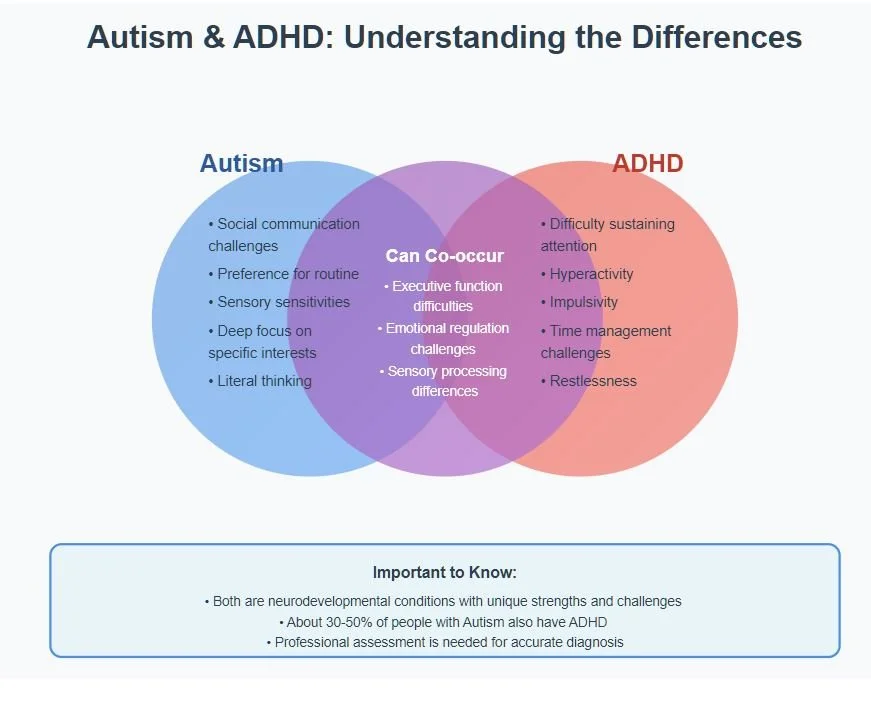
Autism and ADHD share some overlapping traits, which is why they are often mistaken for one another.
Some shared experiences include:
Difficulty with attention or focus
Sensory sensitivity
Emotional regulation challenges
Social difficulties
Feeling overwhelmed in busy environments
From the outside, these behaviors can look very similar. A child who struggles in school may be labeled disruptive or unfocused. An adult who avoids social situations may be seen as withdrawn or inattentive. Without context, it can be hard to tell what is driving the behavior.
Both conditions can also lead to anxiety, especially when someone feels different from their peers but does not understand why. The internal experience of constantly trying to keep up, fit in, or meet expectations that feel impossible can be exhausting. This exhaustion is real and valid, regardless of the underlying cause.
Another reason for confusion is that many people have both autism and ADHD. This is called co occurrence, and it is more common than many realize. In these cases, traits overlap and interact, making identification more complex. Someone might have sensory sensitivities from autism and impulsivity from ADHD, creating a unique experience that does not fit neatly into one category.
Understanding this overlap helps reduce shame. It reminds us that behavior is communication, not a character flaw. When we stop judging and start listening, we can better understand what someone actually needs.
Key Differences Between Autism and ADHD
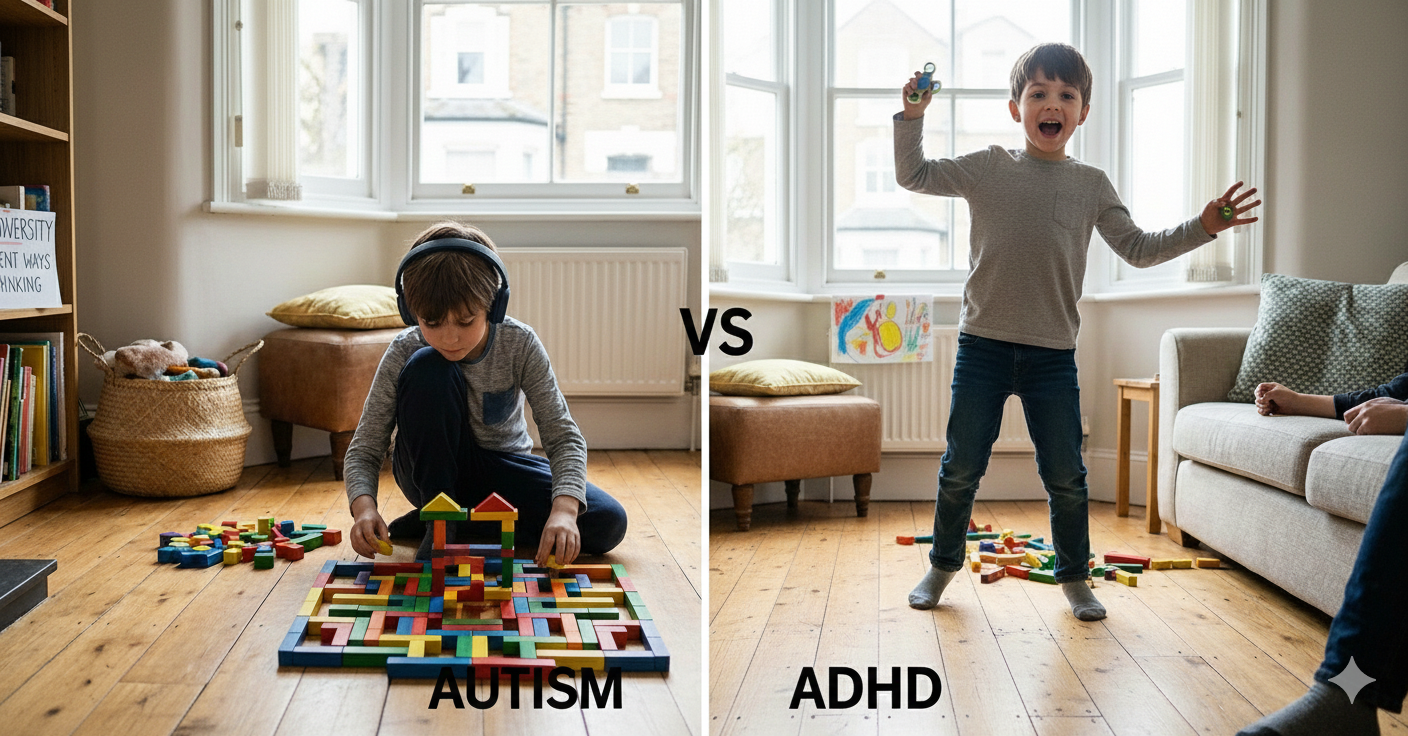
While there is overlap, autism and ADHD differ in important ways.
Autism often centers on:
Differences in social communication
A strong need for predictability or routines
Deep, focused interests
Sensory sensitivities that are consistent over time
ADHD often centers on:
Difficulty regulating attention
Impulsivity or restlessness
Trouble with time management and organization
Seeking stimulation or novelty
For example, an autistic person may prefer routines because predictability feels calming. A person with ADHD may struggle to maintain routines because their attention shifts quickly and repetition can feel unbearably boring.
Socially, an autistic person may not intuitively understand unspoken social rules. They may need these rules explained directly and clearly. A person with ADHD may understand the rules perfectly well but struggle to follow them consistently due to impulsivity or distraction. They might interrupt not because they do not care, but because the thought feels urgent in the moment.
When it comes to interests, autistic people often develop deep, lasting interests that bring comfort and joy. People with ADHD may jump between interests frequently, diving deeply into something for weeks or months before moving on to something else entirely.
These are general patterns, not rules. Every individual experience is unique. The key is to look at the pattern of behaviors over time and in different contexts, rather than focusing on isolated moments.
Can Someone Have Both Autism and ADHD?
Yes, absolutely.
Many people are both autistic and have ADHD. In fact, research increasingly shows that the two conditions often occur together. Studies suggest that up to half of people with one condition may also have the other. For some people, this dual diagnosis explains why they felt misunderstood for so long. Maybe they related to some descriptions of autism but not others, or they felt like the ADHD diagnosis did not quite capture their full experience.
Having both does not mean someone is more limited. It simply means their brain processes information in more than one neurodivergent way. It can also mean that support needs to be more individualized, taking both sets of traits into account.
Understanding co occurrence can:
Reduce self blame
Improve access to appropriate support
Help people understand their own needs more clearly
Validate experiences that felt confusing or contradictory
For people who have spent years feeling like they do not quite fit anywhere, discovering that they have both autism and ADHD can be profoundly validating. It explains why some strategies work and others do not, and why their experience feels layered and complex.
Sonia Chand's work consistently emphasizes that diagnosis is not about labeling. It is about understanding and support. Her book and podcast both reflect this balanced, human centered approach.
How Diagnosis and Support Differ
Diagnosis for autism and ADHD usually involves behavioral observations, developmental history, and clinical assessments. There is no single test that gives a yes or no answer. Professionals look at patterns across time and settings, often gathering input from multiple sources.
Accurate identification matters because support strategies differ.
Autism support may focus on:
Communication tools
Sensory accommodations
Predictable environments
Social understanding without forcing conformity
ADHD support may focus on:
Executive functioning strategies
Time management tools
Medication when appropriate
Environmental structure and flexibility
The goal is not to change who someone is. The goal is to help them thrive in a world that often does not accommodate neurodivergent brains. This might mean noise canceling headphones, visual schedules, fidget tools, flexible deadlines, or a combination of many different supports.
Support is not one size fits all. What works for one autistic person may not work for another. What helps someone with ADHD today might not help them next year. Flexibility, communication, and respect are essential.
For parents, educators, and adults navigating this process, Sonia's book provides practical guidance that feels realistic rather than overwhelming.
Why Understanding the Difference Matters
When autism and ADHD are misunderstood, people are often blamed for things outside their control. Children may be punished instead of supported. Adults may internalize shame or feel broken.
Understanding the difference helps:
Reduce stigma
Improve self understanding
Strengthen relationships
Create better learning and work environments
It also helps shift the conversation from what is wrong with you to what do you need to thrive. This shift is powerful. It moves us from a deficit model, where neurodivergent people are seen as problems to fix, to a support model, where differences are acknowledged and accommodated.
When teachers understand the difference, they can create classrooms that work for more students. When employers understand, they can build workplaces that value diverse minds. When families understand, they can connect more deeply and reduce conflict that comes from misunderstanding.
Sonia Chand's podcast plays an important role here. By bringing together voices from mental health, wellness, and lived experience, it helps listeners feel less alone and more informed.
Supporting Neurodivergent Individuals With Confidence
Whether someone is autistic, has ADHD, or both, support should be flexible and respectful.
Support looks like:
Listening without judgment
Adapting environments when possible
Valuing strengths alongside challenges
Recognizing that needs change over time
It also means believing people when they tell you what they need. Neurodivergent people are the experts on their own experiences. Sometimes support means stepping back and trusting that someone knows themselves better than anyone else could.
Neurodiversity is part of human diversity. When we understand that, we stop trying to fix people and start supporting them. We recognize that different does not mean less than. We create space for people to be themselves without apology.
Sonia's work consistently reflects this mindset. Her book offers a clear and compassionate framework for understanding autism, while her podcast opens up wider conversations around mental health and wellbeing.
Conclusion
Autism and ADHD are different neurodevelopmental conditions, but they often overlap in ways that can be confusing. Understanding both helps replace fear with clarity and judgment with compassion.
The more informed we are, the better we can support children, adults, families, and communities. Understanding is not about labels. It is about connection, dignity, and care. It is about building a world where neurodivergent people can thrive as themselves, not in spite of themselves.
This work matters. Every time we choose understanding over judgment, we create a little more space for people to breathe, to be seen, and to belong.