
I Was Just Diagnosed With Autism. What Now?
You just received your autism diagnosis. Maybe you have been waiting months for this appointment. Maybe it came as a complete surprise. Maybe some part of you already knew, and the paper in front of you is simply confirmation of something that has been true your entire life.
Whatever the path that brought you here, you are probably sitting with a feeling that is difficult to name. Relief, maybe. Grief, possibly. Confusion about what any of this actually means for your life going forward. And underneath all of it, the question that is harder to answer than it looks: what now?
This post is written for exactly this moment. Not the clinical overview of what autism is. Not the list of famous autistic people designed to make you feel better before you have even processed what you are feeling. Just an honest, practical answer to the question you are actually asking.
Table of Contents
First: Let Yourself Feel Whatever You Are Feeling
What the Diagnosis Does and Does Not Change
Understanding Your Own History Through a New Lens
The Practical Steps Worth Taking Early
What You Actually Need Right Now
Why Generic Support Will Not Cut It
What Six Months of the Right Support Can Do
You Do Not Have to Figure This Out Alone
Final Thoughts
First: Let Yourself Feel Whatever You Are Feeling
The most important thing to say in the first few hours and days after a late autism diagnosis is something that almost nobody says: you do not have to have a reaction that makes sense to other people.
You do not have to feel relieved because the diagnosis answers questions. You do not have to feel devastated to validate that this is significant. You do not have to feel immediately empowered or hopeful or ready to reframe your entire life.
You are allowed to feel complicated. You are allowed to feel nothing for a few days while your brain catches up with what just happened. You are allowed to cry in the car on the way home and also feel lighter than you have in years, sometimes in the same hour.
A late autism diagnosis is one of those events that splits life into before and after. The before and after do not always feel different immediately. But they are. And however you are feeling right now is the right way to feel.
The On the Spectrum podcast with Sonia Chand is a space that holds exactly this kind of complexity honestly, with conversations about what the autism journey actually feels like at every stage, including the beginning.
Listen here and find the community that understands where you are right now.
What the Diagnosis Does and Does Not Change
This is worth saying clearly because a lot of people in the days after a diagnosis get caught in a confusing loop.
The diagnosis changes the framework. It does not change you. You are the same person you were before that appointment. Your history is the same. Your struggles are the same. Your strengths are the same. What has changed is that you now have an accurate name for the neurology that has been shaping all of those things your entire life.
That name matters. Not because it defines you but because it opens doors that were previously closed. It gives you access to language you did not have before. It makes certain experiences finally make sense in a way that nothing else ever quite did. And it is the beginning of being able to build a life around who you actually are rather than who you were expected to be.
What the diagnosis does not change: your worth, your capacity, or what is possible for you. A late autism diagnosis is not a ceiling. It is a correction to the map you have been navigating with, and a better map, however late it arrives, is always more useful than a wrong one.
Understanding Your Own History Through a New Lens
One of the most significant and most disorienting parts of a late autism diagnosis is what it does to the past.
Suddenly, experiences that never quite made sense begin to click into place. The friendships that fell apart without explanation. The jobs that seemed fine and then collapsed. The sensory experiences you were always told you were overreacting to. The exhaustion after social situations that other people seemed to find energizing. The years of pushing yourself to function at a level that felt sustainable to everyone around you and genuinely impossible to you.
All of it, seen through the new lens of an accurate diagnosis, looks different.
For many late-diagnosed autistic adults, this is one of the most painful parts of the early post-diagnosis period. Not the diagnosis itself but the reinterpretation of the history. The grief for the support that could have existed and did not. The frustration at the years spent managing something without the right tools or the right understanding.
That grief is valid. It deserves time and space and, eventually, the right kind of support to move through rather than accumulate.
Dropped in a Maze by Sonia Chand is the book that gives this specific experience its most honest account, written from the inside of a late autism journey by someone who has navigated exactly this reinterpretation of history and built something genuinely better on the other side of it.
Photo by Kaja Kadlecova on Unsplash
The Practical Steps Worth Taking Early
Beyond the emotional processing, there are practical steps that are genuinely worth taking in the period after a late autism diagnosis, and knowing what they are reduces the overwhelm of not knowing where to start.
Get the written documentation of your diagnosis: A formal diagnostic report is the document that opens doors to workplace accommodations, healthcare accommodations, and any other formal support you may want to access. Request it if you have not already received it.
Start learning about your specific profile: Autism presents differently in every individual. Understanding which specific features characterize your own autistic experience, whether that is sensory processing, executive functioning, social communication, emotional regulation, or some combination, helps you identify what kinds of support will actually be useful rather than pursuing generic approaches that may not fit your profile.
Consider workplace accommodations: If you are employed, your diagnosis may entitle you to reasonable accommodations under the Americans with Disabilities Act. Written instructions instead of verbal ones, flexible scheduling, a quieter workspace, or clear explicit expectations are all legitimate accommodations that can significantly reduce the daily cognitive load of your working life.
Connect with autistic community: Nothing replaces the specific recognition of being understood by people who share your experience. Online communities, local groups, and autistic-led spaces offer a kind of belonging that is genuinely different from the understanding of even the most empathetic neurotypical person.
Be patient with the pace of integration: A late diagnosis is not something that is processed and integrated in a week or a month. Give yourself permission for this to be a longer and more complex process than you initially expect.
What You Actually Need Right Now
The question underneath most of the practical questions is simpler and harder than any of them: what do I actually need right now to start building a life that genuinely works for who I actually am?
The answer is almost never more information. You have probably already started reading extensively. The internet provides no shortage of autism content, and some of it is genuinely useful.
What most late-diagnosed autistic adults need in the period after diagnosis is not information. It is personalized, skilled, genuinely autism-informed support that helps them translate what they now know about themselves into actual change in how they live.
That is a specific thing. And it is different from general therapy, general coaching, and general self-help, all of which were designed around neurotypical assumptions and frequently fall short of what autistic adults actually need.
Why Generic Support Will Not Cut It
Most late-diagnosed autistic adults have already spent years in support systems that did not quite work. Therapy that addressed the anxiety without ever reaching the autism driving it. Productivity systems designed for neurotypical executive functioning that collapsed every time they tried to implement them. Advice that sounded reasonable and simply did not translate to their actual experience.
The reason none of it fully landed is not that you did not try hard enough. It is that the support was built around a different kind of brain.
Genuine autism-informed support starts from your actual neurology. It builds strategies that work with how your brain processes information, manages social demands, regulates emotionally, and initiates action. It addresses the self-esteem damage that accumulates from years of being expected to function in ways that were never designed for your brain. And it is delivered by someone who understands autistic experience at a level that goes beyond clinical training.
Sonia Chand is a licensed psychotherapist, specialist autism coach, and late-diagnosed autistic adult herself. Her coaching practice is built entirely around neurodivergent adults, which means the approaches, the language, the pace, and the goals are all adapted specifically for autistic neurology rather than borrowed from frameworks that were never designed for it.
Book a discovery call with Sonia here and find out what genuinely autism-informed support actually feels like from the first conversation.
What Six Months of the Right Support Can Do
The six month self-esteem coaching program is where the post-diagnosis work becomes most structured, most comprehensive, and most genuinely transformative.
This is not a program built around learning about autism. It is a program built around you, specifically, and what the accurate understanding of your neurology now makes possible.
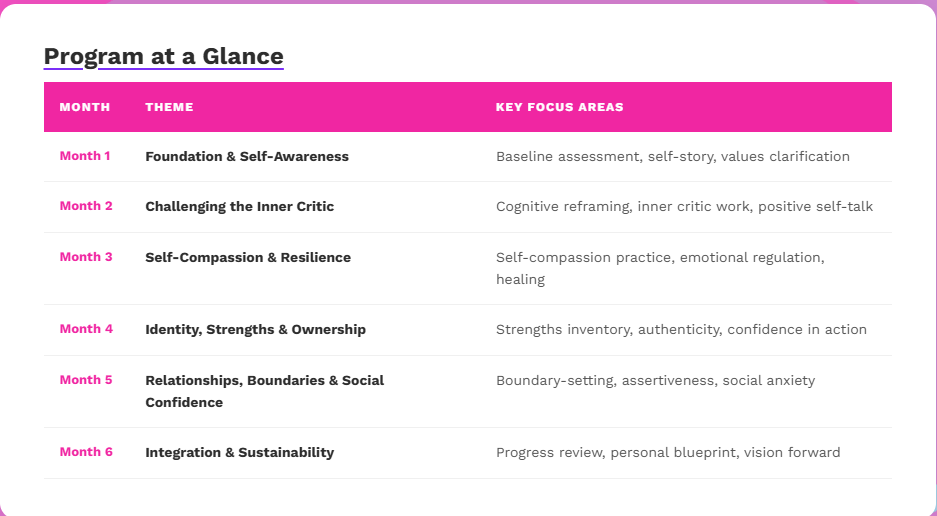
The program runs across twelve to eighteen sessions, two to three sessions per month, each sixty minutes long. It moves through six progressive phases that take you from the foundation of accurate self-knowledge through to a sustainable, independently maintained sense of self that is built on who you actually are.
Month one: begins where everything meaningful begins: with an honest, detailed baseline. Who are you, accurately? What does your specific autistic profile look like? What values are actually yours versus the ones you absorbed from an environment that did not understand you? This month establishes the foundation that everything else builds on.
Month two: addresses the inner critic that a late diagnosis often makes suddenly visible. The accumulated self-critical narratives, the I should have been able to manage this, the why is this so hard for everyone else, get examined and systematically challenged through cognitive reframing and the development of self-talk that is evidence-based rather than inherited from years of misunderstanding.
Month three: builds self-compassion and emotional resilience. The ability to hold your history with kindness rather than judgment. The capacity to regulate your emotional responses without shutting down. The healing work that makes moving forward genuinely possible rather than perpetually effortful.
Month four: focuses on identity, strengths, and ownership. A genuine strengths inventory that takes the autistic neurology into account. Deeper work on authenticity. The building of confidence that is grounded in who you actually are rather than in successfully performing who you were expected to be.
Month five: addresses relationships, boundaries, and social confidence. The practical relational work that a late diagnosis both illuminates and finally makes possible. How to communicate your needs. How to set and maintain boundaries that protect your energy. How to build the social confidence that allows genuine connection rather than exhausting performance.
Month six: brings everything together into a personal blueprint and a clear, grounded vision for the life ahead. Not continued dependency on coaching, but genuine independence built on a foundation of accurate self-knowledge and real self-worth that was not there before.
By the end, the goal is not that you have learned more about autism. It is that you have built a genuinely different relationship with yourself, one that starts from who you actually are, builds on what that neurology makes possible, and holds the history of everything that came before with compassion rather than blame.
The program draws on cognitive behavioral coaching, self-compassion principles, ACT, positive psychology, and attachment theory, all adapted specifically for autistic neurology and informed by Sonia's own late-diagnosed experience.
You Do Not Have to Figure This Out Alone
A late autism diagnosis arrives with no roadmap attached. Nobody hands you a guide to what comes next or a clear path through the emotional, practical, and identity work that follows.
Most late-diagnosed autistic adults spend the early post-diagnosis period doing what they have always done: figuring it out alone, applying the same self-sufficiency that got them through everything else, and wondering why it still feels like something important is missing.
What is missing is the right support. Not any support. The specific, personalized, genuinely autism-informed support that starts from who you actually are and builds from there.
Dropped in a Maze by Sonia Chand is the companion reading for this moment, the book that gives the post-diagnosis journey its most honest human account and helps you understand that what you are feeling, whatever that is, makes complete sense.
Order your copy of Dropped in a Maze here.
And when you are ready for something more, for the structured, supported, personalized process of building a life that genuinely fits your autistic brain, the six month program is where that work begins.
Book your discovery call with Sonia here and take the first real step toward a life built on an accurate understanding of who you actually are.
Final Thoughts
You were diagnosed. The diagnosis is not who you are. But it is, finally, an accurate description of the neurology that has been shaping who you are your entire life.
What comes next is not defined by the diagnosis. It is defined by what you do with the accurate self-knowledge it finally provides.
That knowledge, in the right hands with the right support, is one of the most powerful starting points available to you. Not because the autism changes. But because when you finally understand your own brain accurately, you can stop fighting it and start building with it.
And that changes everything.
References:
Centers for Disease Control and Prevention. Clinical Testing and Diagnosis for Autism Spectrum Disorder [Internet]. Last reviewed 2025 May 8. Available from: https://www.cdc.gov/autism/hcp/diagnosis/index.html
Mayo Clinic Staff. Autism spectrum disorder - Diagnosis and treatment [Internet]. Mayo Clinic; 2025 May 22. Available from: https://www.mayoclinic.org/diseases-conditions/autism-spectrum-disorder/diagnosis-treatment/drc-20352934
Cleveland Clinic. Autism [Internet]. Available from: https://my.clevelandclinic.org/health/articles/autism
Nicole. You've Just Received an Autism Diagnosis. Now What? [Internet]. Autism Research Institute; 2022 Feb 2. Available from: https://autism.org/youve-just-received-an-autism-diagnosis-now-what/
