
What Is Level 3 Autism? A Complete Guide for Parents and Families
What is level 3 autism is a question that often comes with real weight behind it, because Level 3 sits at the most complex end of the autism spectrum and the answer touches on some of the biggest, most life-shaping questions a parent or family member can ask. If you are here because your child, sibling, or loved one has just received this designation, or because you suspect it might apply, you deserve a clear, honest, and complete answer.
What is level 3 autism in the simplest terms is the official DSM-5 designation for autistic individuals who require very substantial support. It is the highest of the three official autism support levels, describing the most significant and pervasive impact on social communication and behavior that the diagnostic system currently recognizes.
This post answers what is level 3 autism in full, what it actually looks like in daily life, how it compares to Level 1 and Level 2, and what genuinely helps families and individuals navigating this end of the spectrum.
Table of Contents
What Is Level 3 Autism?
Where Level 3 Autism Sits on the Spectrum
Signs and Characteristics of Level 3 Autism
Communication and Level 3 Autism
Level 3 Autism vs Level 2 Autism
Level 3 Autism vs Level 1 Autism
How Level 3 Autism Is Diagnosed
What Daily Life Looks Like With Level 3 Autism
What Level 3 Autism Does Not Mean
What Support Actually Looks Like for Level 3 Autism
Final Thoughts
What Is Level 3 Autism?
What is level 3 autism according to the DSM-5? It is described as requiring very substantial support, the most significant of the three official levels. The manual defines it as severe deficits in verbal and nonverbal social communication skills that cause severe impairments in functioning, along with restricted, repetitive behaviors that markedly interfere with functioning across all areas of life.
What is level 3 autism in practical terms is a profile where support is not occasional or supplementary. It is constant, pervasive, and necessary across nearly every domain of daily living, including communication, self-care, safety, and community participation.
What is level 3 autism not is a measure of a person's worth, potential for connection, or capacity for a meaningful life. It is a description of current support needs as assessed in a specific clinical evaluation. It tells you how much support someone needs right now. It does not tell you who they are or what they are capable of experiencing, learning, or feeling.
Where Level 3 Autism Sits on the Spectrum
Understanding what is level 3 autism means seeing it clearly against the other two levels.
Level 1 autism involves support needs that a person can often manage with personal effort, without support being constantly present. Level 2 autism involves support needs that remain apparent and necessary even when support is actively provided, but that still allow for meaningful independence in some areas of life.
Level 3 autism involves support needs that are severe and pervasive enough that they affect functioning across nearly all domains, even when substantial, consistent support is already in place. What is level 3 autism, set against this scale, is the profile with the most significant and far-reaching impact on daily functioning that the current diagnostic system describes.
Signs and Characteristics of Level 3 Autism
What is level 3 autism actually looks like in practice involves a combination of communication, behavioral, and sensory characteristics that are significant and consistent across settings.
Social communication characteristics:
Very limited initiation of social interaction, often appearing to show minimal interest in social engagement as it is typically understood
Minimal response to social overtures from others, including from familiar caregivers
Severe difficulties with both verbal and nonverbal communication
Communication, when present, is often limited to expressing immediate needs rather than broader social or emotional exchange
Restricted and repetitive behavior characteristics:
Repetitive behaviors that are intense, frequent, and significantly interfere with functioning across multiple settings
Extreme distress in response to changes in routine or environment
Restricted interests or behaviors that dominate a significant portion of daily activity
Difficulty redirecting attention away from repetitive patterns even with active support
Sensory characteristics:
Significant sensory sensitivities that affect what environments and activities are tolerable
Strong reactions to sensory input that others may not perceive at all
Sensory needs that require ongoing, active accommodation rather than occasional adjustment
Daily functioning characteristics:
Significant support needs across most or all areas of daily living, including self-care tasks such as dressing, hygiene, and eating
Safety awareness that requires ongoing supervision and support
Higher rates of co-occurring conditions including epilepsy, gastrointestinal issues, and sleep disorders
Communication and Level 3 Autism
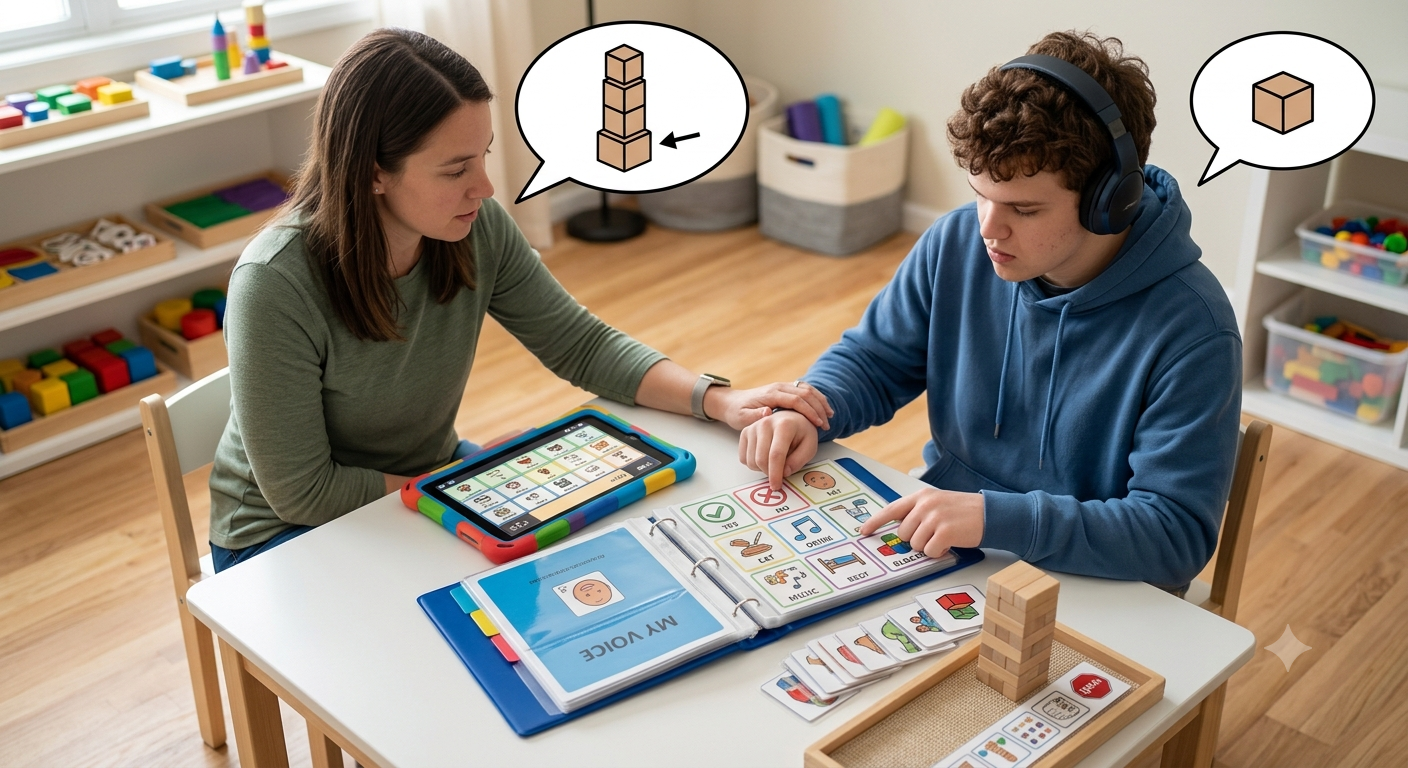
Communication is one of the most significant areas affected by what is level 3 autism, and it is also one of the areas where the right support makes the most measurable difference.
Many individuals with Level 3 autism have little to no functional spoken language. This does not mean they have nothing to communicate. It means spoken language is not a reliable channel for them to express their needs, preferences, and experiences.
Augmentative and Alternative Communication, known as AAC, is often transformative for individuals with Level 3 autism. This ranges from simple picture exchange systems to sophisticated speech generating devices, and finding the right communication channel is consistently one of the highest impact interventions available.
It is worth being direct about something important here: a person with Level 3 autism who cannot speak is not a person without thoughts, preferences, or an inner life. They are a person whose primary communication channel has not yet been found or fully supported. The research on AAC consistently shows that many nonverbal autistic individuals have far more to communicate than their spoken output suggests once the right tool is in place.
Level 3 Autism vs Level 2 Autism
Comparing what is level 3 autism against what is level 2 autism helps clarify exactly where the line sits between them.
Level 2 autism involves social communication deficits that remain apparent even with support, but the person often retains functional spoken language and can manage some independence in daily living with consistent structural support. Level 3 autism involves more severe deficits that cause significant impairment even with very substantial support actively in place, and functional spoken language is frequently absent or extremely limited.
Repetitive behaviors at Level 2 interfere with functioning across multiple settings but are often manageable with redirection and support. At Level 3, these behaviors are more intense and markedly interfere with functioning even when active support is provided.
Daily living independence is more achievable at Level 2 in many domains. At Level 3, support needs typically extend across nearly all areas of daily living, including self-care and safety.
For a complete look at what Level 2 autism involves specifically, the post on what is level 2 autism covers that middle point on the spectrum in full detail.
Level 3 Autism vs Level 1 Autism
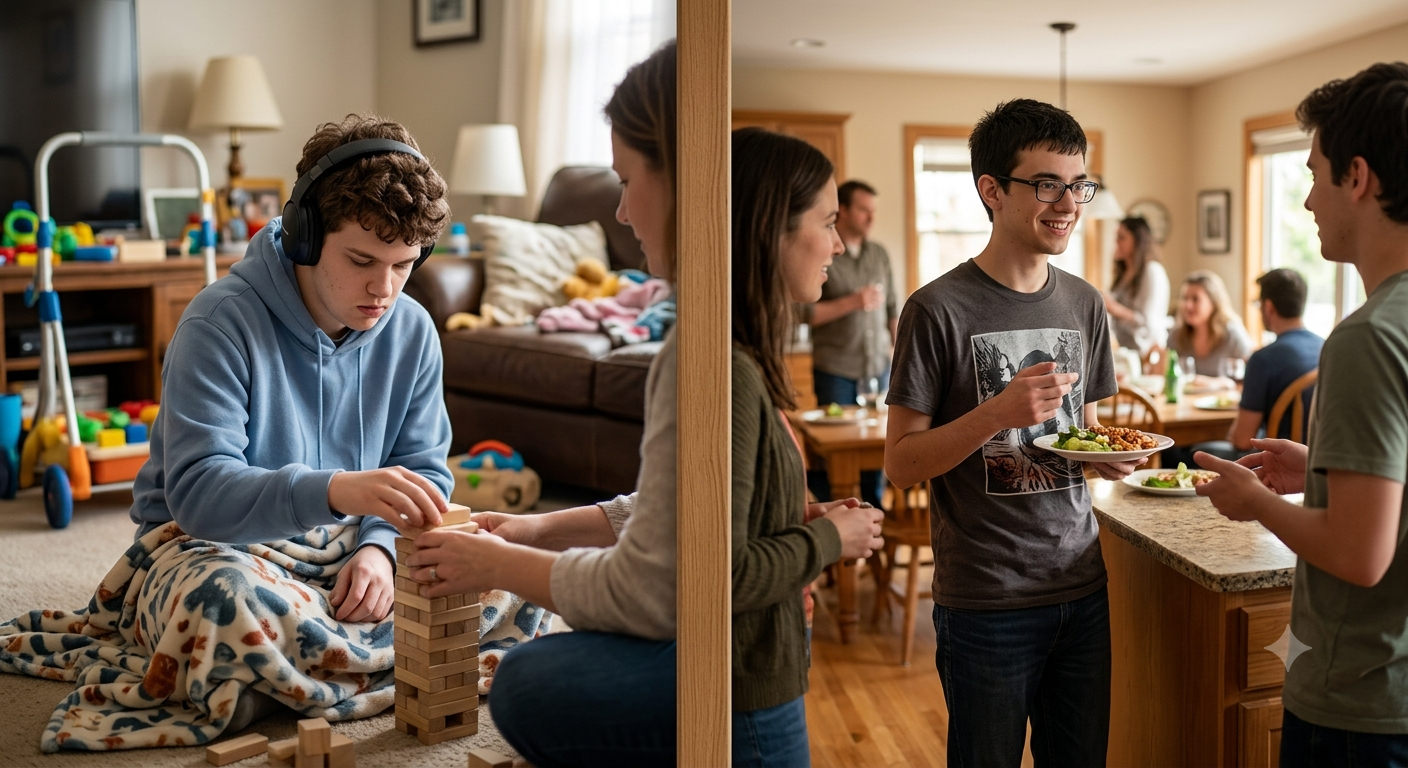
Comparing what is level 3 autism against what is level 1 autism shows the full range the diagnostic system is trying to capture under a single spectrum.
Level 1 autism, sometimes informally called high functioning autism, involves support needs that a person can often manage independently, with social communication challenges that are noticeable but generally compatible with functioning in most everyday settings without support being constantly present.
Level 3 autism sits at the opposite end, with support needs that are constant, pervasive, and necessary across nearly every area of daily life, even when substantial support is already in place. Aside these, Dropped in a Maze provides a clear picture on how to navigate autism.
The distance between these two ends of the spectrum is part of why autism is described as a spectrum rather than a single condition with one presentation. Two people can both carry an autism diagnosis and have profiles, support needs, and daily experiences that look almost entirely different from one another. For a closer look at the other end of this range, the post on what is level 1 autism covers that presentation in depth.
How Level 3 Autism Is Diagnosed
What is level 3 autism in terms of the actual diagnostic process follows the same general framework used across the spectrum, though the evaluation often happens earlier in life because the signs tend to be more pronounced and visible from a younger age.
A comprehensive evaluation typically includes a detailed developmental history from parents or caregivers, direct behavioral observation using tools such as the ADOS-2, cognitive and language assessment adapted for the individual's communication level, and input from other professionals including speech therapists and occupational therapists who know the child or adult well.
For a full walkthrough of the entire testing and diagnostic process from first screening through to full evaluation, the post on how to test for autism covers exactly what families can expect at every stage.
What Daily Life Looks Like With Level 3 Autism
What is level 3 autism in lived, daily terms varies depending on the individual, but it generally involves a level of structure, support, and consistency that shapes most of the day.
Daily routines are often highly structured because predictability significantly reduces distress and supports functioning. Communication happens through whatever channel works best for that individual, whether AAC devices, gestures, behavior, or limited functional speech. Sensory environments are actively managed, with lighting, sound, and textures considered and adjusted wherever possible. Safety supervision is ongoing rather than occasional, particularly for individuals who may not reliably understand environmental risks.
None of this means daily life with Level 3 autism is without joy, connection, or genuine quality of life. Many individuals with Level 3 autism experience real happiness, form meaningful bonds with the people who know how to connect with them, and respond strongly to music, movement, sensory play, and the presence of people who make them feel safe.
Level 3 Autism
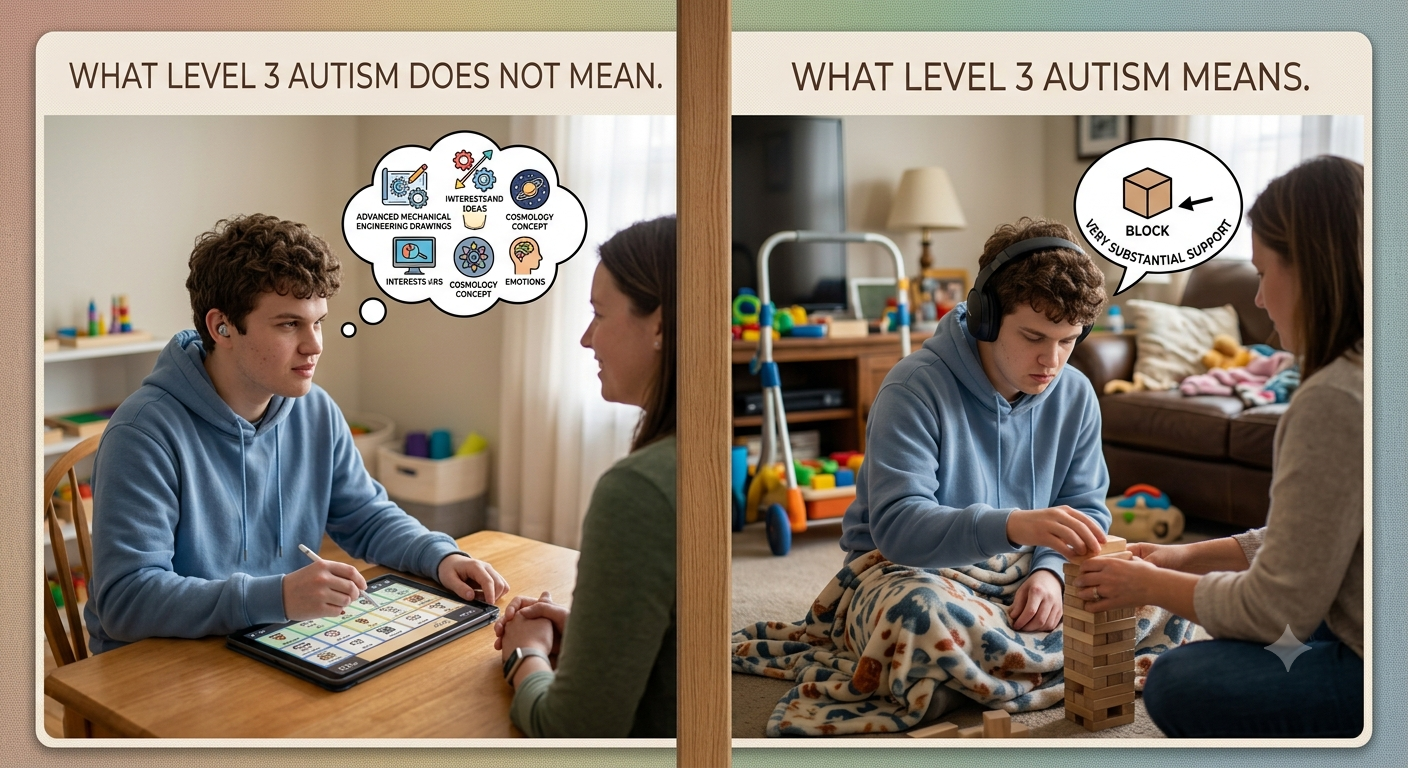
What Level 3 Autism Does Not Mean
This matters as much as anything else in this post, because some of the most harmful assumptions about Level 3 autism come from what people wrongly believe the label implies.
What is level 3 autism does not mean the person has no inner life, no preferences, and no capacity for growth. It does not mean communication is impossible, only that spoken language may not be the right channel. It does not mean the person cannot learn or make meaningful progress with the right support over time. It does not mean their life has less value than the life of someone with Level 1 autism. It does not mean families should lower their hopes for connection and quality of life.
The person is always there. What changes with the right support is how clearly the people around them can see and understand who that person actually is.
What Support Actually Looks Like for Level 3 Autism
Support for what is level 3 autism needs to be comprehensive, consistent, and genuinely tailored to the individual, drawing on several areas working together.
Communication support through AAC evaluation and implementation is consistently one of the highest impact interventions. Educational support under an IEP that addresses communication, behavioral, and daily living goals specifically is essential. Behavioral support that is positive and function-based, focused on understanding what a behavior is communicating rather than simply suppressing it, produces far better outcomes than punitive approaches. Medical management addressing the higher rates of epilepsy, gastrointestinal issues, and sleep disorders associated with Level 3 autism is an important and often overlooked part of comprehensive care.
Ready to navigate this with support? Sonia, a licensed psychotherapist provides Adult Coaching Services
Final Thoughts
What is level 3 autism is, at its core, a description of the most significant and pervasive support needs the current diagnostic system recognizes. It is not a description of a person's worth, their capacity for connection, or the ceiling on their growth.
The families and individuals navigating Level 3 autism deserve fully resourced, genuinely informed, deeply compassionate support, and that support, when it arrives in the right form at the right time, makes a real and lasting difference to quality of life for everyone involved.
References:
Iacono T, Trembath D, Erickson S. The role of augmentative and alternative communication for children with autism: current status and future trends. Neuropsychiatr Dis Treat. 2016;12:2349-2361. Available from: https://pmc.ncbi.nlm.nih.gov/articles/PMC5036660/
Lin W, Chan YH, Kiing JSH, Lim TSH, Chong SC, Kang YQ, Aishworiya R, Mulay KV, Tan MY. Restricted and repetitive behaviors and association with cognition and adaptive functioning in children with autism spectrum disorder in Singapore. Front Psychiatry. 2023;14:1249071. Available from: https://pmc.ncbi.nlm.nih.gov/articles/PMC10687550/
American Speech-Language-Hearing Association. Augmentative and Alternative Communication in Early Intervention [Internet]. Available from: https://www.asha.org/practice/early-intervention-provider-support/augmentative-and-alternative-communication-in-early-intervention/
Maddox BB, Brodkin ES, Calkins ME, Shea K, Mullan K, Hostager J, Mandell DS, Miller JS. The accuracy of the ADOS-2 in identifying autism among adults with complex psychiatric conditions. J Autism Dev Disord. 2017;47(9):2703-2709. Available from: https://pmc.ncbi.nlm.nih.gov/articles/PMC5813679/
What Is Level 2 Autism? A Complete Guide for Adults
What is level 2 autism is a question that often comes up after someone has already read about Level 1 and felt like the description did not quite fit, like their experience involves more visible struggle, more daily friction, and more support than what is typically described as the lighter end of the spectrum. If that is where you are right now, you are asking exactly the right question.
What is level 2 autism in the simplest terms is the official DSM-5 designation for autistic individuals who require substantial support in social communication and who show restricted or repetitive behaviors that interfere with functioning across multiple settings, even when some support is already in place. It sits in the middle of the three official autism levels, more visible and more demanding than Level 1, less pervasive than Level 3.
This post answers what is level 2 autism in full, what it actually looks and feels like for adults living with it, how it compares to Level 1 and Level 3, and what genuinely helps.
Table of Contents
What Is Level 2 Autism?
Where Level 2 Autism Sits on the Spectrum
Signs of Level 2 Autism in Adults
Level 2 Autism vs Level 1 Autism
Level 2 Autism vs Level 3 Autism
Why Level 2 Autism Is Often Missed or Misread in Adults
Getting Assessed for Level 2 Autism as an Adult
What Support Actually Looks Like for Level 2 Autism
Building a Life That Works With Level 2 Autism
FAQs
Final Thoughts
What Is Level 2 Autism?
What is level 2 autism according to the DSM-5? It is the diagnostic category for autistic individuals who require substantial support. The manual describes this as marked deficits in verbal and nonverbal social communication skills, social impairments that are apparent even with support in place, and restricted, repetitive behaviors that interfere with functioning in a variety of contexts.
What is level 2 autism in practical terms is a profile that sits clearly between Level 1, which involves less visible support needs, and Level 3, which involves very substantial support needs across nearly all areas of life. Level 2 is the middle ground, and it is a middle ground that often gets less attention in public conversation than either end of the spectrum, despite affecting a significant number of autistic adults.
What is level 2 autism not is a fixed, unchanging category that determines everything about a person's potential. It describes support needs at a point in time, assessed through specific clinical observation, not a ceiling on what someone can learn, achieve, or become with the right environment around them.
Where Level 2 Autism Sits on the Spectrum
Understanding what is level 2 autism requires seeing it in context against the other two levels.
Level 1 autism involves social communication difficulties that are noticeable but that allow the person to function largely independently in most settings without support, alongside restricted or repetitive behaviors that the person can usually manage with effort.
Level 2 autism involves social communication deficits that remain apparent even when support is actively provided, meaning the person needs that support to be present and ongoing rather than occasional, alongside restricted or repetitive behaviors that interfere with functioning across multiple settings and that are more difficult to redirect or manage than at Level 1.
Level 3 autism involves severe social communication deficits that cause significant impairment even with substantial support in place, alongside repetitive behaviors that markedly interfere with functioning in essentially every domain of life.
What is level 2 autism, set against this scale, is a profile where the support is not optional or occasional. It is genuinely needed, genuinely ongoing, and genuinely makes a difference in how well the person is able to function day to day.
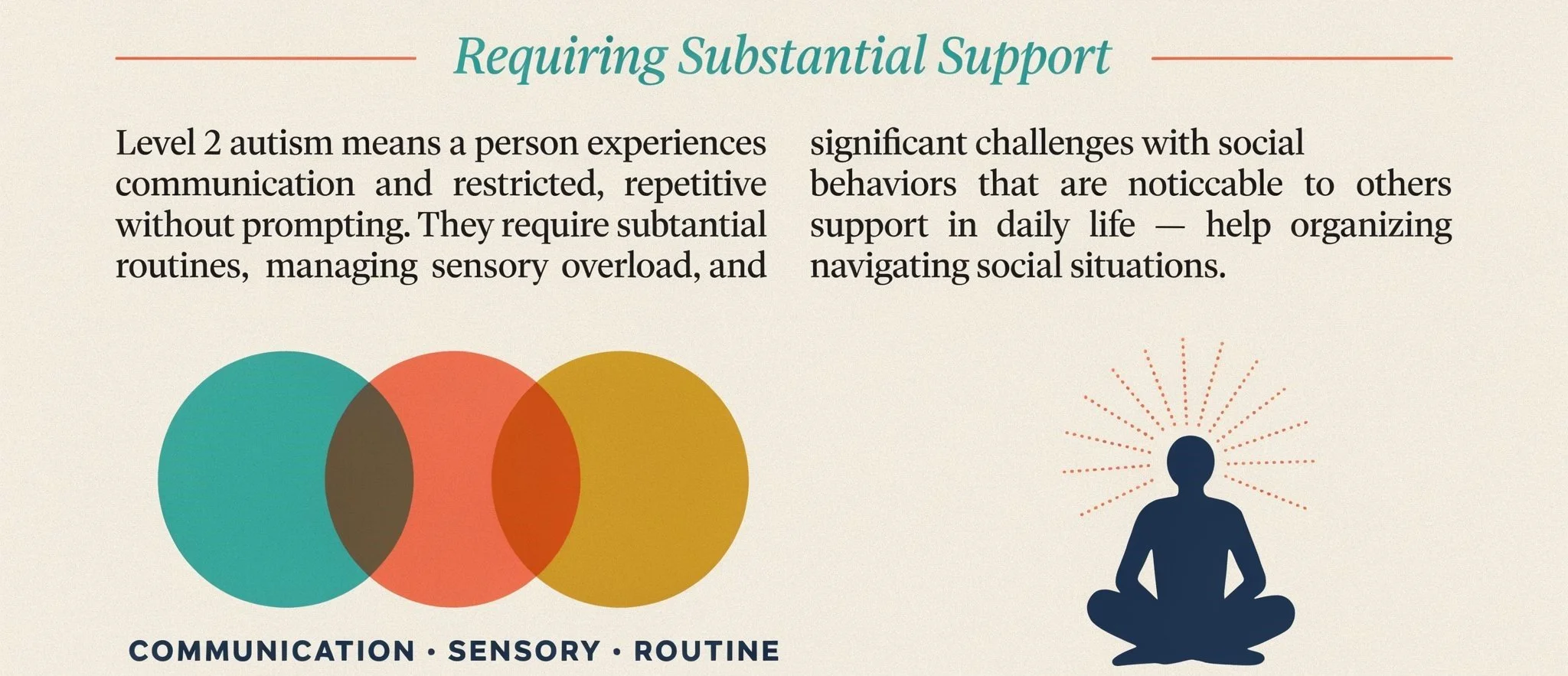
What to know about level 2 Autism
Signs of Level 2 Autism in Adults
What is level 2 autism in adults looks different from a childhood checklist, and recognizing it in your own adult life requires looking at how these traits show up across work, relationships, and daily independence.
Social communication signs:
Communication that others frequently describe as difficult to follow, overly literal, or hard to engage with in typical back and forth conversation, even when support and patience are offered by the other person
Significant difficulty initiating social interaction without a clear script or specific purpose
A need for very explicit, very direct communication from others, with ambiguity or implied meaning causing genuine confusion rather than mild friction
Social interactions that remain effortful and draining even after years of practice and even in relationships with people who are familiar and supportive
Restricted and repetitive pattern signs:
Repetitive behaviors or routines that are difficult to interrupt or redirect, even by people close to you
Significant distress, not just mild discomfort, when routines or environments change unexpectedly
Restricted interests that take up a substantial portion of daily life and that are hard to set aside even when other demands are present
Sensory responses that are intense enough to regularly affect what environments and activities are realistically possible for you
Daily functioning signs:
Needing consistent, ongoing support from a partner, family member, or support worker to manage tasks that most adults handle independently, such as scheduling, finances, or household management
Difficulty maintaining employment without specific accommodations and ongoing support in place
A pattern of needing more structure and more external scaffolding than peers in order to get through an ordinary day
If a significant number of these genuinely describe your daily life, what is level 2 autism may be a far more accurate and useful framework for understanding yourself than the less intensive descriptions you may have read elsewhere.
Level 2 Autism vs Level 1 Autism
One of the most useful ways to understand what is level 2 autism is to directly compare it against what is level 1 autism, since many adults read about one before recognizing themselves more clearly in the other.
The core difference is the visibility and ongoing necessity of support. A person with Level 1 autism can generally function without support present in the moment, even if doing so is exhausting and effortful. A person with Level 2 autism needs the support to actually be there, consistently, for daily functioning to genuinely work.
Social communication difficulties are noticeable in both levels, but at Level 1 they tend to be manageable with personal effort and masking, while at Level 2 they remain apparent and disruptive even when support and accommodation are actively in place.
Restricted and repetitive behaviors at Level 1 typically affect functioning in a more limited way, often in just one or two specific contexts. At Level 2, these behaviors interfere across multiple settings and are noticeably harder to redirect or interrupt.
For a deeper look specifically at what is level 1 autism and how it presents in adults, including the specific masking patterns and missed diagnosis issues that come with it, the dedicated post on what is level 1 autism covers that end of the spectrum in full.
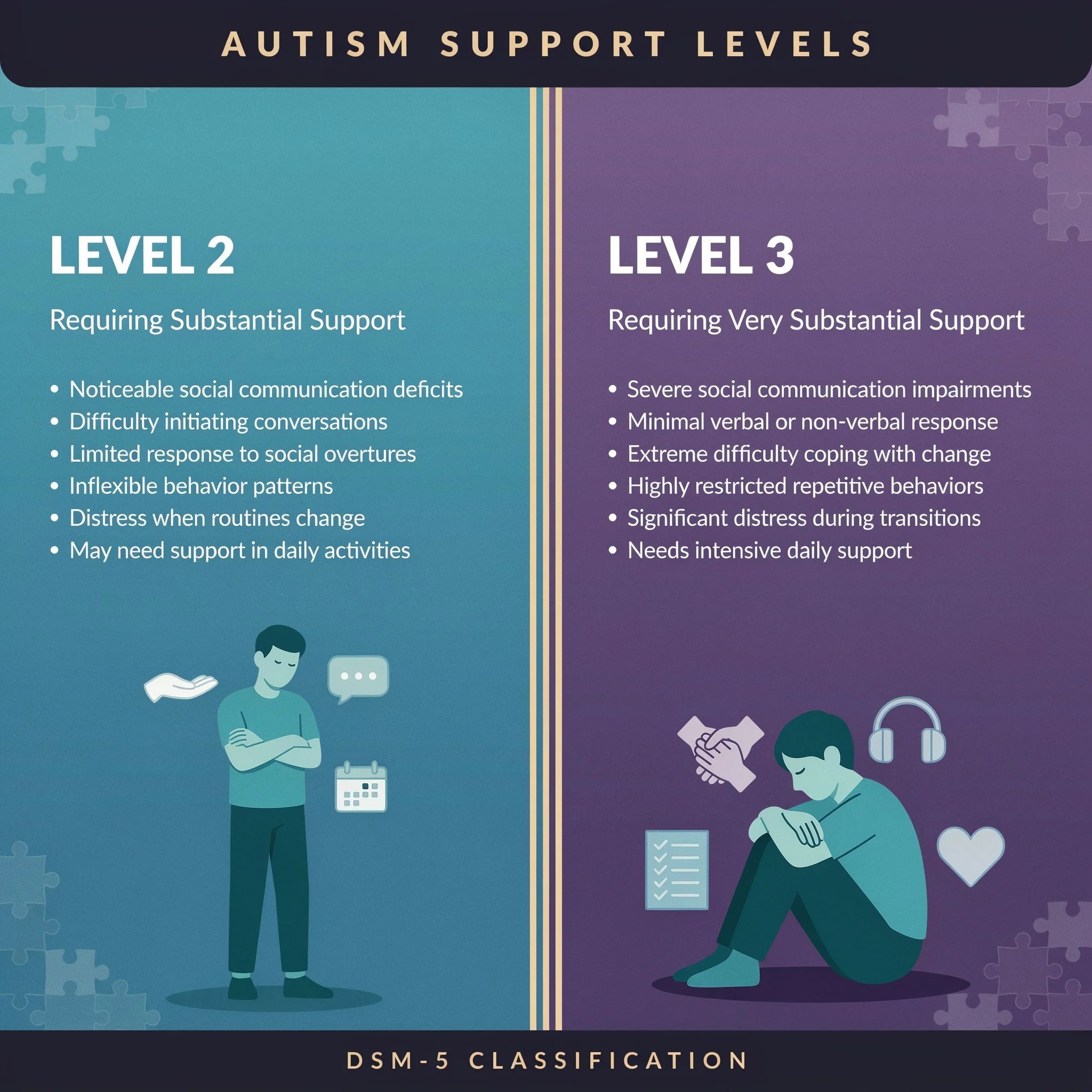
Comparing Level 2 Autism vs Level 3 Autism
Level 2 Autism vs Level 3 Autism
It is equally useful to understand where what is level 2 autism stops and Level 3 begins, since the line between them is not always obvious from a self-assessment alone.
Level 3 autism involves severe deficits in social communication that cause very significant impairment even with very substantial support in place. Level 2 involves deficits that are serious and require real support, but the impairment, even without that support fully optimized, is generally less severe than at Level 3.
Level 3 typically involves very limited functional verbal communication or none at all. Level 2 frequently involves functional spoken language, even if that language is unusual in structure, tone, or use.
Level 3 generally requires support across nearly every domain of daily living, often including self-care. Level 2 requires substantial support in specific domains, particularly social communication and behavioral regulation, but often allows more independence in other areas of daily life.
For a full comparison of how profound autism specifically relates to these official levels, the post on profound autism vs autism level 3 is worth reading if you suspect your needs may extend beyond what is described here.
Why Level 2 Autism Is Often Missed or Misread in Adults
What is level 2 autism, despite being more visible than Level 1, is still frequently missed, delayed, or misread in adults, for reasons that are worth understanding.
It gets misread as something else entirely: Adults with undiagnosed Level 2 autism are frequently given other labels first, including intellectual disability when the issue is actually communication style rather than cognitive ability, personality disorders when the issue is actually autistic rigidity and social difference, or simply being labeled as difficult, demanding, or high maintenance by people who do not understand what they are actually observing.
Adult diagnostic pathways are less developed for this level: Much of adult autism diagnosis has historically focused on identifying Level 1 presentations in people who mask well. Diagnostic pathways and public awareness for adult Level 2 presentations are less developed, meaning adults with this profile may struggle to find evaluators who recognize their presentation accurately.
The support need gets attributed to other causes: When an adult clearly needs substantial ongoing support, that need is sometimes attributed to anxiety, low motivation, or poor life skills rather than being recognized as a feature of an underlying autism profile that has simply never been formally assessed.
Getting Assessed for Level 2 Autism as an Adult
If what is level 2 autism is sounding like an accurate description of your own life, formal assessment can provide genuine clarity and can open access to support that has previously been unavailable without a diagnosis.
Adult assessment for Level 2 autism typically involves the same core tools used across the spectrum, including the ADOS-2, a detailed developmental history, and direct clinical observation, but ideally conducted by an evaluator with specific experience recognizing presentations beyond the more commonly discussed Level 1 profile. Also, there are books that help. Dropped by a Maze is a recommended book to read to help through diagnosis.
For a complete walkthrough of the entire testing and diagnostic process, from initial screening through full evaluation, the post on how to test for autism covers exactly what to expect at every stage.
Building a Life That Works With Level 2 Autism
What is level 2 autism, ultimately, is a profile that genuinely benefits from intentional, well-supported life design rather than an expectation that the person will simply adapt to a world that was not built with them in mind.
This is exactly the work Sonia's coaching focuses on. Socio-emotional coaching helps adults with Level 2 autism build practical, personalized strategies for navigating relationships, work, and daily structure in ways that genuinely fit their actual needs rather than forcing them into a one-size-fits-all approach to independence.
Self-esteem coaching addresses the accumulated impact of years spent being seen as too much, too difficult, or too demanding, helping rebuild a sense of identity grounded in accurate self-understanding rather than years of feeling like a burden for needing real support.
What Support Actually Looks Like for Level 2 Autism
Support for what is level 2 autism in adulthood needs to be genuinely substantial and genuinely ongoing, not occasional or symbolic, in order to make a real difference.
Useful forms of support include consistent, structured routines built collaboratively rather than imposed, clear and explicit communication from the people around you rather than reliance on implied meaning, sensory accommodations in the home and work environment, and coaching or therapy specifically focused on building practical life skills and self-advocacy rather than only addressing secondary anxiety or depression.
Workplace support, where employment is part of the picture, often needs to include written instructions, predictable schedules, a clearly defined role with explicit expectations, and a manager or colleague willing to communicate directly rather than relying on social inference.
Final Thoughts
What is level 2 autism is, at its core, a profile that requires real, ongoing, substantial support to allow for genuine daily functioning, and that support need is not a sign of failure or inadequacy. It is simply what this particular neurology requires in order to thrive.
If what is level 2 autism has started to sound like an accurate description of your own experience, pursuing formal assessment and seeking out support that is built around your actual needs, rather than a watered-down version designed for a different presentation entirely, is a meaningful and worthwhile next step.
References:
Autism Speaks. ASD levels of severity [Internet]. Available from: https://www.autismspeaks.org/levels-of-autism
National Academies of Sciences, Engineering, and Medicine. Autism: Prevalence, Diagnosis, and Interventions. In: The Comprehensive Autism Care Demonstration: Solutions for Military Families. Washington (DC): National Academies Press (US); 2025. Available from: https://www.ncbi.nlm.nih.gov/books/NBK619283/